


ISO 27001 Compliant Safety Software: A 2026 Reference Guide for UK Businesses
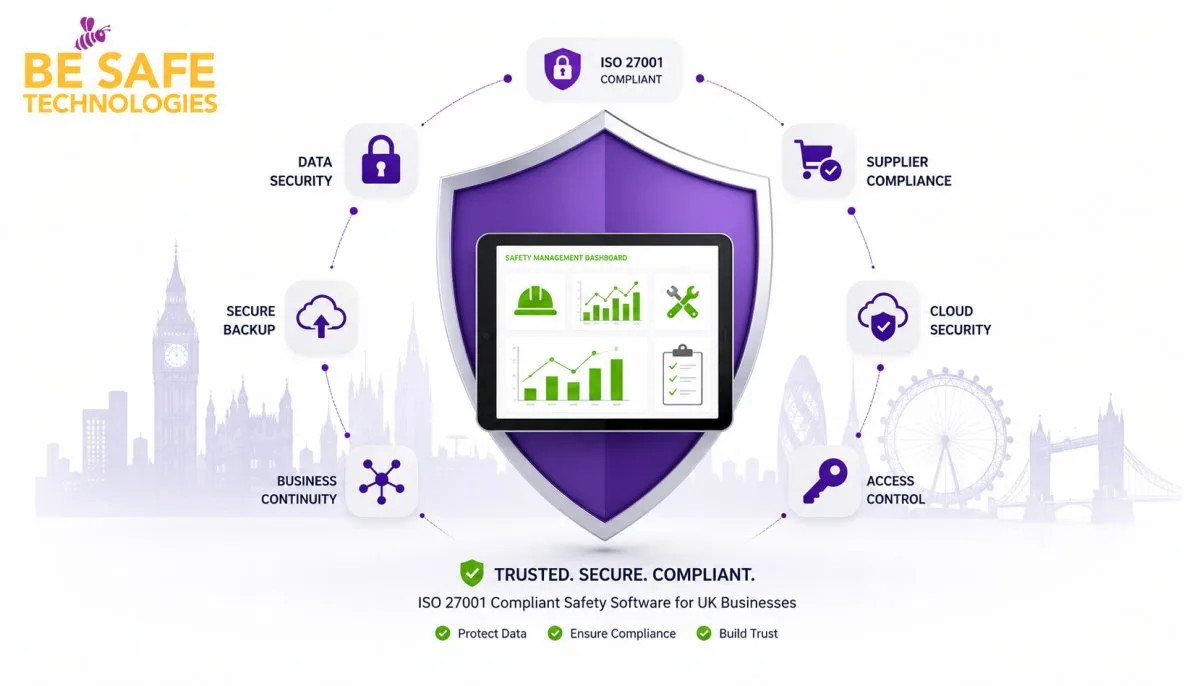
What if your health and safety records are the weakest link in your organisation’s cybersecurity chain? For many safety professionals, there’s a lingering anxiety over the security of sensitive employee health records and the potential for damaging data breaches. It’s easy to feel overwhelmed by the pressure from stakeholders to adopt G-Cloud standards whilst trying to decipher the difference between general compliance and rigorous IT security. Selecting ISO 27001 compliant safety software provides the necessary framework to bridge this gap, ensuring that your digital transformation remains a source of efficiency rather than a liability.
You already understand that workplace safety requires a methodical approach, and digital data management is no different. This guide will help you discover why ISO 27001 certification is the gold standard for protecting sensitive health and safety data in the modern age. We’ll preview a clear framework for evaluating software security, confirm how digital records meet UK GDPR expectations, and provide the peace of mind that comes with knowing your sensitive data is both organised and protected.
Key Takeaways
- Understand how ISO 27001 provides the definitive framework for managing information security risks systematically within your organisation.
- Learn why ISO 27001 compliant safety software offers superior protection for sensitive health records through industry-standard encryption and robust cloud security controls.
- Discover the direct link between ISO standards and UK GDPR, and how this alignment simplifies the process of completing essential Data Protection Impact Assessments.
- Access a practical buyer checklist to help you evaluate vendor security claims and verify certification through UKAS-accredited bodies.
- Explore how a security-first approach to safety management can reduce administrative stress whilst providing total oversight of your compliance obligations.
What is ISO 27001 Compliant Safety Software?
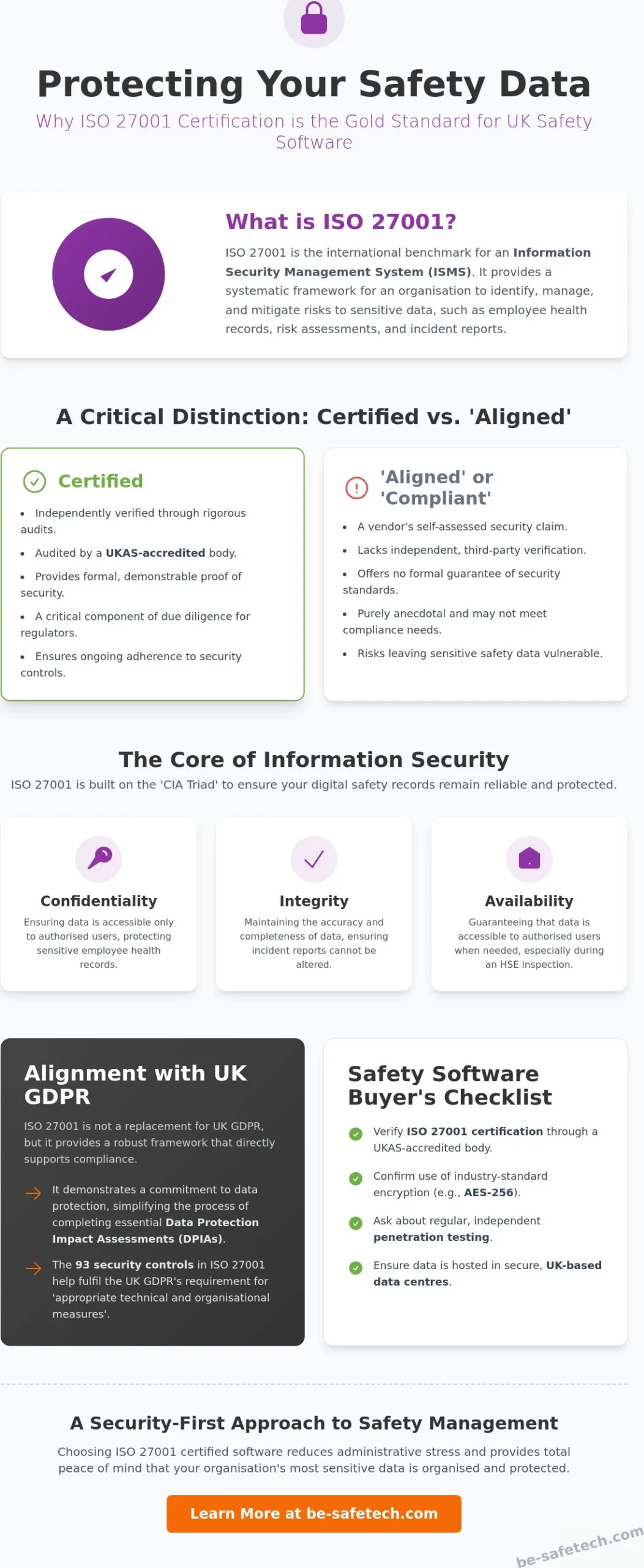
ISO 27001 serves as the international benchmark for Information Security Management Systems (ISMS). It provides a structured methodology for identifying, managing, and mitigating risks to sensitive data across an entire organisation. When a business adopts ISO 27001 compliant safety software, they are choosing a platform designed from the ground up to protect the vast quantities of sensitive information generated by modern health and safety departments. This includes everything from site-specific risk assessments and COSHH data to detailed occupational health records and RIDDOR reports.
It is important to distinguish between software providers who merely “align” with these standards and those who hold independent, third-party certification. A certified provider undergoes rigorous annual audits by UKAS-accredited bodies to prove their security controls are functioning as intended. Without this independent verification, a vendor’s claim of being “secure” is purely anecdotal and lacks the weight required for formal compliance. For UK businesses operating in high-risk sectors like construction or manufacturing, using certified software is a critical component of demonstrating due diligence to both internal stakeholders and external regulators.
The Definition of an ISMS in Safety Technology
An ISMS is a holistic framework that organises people, processes, and technology to ensure total data oversight. In the context of safety technology, this involves the “Plan-Do-Check-Act” cycle, which ensures that security measures are constantly reviewed, tested, and improved. By following the ISO/IEC 27001 standard, a digital platform ensures that safety records remain accurate and accessible whilst reducing the likelihood of catastrophic data loss. This structured approach means your safety data is managed with the same level of discipline as your physical site safety protocols.
Why Safety Managers Should Care About IT Standards
IT security is directly linked to the integrity of risk assessments and incident reports. ISO 27001 supports the “Confidentiality, Integrity, and Availability” triad, ensuring that safety data is only accessible to authorised users and remains untampered with. If a digital incident report is altered or an occupational health record is leaked, the consequences for the business are severe. By implementing 93 specific technical and organisational controls, the standard ensures that your digital evidence remains a reliable asset during legal proceedings or HSE inspections, proving that your organisation takes data safety seriously.
The Core Security Requirements for Safety Management Platforms
Establishing ISO 27001 compliant safety software requires more than just a surface-level commitment to IT security. It demands a rigorous set of technical controls that protect data at every stage of its lifecycle. For platforms operating in the cloud, these controls are the digital equivalent of a high-security vault. They ensure that even if a device is lost on a construction site or a laptop is stolen from a vehicle, the sensitive health records and incident reports remain unreadable to unauthorised parties. According to the ISO 27001 information security management framework, these controls must be reviewed and tested regularly to adapt to an evolving threat landscape where phishing remains the most common attack vector, targeting 93% of breached UK businesses.
Rigorous penetration testing is a non-negotiable requirement in 2026. This process involves ethical hackers attempting to find vulnerabilities in the software before malicious actors can exploit them. For a safety manager, this provides the assurance that their health and safety compliance software isn’t just functional but resilient. This resilience is bolstered by hosting data in secure UK-based data centres, which ensures compliance with residency requirements whilst providing the low-latency performance needed for real-time reporting on-site. If you’re looking for a platform that integrates these standards seamlessly, exploring how Compliance Genie manages these protocols can offer a clearer picture of modern security expectations.
Data Encryption and Cloud Storage Standards
Modern safety platforms utilise AES-256 encryption, the same standard used by financial institutions, to protect data both at rest and in transit. This means that information is scrambled during the journey from a mobile device to the server and whilst it’s stored. Leading providers now adopt a “zero-trust” architecture, where no user or device is trusted by default. This approach ensures that every access request is fully authenticated and authorised, significantly reducing the risk of internal or external data leaks.
User Authentication and Field Access Security
Multi-factor authentication (MFA) is essential for protecting mobile users logging in from active work sites, where devices might be shared or left unattended. Role-based access control (RBAC) further enhances security by limiting the visibility of sensitive health data to only those who strictly need it for their job role. Effective session management also plays a vital role; it automatically logs users out after periods of inactivity, preventing unauthorised access on shared mobile devices or tablets used in the field.
Data Privacy and the Link Between ISO 27001 and UK GDPR
Whilst ISO 27001 focuses on the security of all information, the UK GDPR specifically governs the protection of personal data. These two frameworks are deeply interconnected. When you implement ISO 27001 compliant safety software, you’re essentially building a fortress around the personal information of your workforce. This alignment is particularly critical following the Data (Use and Access) Act 2025, which refined how UK businesses must manage data subjects’ rights. By using a certified system, you ensure that the technical safeguards required for security also satisfy the legal requirements for privacy, creating a unified approach to compliance that reduces administrative friction.
One of the most significant advantages of choosing certified software is the simplification of the Data Protection Impact Assessment (DPIA). Under UK law, a DPIA is mandatory for processing that is likely to result in a high risk to individuals, such as the large-scale processing of health data. Because an ISO 27001 framework already requires a systematic risk assessment of data handling, much of the groundwork for your DPIA is already complete. This saves your Data Protection Officer (DPO) valuable time and provides a clear, audited trail of how risks are mitigated. It transforms a complex legal hurdle into a manageable, documented process.
Modern safety platforms also automate the more granular aspects of data privacy that often trip up manual systems. This includes managing data retention periods and fulfilling “right to be forgotten” requests. Under the latest UK regulations, data subjects have a specific right to complain to a controller, and having an automated system ensures you can respond accurately and within statutory timeframes. It prevents the accidental retention of sensitive accident statements or medical records long after their legal necessity has passed, protecting the organisation from the Information Commissioner’s Office (ICO) fines that can now reach £17.5 million or 4% of global turnover.
Managing Sensitive Personal Data in Safety Records
Safety documentation frequently contains “Special Category Data,” such as employee medical histories, injury details, and occupational health results. Manual paper systems often fail to meet 2026 privacy standards because they lack the granular access controls needed to keep this information truly confidential. Digital platforms solve this by providing detailed audit logs, showing exactly who has viewed sensitive medical information and when. This level of transparency ensures that Special Category Data is only accessible to authorised personnel, such as HR managers or qualified first aiders, maintaining strict confidentiality at all times.
ISO 27001 as Evidence of Due Diligence
In the event of an HSE investigation or an ICO audit, holding ISO 27001 certification serves as a powerful shield. It demonstrates that your organisation has taken proactive, internationally recognised steps to secure its data and protect its employees. This provides immense reassurance to the Board and external stakeholders that you aren’t just reacting to threats but are managing them through a structured, audited system. ISO 27001 proves an organisation treats data safety with the same gravity as physical site safety, establishing a culture of total oversight and professional accountability.
How to Evaluate Safety Software Security: A Buyer Checklist
Evaluating ISO 27001 compliant safety software requires a methodical approach that goes beyond accepting a logo on a vendor’s website. You need to verify that the security claims translate into tangible protections for your site data and employee records. A robust evaluation ensures that your chosen platform isn’t just a digital filing cabinet but a secure environment that meets the high expectations of UK stakeholders and government bodies. Start by asking these critical questions during your next software demonstration:
- Can you provide a copy of your current UKAS-accredited ISO 27001 certificate?
- Does the scope of the certification specifically cover the software application itself, or just the data centre where it’s hosted?
- Is the platform listed on the UK Government’s G-Cloud framework, providing an extra layer of pre-vetted trust?
- How does the system manage offline data syncing to ensure information remains secure whilst users are in areas with poor connectivity?
- What is the frequency of independent penetration testing, and can you share a summary of the latest findings?
If you want to see how these security standards are applied in a practical, user-friendly environment, you can explore the Compliance Genie platform to understand how we prioritise your data integrity.
Verifying Vendor Certifications and Audits
Reading an ISO certificate requires attention to detail. You must ensure the “scope” of the certification includes the development and maintenance of the software product you are purchasing. There is a significant difference between a vendor who undergoes a third-party UKAS audit and one who merely performs a self-assessment. Always request a “Statement of Applicability” (SoA). This document details which of the 93 ISO 27001 controls the vendor has implemented, providing a transparent view of their security posture.
Assessing Operational Resilience and Uptime
The “Business Continuity” section of ISO 27001 is vital for site operations. If your health and safety risk assessment software goes offline, it can stall work and leave you without critical guidance. Look for a 99.9% uptime guarantee to ensure your tools are available when needed. Additionally, your digital audit checklist software must handle data syncing securely. This ensures that even if a connection is lost mid-audit, the data is encrypted locally on the device and uploaded safely once the connection is restored, preventing any data gaps in your compliance history.
Why Be-Safe Technologies Ltd Prioritises ISO 27001 Certification
Be-Safe Technologies Ltd understands that digital transformation in the UK safety sector requires more than just a slick interface; it requires an uncompromising stance on data protection. This is why Compliance Genie was developed from its inception as ISO 27001 compliant safety software. By maintaining both ISO 9001 for quality and ISO 27001 for information security, Be-Safe Technologies Ltd provides a dual layer of assurance that is independently audited to meet the highest British standards. This commitment ensures that sensitive workplace data is managed within a framework of continuous improvement and total oversight, allowing safety managers to focus on site protection whilst we handle the complexities of digital security.
Our mobile-first approach is specifically designed to handle the operational realities of on-site reporting without sacrificing data integrity. The Compliance Genie mobile app utilises secure session management and encrypted local storage, which is particularly beneficial for users of contractor management software UK. By automating the verification of third-party compliance and protecting sensitive health records, the platform streamlines H&S processes whilst remaining fully aligned with the technical expectations of corporate IT departments and government stakeholders. Organisations operating across multiple locations will find this especially valuable, as safety management for multi-site businesses demands consistent, centralised data security controls that can be enforced uniformly across every site.
Compliance Genie: Secure Safety Management
The security features within Compliance Genie are integrated directly into the user experience to ensure high adoption rates without bypassing essential protocols. Our platform provides a transparent environment where risk assessments, incident reports, and training records are stored securely in UK-based data centres. This design ensures that the act of making processes more transparent and less manual does not introduce new vulnerabilities, providing a holistic ecosystem where safety management is both manageable and secure.
Partnering for a Safer, More Secure Future
Be-Safe Technologies Ltd serves as a hands-on ally for businesses navigating the evolving landscape of UK safety regulations. Our focus on user-centric design means that high adoption rates are achieved through ease of use, not by bypassing essential security protocols. With an ongoing commitment to security updates and independent auditing, we ensure that your organisation’s digital records remain a robust asset. To see how our certified systems can protect your business, organise a secure demo of Compliance Genie today.
Future-Proofing Your Health and Safety Data
The transition toward digital safety management is about more than just efficiency; it’s about building a culture of trust. By choosing ISO 27001 compliant safety software, you’re moving beyond basic checklists to a system that protects your people and your reputation. This standard ensures that your sensitive records are handled with the highest level of care, meeting the expectations of stakeholders and regulators alike. It provides a structured foundation that simplifies complex legal obligations whilst allowing you to maintain total control over your information.
Be-Safe Technologies Ltd provides this security through the award-winning Compliance Genie platform, backed by UK-based development and support. We hold both ISO 9001 and 27001 certifications, reflecting our deep commitment to quality and data integrity. Our tools are designed to adapt to your specific workflow, ensuring that security never feels like a burden to your team. We’re here to help you achieve total oversight and lasting peace of mind as you modernise your safety management software processes.
Book a secure demo of our ISO 27001 certified safety platform to explore how we can support your compliance goals. Let’s work together to create a safer, more secure future for your workforce.
Frequently Asked Questions
Is ISO 27001 certification mandatory for UK safety software?
ISO 27001 is not a legal requirement for safety software in the UK, but it is increasingly becoming a commercial necessity. Many public sector organisations and large-scale contractors require it as part of their procurement process, particularly for G-Cloud tenders. Whilst not mandatory by law, it provides the “appropriate technical and organisational measures” required by the Information Commissioner’s Office (ICO) to protect sensitive employee data.
How does ISO 27001 help with UK GDPR compliance in safety management?
ISO 27001 acts as the technical engine for UK GDPR compliance by providing a structured framework for data security. It ensures that personal data, such as medical histories and accident reports, is managed through rigorous encryption and access controls. By implementing ISO 27001 compliant safety software, businesses can demonstrate a “privacy by design” approach, which is a core requirement for completing accurate Data Protection Impact Assessments (DPIAs).
What is the difference between ISO 27001 and Cyber Essentials Plus?
Cyber Essentials Plus is a UK government-backed scheme that focuses on five basic technical controls, such as firewalls and patch management. ISO 27001 is far more comprehensive; it is an international management standard that covers people, processes, and physical security alongside technical controls. Whilst Cyber Essentials Plus is an excellent baseline for UK SMEs, ISO 27001 provides the deeper, audited assurance required for complex safety data management.
Can ISO 27001 compliant software be used on-site without internet access?
Yes, many advanced platforms allow for offline data entry on construction sites or in remote locations. The software encrypts the data locally on the mobile device whilst you are offline, ensuring it remains secure even if the device is lost. Once an internet connection is re-established, the system performs a secure, encrypted sync to the central cloud server, maintaining a continuous and protected audit trail of all safety activities.
How much does it cost to implement ISO 27001 compliant safety software?
The cost of implementing ISO 27001 compliant safety software typically depends on the number of active users and the specific modules your organisation requires. Most UK vendors provide a SaaS (Software as a Service) subscription model, which often includes the cost of secure cloud hosting and regular security updates. You should also consider any initial setup fees for data migration or bespoke training to ensure your team can use the platform effectively.
What happens to my data if the software vendor loses their certification?
Your data remains protected by the technical controls already in place, but the loss of certification means the vendor’s security processes are no longer being independently verified. This situation could lead to a breach of your own internal compliance policies or contractual obligations with stakeholders. It is essential to monitor your vendor’s UKAS-accredited status annually to ensure they continue to meet the rigorous requirements of the 2022 standard.
How often should a safety software provider undergo a security audit?
To maintain a valid ISO 27001 certificate, a provider must undergo an annual surveillance audit by a UKAS-accredited body. Every three years, they must complete a more intensive recertification audit. In addition to these external checks, reputable safety management software providers conduct regular internal audits and independent penetration tests to identify and resolve potential vulnerabilities before they can be exploited by malicious actors.
Does ISO 27001 protection extend to subcontractors using the system?
Yes, the security controls within the software apply to every user, regardless of whether they are a direct employee or a third-party subcontractor. Features such as Multi-Factor Authentication (MFA) and Role-Based Access Control (RBAC) ensure that subcontractors can only see the information relevant to their specific tasks. This protects your organisation’s broader data environment whilst allowing for the transparent, secure exchange of safety documentation across your entire supply chain.