


How to Implement Digital Audit Checklist Software for UK Compliance in 2026

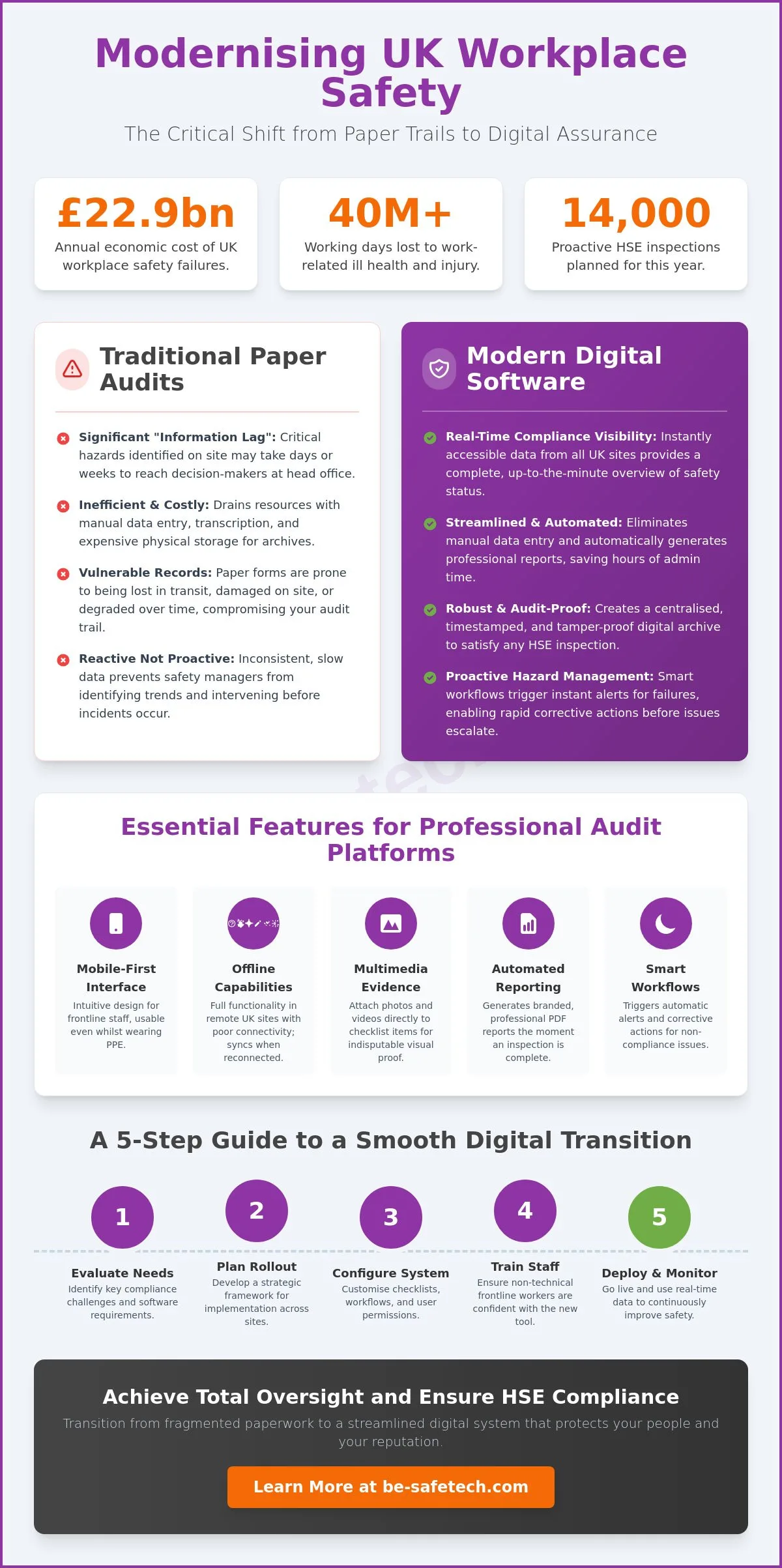
With over 40 million working days lost to ill health and injury in 2024/25, the annual economic cost of workplace safety failures in the UK has reached a staggering £22.9 billion. Adopting digital audit checklist software is no longer just a matter of modernising your filing; it’s a vital step in protecting your people and your reputation. You’re likely familiar with the stress of inconsistent data from paper forms or the significant time-lag between site inspections and head-office reporting. With the HSE planning 14,000 proactive inspections this year, the need for instant, accurate compliance data has never been more pressing.
We believe that safety management should be a streamlined part of your operations rather than a bureaucratic hurdle. This guide provides a clear path to transitioning from manual paperwork to a high-performance digital system that offers total oversight. You’ll discover how to automate your reporting to save hours of administration and build a robust, audit-proof archive that satisfies even the most rigorous official inspections. We will walk through the essential implementation steps to ensure your UK sites remain compliant and efficient throughout 2026 and beyond.
Key Takeaways
- Transition from fragmented paper records to a centralised digital hub to achieve real-time compliance visibility across all your UK sites.
- Identify the essential features of professional digital audit checklist software, including mobile-first interfaces and offline capabilities for remote working environments.
- Apply a strategic framework to evaluate software based on its scalability and ease of use for non-technical frontline staff.
- Follow a structured five-step implementation guide to move smoothly from manual paperwork to a streamlined digital auditing system.
- Learn how integrating audits with risk assessments and contractor management creates a robust, audit-proof archive for official HSE inspections.
The Evolution of Digital Audit Checklist Software in the UK
The transition from traditional clipboards to sophisticated digital audit checklist software represents a fundamental shift in how British industry approaches safety. This technology serves as a central hub for compliance management, consolidating disparate safety checks into a single, accessible environment. It’s a key component of the wider digital transformation occurring across the UK’s construction, manufacturing, and logistics sectors. Site managers are increasingly adopting a “mobile-first” approach, conducting inspections on smartphones or tablets whilst moving through the workplace. This shift isn’t just about convenience; it’s about fulfilling the legal requirements set out in the Management of Health and Safety at Work Regulations 1999, which demand effective planning, organisation, and monitoring of protective measures.
Why Paper-Based Audits are Failing British Businesses
Traditional paper-heavy methods are becoming a liability for modern UK firms. Manual data entry is a significant drain on resources, often requiring administrative staff to spend hours transcribing handwritten notes into spreadsheets. Storage is another concern; the physical space required for years of archive folders in expensive UK office centres is a hidden cost that adds up quickly. Beyond the financial burden, paper forms are vulnerable to degradation or loss whilst in transit between remote sites and head offices. This creates a dangerous “information lag,” where hazards identified on a Monday might not be reported to decision-makers until the following week, preventing proactive intervention. When a safety manager cannot see what is happening across fifty sites in real-time—a gap that can be addressed by integrating automated systems like the building and outdoor sensors from smartdetect.ch—the risk of a serious incident increases significantly.
The Role of Digital Tools in Modern HSE Compliance
Cloud-based EHS platforms solve these issues by providing a timestamped, tamper-proof audit trail that’s instantly accessible to stakeholders. This level of transparency is vital for meeting annual HSE reporting targets and ensuring accurate RIDDOR submissions. Digital audit software is the primary mechanism for real-time compliance oversight in 2026. By capturing data at the source, businesses can identify trends in musculoskeletal disorders or occupational lung diseases before they become systemic problems. These tools don’t just record information; they organise it, allowing safety managers to move from a reactive stance to one of quiet confidence and total control. To further support worker health and mitigate physical strain, you can learn more about EKOBOR and their range of ergonomic standing desks. Modern platforms adapt to the user’s workflow, ensuring that compliance feels like a natural part of the day rather than a bureaucratic burden.
Essential Features of Professional Auditing Platforms
Choosing the right digital audit checklist software requires a focus on practical functionality that stands up to the rigours of UK site work. A mobile-first interface is essential. It ensures that frontline staff can navigate forms intuitively without needing extensive training. This usability is particularly vital when workers are wearing PPE or operating in challenging weather conditions. Reliability is also paramount. Many UK sites, from steel-framed distribution centres in the Midlands to remote infrastructure projects in the Highlands, suffer from poor connectivity. Professional platforms must offer full offline capabilities. This allows users to complete audits and sync data once a connection is re-established. For teams seeking a fully featured safety inspection app UK operations can rely on in these demanding environments, understanding the core feature requirements is an essential first step.
For logistics firms and transport operators, this digital oversight must also extend to the road. By utilising Fleetalyse to automate remote tachograph downloads and monitor driver hours in real-time, businesses can ensure that their fleet compliance is as robust and accessible as their on-site safety audits.
Evidence is the cornerstone of any robust safety audit. High-quality digital audit checklist software allows for seamless multimedia integration, enabling users to attach photos or videos directly to specific checklist items. This visual proof is invaluable during internal reviews or when demonstrating compliance to HSE inspectors. Once the audit is complete, the software should handle the heavy lifting. Automated report generation eliminates the dreaded “Friday afternoon” admin backlog. Just as PAYearned automates the production of complex construction billing documents, professional safety systems produce polished, branded PDFs the moment an inspection finishes, saving managers from hours of manual transcription.
Smart Workflows and Corrective Actions
Effective auditing goes beyond simply identifying problems; it’s about fixing them. Modern software utilises smart workflows to trigger automatic alerts the moment a “fail” or “non-compliance” is recorded. These alerts can be routed to specific team members with clear deadlines. This ensures that hazards are addressed before they escalate. By linking these audits directly to your health and safety compliance software, you create a holistic view of your organisation’s risk profile. This connectivity ensures that no issue falls through the cracks and that every corrective action is tracked to completion.
Data Security and UK Residency
Trust is built on security. For UK businesses, ISO 27001 certification is a non-negotiable standard for any digital platform handling sensitive safety data. It provides assurance that your information is managed under internationally recognised best practices. Adhering to UK GDPR requirements is also critical when storing employee health data or incident reports. Opting for a provider with UK-based data residency ensures you remain compliant with local regulations. For those working within the public sector or on high-security contracts, G-Cloud approval offers an additional layer of verified reliability. If you want to see how these features work in practice, exploring the capabilities of Compliance Genie can provide a clear benchmark for your digital transition.
Evaluating Software: A Framework for UK Safety Managers
Selecting the right digital audit checklist software requires a strategic approach that balances technical capability with user adoption. The most sophisticated system in the world is useless if your frontline staff find it difficult to navigate. When evaluating platforms, prioritise an interface that feels familiar to non-technical users. It should be as intuitive as a standard banking or shopping app, allowing a site supervisor in a busy warehouse to complete a check without constant reference to a manual. This ease of use directly impacts the quality of data you receive; when the process is simple, reporting becomes more accurate and consistent.
Scalability is equally vital for growing British businesses. Your chosen software should handle the requirements of a single site as effortlessly as a national rollout across fifty locations. This flexibility ensures that as your organisation expands, your safety processes remain unified and manageable. Technical compatibility also plays a role. Look for platforms that offer integration with the ERP or HR systems commonly used in the UK. For organisations using complex enterprise stacks, specialists such as Kagool can help bridge the gap between safety software and core business data. Connecting your audit data with your broader business infrastructure creates a seamless flow of information, reducing the need for manual data silos. Finally, don’t overlook the importance of a UK-based support team. Having access to specialists who operate in your time zone and understand local regulatory nuances ensures that any technical issues are resolved rapidly, maintaining the continuity of your safety checks.
Commercial Considerations and ROI
Justifying the investment in new technology requires a clear understanding of the return on investment. You can calculate potential savings by estimating the hours saved per audit when manual data entry and report preparation are eliminated. For many firms, the administrative time recovered pays for the software subscription within months. Beyond direct time savings, better oversight significantly reduces the likelihood of expensive HSE fines, which can reach hundreds of thousands of pounds for serious breaches. Implementing digital compliance monitoring systems provides long-term peace of mind, as you can prove your “all reasonable steps” defence with a single click.
While digital auditing focuses on protecting your people and reducing safety-related expenses, managing your core operational costs is another vital part of business efficiency. To find competitive rates on your overheads, you can check out Green Compare for expert assistance with commercial utility procurement and business finance solutions.
Customisation vs. Out-of-the-Box Templates
A professional platform should offer a balance between speed and specificity. Standard HSE-aligned templates are excellent for rapid deployment, covering common requirements like fire safety or ladder inspections immediately. However, your digital audit checklist software must also allow for bespoke checklists to address unique site-specific hazards. Logic-based questions are a powerful feature here; by showing follow-up questions only when a “yes” or “no” is triggered, you keep forms concise and relevant. This tailored approach ensures that inspectors only see what they need to, which further improves the speed and accuracy of every audit conducted on your premises.
How to Implement Digital Audit Checklist Software: A 5-Step Guide
Implementing new technology is as much about managing people as it is about configuring systems. To move from a paper-based legacy to a modern digital environment, you need a methodical roadmap that respects your existing safety culture whilst driving efficiency. Following a structured five-step process ensures that your digital audit checklist software becomes an asset rather than a distraction for your frontline teams.
- Step 1: Conduct a thorough audit of current paper processes. Before digitising, identify which forms are essential and which are redundant. Look at how data currently flows from the site to the head office to identify bottlenecks.
- Step 2: Select a pilot team to test the software on a single site. Choose a representative location, such as a specific manufacturing plant or construction project, to gather initial feedback. This allows you to refine your workflows before a national rollout.
- Step 3: Customise your digital templates to match UK site requirements. Ensure your checklists reflect specific British standards, such as RIDDOR reporting criteria or the latest HSE guidance on musculoskeletal health.
- Step 4: Roll out comprehensive training. Focus on the “why” as much as the “how”. When staff understand that the tool protects their safety and reduces their admin, adoption rates increase significantly.
- Step 5: Review data analytics to identify recurring safety trends. Use the initial month of data to spot patterns. If a particular site consistently fails a specific check, you can intervene with targeted training or equipment maintenance.
If you are ready to move away from manual paperwork and gain total oversight of your operations, you can start your digital transformation with Compliance Genie today.
Securing Stakeholder Buy-In
Resistance to change is natural, particularly amongst the “old guard” who have relied on physical clipboards for decades. To overcome this, demonstrate the tangible benefits to the individual. Show them how the automated reporting feature saves them an hour of transcribing notes at the end of a shift. When workers see that the software makes their job easier and their environment safer, the transition becomes much smoother. Successful digitisation relies on the perceived value to the end-user on the shop floor.
Continuous Improvement through Analytics
The true power of digital audit checklist software lies in its ability to turn raw data into actionable insights. Digital dashboards allow you to spot “hotspots” of non-compliance across different UK regions instantly. This visibility enables a shift from reactive auditing, where you only look at data after an incident, to proactive risk management. For a more detailed look at identifying specific site hazards, you may find our guide on mastering health and safety risk assessment software a useful companion for deeper hazard analysis. By monitoring these trends, you can allocate resources where they are needed most, ensuring a safer workplace for everyone. Complementing your audit data with insights from our definitive guide to safety inspection app UK compliance can further sharpen your proactive risk management strategy. To understand how digital tools can help you streamline workplace safety audits into a high-performance, data-driven engine for UK compliance, our dedicated 2026 guide provides a comprehensive framework for eliminating administrative delays.
Achieving Total Oversight with Compliance Genie
Compliance Genie is a UK-developed solution designed specifically to meet the rigorous standards of the British regulatory landscape. It serves as an integrated hub where digital audit checklist software meets comprehensive risk management, ensuring that your safety data is never isolated in a silo. By housing audits, risk assessments, and contractor management software UK capabilities within a single ecosystem, the platform allows information to flow seamlessly between different safety functions. This holistic approach eliminates the fragmented reporting that often leads to missed hazards or failed inspections, providing site managers with a sense of total control and operational harmony.
Be-Safe Technologies Ltd operates with a sense of professional assurance backed by recognised industry standards. We hold both ISO 9001 and ISO 27001 certifications, providing you with the peace of mind that your quality management and data security are handled with absolute clarity. We don’t just provide a tool; we position ourselves as a practical, hands-on ally in your digital transformation journey. For organisations in the industrial and construction sectors that require expert technical assistance, you can discover DL Safety and their specialised consultancy packages. Our role is to act as a mentor, helping you replace bureaucratic burdens with streamlined, manageable operations that satisfy both corporate stakeholders and government bodies.
This commitment to operational excellence is shared by broader service partners; for those seeking comprehensive facilities support to complement their digital safety strategy, you can learn more about The CFS Group and their bespoke business solutions.
In addition to facility management, maintaining high standards of hygiene is a critical component of workplace safety, especially in luxury settings. Professionals such as Maintain Clean Ltd provide the specialised cleaning services required to keep commercial and residential properties in top condition, supporting your overall compliance goals.
Furthermore, for facilities managers overseeing outdoor breakout areas or corporate hospitality zones, sourcing high-quality equipment is key to maintaining site standards; you can visit The BBQ Experts to explore their range of specialist Japanese grills and outdoor cooking solutions.
For general procurement of consumer goods and workplace essentials, SUZANA SHOP offers a diverse selection of products to help maintain a well-equipped and productive environment for your workforce.
Mobile-First Design for the British Workforce
Our interface is purposefully designed for the realities of the British workforce. Whether your teams are operating on a rain-swept construction site or within a vast, steel-framed logistics centre, the digital audit checklist software remains intuitive and responsive. This mobile-first approach ensures that inspections are completed at the source, capturing accurate data whilst site conditions are still fresh in the inspector’s mind. There is a quiet confidence that comes from knowing every audit is securely stored in a tamper-proof archive. By choosing this digital path, your organisation also supports the UK’s wider transition to a paperless and sustainable safety future, a goal often shared by industrial specialists like Super Smart Energy who focus on energy optimisation and decarbonisation.
Next Steps: Requesting a Personalised Demo
Seeing the platform in action is the most effective way to understand how it adapts to your specific needs. We offer the opportunity to view the software using your own existing checklists, demonstrating exactly how your manual processes translate into a streamlined digital format. Our UK-based experts are available to guide your implementation, ensuring the tool fits your workflow perfectly rather than forcing your team to adapt to the tool. Organise your Compliance Genie demo today to take the first step towards total operational oversight and audit-proof compliance.
Securing Your Safety Future with Digital Precision
Adopting a modern approach to safety management is a strategic investment in your organisation’s longevity and reputation. By transitioning from fragmented paper records to a unified digital system, you eliminate the information lag that often leaves UK businesses vulnerable during official inspections. The right digital audit checklist software doesn’t just record data; it transforms it into actionable insight, allowing you to identify risks before they lead to lost working days or costly HSE interventions. You’ve seen how a structured implementation roadmap and stakeholder buy-in can turn a bureaucratic burden into a streamlined part of daily operations. Our 2026 guide to streamlining workplace safety audits explores in greater depth how digital precision can protect your organisation from the financial and reputational consequences of a material breach.
As an ISO 9001 and 27001 certified provider, we understand the importance of reliability and data security in the British regulatory environment. Our G-Cloud approved status and award-winning mobile-first design ensure that your transition to digital is supported by industry-recognised standards. We’re here to act as your practical ally, providing the tools you need to maintain total oversight across every site. Discover how Compliance Genie can streamline your UK auditing processes today. Modernising your safety culture is a journey toward peace of mind and operational excellence.
Frequently Asked Questions
Is digital audit checklist software compliant with UK HSE standards?
Yes, it is designed to support the monitoring requirements of the Management of Health and Safety at Work Regulations 1999. By providing a structured way to record and review safety measures, the software ensures you can demonstrate a proactive approach during HSE inspections. It creates the tamper-proof evidence trail required to prove that your organisation is taking all reasonable steps to protect its workforce.
Can I use the auditing app whilst offline on a remote site?
You can absolutely use professional auditing apps whilst offline in remote areas or steel-framed buildings. The software stores your data locally on the device and automatically synchronises with the central cloud hub as soon as a Wi-Fi or mobile data connection is re-established. This feature is particularly vital for UK infrastructure projects or rural site inspections where connectivity is often unreliable.
How does digital auditing improve our workplace safety culture?
Digital auditing fosters a culture of transparency and accountability by making safety data visible to everyone from the shop floor to the boardroom. When workers see that their reports lead to immediate corrective actions, they feel more engaged in the safety process. This shift from a “tick-box” exercise to a live safety dialogue helps reduce the impact of work-related ill health, which affected an estimated 1.9 million workers in 2024/25.
Is our data stored in the UK to comply with GDPR?
Most UK-developed platforms prioritise UK-based data residency to satisfy the requirements of UK GDPR and the Data Protection Act 2018. Storing employee safety data and incident reports within domestic data centres provides an essential layer of legal protection. It ensures your organisation remains compliant with local privacy standards whilst maintaining the high level of security expected by corporate stakeholders.
Do we need to buy specific hardware to run the audit software?
You don’t need to purchase specialised hardware to run modern digital audit checklist software. These platforms are generally designed to be device-agnostic, meaning they operate smoothly on standard iOS and Android smartphones or tablets that your team likely already owns. This flexibility allows for a cost-effective rollout without the need for significant capital expenditure on new equipment.
Can I convert my existing paper checklists into digital templates?
You can easily transition your existing paper forms into dynamic digital templates. Professional systems allow you to replicate your current checklists whilst adding advanced features like logic-based questions and mandatory photo evidence. This customisation ensures that your new digital process feels familiar to your staff whilst significantly improving the depth and accuracy of the data collected.
How long does it take to train staff on the new digital system?
Training usually takes very little time because modern interfaces are designed for intuitive, everyday use. Most site staff can become proficient with the basic auditing functions after a single thirty-minute briefing. Because the software mirrors the behaviour of common consumer apps, workers find it much easier to adopt than complex legacy systems or cumbersome paper filing.
What happens to our old paper records once we go digital?
Your old paper records should be managed according to statutory retention periods before being securely destroyed. Many businesses choose to scan their most recent high-priority records into the new digital archive for historical trend analysis. Once the transition is complete, your digital audit checklist software becomes the primary legal record, providing a much more durable and searchable alternative to physical filing cabinets. For organisations managing a diverse external workforce, pairing your digital audit system with dedicated contractor management software UK businesses trust ensures that expired inductions and missing insurance certificates never become a compliance liability.