


Safety Management for Multi-Site Businesses: A Guide to Centralised Compliance

If you cannot see what is happening at your Manchester branch whilst sitting in your London head office, can you truly claim to be in control of your organisation’s safety? Effective safety management for multi-site businesses is rarely about a lack of intent. Instead, it is a challenge of overcoming the visibility gaps that naturally occur when a business expands across multiple locations and relies on fragmented, site-specific processes.
You likely recognise the frustration of inconsistent safety cultures, where one site follows every protocol whilst another relies on outdated paper systems that cause reporting delays. It is incredibly difficult to prove compliance during a national audit when your data is trapped in local filing cabinets or disparate spreadsheets. We believe that safety should be a streamlined, manageable part of your operations, providing you with peace of mind rather than a bureaucratic headache.
This guide will show you how to eliminate these gaps and standardise safety protocols across your entire estate using modern digital frameworks. We will explore how moving to a single dashboard for national performance, complete with automated alerts and standardised risk assessments, can bring total clarity and operational harmony to your compliance strategy.
Key Takeaways
- Learn how to identify and close the “visibility gap” between your central head office and regional branches to ensure uniform compliance across your entire estate.
- Discover how to implement effective safety management for multi-site businesses by creating a single source of truth for all risk assessments and safety policies.
- Understand how to replace slow, paper-based bottlenecks with streamlined digital frameworks that simplify the daily workload for site managers.
- Explore the strategic role of centralised contractor management in maintaining consistent safety standards amongst external workers moving between different locations.
- Find out how a national dashboard provides real-time oversight and automated alerts to help you manage national safety performance with total confidence.
The Challenge of Safety Management for Multi-Site Businesses
Effective safety management for multi-site businesses represents the strategic coordination of Environmental, Health, and Safety (EHS) protocols across geographically dispersed locations. It’s a move away from isolated site control toward a unified safety management system that provides a consistent level of protection for every employee, regardless of their postcode. When an organisation expands, the complexity of maintaining these standards grows exponentially, often leading to a fragmented approach that puts both staff and the business at risk.
The legal implications of this fragmented oversight are significant for UK leadership teams. Under the Health and Safety at Work etc. Act 1974, directors and senior managers hold a personal responsibility to ensure the safety of all employees across the entire organisation. If a serious incident occurs at a regional branch and it’s proven that head-office oversight was inadequate, directors can face personal prosecution under Section 37 of the Act. Maintaining a clear line of sight across every location isn’t just an operational preference; it’s a legal necessity.
The Information Black Hole: Why Paper Fails
Paper-based systems create a dangerous information lag between a site incident occurring and the head office receiving the report. If a slip or trip happens in a Glasgow warehouse, a London-based safety director might not see the documentation for several days whilst it’s processed and posted. This delay makes it impossible to implement immediate corrective actions. Additionally, the risk of lost, damaged, or illegible documentation during an unannounced HSE inspection can lead to severe penalties. Manually collating data from multiple spreadsheets or physical folders is an administrative burden that saps productivity and increases the likelihood of human error. Understanding why organisations choose to automate safety compliance rather than persist with manual processes is essential for any multi-site business facing these daily pressures.
Inconsistent Safety Cultures Across the Estate
Standardisation is often the first victim of decentralised safety management. Without a digital framework, site managers frequently interpret “standard” procedures differently, leading to a patchwork of safety cultures across the estate. Implementing an urgent safety update across 20 or 50 locations simultaneously becomes a logistical nightmare when relying on manual communication. This is where the concept of “Standardised Digital Compliance” becomes the essential remedy. By moving to a centralised digital framework, you ensure that every site manager is working from the same live version of a risk assessment, creating a culture of total operational harmony.
Pillars of a Centralised Multi-Site Safety Framework
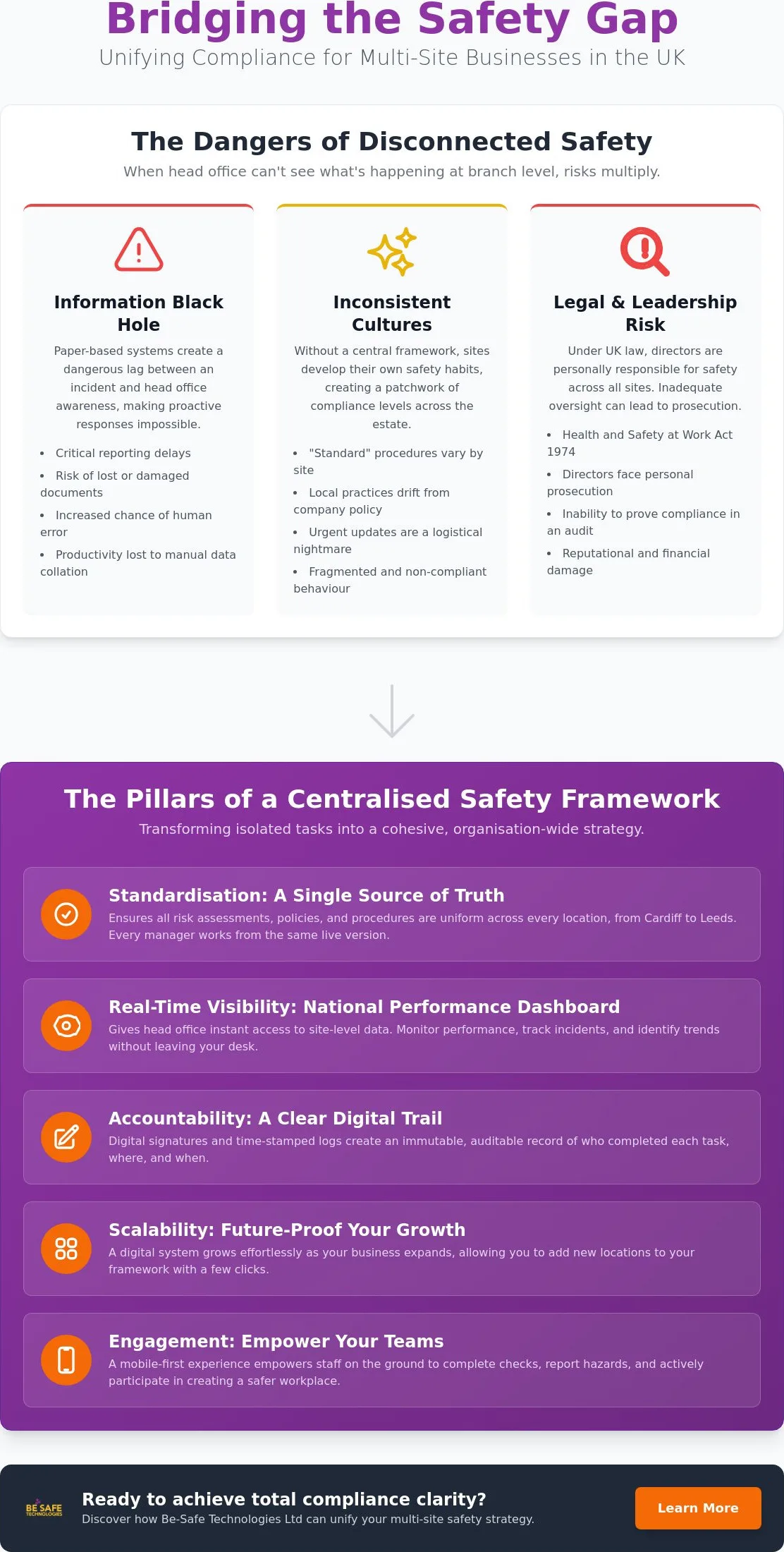
To overcome the fragmentation discussed earlier, robust safety management for multi-site businesses requires a foundation built on five core pillars. These pillars transform safety from a series of isolated local tasks into a cohesive, organisation-wide strategy. By establishing a centralised framework, you ensure that every branch, whether it is a retail unit in Cardiff or a distribution centre in Leeds, operates under the same high standards of protection and accountability.
- Standardisation: Creating a “single source of truth” ensures that all risk assessments and policies are uniform across every location.
- Real-Time Visibility: Instant access to site-level data from a central management portal allows head office to monitor performance without leaving their desk.
- Accountability: Digital signatures and time-stamped logs provide an immutable record of who completed a task and when it occurred.
- Scalability: A digital system grows effortlessly as your business acquires new locations or expands into different UK regions.
- Engagement: A mobile-first experience reduces friction for on-site staff, making it easier for them to report hazards as they see them.
Standardising Risk Assessments Nationally
Consistency starts with the tools your site managers use. Instead of allowing each branch to create their own documents, you can develop master templates that regional leads adapt to their specific environment without diluting core safety requirements. This is where mastering health and safety risk assessment software becomes essential for multi-site consistency. Digital version control ensures that when you update a policy at head office, the latest version is instantly available to every employee across the country, eliminating the risk of staff following superseded guidance.
Achieving Real-Time Assurance
The transition from reactive to proactive monitoring is perhaps the most significant benefit of a centralised approach. Rather than waiting for a monthly report, automated alerts notify you immediately of missed inspections or high-risk incidents. This level of oversight ensures that safety remains a top priority even when you aren’t physically present at a site. Dashboards provide a bird’s eye view of national compliance levels, allowing you to identify trends and allocate resources where they are needed most. If you are looking to enhance your operational harmony, streamlining your multi-site oversight with Be-Safe Technologies Ltd is the most effective path forward.
By focusing on these pillars, you move away from the “information black hole” of paper and toward a transparent, reliable approach to safety management for multi-site businesses. This structured method not only protects your workforce but also provides the documented evidence required to satisfy HSE inspectors and national auditors during any review of your estate.
Overcoming Resistance to Digital Safety Adoption
The most common hurdle when implementing safety management for multi-site businesses isn’t the technology itself, but the human element at the site level. Site managers are often the busiest individuals in an organisation, and their primary objection is usually that they don’t have time for “another piece of software.” This resistance is understandable if they’ve previously dealt with clunky, desktop-bound systems that felt like a bureaucratic burden. However, the true burden lies in the paper-based processes they currently use. Filing, scanning, and posting documents takes significantly more time than the “tap, snap, and send” workflow of a modern mobile app.
Digital tools are designed to automate repetitive reports, effectively giving time back to the manager rather than taking it away. When you focus on modernising site safety management, you’re choosing tools that prioritise user-centric design. By removing the administrative friction, you turn safety from a “have to do” task into a natural, manageable part of the daily routine. This shift is vital for maintaining high standards across diverse UK work sites where various teams must collaborate without the lag of traditional paperwork. Many organisations find that the decision to automate safety compliance processes dispels common misconceptions about digital transformation and delivers immediate, measurable time savings for site managers.
The Mobile-First Advantage for Remote Sites
Training and Onboarding at Scale
Rolling out a new system across 20 or 50 locations shouldn’t mean weeks of lost productivity or expensive classroom sessions. A successful strategy often involves the “Champion” model. By identifying digital leaders at each location, you create a network of peer-to-peer support that reduces the reliance on a central head office. Leveraging in-app guidance also helps, as it allows staff to learn the system whilst they’re actually using it. This approach ensures the transition to digital safety management is smooth, sustainable, and widely accepted by the workforce, creating a sense of total control and clarity from day one.
Essential Features for Multi-Site Safety Software in 2026
Selecting the right digital framework is about more than just replacing paper forms; it is about building a resilient infrastructure that supports safety management for multi-site businesses. As your organisation grows, the tools you use must provide both high-level oversight and granular site-level detail. A centralised dashboard is the cornerstone of this approach, offering customisable views that allow regional managers to focus on their specific clusters whilst giving national directors a comprehensive view of the entire estate’s performance.
One of the most significant advantages of a modern system is the ability to remain “always ready” for an inspection. Instead of scrambling to find documents, you can generate a digital audit checklist for any site instantly. This transparency is particularly valued in the UK public sector and amongst highly regulated industries, where G-Cloud approval serves as a vital marker of trust and reliability. These features ensure that your safety protocols are not just active but are also fully verifiable at a moment’s notice.
Managing the “Contractor Gap”
Multi-site businesses are often vulnerable to incidents involving external workers who move between different locations. Without a centralised system, a contractor might receive a safety induction at one site but miss critical hazard information at another. Using dedicated contractor management software UK allows you to track inductions and certifications across your entire estate. This ensures that every visiting worker is aware of site-specific risks before they begin their task, closing the visibility gap that often leads to avoidable accidents.
Data Security and UK Compliance
Handling incident reports and employee records involves managing sensitive personal data, making ISO 27001 compliant safety software a non-negotiable requirement for enterprise-level businesses. Cloud-based storage plays a dual role here; it ensures that your data is never lost, even in the event of a site-level disaster, whilst also helping you meet strict UK GDPR requirements. By centralising your data in a secure, encrypted environment, you protect your business from both physical hazards and the growing risk of data breaches. If you are ready to secure your organisation’s future, you can explore our full suite of compliance tools to see how they adapt to your specific multi-site needs.
By integrating these essential features, you create a safety ecosystem that is both robust and flexible. This digital foundation provides the quiet confidence that your business is protected, your staff are safe, and your compliance data is always accurate and accessible.
Compliance Genie: The Strategic Solution for Multi-Site Oversight
Compliance Genie serves as the essential bridge between site-level action and head-office intelligence. It provides the quiet confidence that every branch is operating within the same high standards, regardless of its distance from the central hub. By integrating safety management for multi-site businesses into a single, intuitive platform, we help you eliminate the visibility gaps and replace them with a culture of total operational harmony. This transition ensures that safety is no longer a peripheral concern but a core, manageable part of your daily operations.
The benefits of this digital transition extend far beyond simple record-keeping. You gain total visibility into your estate’s performance whilst significantly reducing the administrative burden on your site managers. As an award-winning solution from Be-Safe Technologies Ltd, the platform is backed by dedicated UK-based support, ensuring that you have a practical, hands-on ally at every stage of your digital journey. Whether your organisation operates in high-street retail, complex manufacturing, or national logistics, the framework adapts to your specific risks and reporting requirements without forcing your team to change the way they work. For organisations operating across construction environments in particular, adopting digital safety reporting software has become an increasingly critical component of maintaining HSE compliance and protecting workers on site.
Modular Growth with Contractor Genie
For businesses that rely on external partners, the synergy between Compliance Genie and Contractor Genie creates a truly holistic safety ecosystem. These two platforms work together to ensure that every person on your site, whether a permanent employee or a visiting contractor, is accounted for and properly inducted. You can manage site visits and verify certifications without the need for physical paperwork, creating a seamless experience for both your internal teams and your external partners. This modular approach allows your safety infrastructure to grow in line with your business ambitions, ensuring that your oversight remains robust as your estate expands and your contractor network becomes more complex. Furthermore, for property operators managing a diverse portfolio, SuddenlySpaces provides a unified leasing platform to handle coworking and commercial flex rentals with the same level of digital efficiency.
Next Steps for Your Multi-Site Business
Transitioning to a centralised digital framework is most effective when managed as a phased rollout. This approach allows you to gather site-level feedback and refine your processes as you go, ensuring that the tool truly serves the needs of the end-user. We recommend identifying a pilot location to demonstrate the immediate benefits of automated alerts and real-time reporting before expanding the system across the rest of the estate. This ensures that the transition is smooth and that site managers feel supported rather than overwhelmed by the change.
If you’re ready to see how a unified dashboard can transform your national safety performance, you can request a tailored demo to see the platform in action. Safety management for multi-site businesses is no longer a site-by-site task that happens in isolation; it is a unified business strategy that protects your people, your reputation, and your bottom line. By choosing a modern, digital framework, you aren’t just ticking a compliance box; you’re investing in the long-term resilience and efficiency of your entire organisation.
Securing Your Organisation’s Future through Centralised Oversight
Implementing robust safety management for multi-site businesses is about more than just checking boxes; it is about building a resilient, transparent infrastructure that protects every member of your team across the UK. By closing the visibility gap between your regional branches and head office, you move away from reactive firefighting and toward a proactive, data-driven safety culture. Standardising your risk assessments and policies through a digital framework ensures that every location operates with the same level of excellence and accountability.
As an ISO 9001 and 27001 Certified organisation and a G-Cloud Approved Provider, Be-Safe Technologies Ltd offers the reliability your enterprise demands. Our award-winning UK-based support team is here to ensure your transition to a digital system is smooth and successful. You can book a demo of Compliance Genie to see how we simplify multi-site safety across your entire estate. Transitioning to a unified strategy provides the peace of mind you need to focus on growing your business with total confidence.
Frequently Asked Questions
How does multi-site safety software handle different regional regulations?
Digital platforms allow you to create a core compliance framework whilst enabling site managers to add location-specific protocols. This ensures that whilst every branch meets the overarching requirements of the Health and Safety at Work etc. Act 1974, you can also address specific local hazards or regional bylaws. It is about maintaining a single source of truth that remains flexible enough to adapt to the unique operational needs of different sites across the UK.
Can I limit site managers to only see their own location’s data?
You can implement granular user permissions to ensure that site managers only have access to the data relevant to their specific location. This hierarchy protects sensitive information whilst preventing local teams from becoming overwhelmed by national data. Regional managers can then be granted oversight of multiple sites, providing a structured flow of information that mirrors your organisation’s management hierarchy and maintains strict data security protocols.
What happens if a site has no internet connection when performing an inspection?
Modern safety management for multi-site businesses must include robust offline capabilities to support work in remote depots or basements. Inspections can be completed as normal without an active connection; the data is stored locally on the device. Once the user returns to an area with Wi-Fi or mobile signal, the system automatically syncs the information to the central dashboard, ensuring no data is lost due to connectivity issues.
How much time does it typically take to roll out a digital safety system across 10+ sites?
A phased rollout for ten or more sites typically takes between four and eight weeks, depending on the complexity of your existing safety protocols. This timeframe allows for the initial setup of master templates, followed by pilot testing at a single location to gather feedback. By adopting a structured approach, you can ensure that each site manager is fully trained and that the digital transition does not disrupt your daily operations.
Can digital safety software integrate with our existing HR or project management tools?
Digital platforms are designed to integrate seamlessly with your existing HR and project management systems through secure APIs. This connectivity allows for the automated sharing of employee records, training certifications, and incident data across your entire business ecosystem. By linking these tools, you eliminate manual data entry and ensure that your safety records are always synchronised with your wider corporate management systems, improving overall operational efficiency. For larger organisations, solutions like Syntes AI can help unify complex data into a structured, actionable format to further enhance this integration.
Is it possible to track contractor inductions across all our locations simultaneously?
You can track contractor inductions across every location in real-time through a centralised management portal. This feature ensures that any external worker moving between sites is verified and has received the necessary safety briefings before they begin work. It provides a complete audit trail of contractor activity across your estate, significantly reducing the administrative burden on site managers whilst closing the visibility gap associated with external partners.
How do we prove to the HSE that our digital records are tamper-proof?
Digital records provide a superior level of evidence for HSE inspectors because they include immutable time-stamps and secure digital signatures. Every action taken within the system is recorded in a comprehensive audit log that cannot be altered after the fact. This level of transparency, combined with ISO 27001 certification, demonstrates a commitment to data integrity that is far more reliable than traditional paper-based filing systems or manual spreadsheets.
What are the costs associated with scaling safety software as we open new sites?
Scaling your safety management for multi-site businesses is typically managed through a flexible subscription model that adjusts as your estate grows. Instead of facing large upfront costs for every new branch, you simply add new site profiles or user licences to your existing platform. This approach ensures that your safety infrastructure remains cost-effective and predictable, allowing you to expand your operations whilst maintaining total control over your compliance budget.