


Contractor Compliance Tracking: The Ultimate 2026 Safety Checklist

With the construction industry needing to recruit at least 500,000 workers in 2026 to meet demand, how certain are you that every person on your site is fully qualified and insured? It’s understandable to feel the pressure of mounting paper-based RAMS and insurance certificates, particularly when you want to be certain your site meets every UK regulatory standard. Many professionals find it a challenge to verify if every contractor on-site is truly qualified in real-time, which is why robust contractor compliance tracking has become a vital tool for maintaining a safe and efficient workplace.
We believe that managing your external workforce shouldn’t feel like a bureaucratic burden. This guide provides a comprehensive checklist designed to ensure safety, mitigate risk, and streamline your digital oversight. You’ll gain a clear, repeatable process that reduces your administrative load and provides genuine peace of mind regarding your legal due diligence. We’ll examine the essential steps for modernising your safety culture and ensuring your site remains a secure, professional environment for everyone, allowing you to focus on project delivery rather than paperwork.
Key Takeaways
- Understand how contractor compliance tracking moves beyond simple filing to become a continuous, live process that protects your business from legal liability and HSE scrutiny.
- Identify the four essential pillars of a robust framework to ensure you never overlook a critical blind spot in administrative, competency, safety, or insurance verification.
- Learn why transitioning from manual, paper-based systems reduces administrative burden and eliminates the hidden costs of human error and missed expiry dates.
- Access a definitive, actionable checklist tailored to British safety standards for every stage of the project, from pre-qualification to post-work review.
- Discover how modern digital tools like Contractor Genie provide total oversight and quiet confidence through automated alerts and centralised, ISO 27001 certified data management.
What is Contractor Compliance Tracking and Why is it Critical?
Contractor compliance tracking is the continuous, systematic process of verifying that external workers possess the necessary credentials, insurances, and safety behaviours to work on your site. It isn’t a one-time “gate check” or a simple filing exercise. Instead, it represents an ongoing audit of reality against regulation. By 2026, the industry has shifted away from reactive checking, where you only look at papers after an incident, toward proactive tracking. This ensures that every individual on your premises is qualified at the exact moment they start work.
In the UK, the Health and Safety Executive (HSE) expects more than just a signature on a form. They require evidence of active oversight. Failing to maintain this oversight carries heavy burdens that go beyond the threat of site closures. If a contractor’s insurance expires mid-project and you haven’t utilised robust contractor compliance tracking to catch it, your liability shield essentially vanishes. This creates significant financial and reputational risks that can take years to recover from.
In instances where compliance failures lead to legal friction, expert advisors such as Cosil Solutions provide strategic consultancy to help navigate complex housing, property, and complaint disputes effectively.
Effective tracking allows you to move from a state of constant anxiety to one of quiet confidence. It transforms safety from a bureaucratic hurdle into a streamlined part of your daily operations. When you have total clarity over who is on your site and what they are qualified to do, you protect your workers and your business simultaneously.
The Difference Between Management and Tracking
Contractor management covers the broad relationship with your supply chain, from initial procurement to final payment. Tracking is far more granular. Whilst management might involve periodic reviews or monthly meetings, tracking happens in real-time. It uses live data to highlight expiry dates or missing certifications before they lead to an accident. It’s the difference between knowing a company is reputable and knowing that the specific electrician on-site today has an up-to-date ECS card.
Understanding Your Duty of Care
The law doesn’t distinguish between your direct employees and third-party contractors when it comes to site safety. You hold a non-delegable responsibility to ensure anyone on your premises is safe and competent. This is often referred to as the ‘Golden Thread’ of information. It’s a continuous record of compliance that remains accessible and accurate throughout the project lifecycle, providing a clear audit trail for any inspection.
In 2026, Duty of Care is defined as the active, digital verification of a contractor’s competence and safety status at every point of operational contact.
The Four Pillars of a Robust Compliance Framework
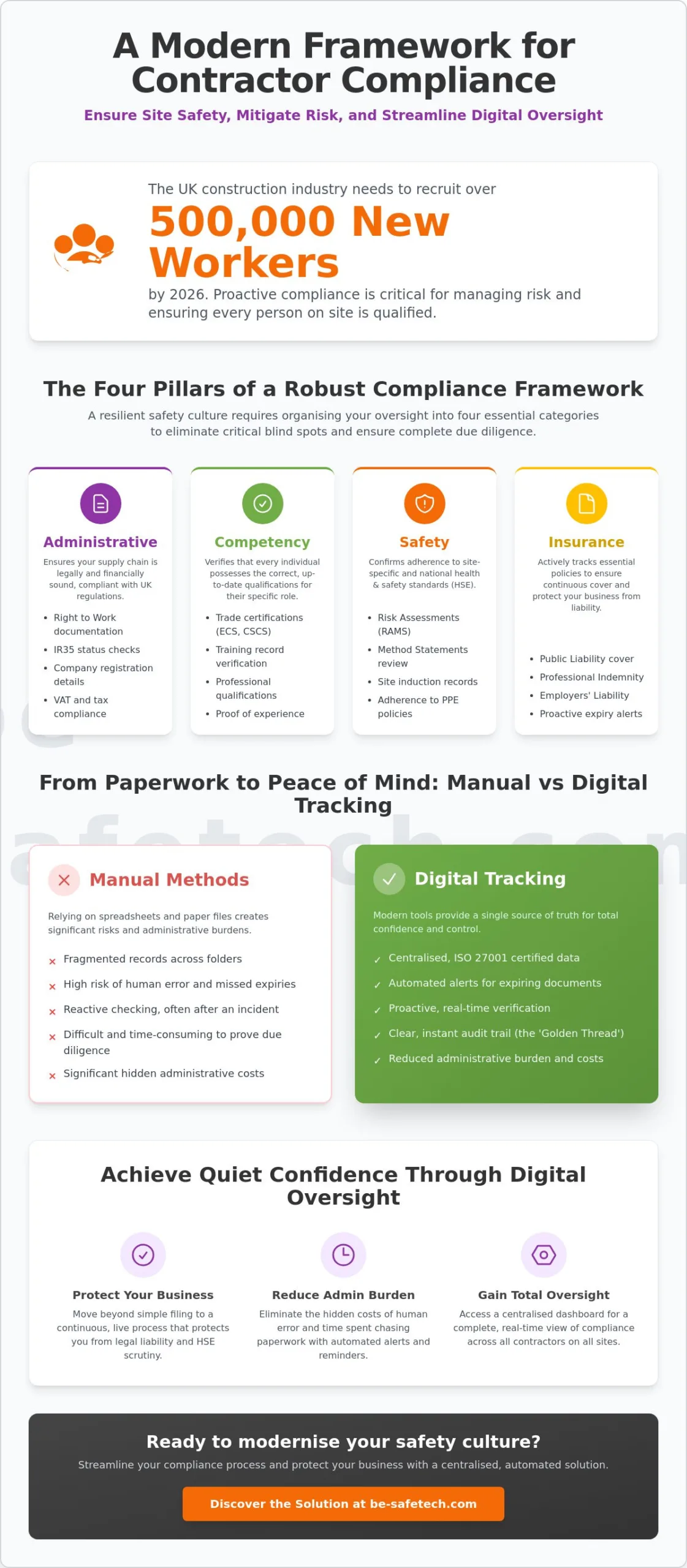
Building a resilient safety culture requires more than just collecting papers. You need to organise your oversight into four specific categories: Administrative, Competency, Safety, and Insurance. These pillars form the foundation of your risk management strategy. Missing even a single element, such as an expired insurance certificate or a lapsed training record, creates a significant blind spot in your liability shield. Effective contractor compliance tracking relies on a centralised source of truth where all data is interconnected and instantly accessible. When your records are fragmented across spreadsheets and physical folders, you lose the ability to prove due diligence under pressure.
Administrative and Insurance Essentials
Administrative oversight ensures that your supply chain is legally and financially sound. This involves verifying Right to Work documentation and conducting IR35 status checks to remain compliant with UK tax regulations. You also need to track Public Liability and Professional Indemnity insurance with absolute precision. These policies often expire mid-project, so a proactive system must alert you well before the cover lapses. It’s a simple step that prevents massive financial exposure.
Large-scale organisations often reference frameworks like the Contractor Performance Assessment Reporting System (CPARS) to model how performance data should be logged and retrieved. Although CPARS serves the U.S. federal sector, the core logic of maintaining a transparent, auditable history of contractor behaviour is essential for UK businesses aiming for high standards. Digitising these records ensures that administrative compliance isn’t just a tick-box exercise but a live asset that supports your business continuity.
Competency and Safety Documentation
Safety tracking also involves the rigorous review of Risk Assessments and Method Statements (RAMS). These documents must be live and site-specific to be effective. By monitoring these safety inputs alongside competency data, you ensure that every worker on your site is both capable and prepared. Transitioning to digital contractor management tools allows you to link these documents directly to individual workers, ensuring that no one steps onto the site without the correct credentials in place. This level of contractor compliance tracking provides the quiet confidence that your site operations are fully protected and compliant with the latest standards.
Evaluating Manual vs Digital Tracking Methodologies
Choosing between a physical filing cabinet and a digital dashboard isn’t just about modern aesthetics; it’s about operational survival. Manual tracking relies on the hope that every certificate was filed correctly and that someone remembers to check the expiry date before a contractor arrives on-site. This approach is riddled with hidden costs, primarily the significant time spent chasing paperwork and the high risk of human error. When you rely on paper, you’re always one misplaced folder away from a compliance failure. In contrast, implementing a digital contractor compliance tracking system ensures that your oversight is active and automated, providing a level of reliability that manual systems simply cannot match.
By 2026, the favourite approach for site managers has become ‘mobile-first’ oversight. Modern sites are fast-moving environments where managers need to verify credentials whilst standing at the site gate, not whilst tethered to a desk in a portable cabin. Digital logs offer a level of auditability that makes HSE inspections far less stressful. Instead of rummaging through dusty lever-arch files, you can present a timestamped, digital audit trail that proves every worker was verified before they started their shift. This transparency builds trust with regulators and stakeholders alike.
Resources like the Contractor Compliance Institute highlight the importance of structured record-keeping for maintaining high safety standards. Whilst their focus is on federal standards, the principle remains the same for UK businesses: your ability to track and retrieve data is as important as the data itself. Digital systems ensure that these records are not only kept but are also functional and searchable.
The Pitfalls of the Spreadsheet Approach
Many businesses attempt to bridge the gap between paper and software by using spreadsheets. However, static spreadsheets are often outdated the moment they’re saved. Version control issues frequently arise amongst team members, leading to situations where one manager is looking at an old list whilst another has the latest updates. Manual spreadsheets fail to provide a real-time view of on-site compliance, meaning you’re often looking at a snapshot of the past rather than the reality of the present. This lag in data creates a dangerous window where unqualified contractors could be working on your site without your knowledge.
Benefits of Cloud-Based Oversight
Cloud-based systems offer instant access to contractor files from any location, ensuring that your data is always current and synchronised. This digital transition provides a sense of professional assurance, knowing that automated expiry alerts will flag issues before they become liabilities. It moves the burden of memory from the individual to the technology, allowing your team to focus on safety leadership rather than data entry. For a deeper look at how these tools are evolving, you can explore The Ultimate Guide to Health and Safety Compliance Software in 2026. Adopting these cloud-based solutions ensures that your contractor compliance tracking is robust, scalable, and ready for any regulatory challenge. If you’re also evaluating which platform best suits the UK market, our detailed Avetta vs Contractor Genie comparison for UK businesses in 2026 can help you make an informed decision.
The Essential Contractor Compliance Checklist
A checklist is only effective when it’s integrated into your daily operations. To maintain a truly safe environment, your contractor compliance tracking must cover the entire lifecycle of a contract, from the initial bid to the final site exit. This structured approach ensures that no critical safety step is missed and that your audit trail remains unbroken. By categorising your requirements into three distinct phases, you can manage the complexities of external workforces with quiet confidence and professional assurance.
When a checklist item is missing or a certificate has expired, your system should provide an immediate, clear response. In a high-stakes environment, the rule must be simple: no valid documentation, no site access. This firm stance protects the individual worker, the rest of your team, and your business’s legal standing. Handling non-compliance isn’t about being bureaucratic; it’s about maintaining the recognised industry standards that keep people safe.
Phase 1: Pre-Qualification and Onboarding
Before a contractor even arrives at your gate, you must verify their company-level credentials. This phase is usually updated annually or whenever a specific policy expires. You should verify that they hold valid Public Liability and Professional Indemnity insurance, with limits that match your project’s risk profile. It’s also vital to check for ISO certifications, such as ISO 45001 for occupational health and safety, which demonstrate a mature approach to safety management. Finally, ensure they have formally accepted your organisation’s code of conduct and safety policies to align their team’s behaviour with your site’s expectations.
Phase 2: Site-Specific Compliance
Once a contractor is approved at the company level, you must focus on the individual workers and the specific tasks they’ll perform. This phase requires daily or project-specific oversight. Every worker must complete a site induction that is logged and timestamped within your digital system. You must also verify that Risk Assessments and Method Statements (RAMS) are not just submitted but have been read and signed by the people actually doing the work. For high-risk activities, ensure that specific permits to work, such as hot works or confined space entry, are active and tracked in real-time.
Phase 3: Continuous Monitoring
Compliance doesn’t end once work begins. Continuous monitoring involves regular spot-checks on safety behaviour and the correct use of Personal Protective Equipment (PPE). If a near-miss or incident occurs, it should be logged directly against the contractor’s digital profile. This creates a live performance history that is invaluable for future hiring decisions. At the end of the project, perform a post-contract evaluation to document their safety performance and reliability, ensuring that you only invite the most compliant partners back for future projects.
Discover how to automate your safety workflows and maintain a live audit trail with Contractor Genie.
Streamlining Oversight with Contractor Genie
Managing a multi-layered supply chain creates a significant administrative weight, yet Contractor Genie is designed to lift this burden entirely. It acts as a sophisticated partner in your safety journey, transforming the complex checklist into a manageable, automated workflow. Having an ISO 27001 certified platform provides the quiet confidence that your sensitive contractor data is protected by the highest international standards for information security. By centralising your contractor compliance tracking within a single, secure digital centre, you replace fragmented processes with total operational harmony.
Automating the Compliance Life Cycle
One of the most immediate benefits is the system’s ability to send proactive alerts well before insurance policies or trade certifications expire. This transition from manual reminders to automated notifications ensures that you’re never caught off guard by a lapsed document. You can easily digitise paper-based assessments, ensuring that every Risk Assessment and Method Statement is stored where it can be retrieved in seconds. This accessibility is vital for maintaining the “Golden Thread” of information discussed earlier in this guide. When an inspection occurs, you can generate a comprehensive compliance report with a single click, significantly reducing the stress of external audits and proving your due diligence with ease.
Enhancing Site Safety Culture
The platform empowers site managers to verify worker credentials instantly via mobile devices, providing the real-time oversight needed on fast-moving projects. It bridges the gap between the site office and the work face, allowing for immediate verification of CSCS cards or specific permits to work. Rather than forcing your business into a rigid, pre-defined structure, the software adapts to your specific workflows and safety protocols. This flexibility ensures that the technology supports your team’s existing expertise whilst enhancing their ability to maintain a rigorous safety culture. By providing a clear, transparent view of contractor behaviour and qualifications, you create an environment where safety is a shared, visible priority. To understand how Contractor Genie compares against other leading platforms on the market, explore our in-depth Avetta vs Contractor Genie guide for UK contractor management software in 2026.
Discover how Contractor Genie can organise your contractor compliance tracking today.
Secure Your Future with Proactive Oversight
Transitioning to a digital safety culture is no longer a luxury for UK businesses; it’s a fundamental requirement for operational resilience. By focusing on the four pillars of compliance and moving away from static spreadsheets, you ensure that your site remains protected against legal and financial risks. Effective contractor compliance tracking allows you to verify every individual’s credentials in real-time, providing the transparency that HSE inspectors expect and your workforce deserves. This shift from reactive checking to proactive oversight turns safety into a streamlined asset rather than a bureaucratic burden.
As an award-winning EHS digital platform with ISO 9001 and 27001 certified security, we’re trusted by businesses across the UK and Europe to simplify complex regulatory tasks. We invite you to book a demo of Contractor Genie to see how we simplify your compliance tracking and replace administrative stress with total operational clarity. Taking control of your contractor management today creates a safer, more efficient, and more professional environment for everyone involved in your projects. You’ve the tools to master these complexities; it’s time to put them to work.
Frequently Asked Questions
What is the most important document to track for contractor compliance?
Public Liability Insurance is often the most critical document because it provides the primary financial protection against claims for injury or damage. However, site-specific RAMS (Risk Assessments and Method Statements) are equally vital for operational safety. Tracking these ensures that the contractor has identified specific risks and outlined safe working methods before starting any task on your premises.
How often should I review my contractor’s safety documentation?
You should review high-level insurance and certifications annually, but site-specific documentation requires daily or project-based checks. Effective contractor compliance tracking involves verifying that RAMS and training records are valid for the specific work being performed each day. This continuous oversight prevents safety lapses that occur when documents are filed once and then forgotten during the project lifecycle.
Can I track contractor compliance using a standard spreadsheet?
Whilst spreadsheets are common, they’re generally insufficient for managing complex supply chains due to version control issues and the lack of automated alerts. Static files quickly become outdated and don’t provide real-time visibility into who is actually on-site. Digital systems replace these manual risks with automated expiry notifications and centralised data access, ensuring your records are always current and auditable.
What happens if a contractor’s insurance expires whilst they are on-site?
If insurance expires, the contractor is technically working without cover, which leaves your business liable for any incidents that occur. You must stop their work immediately until they provide evidence of renewal. Digital tracking systems prevent this scenario by sending automated alerts weeks in advance, allowing you to secure updated certificates before the existing policy lapses and maintaining your liability shield.
Is it a legal requirement to track contractor training records in the UK?
Yes, under the Health and Safety at Work etc. Act 1974, you’ve a duty to ensure that anyone working on your site is competent and adequately trained. Failing to track trade-specific certifications or CSCS cards can lead to heavy fines and legal action if an accident occurs. Maintaining a digital audit trail of these records proves you’ve met your legal duty of care and HSE expectations.
How does digital tracking improve my business’s safety culture?
Digital tracking improves safety culture by making compliance a transparent, everyday priority rather than a hidden administrative task. When site managers can verify credentials instantly via mobile, it reinforces the message that safety is non-negotiable. This visibility encourages contractors to maintain higher standards, knowing that their performance and qualifications are being monitored consistently and professionally across all your sites.
What is the difference between pre-qualification and ongoing tracking?
Pre-qualification is the initial vetting process to ensure a contractor meets your standards before they’re hired, whilst ongoing tracking is the continuous verification of those standards. Whilst pre-qualification checks for general competence, ongoing contractor compliance tracking ensures that specific workers remain qualified and that their insurance policies don’t expire during active projects. Both are essential for a complete safety framework.
How can I get my contractors to engage with a digital tracking system?
You can encourage engagement by highlighting how digital systems reduce their own administrative burden and speed up site-entry processes. Most contractors prefer uploading documents once to a secure portal rather than carrying physical folders to every site. Positioning the system as a tool for efficiency and professionalism helps them see it as a benefit to their own business operations rather than a hurdle.