



Mastering Health and Safety Risk Assessment Software: A 2026 Buyer’s Guide

With 964,000 cases of work-related stress and anxiety reported in the UK this year, the most expensive health and safety risk assessment software in your budget is the one your frontline staff refuse to open. Many safety leaders find themselves drowning in paper-based forms or struggling with complex digital tools that offer no real-time visibility across multiple sites. This lack of engagement creates a dangerous gap between your head office policies and the actual conditions on the ground. It is particularly challenging as you navigate the stringent requirements of the Building Safety Regulator and the security mandates of the Terrorism (Protection of Premises) Act 2025.
You likely recognise that safety management should be a streamlined, manageable part of your operations rather than a constant administrative hurdle. This guide will help you discover how to evaluate and implement the right digital risk assessment tools to ensure total compliance and frontline safety. We will examine the essential features for 2026, such as AI-driven hazard detection and mobile-first interfaces, to help you transition from reactive fixes to proactive oversight and operational harmony.
Key Takeaways
- Understand how modern health and safety risk assessment software serves as a centralised digital ecosystem to replace fragmented spreadsheets and paper trails.
- Identify the essential 2026 features, such as offline functionality and user-centric design, that ensure high adoption rates amongst your frontline staff.
- Learn how to align your digital tools with the HSE’s “Five Steps to Risk Assessment” to maintain rigorous compliance and support complex RAMS.
- Discover a practical strategy for transitioning from paper to digital through targeted pilot programmes and comprehensive form audits.
- Explore how an all-in-one mobile-first platform like Compliance Genie integrates assessments, audits, and incident reporting into a single source of truth.
What is Health and Safety Risk Assessment Software?
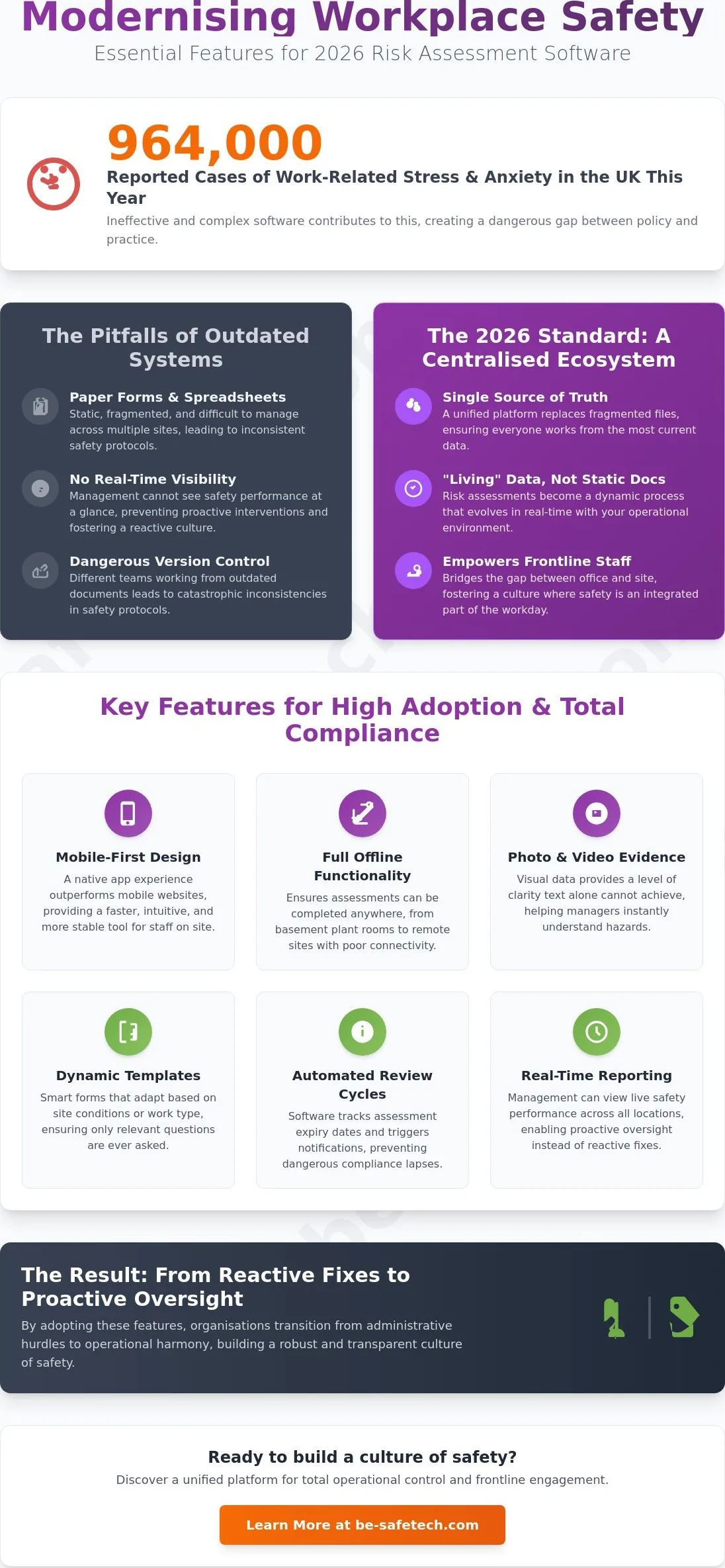
Modern health and safety risk assessment software is far more than a simple digitised form. It functions as a centralised digital ecosystem designed to identify, evaluate, and mitigate workplace hazards through a single source of truth. Historically, businesses relied on filing cabinets full of paper or fragmented spreadsheets that lived in isolated folders. In 2026, the industry has transitioned away from these static documents toward “living” data. This means that a Risk assessment is no longer a box-ticking exercise performed once a year; it’s a dynamic process that evolves alongside your operational environment.
For site-based workers, this shift is transformative. Mobile-first accessibility ensures that the person facing the hazard can document it immediately, rather than waiting to return to a desktop computer. This real-time capability bridges the gap between office-based safety managers and frontline staff. It fosters a culture where safety is an integrated part of the workday. When data flows instantly from the field to the management suite, businesses gain the quiet confidence that comes from total oversight.
The Core Components of a Digital Risk Tool
To be effective, digital tools must move beyond basic text entry. Modern platforms utilise specific capabilities to link digital actions directly to tangible safety outcomes. These include:
- Dynamic templates: These adapt based on specific site conditions or the type of work being performed, ensuring only relevant questions are asked.
- Automated review cycles: The software tracks the “shelf life” of an assessment and triggers notifications before it expires, preventing compliance lapses.
- Real-time reporting dashboards: Senior management can view safety performance across multiple locations at a glance, allowing for proactive intervention.
Why Spreadsheets are No Longer Sufficient
Whilst Excel was once the standard for data tracking, it presents significant risks in a safety-critical context. Version control is perhaps the most dangerous issue. It’s common for different teams to work off outdated copies of a spreadsheet, leading to inconsistent safety protocols across the organisation. This lack of a single version of the truth can be catastrophic during an incident investigation.
Manual systems also lack the robust audit trails required by modern standards. Digital logs record exactly who made a change and when, providing a level of transparency that spreadsheets cannot match. Finally, extracting actionable insights from isolated files is nearly impossible. High-quality health and safety risk assessment software aggregates data from every corner of your business, turning individual reports into a holistic view of your risk profile. This allows you to spot trends before they become accidents.
Essential Features to Look for in 2026
Selecting the right health and safety risk assessment software requires a shift in perspective. It is not simply about finding the platform with the most features. It is about finding the one your team will actually use. If a tool is too complex, frontline workers will often revert to paper or skip the assessment entirely. In 2026, the most effective tools prioritise ease of use to ensure high adoption rates amongst all staff levels. When a system feels intuitive, compliance becomes a natural part of the workday rather than a forced chore.
Many UK work environments, from basement plant rooms to remote infrastructure sites, suffer from poor connectivity. Reliable software must offer full offline functionality; this allows users to complete assessments whilst they are without an active data connection. Additionally, the ability to capture robust photo and video evidence is now essential. Visual data provides a level of clarity that text alone cannot achieve, helping managers understand the exact nature of a hazard instantly. For those looking to unify these features into a single workflow, exploring a modern safety platform can provide the clarity needed for total operational control.
Mobile-First Design and Accessibility
A native mobile app consistently outperforms a mobile-responsive website on-site. Native apps provide a faster, more stable experience that feels intuitive to the user. Simplified interfaces reduce the time workers spend on administrative tasks, which allows them to focus on their primary duties. Push notifications also serve as vital reminders for urgent risk updates or required actions, ensuring that critical information reaches the right person at the right time.
Automated Compliance and Audit Trails
To meet UK HSE standards, digital tools must provide a clear, undeniable record of activity. Digital signatures and time-stamping offer legal defensibility during inspections or incident investigations. Automatic alerts for overdue assessments or high-risk findings ensure that nothing slips through the cracks. Security is equally paramount. Integrating robust health and safety risk assessment software into your business means looking for platforms that adhere to ISO 27001 to protect your sensitive safety data, ensuring that your organisation remains both compliant and secure. Pairing your risk assessments with digital audit checklist software further strengthens your compliance posture by ensuring site inspections and head-office reporting are always aligned in real time.
Evaluating Software Against UK HSE Standards
Effective health and safety risk assessment software must do more than just digitise a paper form; it must actively guide your team through the rigorous logic required by the Health and Safety Executive (HSE). In the UK, the HSE five steps to risk assessment remain the gold standard for protecting workers. Your chosen platform should mirror this process, ensuring that every assessment is both thorough and compliant with national expectations. This alignment provides the peace of mind that your business isn’t just following a trend but is adhering to recognised industry standards.
Flexibility is a critical requirement when choosing a digital tool. Different industries require different risk logic, so your software should offer customisable matrices, such as 3×3 or 5×5 grids, to match your existing internal protocols. This ensures that the transition to digital doesn’t force you to reinvent your safety culture. For businesses operating in fast-moving environments, the ability to conduct a Dynamic Risk Assessment (DRA) is equally vital. Whilst traditional assessments cover known hazards, a DRA allows staff to evaluate new risks as they emerge on-site, providing a complete, well-rounded ecosystem for workplace protection.
Mapping Digital Workflows to HSE Guidance
Modern software facilitates the first two steps of the HSE process by providing pre-populated hazard libraries and prompts to identify who might be harmed. This structured approach to Hazard Identification and Assessment ensures that common risks aren’t overlooked during the initial inspection. For Step 3, built-in logic helps users evaluate the severity and likelihood of risks, suggesting appropriate precautions based on your company’s specific safety rules.
The final steps involve recording findings and reviewing assessments. Digital tools automate these tasks by generating professional reports and setting recurring reminders for future reviews. This ensures that your safety documentation remains a “living” record rather than a forgotten file. The system should also seamlessly support the creation of Risk Assessments and Method Statements (RAMS), which are essential for UK contractors and those working in high-risk industries. For premises with specific fire safety obligations, adopting a dedicated digital fire risk assessment tool ensures your organisation maintains the complete, written audit trail now demanded by the Building Safety Regulator.
Legal Defensibility and RIDDOR Integration
Transitioning from Paper to Digital Assessments
Moving away from traditional filing systems requires a methodical approach to ensure operational harmony and long-term success. Rather than attempting a full-scale rollout that might overwhelm your team, start with a pilot programme in a single department or site. This allows you to refine your workflows and demonstrate tangible success on a smaller scale before expanding across the organisation. This phased approach builds the quiet confidence necessary for a smooth cultural shift. Before you begin, audit your existing paper forms to identify exactly what needs to be digitised. This is the perfect opportunity to strip away redundant questions and simplify your processes. For a detailed roadmap on this process, you can follow our guide on how to digitise paper risk assessments to ensure a secure and efficient migration.
Success in this transition depends heavily on the human element of your business. Identify “super-users” amongst your frontline staff who can act as champions for the new system on the shop floor. These individuals provide essential peer-to-peer support, making the adoption of health and safety risk assessment software feel like a shared goal rather than a top-down mandate. When workers see their colleagues using the tool successfully, it reduces the stress associated with learning new technology and encourages wider engagement across all levels of the company.
Overcoming Resistance to Digital Change
Staff often worry that digital tools will add to their daily workload or complicate simple tasks. You can counter this objection by running time-saving demos that show how quickly a form can be completed on a mobile device compared to a traditional clipboard. Focus your training on the “why” as much as the “how”. When workers understand that these tools are designed to ensure they get home safe every day, they’re much more likely to embrace the platform. Highlighting the reduction in repetitive paperwork is a powerful way to win over those who feel burdened by administrative tasks.
Data Migration and System Setup
You must decide between a “big bang” migration or a gradual update of your forms as they come up for review. A gradual approach often causes less disruption whilst allowing for continuous improvement of your digital templates. Regardless of your choice, it’s vital to clean your data before importing it into the new platform to avoid carrying over obsolete or incorrect information. Setting up user permissions correctly is the final step in ensuring data security and relevance. This ensures that staff only see the information relevant to their specific role, which maintains clarity and prevents information overload. To begin your journey toward a more efficient safety ecosystem, explore our digital transition solutions and see how we can support your move to a paperless office.
Why Compliance Genie is the Premier Choice for UK Businesses
Compliance Genie stands as an award-winning EHS platform that transforms safety management from a bureaucratic burden into a streamlined operational advantage. This mobile-first solution is designed specifically for the UK market, ensuring that your business remains fully aligned with local regulations and HSE expectations. By choosing a partner that understands the nuances of British safety standards, you gain a level of professional assurance that generic, international platforms often fail to provide. Our UK-based support team is always available to offer expert guidance, ensuring your transition to digital is as smooth as possible.
The true power of this system lies in its all-in-one architecture. Integrating your health and safety risk assessment software with audit modules and incident reporting creates a holistic view of your workplace. This unified approach eliminates data silos and ensures that every hazard identified during an assessment is tracked through to resolution. Holding both ISO 9001 and 27001 certifications, the platform provides the peace of mind that your sensitive safety records are managed within a secure, high-quality framework that meets the most stringent corporate requirements. It is a partnership based on reliability and recognized industry standards.
Tailored Solutions for Your Industry
Every sector faces unique challenges, and Compliance Genie adapts to meet them. Whether you’re managing complex sites in construction, high-risk machinery in manufacturing, or hybrid office environments in the IT sector, the platform utilises customisable templates to reflect your unique hazards. This flexibility ensures that the tools adapt to your team rather than forcing your team to adapt to the tool. For organisations managing external workforces, the platform offers perfect synergy with Contractor Genie. This combined ecosystem allows you to oversee both internal staff and external contractors through a single interface, providing total control over your entire operational footprint.
Next Steps: Securing Your Workplace with Be-Safe
Transitioning to a digital future should feel like a manageable step forward rather than a daunting hurdle. We invite you to see the quiet confidence of the Compliance Genie platform in action by booking a personalised demo. This allows you to explore how the tool fits your unique workflows and addresses your specific pain points in real-time. For more detailed insights into the digital safety market, you can read the ultimate guide to health and safety compliance software. When you’re ready to reduce your administrative burden and foster a stronger safety culture, contact our team for a personalised consultation. We are here to help you implement the right health and safety risk assessment software to protect your people and your business.
Future-Proofing Your Workplace Safety Strategy
Transitioning to a digital safety ecosystem is no longer just a trend; it’s a strategic necessity for maintaining total control in a complex regulatory environment. By moving away from fragmented spreadsheets and embracing a system that mirrors HSE logic, you ensure that compliance becomes a seamless part of the workday. This shift not only reduces administrative burdens but also fosters a culture where frontline engagement is the norm rather than the exception.
Implementing the right health and safety risk assessment software provides the transparency needed to spot hazards before they become incidents. As an ISO 27001 certified partner trusted by safety professionals across the UK, we offer an award-winning mobile-first design that adapts to your unique business needs. Experience the quiet confidence that comes from a fully integrated safety platform. Book a Compliance Genie Demo Today to see how we can transform your approach to workplace protection. Taking this step ensures your team stays safe whilst your business remains resilient and compliant for years to come.
Frequently Asked Questions
Is digital risk assessment software a legal requirement in the UK?
Using digital tools is not a legal requirement, but the Management of Health and Safety at Work Regulations 1999 mandate that employers with five or more staff must record the significant findings of their risk assessments. Whilst you can use paper, digital software ensures your records are legible, easily accessible, and time-stamped. This provides a robust audit trail that is much harder to maintain with manual filing systems.
Can I use risk assessment software on my smartphone whilst on-site?
You can certainly use your smartphone to manage safety tasks on-site. Modern health and safety risk assessment software is designed with a mobile-first approach, allowing workers to identify hazards and capture photo evidence immediately. This capability bridges the gap between the office and the field, ensuring that your safety data reflects the actual conditions on the ground rather than being updated days later.
How much does health and safety risk assessment software typically cost?
The cost of health and safety risk assessment software typically depends on the size of your workforce and the specific modules you require. Most providers offer a subscription-based model that scales with your business. To get an accurate figure for your organisation, it’s best to request a personalised quote that considers your unique operational needs and user numbers.
Does the software come with pre-built risk assessment templates?
Yes, high-quality platforms include a library of industry-aligned templates to help you get started quickly. These templates are designed to be flexible, allowing you to customise questions and risk levels to match your specific site hazards. This saves significant administrative time whilst ensuring that your assessments remain consistent across different departments and locations.
Is my data secure in a cloud-based safety management system?
Data security is a primary focus for cloud-based safety providers. Reputable systems utilise advanced encryption and are often hosted on secure servers that comply with ISO 27001 standards. This ensures your sensitive safety information is protected against unauthorised access whilst remaining available to your authorised team members whenever they need it.
Can I integrate this software with my existing contractor management tools?
Integration is a core benefit of modern digital ecosystems. You can often link your risk assessment software with other modules, such as contractor management tools, to create a holistic view of site safety. This allows you to verify that external workers have read and signed relevant risk assessments before they begin work, ensuring total operational oversight.
How long does it take to implement a digital safety system?
What happens if I have no internet connection whilst performing an assessment?
High-quality safety platforms include offline functionality to ensure work never stops. If you lose your internet connection whilst performing an assessment, the software stores your data locally on your device. Once you return to an area with connectivity, the system automatically synchronises your findings with the central database, ensuring no information is lost.