


HSE Compliance Management Tools: A 2026 Guide to Digital Safety Systems

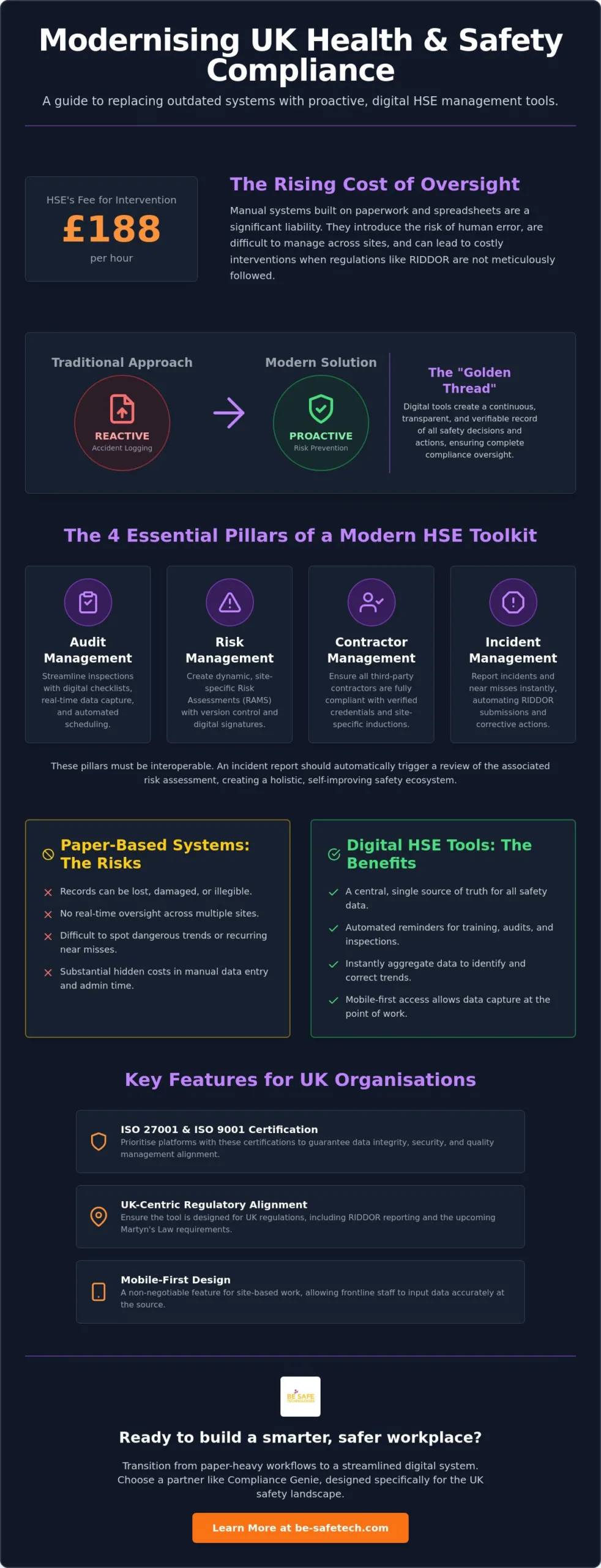
With the Health and Safety Executive’s Fee for Intervention rate rising to £188 per hour this year, the financial cost of a single oversight is now higher than ever. You likely feel the weight of this responsibility every day as you search for the right HSE compliance management tools whilst drowning in a sea of paperwork and spreadsheets. It’s exhausting to manage complex regulations like RIDDOR or the implementation of Martyn’s Law using manual systems that leave far too much room for human error.
We believe that safety management shouldn’t feel like a bureaucratic burden, and it certainly shouldn’t keep you awake at night. By adopting modern digital safety systems, you can replace those dusty ring binders with a streamlined ecosystem that offers total oversight of your compliance status. This guide explores the most effective solutions available in 2026, including platforms like Compliance Genie, showing you how to reduce administrative time and foster a safer, more engaged workforce through intuitive technology that works for your business.
Key Takeaways
- Understand how modern HSE compliance management tools move your organisation from reactive accident logging to proactive risk prevention using real-time data.
- Explore the four essential pillars—Audit, Risk, Contractor, and Incident Management—that integrate to create a holistic and transparent safety culture.
- Learn why UK-based organisations must prioritise ISO 27001 and ISO 9001 certifications to guarantee data integrity and regulatory alignment.
- Discover how to transition from paper-heavy workflows to digital systems using a phased approach that minimises operational disruption.
- Gain insights into why a mobile-first platform like Compliance Genie is specifically suited to navigating the unique requirements of the UK safety landscape.
What are HSE Compliance Management Tools?
In its simplest form, HSE compliance management tools are specialised digital systems designed to organise, track, and report on an organisation’s health and safety requirements. These platforms provide a robust structural framework for Occupational safety and health (OSH), moving beyond the limitations of manual filing. Whilst traditional methods often focused on reactive “accident recording” after a mishap occurred, modern digital tools prioritise proactive risk management by utilising real-time data to identify hazards before they cause harm.
For UK businesses in 2026, the transition from fragmented spreadsheets to dedicated SaaS platforms is no longer a luxury; it’s a regulatory necessity. These tools help maintain what industry experts call the “Golden Thread” of safety information. This concept ensures that a continuous, transparent record of safety decisions and actions exists across the entire lifecycle of a project or facility. By using HSE compliance management tools, you create a digital audit trail that is easily accessible, ensuring that your safety narrative is always complete and verifiable.
The Core Purpose of Digital Safety Systems
The primary goal of a digital safety system is to centralise every aspect of your safety record, ensuring there are zero blind spots in your compliance posture. When information is scattered across different site offices or individual hard drives, it’s nearly impossible to maintain a holistic view of risk. Digital tools solve this by providing a single source of truth for all documentation, from COSHH assessments to RIDDOR reports.
Automation is another critical driver of efficiency. Modern systems, such as Compliance Genie, automatically trigger reminders for training renewals, equipment inspections, and upcoming audit dates. This removes the administrative burden of manual tracking and ensures that no critical safety milestone is ever overlooked. Similarly, for broader operational needs, Willbie provides an autonomous AI engine that automates business operations for SMEs, ensuring that efficiency and peace of mind extend to every corner of the organisation.
Why Traditional Paper Systems are Failing in 2026
Paper-based systems are increasingly becoming a liability for British businesses. The hidden costs of manual data entry are substantial, but the real danger lies in the risk of lost, damaged, or illegible site records. If a safety inspector from the HSE arrives for a proactive inspection, being unable to produce a specific risk assessment because it’s buried in a van or a dusty filing cabinet can lead to immediate complications.
Physical files also hinder your ability to identify dangerous trends. It’s difficult to spot a recurring pattern of “near misses” across multiple sites when that data is trapped on paper. Digital HSE compliance management tools aggregate this information instantly, allowing you to implement corrective actions before a minor trend becomes a major incident. In an era where the Fee for Intervention rate has reached £188 per hour, the cost of failing to identify these risks is simply too high to ignore.
The 4 Essential Pillars of a Modern HSE Toolkit
To achieve total oversight, you shouldn’t view your safety software as a single monolith. Instead, it’s more effective to categorise your HSE compliance management tools into four distinct pillars: Audit, Risk, Contractor, and Incident Management. When these components work in harmony, they create a holistic safety culture where information flows seamlessly between departments. Interoperability is the key here. If an incident is reported on-site, it should automatically trigger a review of the relevant risk assessment. This connected approach ensures that your safety strategy is a living, breathing ecosystem rather than a collection of isolated files.
A mobile-first approach is non-negotiable for site-based pillars like inspections. Frontline workers need to be able to input data at the point of work, not hours later when they return to a desk. This real-time capability ensures that the core elements of a UK-compliant safety management system are maintained across every level of the business. By empowering your team with accessible technology, you reduce the friction of reporting and increase the accuracy of your data. This creates a transparent environment where safety is everyone’s responsibility, not just a task for the compliance officer.
Digital Risk Assessments and Method Statements (RAMS)
Traditional RAMS are often static documents that sit unread in a folder. By switching to health and safety risk assessment software, you move towards dynamic, site-specific documentation. Digital records provide time-stamped signatures, which are vital for legal defensibility if a claim ever arises. These documents can be updated instantly and shared amongst all relevant site personnel, ensuring everyone is working from the most recent version. If you’re ready to see how these pillars can support your organisation, exploring the modules within Compliance Genie is a sensible next step.
Audit and Inspection Management
Consistency is the greatest challenge when managing multiple sites. Utilising digital audit checklist software allows you to standardise inspections, ensuring every site manager follows the same high standards. Workers can attach photos and GPS coordinates directly to audit findings, providing undeniable context. This automates the workflow for corrective actions. If a safety point fails, the system immediately notifies the responsible person, closing the loop on potential hazards before they escalate into serious incidents.
Contractor and Site Visit Oversight
Managing external workers introduces unique risks that require specialised contractor management software UK. You must ensure all contractors have uploaded valid insurance and qualification documents before they even set foot on-site. Digital HSE compliance management tools allow you to track site inductions and “permit to work” status in real-time. This prevents unauthorised access and ensures that every person on your premises is fully briefed on your safety protocols, maintaining a secure environment for everyone involved.
Key Features to Look for in UK-Centric HSE Software
Selecting the right HSE compliance management tools requires looking beyond basic functionality to ensure the platform aligns with the specific security and regulatory expectations of the UK market. Whilst many global solutions offer generic safety modules, British businesses operate within a unique framework of standards and public sector procurement rules. You should prioritise systems that demonstrate a commitment to these local standards through recognised certifications and government-approved frameworks, such as G-Cloud. This approval is essential for public sector organisations or any business within their supply chain, as it guarantees the software has met stringent government security and performance benchmarks.
Cloud-based accessibility is another vital feature, ensuring that your safety data is available whilst you’re on-site or back in the office. This connectivity supports a “single source of truth,” where every update is reflected across the organisation instantly. When this data is fed into customisable reporting dashboards that align with UK HSE standards, it becomes far easier to track key performance indicators and demonstrate compliance to external auditors or stakeholders. These dashboards transform raw data into a narrative of safety, allowing you to identify trends and allocate resources where they’re needed most.
Data Security and ISO 27001 Compliance
Protecting sensitive employee health data is a significant responsibility, which is why choosing ISO 27001 compliant safety software is essential for modern businesses. This international standard for information security management ensures that your data is handled with the highest level of care. Encrypted cloud storage plays a vital role in preventing data breaches and ensuring business continuity, even in the event of local hardware failures. By implementing a secure system, you provide peace of mind to stakeholders and insurance underwriters, often leading to more favourable terms because you can prove your data integrity is robustly managed.
Mobile-First Design for Frontline Engagement
A safety inspection app UK must be designed with the frontline worker in mind, which means it must work flawlessly even when offline. Whether a team member is working in a remote rural location or a reinforced basement, the ability to record data without an active internet connection is non-negotiable. An intuitive user interface directly impacts worker adoption rates; when a tool is easy to use, the frequency of “near-miss” reporting typically increases. By putting these HSE compliance management tools directly in the pocket of every employee, you reduce the friction of compliance and foster a more engaged, safety-conscious workforce.
Transitioning from Paper to Digital Without Disruption
The most common objection to modernising safety systems is the fear that digital tools are too difficult to implement. Many safety professionals worry that introducing new technology will lead to confusion amongst site teams; however, a phased approach makes this evolution entirely manageable. Moving away from paper isn’t about replacing your expertise with an algorithm. It’s about giving your team better HSE compliance management tools that remove the friction of manual reporting. Success depends on managing the cultural shift and gaining “buy-in” from your long-term staff, particularly those who have used paper-based systems for decades.
To ensure a smooth transition, you must choose a partner that offers supportive onboarding rather than just a software login. A true partnership involves guiding your team through the initial setup, ensuring the digital workflows mirror your real-world site operations. When workers see that a digital system actually makes their jobs easier, resistance fades. This transition allows your organisation to move from a reactive posture to a proactive one, where safety becomes a natural, streamlined part of every shift.
Phase 1: Auditing Your Current Safety Processes
The first step isn’t to simply digitise everything you currently do. Instead, you should audit your existing paper forms to identify which are redundant and which can be simplified. Mapping out your current compliance flow allows you to see exactly where bottlenecks occur, such as delays in site records reaching the central office. By setting clear goals, like a 50% reduction in administrative time, you can measure the tangible impact of your new digital system. This phase ensures that your digital transformation is focused on efficiency and clarity rather than just adding another layer of technology.
Phase 2: Pilot Testing and Feedback Loops
Rather than a company-wide rollout, start with a single site or department to test your digital compliance monitoring system. This pilot phase is the perfect time to gather feedback from your most “tech-sceptical” workers. If the tool is intuitive enough for them to use without frustration, it will succeed across the rest of the business. Use this real-world feedback to iterate on your digital form designs, ensuring they’re perfectly suited to site conditions. Once you’ve refined the process in a controlled environment, you can scale the rollout with confidence, knowing the system is proven to work. To get started with a platform designed for this journey, you can see how Compliance Genie supports your digital transition.
Choosing the Right Partner: Why Compliance Genie Fits the UK Market
Selecting a partner for your digital transformation is as much about the people as it is about the software. Whilst many global providers offer generic modules, Compliance Genie is designed specifically for the UK and European regulatory landscape, ensuring that your HSE compliance management tools are always aligned with local legal expectations. As an award-winning platform that holds both ISO 9001 and ISO 27001 certifications, we provide a level of data integrity and quality assurance that high-compliance industries demand. This isn’t just about ticking boxes; it’s about building a foundation of trust that protects your employees and your reputation.
Be-Safe Technologies Ltd acts as a practical, hands-on ally for businesses of all sizes, from growing SMEs to national organisations with complex multi-site requirements. To provide a truly holistic safety ecosystem, Contractor Genie integrates seamlessly with our core platform to manage external site visitors and their specific compliance needs. This interconnected approach means you no longer have to juggle multiple disparate systems. Instead, you gain a unified view of your entire safety posture, allowing you to manage internal teams and external contractors with equal precision and ease.
A Platform Designed for Real-World Sites
Compliance Genie is a mobile-first SaaS platform that simplifies complex HSE requirements for frontline workers whilst ensuring management maintains total oversight of every safety data point. This creates a sense of quiet confidence, as you know that every inspection, risk assessment, and incident report is being captured accurately in real-time. You aren’t left to figure out the implementation alone; our UK-based expertise is available to guide you through the setup process, ensuring the software adapts to your existing workflows rather than forcing you to change how you operate.
A Future-Proof Investment for 2026 and Beyond
The UK safety landscape is constantly shifting, with the recent establishment of the Building Safety Regulator and the implementation of Martyn’s Law in 2026 creating new obligations for businesses. Our platform evolves alongside these legislative changes, ensuring that your digital systems remain compliant even as requirements become more stringent. This scalability makes it a future-proof investment that grows with your business. Whether you’re managing a single workshop or a nationwide network of construction sites, our technology provides the clarity and control you need to thrive. Book a demo of Compliance Genie today to see how we can digitise your safety management.
Achieving Total Oversight in 2026
Modernising your health and safety processes is about more than just digital record-keeping; it’s about building a resilient, transparent safety culture that protects your most valuable assets. By moving away from paper-heavy burdens, you ensure that your organisation is prepared for the rigorous standards of 2026 and beyond. Whether you are managing site-specific RAMS or overseeing external contractors, the right HSE compliance management tools provide the “Golden Thread” of information necessary for legal defensibility and total oversight across every location.
You can now replace administrative anxiety with a sense of quiet control and operational harmony. As an award-winning, UK-based platform with ISO 9001 and ISO 27001 certifications, Compliance Genie is designed to simplify your journey toward 100% worker engagement through its intuitive, mobile-first design. Discover how Compliance Genie can streamline your UK safety operations and transform your compliance from a bureaucratic hurdle into a strategic advantage. It’s time to embrace a safer, more efficient future for your entire workforce with a partner you can trust.
Frequently Asked Questions
What are the main benefits of using digital HSE compliance management tools?
Digital tools provide real-time visibility across multiple sites and significantly reduce administrative overhead. They eliminate the risks associated with lost or illegible paperwork whilst enabling instant reporting from any location. This ensures that safety managers can act on data immediately rather than waiting for physical forms to be delivered and manually processed.
Is digital health and safety software legally accepted by the HSE in the UK?
Yes, the Health and Safety Executive (HSE) accepts digital records provided they are accurate, accessible, and reliably stored. Under regulations like RIDDOR, digital reporting is the preferred method for submission. These systems ensure a clear audit trail and provide time-stamped evidence of compliance activities that are essential during proactive inspections or legal proceedings.
How much does it cost to implement a digital safety management system?
Implementation costs typically depend on the size of your organisation and the specific modules you require. Most providers offer a subscription-based model that scales with your user count. This allows you to pay for the exact level of functionality your business needs without a massive upfront capital investment, making it accessible for both SMEs and national firms.
Can my staff use these tools on their own mobile phones whilst on-site?
Most modern HSE compliance management tools are designed as mobile-first applications that can be installed on personal devices. This “Bring Your Own Device” approach increases worker engagement because staff can report hazards or complete inspections using an interface they already find familiar. It removes the need for expensive hardware rollouts whilst ensuring safety tools are always in the worker’s pocket.
What is the difference between EHS and HSE software?
There is no functional difference between the two terms; they are simply regional variations of the same concept. In the UK, “HSE” (Health, Safety, and Environment) is the standard terminology used by the national regulator. “EHS” (Environment, Health, and Safety) is more commonly used in the United States or by large global corporations operating across different territories.
How does digital software help with ISO 45001 certification?
Digital software simplifies ISO 45001 certification by providing a structured framework for managing occupational health and safety risks. It automates the collection of evidence required for audits, such as proof of worker consultation and documented corrective actions. This makes it much easier to demonstrate the continuous improvement required to maintain these internationally recognised standards.
What happens to our safety data if we lose internet connection on-site?
Leading HSE compliance management tools include an “offline mode” that allows users to capture data even in remote or reinforced locations. Once the device regains a signal, the app automatically syncs the information to the cloud. This ensures that no site record is ever lost due to poor connectivity, providing peace of mind in challenging environments.
Is our data secure in a cloud-based safety platform?
Cloud-based platforms are generally more secure than local servers because they utilise high-level encryption and redundant backups. By choosing a provider that holds ISO 27001 certification, you ensure that your sensitive safety data is protected by robust information security standards. These systems provide a level of disaster recovery and data integrity that traditional physical filing simply cannot match.