



Hazard vs Risk: The Definitive Guide for UK Workplace Safety in 2026

What if the biggest threat to your team isn’t the physical hazard itself, but the way your organisation defines it? In 2026, with HSE Fee for Intervention rates standing at £188 per hour, a simple misunderstanding of hazard vs risk can become a costly administrative headache. You’ve likely seen these terms used interchangeably on site; however, this linguistic slip is often the root cause of poor risk assessments and preventable incidents. It’s a frustrating hurdle that makes it difficult to maintain a consistent safety culture amongst a diverse workforce.
We believe that safety management should be a source of peace of mind, not a bureaucratic burden. This guide provides the clarity you need to master these fundamental concepts and build a more compliant, resilient business. You’ll gain access to legally-sound definitions, a practical framework for calculating risk, and modern strategies to move beyond static paperwork. By the end of this article, you’ll have the tools to communicate safety with total confidence and streamlined efficiency.
Key Takeaways
- Master the fundamental distinction of hazard vs risk to ensure your safety assessments are accurate, legally sound, and easy for your workforce to understand.
- Learn to categorise common workplace hazards into physical, chemical, and biological groups to ensure no threat to your team’s wellbeing is overlooked.
- Implement the 5×5 Risk Matrix as a standard tool to quantify the likelihood and severity of incidents with professional precision and quiet confidence.
- Follow the HSE’s Five Steps to Risk Assessment to maintain full compliance with the Management of Health and Safety at Work Regulations 1999.
- Transition from static paper logs to mobile-first digital oversight to achieve real-time hazard reporting and improved operational harmony across your organisation.
Defining Hazard and Risk: The Fundamental Distinction
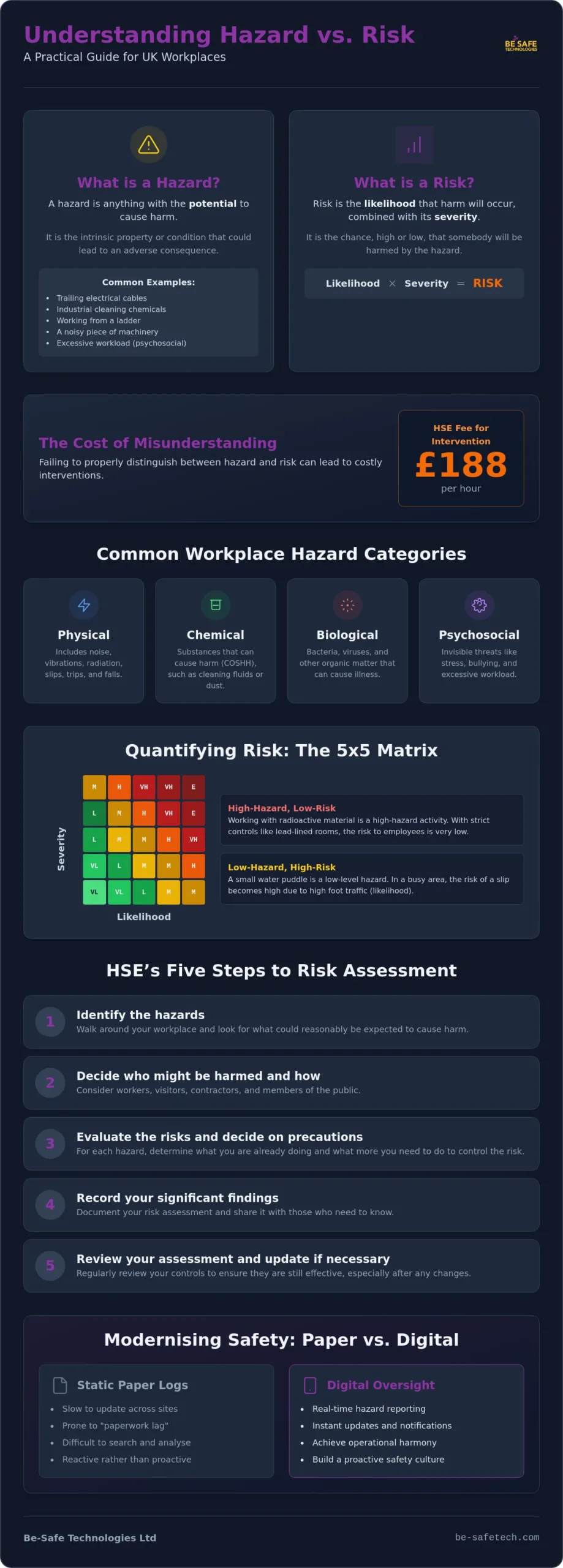
Establishing a clear understanding of the fundamental distinction between hazard and risk is the cornerstone of any robust safety strategy. In a professional UK context, a hazard is defined as anything with the potential to cause harm, such as chemicals, electricity, or working from ladders. Risk, on the other hand, is the likelihood that a person will be harmed by that hazard, combined with the severity of the potential injury. When organisations fail to distinguish between the two, they often develop safety policies that are either overly restrictive or dangerously inadequate, leading to wasted resources and a frustrated workforce.
Think of the classic British safety analogy involving the sea. The North Sea is a permanent hazard because it’s deep, cold, and capable of causing drowning. However, the risk only exists if someone decides to go swimming or work on a cliff edge. If your team remains safely on the beach, the hazard is still there, but the risk is effectively zero. Mastering the hazard vs risk relationship allows you to focus your energy on where the actual danger lies, rather than trying to eliminate every potential source of harm in the building.
The Anatomy of a Hazard
Hazards are often inherent to a task or environment; they don’t simply vanish when you clock off. They are the “potential” waiting to happen. For a diverse UK workforce, hazards might include a stack of heavy boxes in a warehouse, a noisy generator, or even a stressful workload that impacts mental health. These elements are dormant until human interaction occurs. Recognising that a hazard exists independently of your current activity is vital for long-term planning and ensuring that your safety measures aren’t just reactive but truly preventative.
The Components of Risk
Risk is a dynamic value that fluctuates based on the environment and the controls you’ve put in place. It’s typically broken down into two core elements: likelihood and severity. Likelihood asks how often an incident is expected to happen, whilst severity measures the impact of that incident on a person’s health or safety.
- High-Hazard/Low-Risk: Working with radioactive materials is high-hazard, but with lead-lined rooms and strict protocols, the risk to the employee is kept very low.
- Low-Hazard/High-Risk: A small puddle of water on a busy canteen floor is a low-level hazard, but because hundreds of people walk through that area, the risk of a slip is exceptionally high.
By understanding that risk is manageable and changeable, you can move away from a “box-ticking” exercise and toward a proactive safety culture. Modern digital tools can help track these changes in real-time, ensuring that your assessments always reflect the current reality of your site.
Identifying Common Workplace Hazards in the UK
To build a safer environment, you must first recognise the different variables at play. As the saying goes: “A hazard is the potential for harm; risk is the price of exposure without protection.” In the UK, this exposure often changes with the seasons. Wet weather and icy walkways are constant environmental hazards that require dynamic oversight. Understanding the hazard vs risk relationship starts with accurate identification across four primary categories: physical, chemical, biological, and ergonomic.
Capturing these diverse threats on a static sheet of paper is often where the safety system fails. When you digitise paper risk assessments, you ensure that every category is logged and updated instantly. This removes the “paperwork lag” that often leads to avoidable accidents. Digital oversight allows your team to report a broken floor tile or a leaking pipe the moment they see it, rather than waiting for the next scheduled audit.
Physical and Chemical Hazards (COSHH)
Under the Control of Substances Hazardous to Health (COSHH) regulations, British businesses must identify everything from industrial cleaning fluids to wood dust. Physical hazards like machinery noise or trailing cables in high-traffic areas require constant monitoring because the environment is never static. A site that was safe at 08:00 might be hazardous by midday due to simple operational changes or a delivery of new materials. Staying compliant requires a system that tracks these moving parts with professional assurance.
The Rise of Psychosocial Hazards
In 2026, the HSE has placed a much greater emphasis on psychosocial hazards. These are the “invisible” threats such as excessive workload, workplace bullying, and chronic fatigue. HSE data for 2025/26 reveals that 875,000 workers in the UK suffered from work-related stress, depression, or anxiety. Unlike a physical trip hazard, you cannot see stress, but its impact on your organisation is just as severe. Assessing the risk level of mental health factors is a unique challenge because it relies on open communication and honest reporting from a diverse workforce.
Managing these complexities requires a tool that adapts to your needs rather than forcing you to adapt to a rigid process. Using a modern platform like Compliance Genie helps you identify these invisible hazards and manage them with quiet confidence before they escalate into a crisis.
Quantifying Risk: The Likelihood vs Severity Matrix
Assigning a numerical value to your safety observations transforms a list of concerns into a manageable action plan. The 5×5 Risk Matrix serves as the gold standard for British safety professionals, providing a structured way to evaluate the hazard vs risk relationship. By plotting the likelihood of an event against its potential severity on a scale of 1 to 5, you create a risk score that informs your priorities. This methodical approach replaces guesswork with professional assurance, ensuring that your resources are directed where they’re needed most.
Underpinned by the principle of ALARP (As Low As Reasonably Practicable), this quantification process is about achieving a sensible balance. It requires you to reduce risk until the cost of further measures, in terms of time and effort, is grossly disproportionate to the benefit gained. Documenting these scores isn’t just a best practice; it’s a legal requirement. Clear records provide essential evidence for HSE inspectors, proving that your organisation has taken a proactive and reasoned approach to workplace protection.
Determining Likelihood and Severity
Likelihood is influenced by the frequency of a task, the environment, and the training levels of your workforce. Severity, conversely, focuses on the nature of the potential injury and the number of people affected. Consider a forklift operating in a busy warehouse with a diverse workforce of 50 people. The likelihood of an interaction is high (4 or 5). If that same forklift operates in a quiet, restricted yard once a week, the likelihood drops significantly (1 or 2), even though the inherent hazard of the heavy machinery remains identical.
Using a Risk Matrix to Prioritise Action
Once you’ve calculated your scores, the Red, Amber, Green (RAG) system helps you categorise your response. Red scores demand immediate cessation of work or urgent intervention, whilst Green scores suggest the risk is well-managed. This system is particularly useful for handling “High Severity / Low Likelihood” events such as a major fire. Whilst the likelihood is low, the severity is catastrophic, so the matrix ensures that robust emergency plans remain a priority.
Managing these shifting scores across multiple sites can be a complex task. Utilising health and safety risk assessment software allows you to track these calculations in real-time. This digital oversight ensures that your risk profile is always current, providing the peace of mind that comes from total operational control.
The UK Regulatory Framework: HSE and the Five Steps
Compliance in the British workplace is built upon the foundation of the Health and Safety at Work etc. Act 1974 and the Management of Health and Safety at Work Regulations 1999. These laws establish a clear “Duty of Care” that you owe to every member of your workforce, regardless of their role or background. To meet this legal obligation, the Health and Safety Executive (HSE) requires that your risk assessments are “suitable and sufficient”. This means they must accurately reflect the hazard vs risk dynamic present on your specific site, rather than relying on generic templates that lack operational detail.
Following the hse five steps to risk assessment provides a structured compliance path that the HSE recognises as the industry standard. With the HSE Fee for Intervention (FFI) rate rising to £188 per hour in April 2026, the financial cost of a flawed safety framework is higher than ever. Adopting a methodical approach ensures that you aren’t just ticking a box; you’re building a culture of reliability and peace of mind. You can begin digitising your safety framework today to ensure your records are always ready for inspection.
Step 1 & 2: Identify Hazards and Who Might Be Harmed
Effective hazard spotting requires more than just a cursory glance at the warehouse floor. It involves site walks, staff interviews, and thorough record reviews. It’s vital to identify vulnerable groups amongst your team, such as young workers, new mothers, or visiting contractors who may be unfamiliar with your specific site layout. Encouraging diverse representation in your safety committees often leads to better hazard identification. A multicultural workforce brings varied perspectives that can highlight risks that a less diverse group might overlook, such as language barriers in safety signage or specific ergonomic challenges.
The Hierarchy of Controls
When you’ve identified a risk, British law requires you to apply the Hierarchy of Controls in a specific order. You must first attempt to eliminate the hazard entirely. If that isn’t possible, you move through substitution, engineering controls, and administrative changes; for example, you can find out more about Fall Protection Training and Safety Engineering to ensure your technical controls are robust. Personal Protective Equipment (PPE) is always the last resort because it only protects the individual and does not remove the hazard itself. Recording these decisions in a digital audit trail provides a transparent history of your safety choices, proving to stakeholders and regulators that you’ve prioritised the most effective measures first.
Modernising Safety: From Static Definitions to Digital Oversight
Transitioning from understanding the theory of hazard vs risk to implementing a daily safety strategy is where many UK businesses encounter friction. Traditional paper-based hazard logs are inherently static; they capture a single moment in time that may be irrelevant by the next shift. In a fast-moving 2026 environment, relying on a physical folder in a site office creates a “data silo” that prevents real-time intervention. Modernising your approach requires moving toward digital oversight, where information flows instantly from the shop floor to the management dashboard.
Mobile-first software like Compliance Genie transforms safety from a periodic chore into a continuous, streamlined process. This technology allows for immediate reporting, ensuring that an identified hazard doesn’t sit on a clipboard for days before it’s addressed. For complex sites with high-stakes requirements, utilising digital fire risk assessment tools ensures that even the most technical compliance needs are managed with total control and clarity. The journey from a simple definition to a robust organisational strategy is completed when your tools match the speed of your operations.
Real-Time Hazard Reporting
Capturing a “near-miss” is often the most effective way to prevent a future accident. When every employee has the power to report a hazard via their smartphone, you build a proactive safety culture that spans your entire diverse workforce. Modern apps enhance this process by allowing users to attach photo evidence and GPS tags to their reports. This level of detail removes ambiguity; it provides managers with the exact context needed to evaluate the risk level and deploy the correct controls. It shifts the responsibility of safety from a single manager to a collective, empowered team.
Achieving Total Oversight with Compliance Genie
Digital dashboards take individual data points and turn them into organisational intelligence. Instead of looking at a stack of forms, you can view a real-time heatmap of risks across multiple UK sites. This bird’s-eye view allows you to spot trends, such as a recurring ergonomic issue in a specific department, before it leads to a RIDDOR-reportable incident. It creates a logical flow of cause and effect that makes safety management feel like a manageable part of business operations rather than a bureaucratic burden.
Security is equally vital when handling sensitive safety records. Compliance Genie offers ISO 27001 secure data storage, providing the peace of mind that your compliance history is protected against loss or unauthorised access. By moving beyond static definitions and embracing digital tools, you ensure that your organisation remains not only compliant but truly resilient. Explore how Compliance Genie can organise your safety processes today and turn your safety obligations into a modern operational advantage.
Transforming Your Safety Culture Through Digital Precision
Mastering the fundamental hazard vs risk relationship is more than a regulatory requirement; it’s the foundation of a resilient, forward-thinking organisation. By applying the 5×5 matrix and following the HSE’s Five Steps, you move from reactive hazard spotting to proactive risk management. This transition ensures your safety policies are suitable, sufficient, and capable of protecting every member of your diverse workforce. It replaces the stress of potential non-compliance with the quiet confidence of total operational oversight.
As an award-winning, mobile-first EHS platform, Be-Safe Technologies Ltd is trusted by organisations across the UK and Europe to modernise their safety processes. Our software is ISO 9001 and 27001 certified, ensuring your data remains secure whilst your team stays protected. Moving your risk assessments into a digital ecosystem eliminates the paperwork lag and provides real-time intelligence for your management team. Discover how Compliance Genie simplifies risk management for your business and take the final step toward a safer, more efficient workplace. You have the tools to build a better safety future today.
Frequently Asked Questions
What is the simplest way to remember the difference between hazard and risk?
The simplest way to distinguish them is by looking at “potential” versus “probability”. A hazard is the source of potential harm, whilst risk is the likelihood of that harm actually occurring. If you think of a sharp knife as the hazard, the risk only arises when someone begins to use it without proper training or safety equipment.
Can a hazard exist without a risk being present?
A hazard can certainly exist without an active risk if there is no exposure. For instance, a hazardous chemical stored in a sealed, inaccessible container remains a hazard because of its inherent properties, but it poses no risk until someone interacts with it. Safety management focuses on controlling these interactions to keep risk levels as low as possible.
How often should I review the hazards and risks in my UK workplace?
There is no fixed legal timeframe, but you must review your assessments if they are no longer valid or if significant changes occur. This includes introducing new equipment, changing work patterns, or following an accident. Many UK organisations conduct annual reviews to maintain a high safety standard and ensure total operational oversight of their site.
What are the four main types of hazards I should look for?
British safety standards typically categorise hazards into physical, chemical, biological, and ergonomic groups. Physical hazards include slips and falls, whilst chemical hazards involve substances covered by COSHH. Biological hazards relate to bacteria or viruses, and ergonomic hazards involve repetitive movements or poor posture. Identifying these categories ensures a comprehensive approach to workplace protection for every employee.
Does a risk assessment need to be written down for small businesses?
Legal requirements state that businesses with five or more employees must record their risk assessment findings in writing. Whilst smaller firms aren’t strictly required to do so, keeping a record is highly recommended. It serves as vital evidence of your commitment to safety and helps communicate essential control measures to your team with professional assurance.
How does digital software help in differentiating between hazard and risk?
Digital tools provide a structured framework that guides users through the hazard vs risk calculation process with quiet confidence. By using mandatory fields for likelihood and severity, software like Compliance Genie prevents employees from skipping vital steps. This results in more accurate data and a clearer understanding of safety priorities across your entire organisation.
What is the role of the HSE in managing workplace hazards?
The HSE is the government body responsible for encouraging, regulating, and enforcing workplace health and safety in the UK. They set the standards that businesses must follow and provide the Five Steps framework for assessments. Their role includes inspecting sites and recovering costs through the Fee for Intervention scheme, which stands at £188 per hour in 2026.
Can a risk ever be completely eliminated?
Risk can only be completely eliminated by removing the hazard itself, which is the most effective control measure in the hierarchy. For example, replacing a hazardous solvent with a non-toxic alternative removes the chemical risk entirely. If the hazard remains, your goal is to reduce the risk to a level that is as low as reasonably practicable.