


The Essential Guide to Choosing a Digital Fire Risk Assessment Tool in 2026

If a Fire and Rescue Service inspector walked through your doors today, could you produce a complete, written audit trail in under sixty seconds? For many UK businesses, the reality involves a frantic search through disparate filing cabinets and inconsistent spreadsheets across various departments. You likely recognise the stress of managing fire safety whilst worrying about the latest 2026 amendments to Approved Document B or the new PEEP requirements. Relying on a manual process often feels like a gamble with your compliance. Adopting a dedicated digital fire risk assessment tool is no longer just a modern convenience; it’s a fundamental requirement for maintaining the “Golden Thread” of safety information that the Building Safety Regulator now demands.
This guide helps you move away from the chaos of paper-based systems towards a more structured and reliable way of working. By choosing the right software, you can secure a centralised repository for all fire safety data and ensure that automated reminders keep your remedial actions on track. We’ll explore the essential features you need to remain compliant with the Building Safety Act 2022, whilst showing you how to generate professional, standardised reports instantly. From understanding the impact of Martyn’s Law to evaluating technical specifications, this article provides the clarity you need to achieve total operational oversight and genuine peace of mind.
Key Takeaways
- Understand why the shift towards a digital fire risk assessment tool is essential for maintaining the “Golden Thread” of safety information required by 2026 UK regulations.
- Identify the essential features of a modern system, including PAS 79:2020 standardisation and mobile-first design for real-time reporting on the shop floor.
- Learn how to automate your compliance workflow using dynamic action tracking and high-resolution photo evidence for every remedial task.
- Discover a practical framework for auditing your current fire safety data and transitioning smoothly to custom digital templates that reflect your specific site risks.
- Explore how integrating fire safety into a broader oversight platform like Compliance Genie ensures total operational harmony across your entire business.
The UK Fire Safety Landscape: Why Digital Tools are Replacing Paper
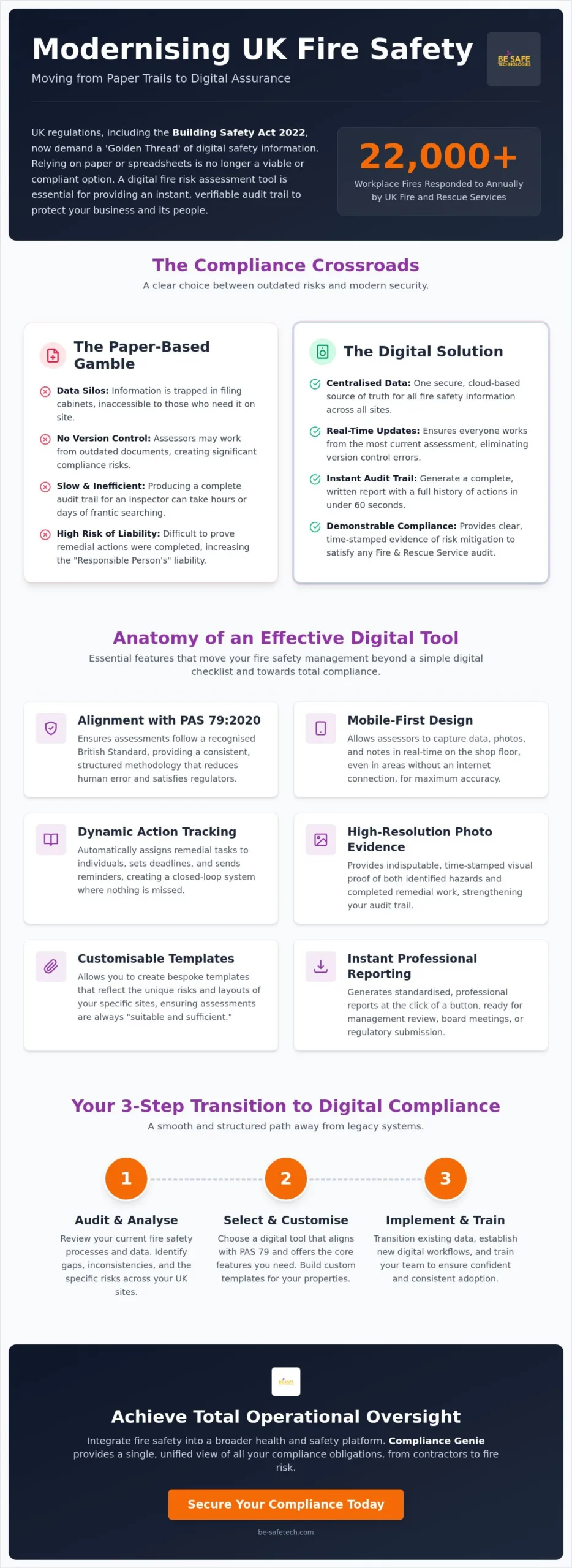
In 2026, managing fire safety is no longer about ticking a box on a dusty clipboard. A digital fire risk assessment tool acts as a cloud-based compliance engine, transforming safety from a reactive chore into a proactive business asset. Whilst the Regulatory Reform (Fire Safety) Order 2005 remains the bedrock of UK law, the expectations for data oversight have evolved. The Building Safety Regulator (BSR) now demands a higher level of transparency, making the “Golden Thread” of digital record-keeping a central requirement for modern premises management. This shift ensures that safety data isn’t just archived but is actively used to protect lives and property.
The Legal Burden of the Responsible Person
Every UK business has a designated “Responsible Person” who carries the weight of ensuring fire assessments are “suitable and sufficient”. This role involves significant personal and corporate liability. Under the Building Safety Act 2022, all businesses, regardless of their size, must record their full fire risk assessment in writing. If an incident occurs, you must be able to prove that you’ve identified risks and taken reasonable steps to mitigate them. Digital audit trails provide the necessary evidence to satisfy a Fire and Rescue Service audit, showing a clear history of inspections and completed remedial works. Without this digital breadcrumb trail, proving compliance during a formal investigation becomes a stressful and often impossible task.
The Problem with Paper and Spreadsheets in 2026
Relying on paper folders or isolated spreadsheets creates dangerous blind spots. Version control is a constant headache; it’s all too easy for an assessor to work from an outdated document whilst the latest version sits on a different hard drive. This lack of synchronisation is particularly risky for organisations managing multiple UK sites where consistency is vital. Physical folders often act as a barrier to a healthy safety culture because the information they contain is inaccessible to the people who need it most. When data is trapped on paper, it’s difficult to track whether fundamental fire safety principles are being upheld across the entire estate. Digital systems remove these barriers, ensuring that the most current safety data is always available to those responsible for site safety.
UK Fire and Rescue Services respond to more than 22,000 workplace fires each year. These statistics highlight the gravity of the situation. Moving to a digital system isn’t just about avoiding fines; it’s about creating a manageable, streamlined process that provides genuine peace of mind. By centralising your data, you eliminate the risk of lost paperwork and ensure that every remedial action is tracked to completion. It’s a move from hope-based compliance to a fact-based, secure environment that protects both your employees and your professional reputation.
Anatomy of an Effective Digital Fire Risk Assessment Tool
A high-quality digital fire risk assessment tool is more than just a digitised checklist. It serves as a comprehensive framework that guides the assessor through a logical sequence, ensuring no critical safety element is overlooked. This structured approach is vital for meeting your legal responsibilities for fire risk assessments, as it provides the depth required for a “suitable and sufficient” report. By automating the scoring of hazards, these tools help businesses prioritise remedial actions based on actual risk levels rather than guesswork. A clear understanding of hazard vs risk is fundamental to this process, ensuring that your team correctly identifies and evaluates each threat before assigning a priority. This ensures that resources are directed where they are needed most to protect life and property.
Alignment with British Standards (PAS 79)
Consistency is the primary benefit of using a tool aligned with the PAS 79:2020 framework. This British Standard provides a recognised methodology for conducting and recording fire risk assessments, ensuring that reports are uniform across different assessors and sites. Structured questions within the software reduce the likelihood of human error or omission. A versatile tool will adapt its questioning based on the premises type, whether you are inspecting a high-rise residential block or a small commercial unit. This level of adaptability ensures that the data collected is always relevant, proportionate, and legally robust.
User Experience: Designing for the Site Worker
Technology only works if people actually use it. An effective tool must prioritise an intuitive interface that feels familiar to site-based staff. Mobile-first design is essential, allowing workers to enter data directly from the shop floor or plant room using their own devices. Offline functionality is a non-negotiable feature for UK businesses with basements, thick-walled heritage buildings, or remote locations where Wi-Fi signals are unreliable. The ability to switch seamlessly between a tablet on-site and a desktop at head office ensures that stakeholders have instant access to live safety data without any manual data entry delays.
Real-time synchronisation allows head office to monitor compliance across the entire estate in one centralised view. When a high-risk hazard is identified on-site, the system can immediately flag it to senior management, enabling swift and documented intervention. Adopting a platform like Compliance Genie ensures that your fire safety methodology is integrated into a wider, reliable health and safety ecosystem. This holistic approach simplifies complex tasks and builds a stronger, more transparent safety culture amongst your workforce, moving away from fragmented spreadsheets and towards total operational harmony.
Core Features: Moving Beyond the Digital Checklist
A robust digital fire risk assessment tool does more than record observations; it acts as a dynamic safeguard for your organisation. In 2026, the technical infrastructure behind your safety data is as vital as the assessment itself. Choosing a platform that adheres to ISO 27001 standards ensures that sensitive building plans and risk profiles are protected by enterprise-grade security. This level of data integrity provides peace of mind to corporate stakeholders whilst satisfying the stringent requirements of the Building Safety Regulator. Guidance from the UK’s national fire safety organisation consistently highlights that accuracy and thoroughness are the fundamental pillars of workplace protection.
Evidence-Based Reporting and Photo Capture
Visual evidence is a powerful tool for clarity and accountability. High-resolution photo capture allows assessors to document the exact condition of fire doors, the placement of extinguishers, or the clarity of escape signage. By adding digital annotations directly onto these images, you provide maintenance teams with unmistakable instructions. This precision eliminates the guesswork often associated with vague written descriptions. Presenting a clear visual record of a safety breach often speeds up the approval of remedial budgets; senior management can see the physical risk rather than just reading a line on a spreadsheet. Time and date stamping these images creates an indisputable record of site conditions during each inspection.
Closing the Loop: Automated Action Management
The true value of a digital system lies in its ability to ensure that identified hazards are actually resolved. Dynamic action tracking allows you to assign tasks to specific team members or external contractors the moment a risk is identified. If a high-priority fire safety breach is recorded, escalation protocols can trigger immediate alerts to senior safety officers. This proactive approach prevents critical tasks from slipping through the cracks. It represents a significant shift from traditional methods where remedial actions are often buried in a static PDF report.
Maintaining a complete history of “actioned” items is essential for any future Fire and Rescue Service inspection. When an auditor asks for proof of maintenance, you can instantly generate a report showing when a fault was found, who was assigned to fix it, and the date it was resolved. Comprehensive dashboard analytics provide a national view of fire risk across your entire estate, allowing you to identify recurring issues at specific UK sites. This high-level oversight enables you to move from individual site management to a cohesive, data-led safety strategy that protects every employee and visitor.
Implementing a Digital Tool: A Transition Framework
Transitioning to a digital fire risk assessment tool requires a methodical approach to ensure operational continuity. It isn’t simply about replacing a physical folder with a screen; it’s about refining your safety processes for long-term reliability. Start by auditing your current fire safety data to identify gaps in your existing records. This initial review ensures that your new digital system is built on a foundation of accurate, up-to-date information rather than carrying over historical errors. Taking the time to map out your current workflows allows you to see exactly where the digital shift will provide the most immediate relief for your team.
Step 1: Data Centralisation and Template Customisation
The first practical hurdle is often the sheer volume of legacy information stored across different departments. You need a clear strategy to digitise paper risk assessments without losing the historical context of your buildings. Customising your digital templates is essential to ensure they reflect the specific risks of your industry. For instance, a retail environment’s fire safety priorities will differ significantly from those of a heavy manufacturing site or a high-rise residential block. By tailoring the checklists and ensuring the software uses your organisation’s existing safety terminology, you reduce confusion and make the system feel like a natural extension of your daily operations.
Step 2: Training and Cultural Adoption
Software is only as effective as the people using it. Successful implementation relies on high adoption rates amongst your site-based staff. Organising “train the trainer” sessions helps build internal expertise, creating a network of specialists who can support their colleagues during the national rollout. It’s vital to communicate the “why” behind the shift. Explain how the tool reduces their administrative burden and provides them with total control over site safety. When staff understand that the digital system is there to support their safety rather than just monitor their performance, they’re more likely to embrace a proactive fire safety culture.
Before a full national rollout, conduct a pilot phase at one or two representative sites. This allows you to gather feedback from end-users and make necessary adjustments to the templates or workflows based on real-world usage. Once the pilot is successful, you can roll out the system across all UK sites with clear training and ongoing support. This phased approach ensures that any minor issues are resolved before they impact the wider business. If you’re ready to modernise your approach and ensure your business is fully protected, you can book a demo of Compliance Genie to see how our framework supports your transition to a paperless environment.
Compliance Genie: Integrating Fire Safety into Total H&S Oversight
Compliance Genie acts as the final piece of the safety puzzle, bridging the gap between fire-specific protocols and your wider health and safety strategy. Managing fire safety in isolation often leads to fragmented data, where critical correlations between building maintenance and fire risk are missed. By embedding a digital fire risk assessment tool within a broader compliance platform, you ensure that every fire hazard is viewed in context with general workplace safety. This unified oversight provides Directors with real-time visibility through the Compliance Genie dashboard, ensuring that safety is always manageable and transparent. Because the system is built with a mobile-first philosophy, you can access these insights from the shop floor or the boardroom, keeping life safety in the palm of your hand.
A Holistic View of Risk
Managing fire safety in a silo is a significant risk to any business, as it prevents a cohesive understanding of site-wide hazards. Integrating your fire risk protocols with the HSE five steps to risk assessment ensures that your methodology remains consistent across all safety audits. This integration creates a single source of truth, where fire assessments are linked directly to contractor management software UK. When an external engineer arrives to service a fire alarm system, their credentials and work logs are instantly tied to the building’s digital record, fulfilling the core requirements of the Golden Thread. This prevents the dangerous disconnect that often occurs when fire safety is handled by a separate department.
Award-Winning UK Innovation
Be-Safe Technologies Ltd is a UK-based partner dedicated to professional assurance, holding both ISO 9001 and ISO 27001 certifications. These standards guarantee that your safety data is handled with the highest level of security and quality management, providing total peace of mind to corporate stakeholders. Our platform is designed to evolve alongside the latest safety management software trends, ensuring your business remains at the forefront of compliance. We understand the intricacies of UK regulation and prioritise an ease of use that empowers your staff to take ownership of safety. If you’re ready to achieve total operational harmony, organise a personalised demo of Compliance Genie today. We provide the tools you need to move from a bureaucratic burden to a state of total control.
Secure Your Compliance and Operational Harmony
Adopting a digital fire risk assessment tool is the final step in future-proofing your business against the complexities of modern safety standards. By centralising your data and automating remedial tasks, you move away from the uncertainty of paper-based systems and towards a culture of total transparency. This transition doesn’t just satisfy a legal requirement; it empowers your team to work with greater precision and confidence, ensuring that safety is an integrated part of your daily success rather than a separate administrative burden.
As an ISO 9001 and 27001 certified partner, Be-Safe Technologies Ltd provides the secure infrastructure and award-winning UK-based support that multi-site organisations across the country trust. Our platform bridges the gap between fire safety and general health and safety, giving you the oversight needed to protect both your people and your reputation. You can now manage every hazard and contractor visit with absolute clarity, knowing that your data is protected by industry-leading standards and a team that understands your regulatory needs.
Discover the power of Compliance Genie for your fire safety management and take the first step towards a more resilient, streamlined future. We are here to help you turn complex compliance into a manageable, everyday success.
Frequently Asked Questions
Is a digital fire risk assessment tool legally acceptable in the UK?
Yes, a digital fire risk assessment tool is fully legally acceptable and often preferred by regulators. Under the Building Safety Act 2022, all businesses must record their fire risk assessments in writing, and digital records provide the “Golden Thread” of information required for modern compliance. These systems ensure your data is structured, timestamped, and easily accessible, meeting the requirements of the Regulatory Reform (Fire Safety) Order 2005.
Does the software work offline if there is no Wi-Fi on site?
The software is designed to function perfectly without an active Wi-Fi or mobile data connection. Site workers can complete assessments in basements, thick-walled heritage buildings, or remote plant rooms, and the data is stored locally on the device. Once the user returns to an area with connectivity, the system automatically synchronises the information with the cloud, ensuring head office stakeholders have access to the latest safety data.
Can I customise the fire safety checklists for different types of buildings?
You can certainly customise your checklists to reflect the specific risks of different premises types. Whether you’re managing a high-rise residential block, a retail unit, or a complex manufacturing plant, the software allows you to tailor questions to suit the environment. This ensures that your assessments remain relevant and proportionate, avoiding the “one size fits all” pitfall of generic paper forms or static spreadsheets.
How does digital software help during a Fire and Rescue Service inspection?
Digital software provides an instant, professional audit trail that demonstrates your commitment to safety. During an inspection, you can immediately show the Fire and Rescue Service when each assessment was conducted and prove that remedial actions were completed on time. This level of transparency builds trust with inspectors and reduces the risk of non-compliance penalties caused by missing or incomplete paper records.
Can I assign remedial fire safety tasks to external contractors through the tool?
You can assign tasks directly to external contractors through the platform. By integrating with a system like Contractor Genie, you can send automated alerts for remedial works and track their progress in real-time. This ensures that fire safety faults are fixed quickly and that a digital record of the repair is automatically linked to the original risk assessment, providing a complete history of the “actioned” item.
Is our fire safety data secure in a cloud-based system?
Your data is highly secure when using a cloud-based system that meets ISO 27001 standards. This certification ensures that your building plans and safety records are protected by enterprise-grade encryption and rigorous security protocols. Cloud storage actually offers far better protection against loss, theft, or fire damage than traditional paper folders stored in a physical office or filing cabinet.
How long does it take to transition from paper to a digital fire risk assessment tool?
The transition time typically depends on the size of your organisation and the volume of legacy data. Most UK businesses can complete a pilot phase and a national rollout within a few weeks to a few months. A phased approach allows you to refine your custom templates and train your staff effectively, ensuring a smooth move away from paper without disrupting your daily operations.
Do I need a separate app for each type of health and safety risk assessment?
You don’t need separate apps for different safety tasks if you choose a holistic platform. Compliance Genie integrates fire safety, COSHH, and general risk assessments into a single ecosystem. This unified approach provides a “single source of truth” for all your health and safety data, making it easier for Directors to monitor compliance across the entire business from one centralised dashboard.