



How to Digitise Paper Risk Assessments: A Comprehensive Transition Guide
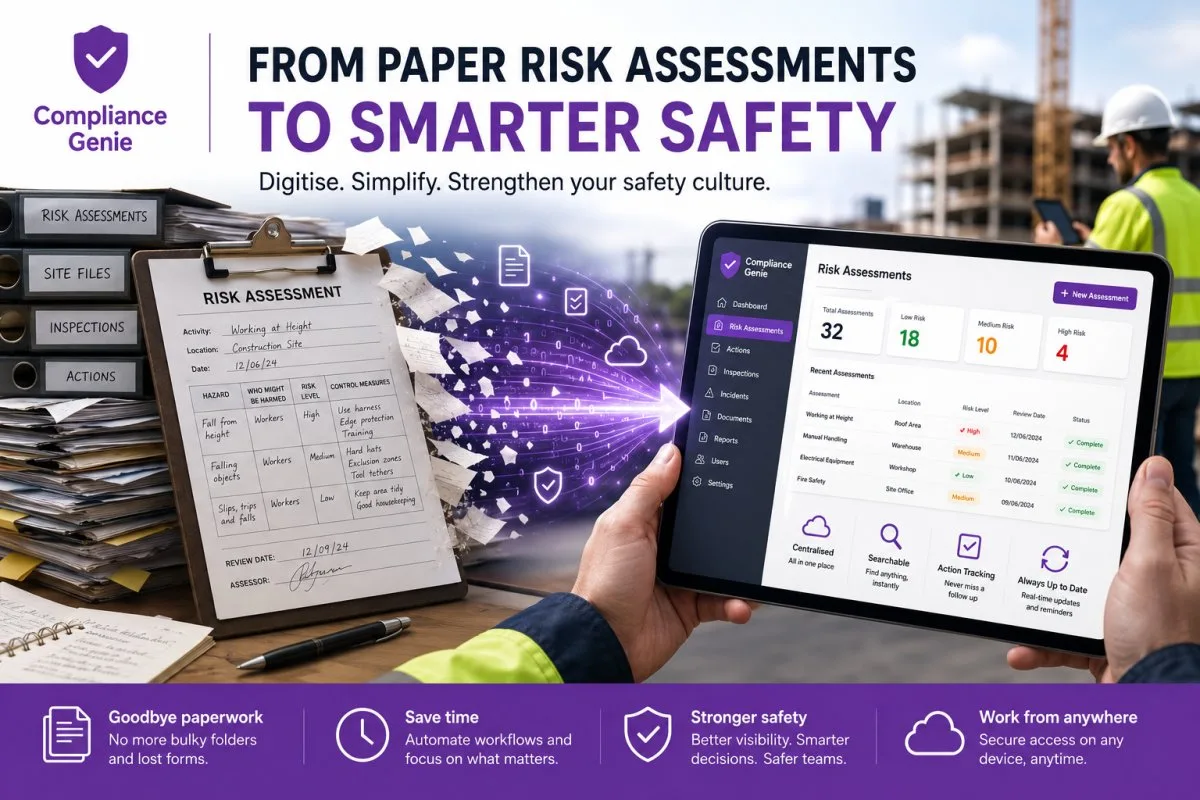
Over 60% of chief financial officers report that every £1 invested in injury prevention returns £2 or more in value, yet many organisations still rely on manual processes that drain productivity. It’s a common frustration to face illegible handwriting on weathered forms or significant time lags between a site observation and management oversight. You likely recognise that your current system is cumbersome, but the fear of disrupting live site operations often keeps the status quo in place. This guide explains how to digitise paper risk assessments to move your safety data from static sheets into a dynamic, real-time environment.
Transitioning to a digital approach doesn’t have to be a bureaucratic burden. By following a structured transition, you can achieve a centralised safety dashboard and a 50% reduction in reporting labour within the first year. We’ll show you how to build a reliable audit trail that satisfies HSE standards and provides total clarity across your entire organisation. You’ll learn the practical steps to modernise your workflow, ensuring your team stays protected whilst your administrative efficiency reaches new heights.
Key Takeaways
- Identify and eliminate the “data lag” in your current processes to ensure site hazards are visible to management in real time rather than days later.
- Follow a practical five-step roadmap to digitise paper risk assessments without causing operational downtime or confusion for your site teams.
- Distinguish between static PDF forms and true digital-first platforms that are designed for efficient use in remote locations or whilst wearing PPE.
- Learn how to optimise your existing safety templates for mobile devices to significantly reduce human error and improve the quality of your audit trails.
- Discover how G-Cloud approved software like Compliance Genie creates a centralised hub for maintaining rigorous and consistent HSE compliance.
The Hidden Cost of Paper: Why Manual Risk Assessments Fail in 2026
Paper-based systems act as a significant bottleneck in modern safety management. Whilst they may have served their purpose in the past, they now create a dangerous “data lag” that leaves management blind to site hazards for days at a time. A risk identified on a Monday morning might not be filed, transported, and reviewed until the end of the week. This delay means that the risk assessment process remains a reactive exercise rather than a proactive safety measure. When hazards go unaddressed because the paperwork is sitting in a site office tray, the risk to your workforce increases with every passing hour.
Physical documents are inherently fragile and unreliable. On high-intensity UK construction sites or exposed infrastructure projects, forms frequently become weathered, torn, or entirely lost. When you attempt to digitise paper risk assessments, you’re not just moving text to a screen; you’re eliminating the operational friction that occurs when safety officers spend hours deciphering illegible handwriting. This friction slows down response times and prevents the immediate intervention required to keep workers safe. Beyond physical damage, manual filing systems make it difficult to retrieve specific data points during a crisis, creating a sense of disorganisation that can undermine the authority of your safety team.
The Legal Risk of Illegible Records
Poor record-keeping is often the primary reason organisations fail HSE audits. If a safety inspector cannot read the corrective actions written on a weathered form, they cannot verify that you’ve met your legal obligations. Proving a robust safety culture is nearly impossible when your audit trail consists of fragmented, coffee-stained documents. This lack of clarity makes defending against legal challenges or insurance claims incredibly difficult. An accountability gap is created whenever a manual system fails to provide a timestamped, unalterable record of site observations and management sign-offs.
Administrative Drain and Lost Productivity
The administrative burden of manual systems is immense. Safety officers often spend up to 50% of their working week on reporting labour, which includes scanning, filing, and re-typing site notes into spreadsheets. Major infrastructure projects, such as HS2, have highlighted how easily paper forms are mislaid and have identified that digitisation can lead to six-figure savings by streamlining these workflows. Over 40% of CFOs now cite productivity as the leading benefit of an effective workplace safety programme, yet paper systems actively work against this goal. Without digital tools, you lose the ability to perform real-time trend analysis. Instead of identifying a recurring hazard across multiple sites, management remains trapped in a cycle of manual data entry that offers zero strategic insight. When you finally digitise paper risk assessments, you reclaim these lost hours and allow your safety professionals to focus on protection rather than paperwork. This newfound efficiency also provides more time for planning team-building days or company celebrations; for those looking to elevate their next corporate event, you can discover Gen Sax for premium solo saxophone performances.
Understanding the Shift: From Static Templates to Digital Platforms
Many organisations confuse “going digital” with simply saving a Word document as a PDF. Whilst this removes the physical paper, it fails to solve the data lag or visibility issues discussed in the previous section. To truly digitise paper risk assessments, you must move toward digital-first SaaS (Software as a Service) platforms. These systems treat safety data as dynamic, searchable entries rather than static images. This fundamental shift allows information to flow instantly from the site to the head office, ensuring that when you conduct a risk assessment, the findings are immediately visible to those who need them most. Before committing to a platform, it’s worth consulting a comprehensive resource on health and safety risk assessment software to understand which features matter most for frontline adoption and multi-site compliance.
Cloud connectivity is the backbone of this transition, yet it must be balanced with the practical realities of UK industry. Whether your team is working in a reinforced concrete basement in London or a remote utility site in the Welsh valleys, mobile signal can be unreliable. A modern digital platform provides robust offline functionality. This allows workers to record data without an active connection, with the system synchronising automatically once they return to a 4G or Wi-Fi zone. This ensures no critical safety data is ever lost due to technical limitations.
Mobile-First Capture for Field Teams
The success of any digital transition relies on high adoption rates amongst field staff. The user interface must be simple enough for non-tech-savvy workers to navigate whilst wearing PPE or working in challenging weather. Mobile-first design prioritises large, accessible buttons and logical workflows that guide the user through the process. Integrated photo capture and GPS stamping add a layer of reliability, providing objective evidence of site conditions and validating that the assessment took place at the correct time and location. By providing a visual record of the site, safety officers can verify that controls are actually in place without needing to visit every location personally. Voice-to-text features further improve the quality of site observations by allowing workers to dictate detailed notes without removing their gloves.
Centralised Data and Real-Time Oversight
A centralised platform creates a single source of truth that eliminates the risk of conflicting document versions. Instead of chasing paper trails or email attachments, management can use real-time dashboards to monitor safety performance across every project simultaneously. This moves the organisation from a reactive stance to a proactive one. Dashboards allow for the aggregation of data across multiple sites, highlighting systemic issues that might otherwise remain hidden in individual reports. You can instantly identify which assessments are overdue or spot hazard trends before they escalate into incidents. If you’re ready to digitise paper risk assessments and modernise your approach, adopting SaaS safety solutions can provide the total oversight required for complex site management.
Evaluating the Benefits: Efficiency, Accuracy, and Security
The business case for moving beyond physical forms rests on three pillars: efficiency, accuracy, and security. Manual data transcription is a significant source of error in safety management. When you digitise paper risk assessments, you eliminate the risk of misinterpretation that occurs when site notes are re-typed into spreadsheets or databases. Companies that transition to a digital platform typically see a 50% reduction in reporting labour within the first year, allowing safety professionals to spend more time on-site and less time at a desk.
Beyond the numbers, there’s a vital human element. Workers often feel more supported when they’re equipped with modern, intuitive tools that simplify their daily tasks. This shift reduces the frustration associated with administrative hurdles and fosters a more proactive safety culture. Additionally, large-scale operations can significantly reduce their environmental footprint by cutting out the thousands of paper sheets generated annually across multiple sites. This commitment to modern efficiency often leads to the following outcomes:
- Reduced Human Error: Automated validation ensures all required fields are completed before submission.
- Enhanced Productivity: Real-time data entry removes the need for evening or weekend admin sessions.
- Improved Compliance: Instant access to the latest HSE standards and internal safety protocols.
Automating the Audit Trail
Digital systems provide a level of oversight that paper simply cannot match. Every entry is automatically logged with a precise date, time, and user ID, creating a transparent history of your safety activities. This makes generating compliance reports for stakeholders or insurers a simple task that takes seconds rather than hours. Digital timestamps provide irrefutable proof of compliance by creating a permanent, unalterable record of exactly when a hazard was identified and addressed. This level of detail is essential for protecting your organisation during an inspection or legal review.
Information Security and ISO Standards
When you digitise paper risk assessments, the security of your data becomes a top priority. ISO 27001 and 9001 certifications are non-negotiable for any safety software provider as they demonstrate a commitment to information security and quality management. Cloud storage offers far greater protection than physical filing cabinets, which are vulnerable to fire, theft, or accidental loss. Role-based access control further enhances this security by ensuring that sensitive data remains restricted to authorised personnel only. This structured approach to data management provides the peace of mind that your compliance records are both safe and accessible whenever they’re needed.
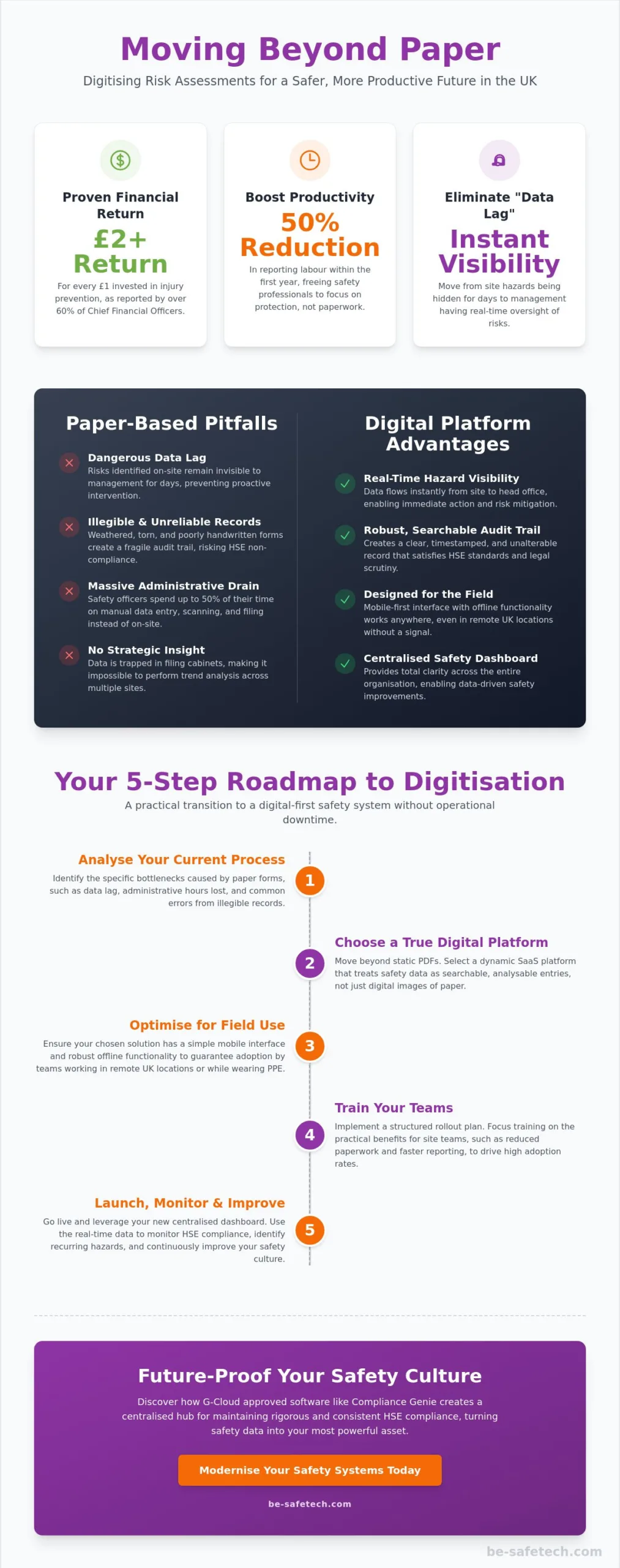
A 5-Step Roadmap to Digitise Paper Risk Assessments
Moving from a manual system to a digital environment requires more than just new software. It demands a structured plan to ensure that site operations continue without disruption. For organisations seeking a robust digital strategy, Business Analysis & Solutions provides expert consultancy to ensure your ICT systems drive organisational efficiency. To successfully digitise paper risk assessments, you should follow a chronological roadmap that respects the complexities of your current worksites. This methodical approach ensures that the transition is viewed as an operational upgrade rather than a bureaucratic hurdle.
- Step 1: Audit and Categorise. Begin by identifying every physical form, checklist, and permit currently in use across all your sites. Understanding the full scope of your paper trail is essential before you attempt to move it online.
- Step 2: Template Optimisation. Avoid the temptation to simply copy your paper forms. Instead, rethink the workflow to take advantage of digital features like drop-down menus and automated calculations.
- Step 3: Pilot Programme. Select a single site or a high-performing team to test the digital platform. This allows you to identify and resolve any operational friction in a controlled environment before a wider launch.
- Step 4: Training and Onboarding. Focus your training on the “why” as much as the “how”. Site teams are more likely to adopt the system if they understand how it improves their safety and reduces their administrative burden.
- Step 5: Full Rollout and Review. Launch the system across the organisation whilst maintaining a strict review schedule. Monitor data quality and gather feedback to ensure the system evolves with your needs.
Optimising Forms for Digital Workflow
Digital forms offer capabilities that paper simply cannot match. You should use conditional logic to ensure that workers only see questions relevant to their specific task; this significantly shortens the time required to complete a check. Incorporate mandatory fields to prevent critical safety steps from being skipped by mistake. Pre-filled fields, such as site locations and user IDs, further streamline the process and reduce the risk of clerical errors during data entry. These small optimisations collectively lead to a 50% reduction in reporting labour within the first year of adoption.
Winning Buy-In from Site Workers
Resistance to change is often rooted in a fear of complex technology. You can overcome this by choosing a platform with a familiar, app-like interface that feels intuitive on a smartphone or tablet. It’s often helpful to appoint “Digital Safety Champions” amongst your site crews to act as mentors for their peers. This peer-to-peer support is frequently more effective than top-down instruction from the head office. Encourage an open feedback loop where workers can suggest improvements, ensuring the tool adapts to the user rather than forcing the user to adapt to the tool. If you’re ready to begin your transition, you can book a personalised walkthrough of Compliance Genie to see how these steps apply to your business.
Future-Proofing Your Safety Culture with Compliance Genie
Compliance Genie represents the logical conclusion of your journey to digitise paper risk assessments. As a G-Cloud approved SaaS platform, it provides the technical infrastructure required to meet rigorous UK safety standards whilst remaining accessible to field teams on the ground. The mobile-first design ensures that your workforce can record data accurately in any environment, from busy city centres to remote infrastructure projects. This technology does more than just replace paper; it integrates your risk assessments into a wider EHS ecosystem. By connecting hazard identification with incident reporting and contractor management via Contractor Genie, you create a holistic view of your operational risk.
Adopting a digital-first approach allows your organisation to maintain a high level of agility. When safety protocols need to be updated in response to new legislation, changes can be implemented across the entire platform in minutes. This ensures that every worker, regardless of their location, is always working from the most current version of your safety documents. This level of control is impossible to achieve with physical folders and manual distribution lists.
Scaling Across Multi-Site Operations
The platform is built to grow alongside your business. Whether you’re managing a single site in the Midlands or a national portfolio of hundreds across the UK, the centralised nature of the software ensures consistency. Directors gain total oversight of national operations, providing the peace of mind that safety protocols are being followed everywhere. When a regulation changes or an internal policy is updated, you can modify templates centrally and push them to every user instantly. This agility eliminates the risk of teams using outdated forms, which is a common failure in manual systems that often leads to non-compliance during HSE inspections.
Beyond Paper: The Power of Predictive Safety
Transitioning to a digital system allows you to move from basic compliance to continuous improvement. Historical data becomes a strategic asset, enabling you to identify patterns and predict where the next incident might occur. This proactive approach transforms your safety culture from one that merely reacts to accidents to one that actively prevents them. By analysing leading indicators across your sites, you can implement targeted interventions that protect your workforce more effectively. This shift from static records to real-time intelligence is the hallmark of a modern, safety-conscious organisation. To start your journey toward total operational harmony, book a demo of Compliance Genie to start your digital transition today.
Modernising Your Safety Legacy
Transitioning away from manual systems is a strategic investment that yields immediate returns in productivity and oversight. By following a structured roadmap, you can digitise paper risk assessments without disrupting your daily site operations. This shift isn’t just about compliance. It’s about protection. You’ve seen how digital-first platforms eliminate the accountability gap and provide your management team with real-time insights that paper simply cannot match. Moving to a centralised system ensures that your safety data is always accurate, accessible, and ready for inspection.
As an ISO 9001 and 27001 certified organisation and a G-Cloud approved provider, we understand the complexities of UK safety regulations. Our award-winning EHS digital platform is designed to adapt to your specific workflows. We help make your transition as smooth as possible. If you’re ready to replace cumbersome filing cabinets with streamlined digital oversight, request a personalised demo of Compliance Genie today. You can take full control of your site safety and enjoy the peace of mind that comes with total operational clarity. We look forward to helping you build a safer, more efficient workplace.
Frequently Asked Questions
How do I ensure my site workers actually use the digital system?
Focus on simplicity and immediate benefits to ensure high adoption rates amongst your team. Choose a platform with an intuitive, app-like interface that mirrors the tools workers already use in their personal lives. Appointing “Digital Safety Champions” amongst the crew provides peer-to-peer support, which is often more effective than top-down mandates. When workers see that the system reduces their admin time and removes the need for late-night paperwork, usage naturally increases.
Can I digitise my existing bespoke paper risk assessment templates?
Yes, you can fully replicate and enhance your current bespoke forms within a digital platform. The transition allows you to take your established workflows and improve them with conditional logic, drop-down menus, and mandatory fields. This ensures that you don’t lose the specific nuances of your site-specific assessments whilst gaining the benefits of automated data capture. It’s often an opportunity to streamline your existing templates for better operational efficiency.
What happens if there is no mobile signal on a construction site?
Modern safety platforms include robust offline functionality to ensure work continues without interruption. Workers can complete their assessments as usual, and the data is stored securely on the device. Once the device reconnects to a 4G or Wi-Fi network, the system automatically synchronises the information with the central dashboard. This reliability is essential for remote UK infrastructure projects or deep basement works where signals are frequently blocked by the environment.
Is digital safety data more secure than paper records?
Digital data is significantly more secure than physical records because it’s protected by encryption and role-based access controls. Unlike paper forms that can be lost, damaged by weather, or destroyed in a fire, digital records are backed up in secure cloud environments. When you digitise paper risk assessments, you also create an unalterable audit trail with precise timestamps, which is far more reliable for legal and insurance purposes than manual filing cabinets.
How long does it typically take to digitise a paper-based safety system?
A standard transition typically takes between four to eight weeks, depending on the complexity of your existing templates and the size of your team. The process begins with a template audit, followed by a pilot programme on a single site to gather feedback. This phased approach allows for necessary adjustments before a full rollout, ensuring the new system is fully integrated into your safety culture without causing operational chaos on your sites.
Does the HSE accept digital risk assessments as valid legal documents?
Yes, the Health and Safety Executive (HSE) accepts digital records as long as they are readily accessible and provide a clear, reliable audit trail. Digital systems often exceed the HSE’s minimum requirements by providing timestamped entries and digital signatures that are harder to dispute than handwritten notes. Maintaining your records in a structured digital format demonstrates a proactive approach to safety management that inspectors generally view favourably during site audits. For a deeper understanding of the regulatory framework underpinning this process, our guide to the HSE five steps to risk assessment explains each stage in detail to help you build a fully compliant and repeatable process.
What are the hardware requirements for digitising paper risk assessments?
You don’t need specialised hardware to digitise paper risk assessments, as most modern platforms work on standard smartphones and tablets. Site workers can use their existing company-issued devices or personal phones if your policy allows it. For more rugged environments, you might consider industrial-grade protective cases for tablets to prevent damage, but the software itself is designed to be lightweight and compatible with standard iOS and Android operating systems.