



HSE Five Steps to Risk Assessment: A Practical Guide for UK Businesses in 2026
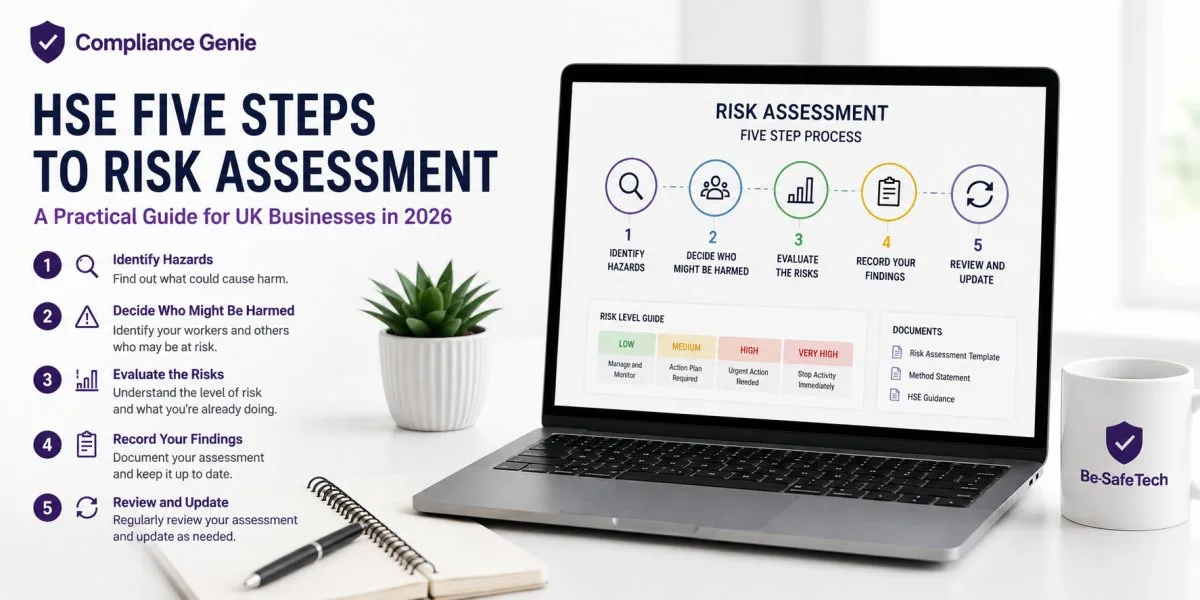
With 875,000 UK workers suffering from work-related stress, depression, or anxiety in 2025/26, the definition of workplace safety has evolved far beyond simple physical hazards. Effectively implementing the hse five steps to risk assessment is no longer just a legal box-ticking exercise; it’s a vital strategy for modern business resilience. Managing these complex requirements whilst drowning in manual paperwork can feel like a losing battle, especially when the fear of a surprise HSE inspection is always at the back of your mind.
We understand that you want a safety culture built on reliability and peace of mind rather than administrative chaos. This guide will show you how to master the HSE framework, transforming a daunting regulatory burden into a streamlined, repeatable process for every site you manage. We’ll preview each of the five critical stages, from hazard identification to digital recording, ensuring you have the tools to achieve total oversight and legal compliance in 2026.
Key Takeaways
- Understand your legal obligations under the Management of Health and Safety at Work Regulations 1999 to ensure your business remains fully compliant.
- Master the hse five steps to risk assessment to build a robust safety framework that addresses both physical hazards and modern psychosocial risks.
- Learn why involving your workforce in hazard identification is essential for creating an accurate and effective safety profile of your daily operations.
- Avoid common pitfalls by transforming your risk assessments into live, dynamic documents that adapt as your workplace environment evolves.
- Discover how Compliance Genie digitises the entire assessment process to eliminate manual filing and provide a clear audit trail for HSE inspections.
Understanding the HSE Five Steps to Risk Assessment
The Management of Health and Safety at Work Regulations 1999 mandate that every UK employer must carry out a systematic risk assessment. The hse five steps to risk assessment represent the industry’s gold standard for meeting this requirement. It’s a structured methodology that moves beyond guesswork, providing a clear pathway to identify and mitigate dangers before they lead to accidents or ill health. By following this framework, businesses ensure they remain on the right side of the Health and Safety Executive (HSE) whilst protecting their most valuable asset: their people.
To lead this process effectively, you must appoint a "competent person". This individual doesn’t necessarily need external qualifications for every single task, but they must possess the necessary skills, knowledge, and experience to manage health and safety. In smaller businesses, this is often the owner; in larger organisations, it might be a dedicated safety officer or a team using specialised digital tools to maintain oversight across multiple sites.
Why British Businesses Prioritise the HSE Framework
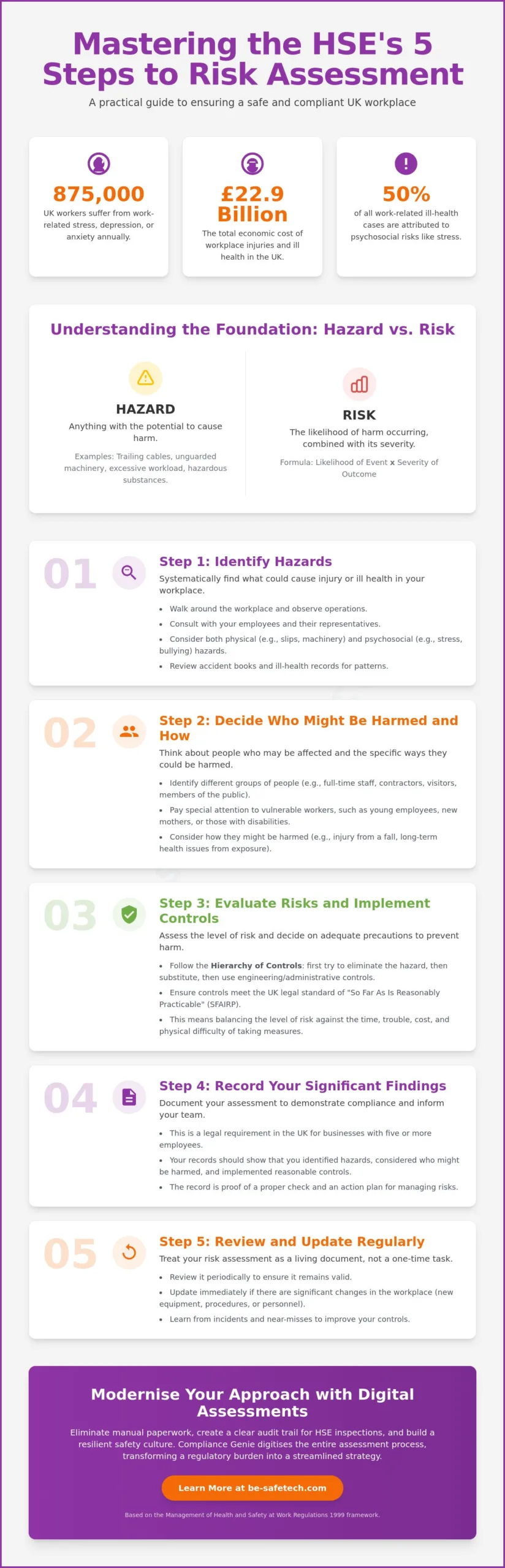
British companies don’t just follow these steps because they’re a legal requirement; they do it because it makes commercial sense. With the total economic cost of workplace injuries and ill health reaching £22.9 billion in recent years, prevention is far more cost-effective than cure. Adhering to the HSE framework helps you avoid the catastrophic fines that, in 2026, can reach millions of pounds for serious breaches. Beyond the balance sheet, it fosters a culture of care. When staff see that their wellbeing is managed through a recognised, professional standard, morale improves and staff turnover often drops. It positions safety as a streamlined part of your operations rather than a bureaucratic hurdle.
Hazard vs Risk: The Critical Distinction
A common point of confusion in safety management is the difference between a hazard and a risk. A hazard is anything with the potential to cause harm. Think of a trailing cable in a London office or an unguarded circular saw on a Birmingham construction site. The risk is the likelihood that someone will actually be harmed by that hazard, combined with the severity of the potential injury. For a deeper understanding of these legally-sound definitions and how misusing these terms can undermine your assessments, read our definitive guide to hazard vs risk for UK workplace safety. Use this distinction as your foundation:
- Identify the Hazard: Spot the physical or psychosocial factor that could cause an issue.
- Evaluate the Risk: Use a risk matrix to plot the probability of an event against its impact.
- Prioritise Action: Focus your resources on high-risk areas first.
Identifying hazards is the vital first stage of the hse five steps to risk assessment. You can’t manage what you haven’t spotted. By clearly separating the "thing that can hurt you" from the "chance of it happening", you ensure your safety measures are proportionate and focused where they are needed most.
Executing the Five Steps: A Comprehensive How-To
Putting theory into practice requires a methodical approach that engages every level of your workforce. Implementing HSE’s five steps to risk assessment transforms safety from a static document into a dynamic operational reality. This process ensures your business remains resilient against both traditional physical hazards and the emerging psychosocial challenges of the modern workplace.
Step 1 & 2: Spotting Hazards and Evaluating Impact
Step 3 & 4: Implementing Controls and Keeping Records
Once hazards are identified, you must control the risks by following the hierarchy of controls: eliminate the hazard entirely, substitute it with something safer, or use engineering controls to isolate people from the danger. In the UK, we use the principle of "So Far As Is Reasonably Practicable" (SFAIRP). This means you must balance the level of risk against the cost, time, and trouble needed to control it. If you have five or more employees, recording your significant findings is a legal requirement. Traditional paper-based systems often fail here because documents get lost, damaged, or remain tucked away in a filing cabinet where staff can’t see them. You can learn how to digitise paper risk assessments to ensure that every team member has instant access to the latest safety protocols via their mobile devices. For premises-specific hazards, using a dedicated digital fire risk assessment tool ensures your fire safety documentation meets the "Golden Thread" requirements now demanded by the Building Safety Regulator.
Step 5: The Importance of the Review Cycle
The final stage of the hse five steps to risk assessment is the one most frequently neglected. A risk assessment isn’t a "one and done" task; it’s a live document that must evolve with your business. You should set regular review dates, but certain "trigger events" necessitate an immediate update. These include the introduction of new machinery, a change in your office layout, or following a "near-miss" incident where an accident almost occurred. Real-time data allows you to spot trends before they become injuries. Using a streamlined platform like Compliance Genie makes this review process significantly faster, as it allows you to update templates and push notifications to all relevant staff instantly, ensuring your safety standards never slip.
Common Pitfalls in the Risk Assessment Process
Many UK businesses fall into the trap of treating the hse five steps to risk assessment as a one-off administrative hurdle. This "tick-box" mentality results in safety folders that gather dust on a shelf whilst real-world risks evolve unnoticed on the factory floor or in the office. A risk assessment only provides genuine peace of mind when it functions as a live document, reflecting the current state of your equipment, staff, and environment. If your assessment hasn’t been updated since it was first filed, it’s likely failing to protect your business or your employees from the latest regulatory expectations.
Another frequent error is the tendency to over-complicate the recording process. Whilst you must be thorough, the official HSE guidance emphasises that records should be clear, simple, and actionable. A 50-page manual is often less effective than a concise, two-page summary that a supervisor can actually use during a shift. Similarly, businesses often neglect non-routine tasks such as annual plant maintenance or deep cleaning. These activities frequently carry higher risks than daily operations because they involve unfamiliar movements or hazardous chemicals that aren’t part of the standard workflow.
Avoiding the Paperwork Trap
Excessive bureaucracy often creates "safety clutter", where the sheer volume of rules makes it impossible for staff to identify the most critical controls. When safety information is buried under layers of unnecessary text, employee engagement drops and the risk of an incident increases. To keep your team safe, focus on practical, high-impact controls that are easy to follow in a busy environment. Streamlining your documentation ensures that vital instructions are accessible rather than hidden behind a wall of jargon.
Involving Your Team for Better Accuracy
Worker consultation is a collaborative tool for identifying real-world hazards that a manager might miss from an office. Your site workers possess tacit knowledge, which is the deep, practical understanding of how a job is actually performed versus how it’s described in a manual. Facilitating brief safety discussions during tool-box talks allows you to capture these insights without disrupting productivity. By involving the people doing the work, you build a more accurate safety profile and increase staff buy-in for new protocols. If you find managing these discussions across multiple sites a challenge, using a tool like Compliance Genie can help centralise feedback and keep your records updated in real-time.
Modernising Your Approach: Digital vs Paper Assessments
Whilst the core principles of the hse five steps to risk assessment remain unchanged, the method of delivery has shifted significantly to meet the demands of 2026. Many UK businesses still rely on handwritten forms and physical ring binders, which often leads to fragmented data and delayed responses. Digital data entry eliminates the risk of illegible handwriting and manual filing errors, creating a more professional and reliable safety record. It’s a logical step for any organisation looking to replace bureaucratic burdens with streamlined efficiency.
Using health and safety risk assessment software ensures your business maintains a "single source of truth". This means that whether your team is in a London warehouse or on a remote construction site in the Scottish Highlands, they are all working from the exact same version of the risk assessment. Version control prevents the dangerous scenario where staff follow outdated protocols because a new paper copy hasn’t reached their site yet. It provides total control and clarity for stakeholders who need to prove compliance at a moment’s notice. This same principle applies to specialist assessments; selecting the right digital fire risk assessment tool gives fire wardens and safety managers a centralised, audit-ready record that can be produced instantly for a Fire and Rescue Service inspector.
The Benefits of Real-Time Safety Data
Digital systems allow managers to monitor compliance across multiple locations from a central dashboard, providing a level of oversight that was previously impossible. These tools facilitate the inclusion of photo evidence and GPS stamping, which adds a layer of accountability to every inspection. For instance, a site manager in Birmingham can instantly verify that a hazard has been controlled by viewing a time-stamped image uploaded by a worker. Automated alerts also solve the common issue of forgetting Step 5. The system reminds you exactly when a review is due, ensuring the framework of the hse five steps to risk assessment is followed consistently throughout the year.
Ensuring Accessibility for All Employees
To truly modernise site safety management, you must place information where it’s needed most: in the hands of the workers. Mobile-first platforms enable employees to access risk assessments at the point of use, rather than having to return to a central office to check a manual. Digital signatures provide a robust audit trail, proving that staff have read and understood the necessary controls. This level of transparency is essential for meeting the expectations of a modern workforce that values clear communication and efficient tools. If you’re ready to move beyond the limitations of paper, discover how our SaaS health and safety software can streamline your compliance today.
Implementing the Five Steps with Compliance Genie
Compliance Genie is a mobile-first SaaS solution specifically engineered to mirror the hse five steps to risk assessment. It moves beyond the limitations of static templates by providing a guided, intuitive interface that ensures no detail is overlooked during the evaluation process. By using our platform, you transform complex regulatory requirements into a series of manageable, digital tasks. This approach not only ensures legal compliance but also builds a foundation of reliability and trust across your entire organisation.
The platform features built-in automation to handle the most neglected part of the framework: the review cycle. Step 5 is frequently forgotten in the rush of daily business, but Compliance Genie sends automated notifications to ensure your assessments remain current and effective. Your data is protected by ISO 27001 certified security, providing the peace of mind that sensitive safety information is stored in a highly secure, cloud-based environment that meets the highest international standards.
A Centralised Hub for Risk Management
Compliance Genie organises every assessment into a single, searchable cloud centre, eliminating the need for physical filing systems and manual archives. When an HSE inspector arrives, you can generate comprehensive reports at the touch of a button, demonstrating a clear and consistent audit trail. You can also link risk assessments directly to digital audit checklists. This integration creates a holistic safety ecosystem where your risk controls are verified through regular, automated inspections, ensuring that your theoretical safety plans are working in practice.
Empowering Your Workforce
The mobile app empowers your staff to take an active role in Step 1 of the hse five steps to risk assessment. Workers can report new hazards instantly from their phones, including photo evidence and precise location data. This real-time reporting ensures that potential dangers are identified and evaluated before they can lead to an incident. For businesses managing external parties, Contractor Genie works alongside our main platform to oversee the risks introduced by third-party workers on your site. We invite you to see how our technology can modernise your safety culture. Contact us today to book a demonstration and discover how Compliance Genie brings total oversight to your workplace safety management.
Future-Proofing Your Workplace Safety in 2026
Mastering the hse five steps to risk assessment is the most effective way to protect your employees whilst ensuring your business remains legally compliant. By moving away from static paper folders and embracing a digital, worker-led approach, you transform safety from a bureaucratic burden into a core operational strength. You’ve seen how identifying real-world hazards and maintaining a live review cycle can prevent the accidents and ill-health cases that cost UK businesses billions each year.
As an award-winning UK safety platform, Compliance Genie offers the total control and clarity needed to manage complex regulations across multiple locations. Our system is ISO 9001 and 27001 certified, providing the highest level of data security and quality management for your peace of mind. We’re proud to be trusted by multi-site UK organisations that value efficiency and reliability in their safety protocols. Digitise your HSE Five Steps with a Compliance Genie demo today to experience a more streamlined approach to risk management. Safeguarding your team has never been more manageable.
Frequently Asked Questions
What are the five steps to risk assessment as defined by the HSE?
The HSE defines the framework as: identifying hazards, deciding who might be harmed and how, evaluating the risks and deciding on precautions, recording your significant findings, and reviewing the assessment. These stages form the hse five steps to risk assessment, which is the recognised gold standard for managing workplace safety. Following this sequence ensures that you address both physical dangers and psychosocial risks like workplace stress.
Is a written risk assessment a legal requirement for my small business?
You are legally required to record the significant findings of your risk assessment if you employ five or more people. Whilst businesses with fewer than five employees don’t have this strict recording obligation, they must still carry out the assessment process to ensure staff safety. Keeping a record is often recommended for all businesses, as it provides a clear defence if an incident occurs or an inspector visits.
How often should I review my workplace risk assessments?
There is no fixed legal expiry date, but you should review your assessments whenever they are no longer valid or if there has been a significant change in your workplace. This includes introducing new equipment, changing your office layout, or following a "near-miss" incident where an accident almost occurred. Setting an annual review date is a common industry standard to ensure your safety standards remain compliant and effective.
Can I use a digital app to record my HSE five steps?
Yes, the HSE accepts digital records provided they are accessible and accurately reflect your findings. Using a mobile-first app like Compliance Genie allows you to complete the hse five steps to risk assessment on-site, creating an instant, time-stamped digital audit trail. Digital systems are often preferred by modern businesses because they are much harder to lose or damage than traditional paper files kept in a ring binder.
Who is responsible for carrying out the five steps to risk assessment?
The ultimate legal responsibility lies with the employer, although they can delegate the task to a "competent person" within the business. This individual must have the necessary skills, experience, and knowledge to identify hazards and implement effective control measures. In many smaller UK firms, the business owner takes on this role, whilst larger organisations may appoint dedicated health and safety managers to lead the process.
What is the difference between a hazard and a risk in HSE terms?
A hazard is anything with the potential to cause harm, whilst a risk is the likelihood and severity of that harm actually occurring. These terms are frequently confused on site, but understanding the distinction is fundamental to completing an accurate risk assessment. For a comprehensive breakdown of both concepts and a practical framework for applying them, see our guide to hazard vs risk in UK workplace safety.
Do I need to hire a consultant to complete my risk assessments?
You don’t usually need to hire an external consultant if you or a member of your staff has the competence to manage the process. Most workplace risks are straightforward to assess in-house, especially when using digital tools that guide you through the required regulatory steps. However, for highly complex or specialist environments, seeking expert advice can provide additional peace of mind and ensure total compliance.
What happens if I fail to record my risk assessment findings?
Failing to record your findings if you have five or more staff is a breach of the Management of Health and Safety at Work Regulations 1999. This can lead to enforcement action from the HSE, including "Fees for Intervention" or unlimited fines that can reach millions of pounds for serious breaches. It also leaves your business highly vulnerable during civil litigation, as you won’t have the documentation to prove you took reasonable precautions.