


Automate Safety Compliance: Busting the Myths of Digital Transformation in 2026

Could your health and safety records survive one of the 14,000 proactive HSE inspections scheduled for this year? If the thought of a surprise visit leaves you searching through stacks of paperwork or chasing missing site signatures, you aren’t alone. Many safety officers feel buried by manual processes, fearing that a single oversight could lead to a £188-per-hour Fee for Intervention. It’s a stressful way to manage risk, especially when you’re responsible for maintaining consistent safety behaviours across multiple locations.
We understand that the transition to digital tools can feel daunting, yet the decision to automate safety compliance is actually the simplest way to regain control. This article explores how modern technology liberates your team from administrative overhead whilst ensuring you remain fully compliant with the latest Building Safety Regulator standards. You’ll discover why moving away from spreadsheets isn’t just about efficiency; it’s about achieving total peace of mind through a streamlined, audit-ready system. We will dismantle the common myths of digital transformation and show you how to gain real-time visibility into every corner of your operations.
Key Takeaways
- Understand how digitising your workflows shifts your safety culture from reactive “tick-box” exercises to proactive risk management.
- Discover why digital tools are designed to support safety officers rather than replace them, freeing your experts for critical site-based decision-making.
- Identify the hidden financial and operational costs of relying on manual spreadsheets and paper records for your compliance data.
- Learn how to automate safety compliance through a phased, manageable roadmap that prevents operational downtime during implementation.
- Explore how scalable, UK-based software provides audit-ready visibility for businesses of all sizes across multiple sites.
Beyond the Spreadsheet: Why You Should Automate Safety Compliance in 2026
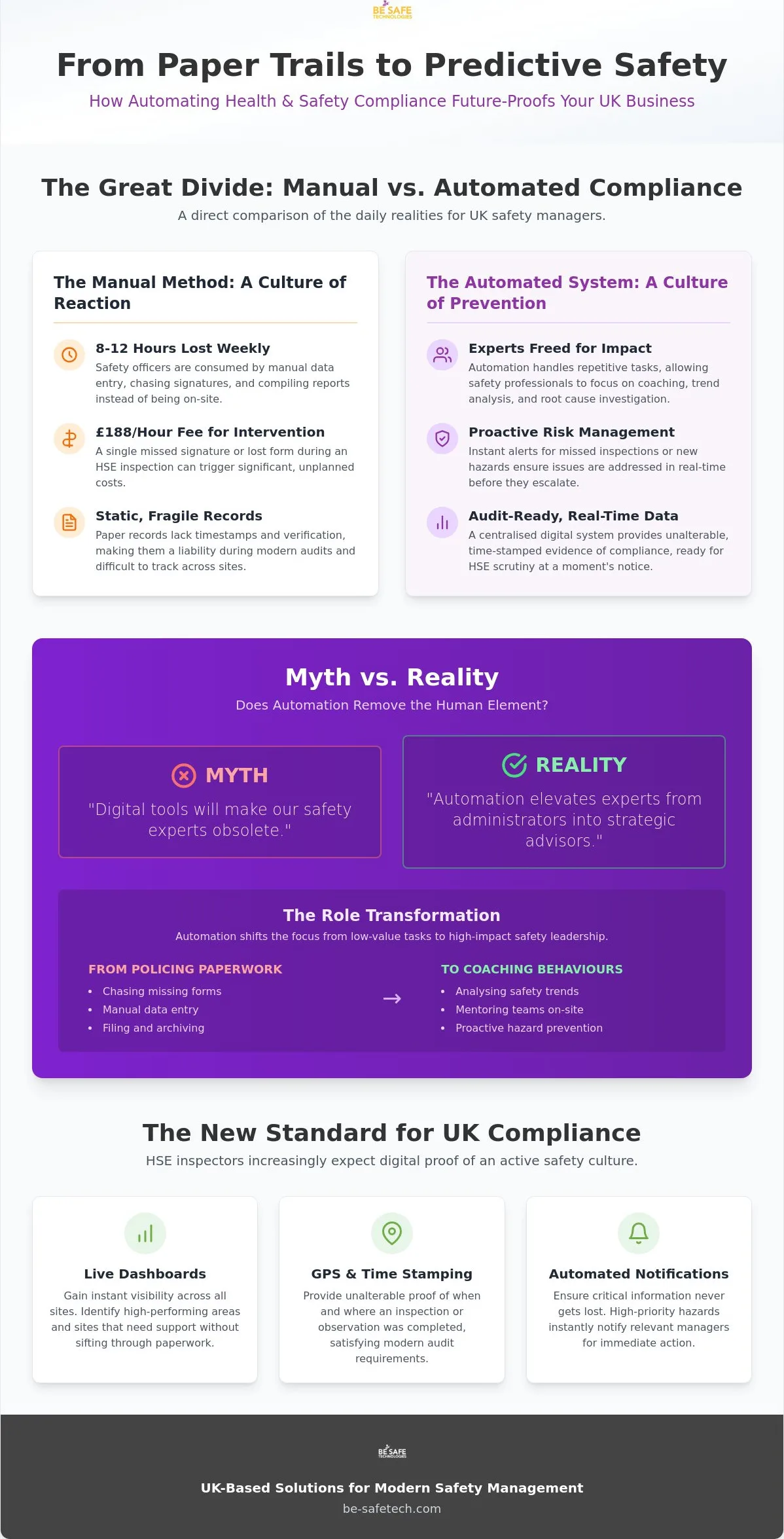
For many UK businesses, the traditional ring-binder is a comfort blanket. There is a long-held belief that manual systems are more reliable because they are tangible; you can touch the paper and see the physical signature. This is a significant myth. In reality, a physical record is static, fragile, and difficult to track across multiple sites. To maintain robust regulatory compliance, organisations must move beyond these fragile systems. True safety automation is the digitisation of workflows, alerts, and reporting into a live ecosystem that protects your business 24/7.
The decision to automate safety compliance transforms your approach from a reactive “tick-box” exercise into proactive risk management. Instead of discovering a missed inspection weeks after the fact, digital systems alert you the moment a task is overdue. This shift is essential as we look toward the Future of Safety Management Software, where predictive data and real-time oversight become the industry standard. Automation doesn’t just store data; it makes that data work for you by highlighting trends before they become incidents.
The Evolution of UK Safety Standards
HSE expectations are rapidly shifting towards digital transparency. Inspectors no longer want to wait for you to pull a dusty lever-arch file from a shelf; they expect to see real-time data that proves a consistent safety culture. We are moving from a culture of “filing” to one of “analysing.” Paper records are increasingly viewed as a liability during modern audits because they lack the unalterable timestamps and GPS verification that digital platforms provide. By adopting digital transparency, you demonstrate to regulators that your safety protocols are active and verified rather than merely performative.
Recognising the Administrative Burden
The “compliance gap” is a silent drain on UK productivity. This gap occurs when the time taken to complete, transport, and file paperwork lags behind actual site activity. Safety officers often lose between eight and twelve hours every week to manual data entry and report generation. This administrative overhead isn’t just expensive; it’s dangerous. When your experts are stuck behind a desk processing forms, they aren’t on-site identifying hazards. Transitioning to a “single source of truth” ensures that every piece of data is captured instantly at the point of work. This eliminates the need for double-entry and ensures your compliance status is always current, accurate, and ready for scrutiny.
Myth vs Reality: Does Automation Remove the Human Element?
One of the most persistent concerns regarding digital transformation is the fear that technology will replace human expertise. Myth 2 suggests that digital tools make safety officers obsolete. In reality, the opposite is true. Automation is designed to handle the “what” of compliance, such as tracking expiry dates, logging inspections, and filing reports. This liberation from administrative drudgery allows safety professionals to focus on the “why”—analysing root causes and mentoring teams on the ground. When you automate safety compliance, you aren’t replacing the person; you’re upgrading their capabilities.
Mobile-first applications significantly improve engagement amongst front-line workers. Instead of seeing safety as a distant, bureaucratic requirement, site operatives can report hazards or complete checks in seconds from their own devices. Automated alerts ensure that no one is left in the dark regarding potential risks. If a high-priority hazard is identified on a remote site, the relevant managers receive an instant notification. It’s a proactive safety net that ensures critical information never gets stuck in a tray or lost in an email chain. A well-implemented system, like the Compliance Genie platform, acts as a digital assistant that never sleeps.
Empowering the Safety Professional
Digital reporting provides safety managers with actionable insights that were previously hidden in stacks of paper. By viewing real-time dashboards, you can identify which sites are excelling and which require additional support. This facilitates a vital shift from “policing” paperwork to “coaching” safety behaviours. Instead of reprimanding a supervisor for a missing form, you can have a meaningful conversation about why a specific risk assessment wasn’t completed. Digital tools amplify expert judgement rather than silencing it. Whilst these tools are modern, they are built upon established UK standards, such as the HSE’s guidance on managing for health and safety, which emphasises the need for active leadership and worker involvement.
Improving Site-Wide Safety Culture
Easy-to-use apps encourage a higher volume of near-miss reporting across diverse teams. When the process is frictionless, workers are more likely to participate in the safety conversation. Transparency builds trust between management and site operatives because everyone can see that their concerns are being logged and addressed. Inclusive safety training that features a wide range of ethnicities ensures that every worker feels represented and valued within the organisation. This sense of belonging is a cornerstone of a strong safety culture, as it encourages every individual to take personal responsibility for the well-being of their colleagues.
The Hidden Costs: Spreadsheets vs Dedicated Safety Software
Many UK businesses rely on Excel because it feels “free” and accessible. This is a dangerous fallacy. Myth 3 suggests that spreadsheets are an effective way to manage health and safety, yet they are often a source of significant hidden costs that don’t appear on a balance sheet until something goes wrong. Beyond the hours spent manually updating cells, there is the massive risk of data loss, accidental deletion, or file corruption. When you choose automating compliance, you replace this fragile infrastructure with a resilient system designed for modern regulatory demands and secure UK-based storage.
The Spreadsheet Trap
Version control is the primary enemy of manual systems. It’s common to find multiple versions of a risk assessment floating around different email threads, causing confusion on the shop floor and amongst site managers. This leads to dangerous compliance gaps where workers may be following outdated protocols whilst management believes they are protected. Traditional file-sharing systems lack the robust, unalterable audit trails required during a formal HSE inspection. Proving who signed what, and exactly when they signed it, becomes an impossible task. This difficulty is magnified when trying to manage safety for multi-site businesses via email. Information gets siloed, and site-wide oversight becomes a reactive game of catch-up rather than a strategic advantage.
Calculating the ROI of Automation
The financial impact of poor record-keeping is stark and measurable. In 2025, the HSE secured a 96% conviction rate across 246 prosecutions, resulting in approximately £33 million in fines. These figures don’t account for the legal fees, the reputational damage, or the rising economic cost of workplace ill-health, now estimated at £22.9 billion. Investing in ISO 27001 Compliant Safety Software is not just about ticking boxes; it’s a strategic move to mitigate these astronomical risks through encrypted data management.
Automated systems effectively pay for themselves through sheer administrative time savings and risk reduction. By removing the need for manual data entry and physical storage centre costs, your safety team can reclaim several hours of their week for high-value tasks. Robust digital records can also lead to reduced insurance premiums, as UK insurers increasingly favour companies that can demonstrate a data-driven approach to risk management. To automate safety compliance is to move safety from the “cost centre” column to the “operational asset” column, ensuring your business remains resilient in an increasingly regulated environment.
A Roadmap to Automate Safety Compliance Without the Stress
A common misconception, often referred to as Myth 4, suggests that digital transformation requires months of operational downtime. In practice, the most successful transitions are phased rather than immediate. You don’t need to switch everything off on a Friday and hope for the best on Monday. Instead, a methodical roadmap allows you to automate safety compliance whilst your teams continue their essential work. This approach involves four key stages: Audit, Digitise, Train, and Optimise. By starting with your most critical processes, you create immediate value without disrupting site activity.
When selecting a partner, it’s vital to choose a vendor with recognised UK credentials. G-Cloud approval and ISO 27001 certification provide the assurance that your sensitive compliance data is handled with the highest level of security. These standards aren’t just badges; they’re your guarantee that the software is reliable and built to support the rigorous demands of UK law. To understand the depth of testing and development required for such enterprise-grade systems, you can discover Test Triangle and their specialist IT services. This is particularly important when aligning your new digital tools with existing HSE frameworks, such as the “Five Steps to Risk Assessment”. Your software should enhance these established methods, making it easier for site managers to identify hazards and record their findings instantly. By following this structured approach, you can automate safety compliance across your entire organisation without the risk of operational disruption.
Step-by-Step Migration from Paper
Migration begins by identifying high-priority forms that carry the most risk if they are lost or delayed. Start with daily site diaries or equipment inspections. Once these are live, you can set up automated alerts for expiring certifications and mandatory training sessions. This ensures that no worker is ever on-site without the correct qualifications. For those in high-risk sectors, ensuring your system supports digital safety reporting in construction is a critical step towards total site visibility and long-term data integrity.
Training and Adoption Strategies
Successful adoption depends on people, not just code. To overcome “tech-phobia” amongst long-term staff, it’s helpful to appoint “Safety Champions” who can offer peer-to-peer support. These champions act as a bridge between the software and the workforce, demonstrating how a mobile app is actually simpler than a clipboard. It’s also essential to use training materials that are diverse and inclusive, reflecting the multicultural nature of the modern UK workforce. When every worker sees themselves represented in the safety narrative, they’re more likely to engage with the system. If you’re ready to see how this roadmap fits your business, you can explore our G-Cloud approved compliance solutions to start your digital journey.
Compliance Genie: The UK Solution for Modern Safety Management
Whilst many assume that only multinational conglomerates can afford to automate safety compliance, the reality is far more inclusive. Myth 5 suggests that comprehensive safety software is an exclusive luxury for massive corporations with vast administrative departments. In truth, Compliance Genie is built to be a scalable solution that serves UK businesses of all sizes. Whether you are a growing SME or a national enterprise, the platform adapts to your specific operational needs rather than forcing you to change your established workflows. This flexibility ensures that modern safety tools are accessible to any organisation committed to protecting its workforce.
The mobile-first design of our platform brings compliance directly to the point of work. Instead of safety being something that happens in a distant office, it becomes a live part of every site visit and shift. Workers can complete assessments and report hazards on their own devices, ensuring that data is captured accurately and instantly. Our ISO 9001 and 27001 certifications, combined with our G-Cloud approved status, provide the professional assurance that your sensitive data is handled with the highest level of security. This reliability offers peace of mind to stakeholders who need to know that their compliance records are both audit-ready and protected by recognised industry standards.
Secure and Centralised Oversight
Centralised oversight is the foundation of a resilient safety strategy. Our cloud-based platform provides total visibility across your entire organisation, regardless of how many sites you manage or where they are located in the country. By housing all risk assessments, training records, and incident reports in one secure location, you eliminate the risk of information silos. The Contractor Genie module extends this control to your supply chain, allowing you to manage site visits seamlessly. It ensures that every contractor has provided the necessary documentation and completed their induction before they even arrive on-site, reducing the risk of unauthorised or unsafe work practices.
Ready for the Future of Safety
The platform is designed to evolve alongside the UK regulatory landscape. With recent significant changes, such as the Housing Health and Safety Rating System (HHSRS) 2026 overhaul and the standalone independence of the Building Safety Regulator, staying current is a full-time job. We handle the technical updates so you don’t have to, ensuring your system always reflects the latest HSE expectations. Access to UK-based support and expertise means you are never left to solve complex technical or regulatory challenges alone. We act as a practical ally in your safety journey, providing the tools and the confidence to manage risk effectively. To see these tools in action and discover how they can liberate your team, request a demo of Compliance Genie today.
Securing Your Safety Future in 2026
Digital transformation isn’t an obstacle to overcome; it’s the foundation for a more resilient, transparent, and human-centric safety culture. We’ve explored how moving away from the “spreadsheet trap” eliminates version control risks and administrative fatigue, allowing your safety professionals to focus on genuine risk reduction. Whether you’re managing a single local site or a complex national operation, the transition to digital tools is a scalable journey that prioritises your team’s ease of use and long-term safety engagement.
By choosing to automate safety compliance, you protect your business from the inconsistencies of manual records whilst ensuring you’re always audit-ready for the Building Safety Regulator. As an award-winning, mobile-first platform and a G-Cloud Approved UK supplier, we’re here to support your transition with the highest standards of data security. Our ISO 27001 and 9001 certifications ensure your records are handled with total integrity and professional oversight. Take the first step towards a more efficient, stress-free compliance environment and book your Compliance Genie demo today. You’ve the expertise to keep your people safe; we’ve the technology to make it easier.
Frequently Asked Questions
Is it legal to use digital signatures for UK safety risk assessments?
Yes, digital signatures are fully recognised under UK law, including the Electronic Communications Act 2000. The HSE accepts digital records provided they are accurate, accessible, and reliably demonstrate that you’ve identified hazards and implemented controls. Using digital timestamps and GPS verification actually provides a more robust audit trail than a traditional handwritten signature, making it easier to prove compliance during an investigation.
How much time can my business save by automating safety compliance?
Most safety officers reclaim between eight and twelve hours every week by removing the need for manual data entry and physical filing. When you automate safety compliance, you eliminate the “compliance gap” caused by paperwork lagging behind site activity. This allows your team to spend more time on-site coaching safe behaviours rather than being stuck behind a desk processing repetitive forms.
Will our data be secure if we move to a cloud-based safety system?
Your data is highly secure when using a platform that holds ISO 27001 certification for information security management. We utilise secure, UK-based data storage and maintain G-Cloud approved status, ensuring your records meet the stringent requirements of both corporate stakeholders and government bodies. This digital approach is often safer than physical storage, which is vulnerable to fire, theft, or simple misplacement amongst site files.
Can small UK businesses afford to automate their safety processes?
Yes, modern safety software is designed to be scalable and accessible for organisations of all sizes. Rather than being a prohibitive cost, it functions as an investment that protects you from the rising HSE Fee for Intervention rate, which increased to £188 per hour in April 2026. Smaller teams often see the fastest return on investment because they have less administrative capacity to waste on manual systems.
What happens if our site workers don’t have a reliable internet connection?
Our mobile-first platform is built to handle the realities of remote UK sites with poor connectivity. Workers can still complete their assessments and reports whilst offline; the data is cached securely on their device and automatically syncs to the cloud once a connection is restored. This ensures that safety protocols are followed in real-time, even in basements, rural locations, or shielded steel structures.
How does automation help during an unannounced HSE inspection?
Automation allows you to present a complete, audit-ready history of your safety activities at the touch of a button. Instead of searching through dusty files or chasing missing signatures, you can provide an inspector with instant proof of site inductions, risk assessments, and equipment checks. This transparency demonstrates a proactive safety culture and significantly reduces the stress and potential costs associated with unannounced visits.
Do we need to replace all our existing paper forms at once?
No, a phased approach is the most effective way to manage your digital transformation. You can start by digitising your highest-priority forms, such as daily site diaries or high-risk permits, whilst keeping other processes manual for a short period. This methodical roadmap prevents operational downtime and allows your team to build confidence with the software at a pace that suits your specific business needs.