


How to Reduce Health and Safety Paperwork Digitally in 2026

What if the greatest risk to your site’s safety isn’t a physical hazard, but the hours your senior team spends buried under a mountain of filing? You’ve likely felt the frustration of chasing contractors for signed documents or the anxiety of searching for a specific record whilst an auditor waits. It’s a common struggle for UK safety professionals who want to focus on protection rather than administrative bloat. This guide provides a practical roadmap to help you reduce health and safety paperwork by transitioning to a streamlined digital compliance system.
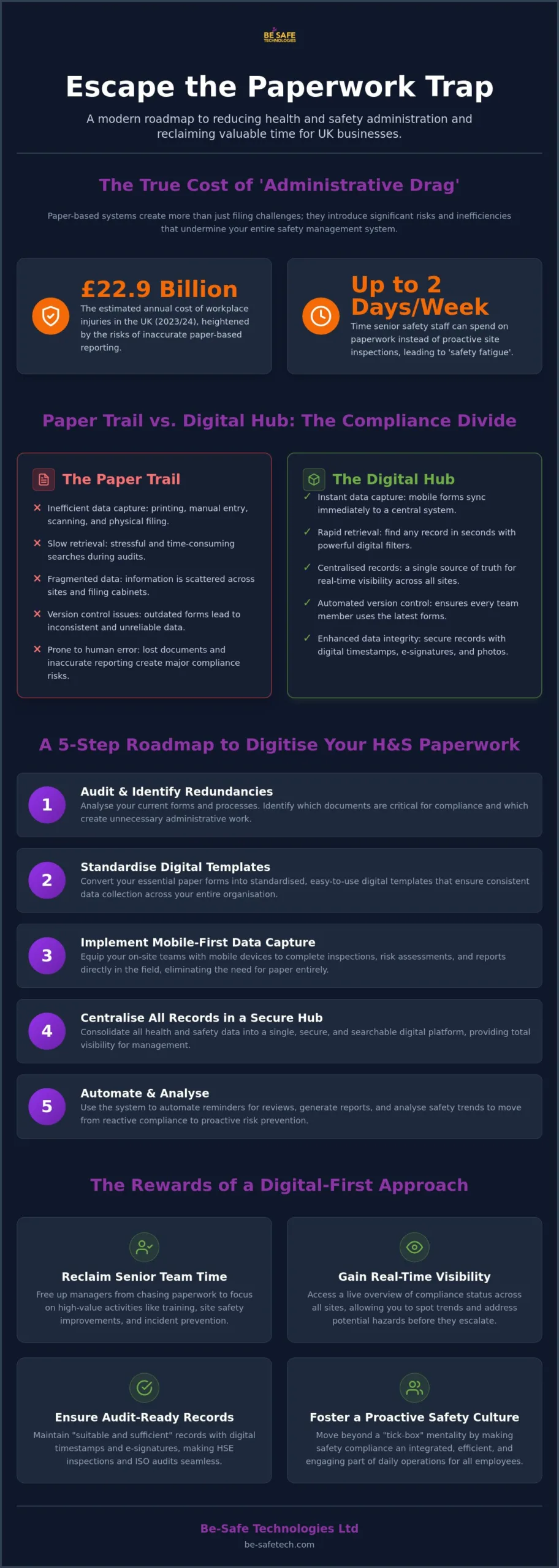
With the HSE recently consulting on significant RIDDOR reforms and the annual cost of workplace injuries in the UK reaching £22.9 billion, the need for precision has never been higher. You’ll learn how to replace fragmented filing cabinets with a centralised digital record system that offers real-time visibility across every site. We’ll examine the steps to eliminate the “administration middle-man” and ensure your team has the total control and clarity needed for a modern, safe workplace. By moving away from manual processes, you can reclaim your time and focus on what truly matters: keeping your people safe.
Key Takeaways
- Understand the true cost of “administrative drag” and how physical filing systems create fragmented data gaps across your organisation.
- Learn a practical five-step roadmap to reduce health and safety paperwork by auditing your current forms and moving to a mobile-first data capture model.
- Discover how digital timestamps and e-signatures ensure your records remain “suitable and sufficient” for HSE inspections and ISO audits.
- Compare the retrieval speed of digital filtering against physical searching to see how much time your senior staff can reclaim each week.
- Explore how specialised modules in Compliance Genie can automate site visits and risk assessments to eliminate manual data entry entirely.
The Hidden Cost of Paper-Based Health and Safety Management
Many UK businesses believe they’re managing safety effectively by simply filling out more forms. This often leads to “administrative drag”, where the act of printing, scanning, and filing physical documents consumes more time than the actual safety inspections themselves. When information is scattered across various filing cabinets and site offices, data fragmentation becomes a serious liability. It’s difficult to maintain a cohesive safety management system when records are physically inaccessible or lost amongst stacks of paper. This lack of transparency means that critical safety trends remain hidden until an incident occurs, undermining the very purpose of your compliance efforts.
Beyond the immediate time loss, there are physical costs. Storing years of health and safety records requires significant office space, whilst the environmental impact of paper consumption contradicts modern sustainability goals. Manual systems also increase the risk of human error. Inaccurate RIDDOR or COSHH reporting can lead to legal complications, especially with the HSE currently consulting on reforms to reporting regulations as of mid-2026. Given that the estimated annual cost of workplace injuries in the UK reached £22.9 billion in 2023/24, the financial stakes of inaccurate reporting have never been higher. A single misplaced signature or a lost risk assessment can leave an organisation vulnerable during an inspection.
The “Paperwork Trap” in Modern UK Industry
Adding more paper templates doesn’t make a site safer; it usually just increases the burden on supervisors. Version control becomes a nightmare when different sites use outdated forms, leading to inconsistent data across the company. This creates a “compliance lag”, where a safety manager might only discover a breach days after it occurred, missing the window for immediate intervention. If you want to reduce health and safety paperwork, you must first address the inefficiencies baked into manual record-keeping. Simply digitising a bad process isn’t enough; you need to eliminate the redundant steps that paper creates.
Quantifying the Administrative Burden
Whilst specific national averages vary, some industry professionals report that safety managers can spend up to two days a week managing physical records instead of conducting active site inspections. This heavy administrative load directly contributes to “safety fatigue” amongst site workers, who begin to view compliance as a tick-box exercise rather than a life-saving practice. When paperwork feels like a barrier, it’s nearly impossible to foster a high-level safety culture where employees feel genuinely engaged. Moving to a digital model isn’t just about speed; it’s about reclaiming the time needed to protect people on the ground and ensuring that safety remains a proactive, rather than reactive, part of your business operations. This drive for efficiency is universal; for example, in the UK’s beauty and wellness sector, Bookivo helps professionals automate their bookings and compliance records, allowing them to focus on client care rather than administration.
Paper Templates vs Digital SaaS: Which Truly Reduces Admin?
Whilst downloading a free PDF might seem like a quick fix, it often creates more work than it saves. The lifecycle of a paper-based risk assessment is inherently inefficient. It requires printing, manual completion on-site, transportation back to the office, and eventually, scanning or filing. Each of these steps represents a point of failure where data can be lost or misinterpreted. In contrast, a digital assessment is captured on a mobile device and synced instantly to a centralised hub. This transition is the most effective way to reduce health and safety paperwork because it removes the “administration middle-man” entirely.
Consider the “retrieval speed” during an unexpected visit from an HSE inspector. Searching through physical folders is stressful and time-consuming. Digital filtering allows you to find any record in seconds, whether it’s a training certificate or a site inspection report. Digital systems also use automated notifications to alert managers when a document is due for review or a signature is missing. This eliminates the need for manual “chasing”, allowing senior staff to focus on active safety oversight rather than spreadsheets. The accuracy of data captured on-site via mobile devices is also significantly higher, as it includes GPS stamps and photos that provide a more reliable record than a handwritten site diary.
The Limitations of the “Template-Only” Approach
Free templates lack the dynamic nature required for complex UK operations. If you have 100 separate Word documents, you essentially have 100 separate data silos. Aggregating that information for a monthly safety report becomes a manual task that takes hours. Unmanaged templates also lead to inconsistent standards. One team might use version 2 whilst another uses version 4, creating a compliance gap that’s difficult to close without a managed system. To truly reduce health and safety paperwork, you need a platform that organises the data for you, rather than just providing a blank digital page.
Why Cloud-Based Safety Management is the Solution
Adopting cloud based safety management provides your organisation with a “single source of truth”. You no longer need to worry about physical backups or local server failures. Modern platforms often carry ISO 27001 certification, offering security that a physical filing cabinet simply cannot match. This shift aligns with the UK’s broader push toward digital transformation in health and safety, ensuring that data is both accurate and immediately accessible for audits. When evaluating your options, a detailed Intelex vs Compliance Genie comparison can help you determine which platform best balances enterprise-grade oversight with the mobile-first agility your UK operations require. If you’re ready to see how this works in practice, you might explore how digital modules can transform your site safety through automated workflows.
A 5-Step Roadmap to Digitise Your H&S Paperwork
Moving away from a paper-heavy system requires more than just a change of hardware. It’s a strategic shift in how your organisation captures, stores, and utilises safety data. To effectively reduce health and safety paperwork, you need a structured roadmap that addresses both the technical requirements and the human element of workplace safety. This five-step process ensures that your transition is smooth, compliant, and, most importantly, permanent.
- Step 1: Audit your current paperwork to identify redundant forms and duplication.
- Step 2: Transition to a mobile-first data capture system to empower site workers.
- Step 3: Centralise all records in a secure, cloud-based environment.
- Step 4: Automate reporting and alerts to eliminate manual oversight tasks.
- Step 5: Review and refine processes using real-time data analytics.
Step 1 & 2: Auditing and Empowering the Workforce
The first stage involves a thorough review of every form currently in use. You’ll often find that site inductions, contractor checklists, and daily briefings contain overlapping questions that can be merged into a single digital entry. Eliminating these redundancies is the quickest way to reduce health and safety paperwork before you even touch a piece of software. Once your forms are lean, adopting mobile first safety software becomes essential. It allows workers to log hazards or complete inspections at the point of work, rather than waiting until they return to a site office.
Securing worker buy-in is vital for this transition to succeed. When site teams see that a digital app replaces a cumbersome clipboard and saves them thirty minutes at the end of every shift, adoption rates soar. Focus on the ease of use and the immediate feedback loops that digital systems provide. If a worker logs a faulty piece of equipment, they should see that it’s been flagged for repair instantly, reinforcing the value of the new system.
Step 3 & 4: Centralisation and Automation
Once data is being captured digitally, it must be stored in a way that is both accessible and secure. Utilising ISO 27001 compliant safety software ensures that your organisation meets international standards for data protection. This is particularly important for UK firms managing sensitive personnel records or training certifications. Centralisation removes the risk of “data silos” where information is trapped on a single laptop or in a physical file on one specific site.
Automation is the final piece of the administrative puzzle. You can set up automated triggers for expiring training licences, overdue plant inspections, or monthly safety reviews. Instead of a manager manually checking a spreadsheet, the system sends a notification to the relevant person. This significantly reduces the “cognitive load” on your health and safety officers, allowing them to move away from clerical work and back into active safety leadership. By Step 5, you’ll have the real-time analytics needed to spot trends across multiple sites, allowing for proactive interventions before accidents happen.
Organising Digital Data for HSE and ISO Compliance
For any UK business, the transition to digital record-keeping must do more than just save space; it must satisfy the legal requirements set out by the Health and Safety Executive (HSE). The HSE requires that risk assessments and safety records are “suitable and sufficient”. Digital systems meet this standard by ensuring that data is legible, accurate, and easily accessible. When you reduce health and safety paperwork through a managed platform, you aren’t just moving files to a computer. You’re creating a structured environment that aligns with ISO 9001 and ISO 45001:2018 standards, ensuring your safety management remains robust during external audits.
A common concern amongst operations managers is whether a digital signature carries the same weight as a traditional “wet-ink” signature. In the UK, the Electronic Communications Act 2000 and subsequent regulations provide clear legal standing for electronic signatures. Digital systems enhance this legal validity by attaching metadata to every sign-off, including precise GPS locations and unalterable timestamps. This creates a level of accountability that physical paper simply cannot match, providing senior leadership with peace of mind that their compliance data is genuine and verifiable.
Building a “Bulletproof” Audit Trail
One of the greatest risks of paper systems is the potential for documents to be lost or, in some cases, back-dated to cover a compliance gap. Digital platforms eliminate this risk by creating an immutable audit trail where every entry is logged in real-time. This level of integrity is invaluable during unannounced HSE site visits, where the ability to retrieve a specific record in seconds can prevent a minor query from escalating into a formal notice. Implementing digital audit checklist software improves compliance transparency by providing a clear, chronological history of every safety action taken across your organisation.
Data Security and Privacy in H&S
Managing safety records involves handling sensitive employee health data, which falls strictly under UK GDPR. Whilst many firms still rely on spreadsheets, these files are a major security risk because they lack granular access controls and are easily shared or deleted. Dedicated digital platforms use role-based access control to ensure that only authorised personnel can view sensitive safety or medical records. This high level of security is a core component of ISO 27001 compliance, protecting your business from data breaches whilst helping you reduce health and safety paperwork. To ensure your organisation meets these rigorous standards, you can streamline your compliance records with a secure, cloud-based solution today.
Streamlining Operations with Compliance Genie
Compliance Genie serves as the definitive platform for UK organisations ready to transition from manual filing to a streamlined digital ecosystem. By integrating your safety protocols into a single SaaS application, you can effectively reduce health and safety paperwork across every level of your business. The platform’s dedicated “Site Visit” and “Risk Assessment” modules are designed to eliminate manual data entry entirely. Instead of transcribing notes from a paper pad into a spreadsheet at the end of the day, site managers complete their checks directly within the app. This creates an immediate digital record that syncs to your central hub, ensuring that senior staff have total oversight without the need for weekly administrative catch-ups.
Managing external parties often generates the most significant administrative burden for safety officers. Contractor Genie complements this system by automating the collection of insurance documents, RAMS, and training records from third-party suppliers. This ensures that your contractor management is just as organised as your internal safety processes, creating a unified approach to site protection. Be-Safe Technologies Ltd acts as a practical ally for UK businesses, providing the technical proficiency needed to modernise traditional, paper-heavy processes whilst maintaining the grounded reliability of a seasoned industry specialist.
Key Features that Eliminate Administrative Bloat
The software’s customisable forms adapt to your specific operational needs rather than forcing your team to work around rigid, generic templates. Real-time dashboards replace the need for manual monthly reporting, as data is aggregated automatically as it’s captured on the ground. This provides an instant snapshot of compliance across multiple sites, allowing you to identify trends or gaps without opening a single filing cabinet. For teams working in remote areas of the Scottish Highlands or rural Wales, the “offline mode” ensures that data is stored locally on the device and uploaded as soon as a connection is restored. This capability is essential for 2026 site operations where connectivity can still be inconsistent; for organisations looking to bolster their digital infrastructure, reliable support from roundedit.co.uk ensures these compliance tools remain effective and connected.
Next Steps: Moving Toward a Paperless Future
Transitioning to a paperless future is a strategic investment that offers a significant return on interest by reclaiming hundreds of administrative hours each year. You can begin a trial to experience these time savings first-hand and see how a digital system provides the clarity and control your organisation deserves. By removing the “administration middle-man”, you empower your safety team to spend less time on clerical tasks and more time on active site protection. This shift doesn’t just reduce health and safety paperwork; it fosters a more proactive and engaged safety culture across your entire workforce.
Discover how Compliance Genie can reduce your paperwork burden today.
Embracing a Streamlined Future for UK Site Safety
The shift toward digital safety management is about more than just moving files to a screen; it’s about reclaiming the time your team needs to lead on-site. By following a structured roadmap to reduce health and safety paperwork, you can replace fragmented filing with a single source of truth that satisfies both the HSE and rigorous ISO standards. You’ve seen how mobile-first data capture empowers site workers whilst automated alerts ensure that no training record or inspection ever slips through the cracks. Moving away from the “paperwork trap” allows your senior staff to focus on active risk management rather than administrative recovery.
As an award-winning UK EHS platform, Compliance Genie provides the peace of mind that comes with ISO 9001 and 27001 certification. Our G-Cloud approved health and safety app is designed to adapt to your specific site needs, ensuring that compliance feels like a natural part of the workday rather than a bureaucratic burden. It’s time to modernise your processes and focus on the proactive protection of your workforce. Book a demo of Compliance Genie to see how we can reduce your paperwork and start your journey toward a more efficient, paperless future today.
Frequently Asked Questions
Is it legal to have paperless health and safety records in the UK?
Yes, it’s entirely legal. The HSE confirms that digital records are valid as long as they remain accessible and provide a “suitable and sufficient” account of your safety activities. The Electronic Communications Act 2000 supports the use of electronic signatures and records. This legal framework allows UK businesses to confidently reduce health and safety paperwork whilst maintaining full regulatory compliance.
How much time can I realistically save by digitising my H&S paperwork?
You can realistically reclaim several hours each week. By removing the need for manual printing, scanning, and physical filing, managers often find they can shift their focus back to active site oversight. Some industry professionals report that digitisation saves up to two days of administrative work per week. This reduction in “administrative drag” allows for more proactive safety leadership rather than reactive clerical tasks.
Do I need an internet connection on-site to use digital safety forms?
You don’t need a constant connection if your platform includes an offline mode. Many UK sites, particularly in rural or underground locations, suffer from poor signal. Modern apps allow you to capture data, take photos, and sign documents whilst offline. The system then synchronises the information automatically once you’re back in range of Wi-Fi or a mobile network.
Will my older employees struggle to use a digital H&S app?
Modern safety apps are built with user-centricity in mind to ensure they’re accessible to everyone. The interface is often more intuitive than a complex paper form, using simple buttons and voice-to-text features. Most employees find that once they’ve used the app a few times, it’s much faster than carrying a clipboard. Clear training and demonstrating the time-saving benefits usually ensure high adoption rates across all age groups.
Can digital H&S software help with ISO 45001 certification?
Digital systems are a powerful tool for achieving and maintaining ISO 45001 certification. The software creates an immutable audit trail and provides real-time data analytics, which are essential for the “continuous improvement” requirement of the standard. Having a centralised system ensures that your documentation is always current and easily retrievable during an external audit, demonstrating a high level of organisational control.
How do I ensure my digital safety records are GDPR compliant?
Ensuring GDPR compliance involves using a platform with robust security features like role-based access control. This ensures that sensitive employee health data is only visible to authorised personnel. Unlike spreadsheets or paper files, dedicated safety software provides a secure, encrypted environment that meets UK GDPR standards. This protects your organisation from data breaches whilst you work to reduce health and safety paperwork.
What happens to my old paper records when I switch to a digital system?
You’re required to keep existing paper records for their full legal retention period, but you can digitise them for easier access. Many organisations scan their historical documents into their new digital hub to create a single point of reference. This allows you to archive the physical copies off-site, freeing up office space whilst ensuring that your older records are still searchable during an audit.
Can I customise digital forms to match my existing paper templates?
You can customise digital forms to match your existing templates exactly. This familiarity helps with the transition, as site teams don’t have to learn a completely new way of reporting. Compliance Genie allows you to build forms that reflect your specific site requirements, ensuring that your digital system adapts to your business rather than forcing your business to adapt to the tool.