


The Ultimate Guide to Workplace Health and Safety Software in 2026

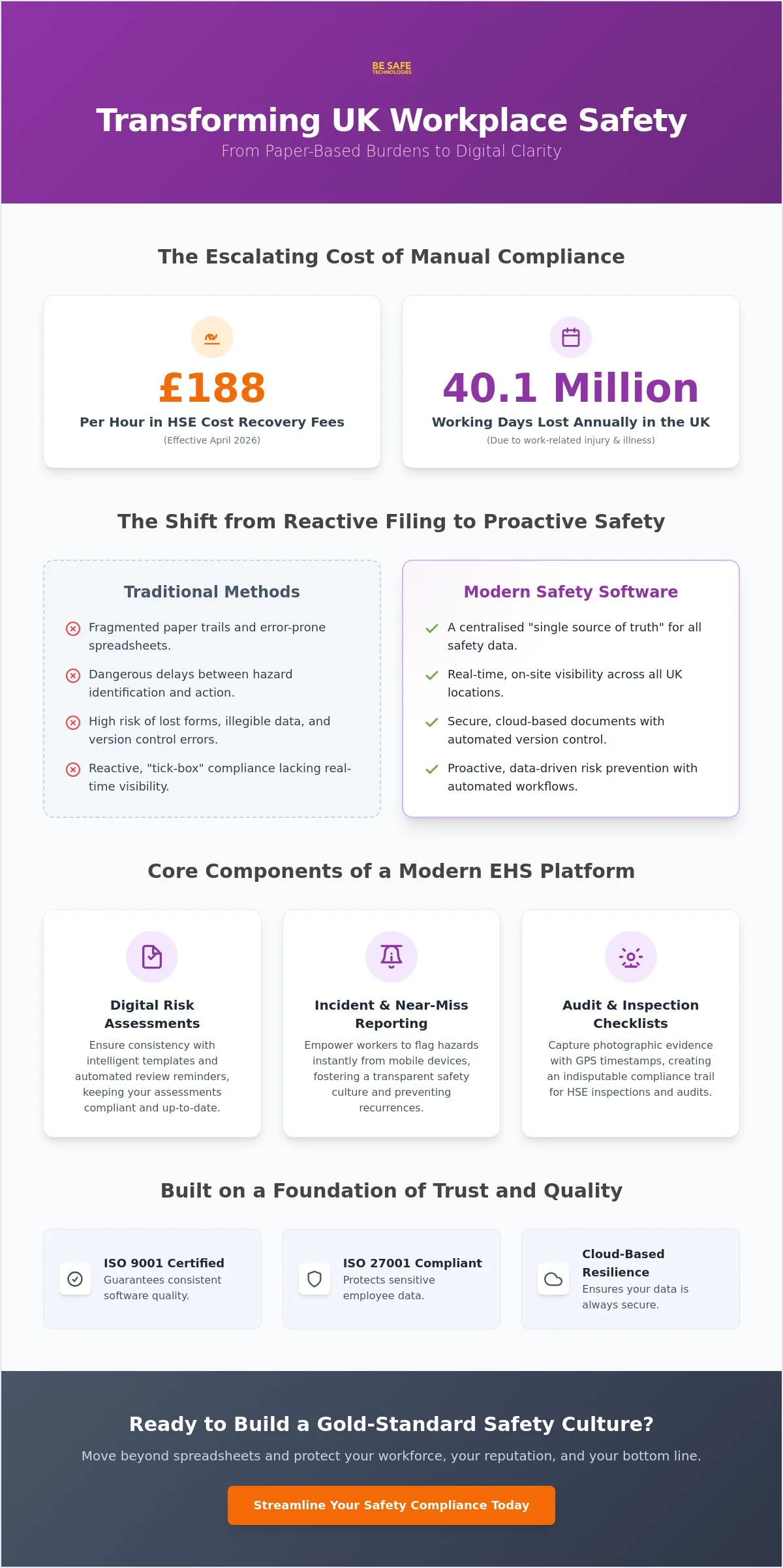
Did you know that as of April 2026, a single HSE intervention now costs businesses £188 per hour in cost recovery fees? With work-related injuries and illnesses resulting in 40.1 million lost working days annually, the pressure to maintain flawless records has never been higher. You likely feel the weight of drowning in paper-based risk assessments whilst struggling to maintain real-time visibility across multiple sites. It’s a stressful position to be in, especially when the threat of a surprise inspection or a heavy fine is always at the back of your mind.
This guide demonstrates how modern workplace health and safety software can transform your compliance from a bureaucratic hurdle into a streamlined, manageable part of your daily operations. You’ll learn how digital platforms create a centralised “single source of truth” for your data, significantly reducing administrative burdens whilst protecting your workforce across the UK. We’ll preview the essential features you need to navigate the October 2026 UK REACH deadlines and show you how to present a gold-standard safety culture during every audit or tender opportunity.
Key Takeaways
- Learn how to transition from fragmented manual processes to a centralised workplace health and safety software platform that provides real-time visibility across all your UK sites.
- Understand the critical role of ISO 27001 and ISO 9001 certifications in protecting sensitive employee data whilst ensuring consistent software quality across your organisation.
- Discover why moving away from spreadsheets eliminates the legal risks associated with version control errors and missing documentation during HSE inspections.
- Identify practical strategies for implementing mobile-first digital tools that drive high engagement amongst site workers without causing operational disruption.
- Explore how digitising your contractor management processes helps your business meet its legal obligations under the CDM 2015 regulations.
What is Workplace Health and Safety Software?
At its core, workplace health and safety software is a centralised SaaS (Software as a Service) platform designed to manage an organisation’s entire safety ecosystem from a single digital hub. Rather than relying on disparate folders, paper logs, or local hard drives, these platforms host all essential data in the cloud. This allows safety managers to digitise Risk Assessments, Method Statements (RAMS), and incident reporting, ensuring that every document is version-controlled and instantly accessible to those who need it. In the UK, this technology is engineered to align with Health and Safety Executive (HSE) standards, providing a framework that supports legal compliance whilst fostering a proactive safety culture. It represents a fundamental shift from reactive filing, where documents are only retrieved after an accident, to proactive, real-time safety monitoring that identifies risks before they escalate.
The Evolution from Paper to Digital Platforms
The transition from “clipboards and filing cabinets” is driven by the need for speed and accuracy in modern UK industry. Traditional paper systems are often plagued by illegible handwriting, lost forms, and significant delays in communication. These limitations create a dangerous lag between a hazard being identified on-site and a manager being able to intervene. Cloud technology solves these issues by allowing for instant data synchronisation across multiple sites, whether they are located in London, Manchester, or a remote offshore facility. By adopting a “mobile-first” approach, workers on a construction site or shop floor can input data directly into the system. This ensures that safety information is never trapped in a physical folder, giving management a live view of the safety status across the entire business. For organisations ready to take this step, our guide to paperless health and safety in 2026 provides a clear roadmap for establishing a single source of truth across all your UK sites.
Core Components of an EHS Management System
A robust EHS management system typically includes several key modules that work together to create a safer environment. Effective workplace health and safety software provides the structure needed to protect both the workforce and the business’s legal standing through several core features:
- Digital risk assessment builders: These tools use intelligent templates to ensure consistency across the business. They include automated review reminders, ensuring that assessments are updated as work environments change or as new regulations are introduced.
- Incident and “near-miss” reporting: Mobile modules allow employees to flag hazards instantly. This rapid communication is essential for preventing repeat occurrences and building a transparent reporting culture where every voice is heard.
- Audit and inspection checklists: Digital forms allow users to capture photographic evidence and GPS timestamps directly from the site. This provides a clear, indisputable trail of compliance that is invaluable during HSE inspections or insurance audits.
By integrating these components, businesses move away from a “tick-box” exercise and towards a dynamic system that actively reduces risk. This digital transformation ensures that safety remains a manageable part of business operations rather than a bureaucratic burden.
The Technical Pillars of Modern Safety Management
Behind every effective digital safety strategy lies a robust technical infrastructure. Whilst the user interface is what site workers interact with, the underlying architecture determines the reliability and security of your data. For UK organisations, choosing a platform built on recognised international standards is not merely a preference; it’s a necessity for risk mitigation. High-quality workplace health and safety software leverages ISO 9001 certifications to guarantee that the development process is consistent and focused on continuous improvement. This ensures that the tools you rely on today will remain functional and compliant as your business grows.
Cloud-based storage provides a level of business continuity that traditional paper or local server systems cannot match. In the event of a local disaster, such as a fire or hardware failure at a head office, your safety records remain secure and accessible from any internet-enabled device. This resilience is paired with automated workflows that eliminate the “human error” factor in compliance scheduling. Instead of a manager needing to remember a specific review date, the system triggers notifications automatically. This proactive approach ensures that no risk assessment expires and no training certification lapses, maintaining a constant state of audit-readiness.
Data Security and GDPR Compliance in Safety
Managing health data and accident reports carries significant responsibility under UK GDPR. Because these documents often contain sensitive personal information, high-level encryption is essential to prevent unauthorised access. Secure user permissions allow you to control exactly who can view specific records, ensuring that confidentiality is maintained across different departments. ISO 27001 provides a rigorous framework that ensures data integrity and availability, protecting UK businesses from the financial and reputational fallout of a security breach. Implementing a certified digital compliance solution ensures your sensitive records are handled with the professional care they require.
Real-Time Reporting and Dashboard Analytics
Live dashboards transform raw safety data into actionable insights for senior leadership. Rather than waiting for monthly reports, directors can view an instant overview of organisational risk across multiple sites. This transparency is vital for identifying recurring hazards through trend analysis. If data shows a spike in “near-miss” incidents at a specific location, management can intervene before a serious accident occurs. Utilising these analytics allows safety professionals to present clear, evidence-based justifications for safety investments to board-level stakeholders, moving the conversation from cost to value.
Why UK Businesses are Abandoning Spreadsheets for SaaS
Falling into the “spreadsheet trap” is a common pitfall for UK businesses attempting to manage complex safety requirements manually. Whilst Excel is a versatile tool for finance, it lacks the structural integrity required for rigorous safety logging. Version control issues often lead to multiple “final” versions of the same document, whilst broken formulas can silently corrupt months of incident data. These technical failings create significant legal risks. During an HSE inspection or an insurance claim, the inability to produce a specific document can lead to costly Fee for Intervention (FFI) charges, which currently stand at £188 per hour. Using dedicated manufacturing safety compliance tools provides the industry-specific structure that generic spreadsheets simply cannot offer.
Beyond mere document storage, modern workplace health and safety software fosters a genuine culture of safety. When digital tools are intuitive and accessible, employees are far more likely to engage with reporting and assessments. This shift from a paper-heavy burden to a streamlined digital experience empowers staff at all levels to take ownership of their environment. It transforms safety from a top-down mandate into a collaborative, everyday practice that protects everyone on site. Transitioning to a fully paperless health and safety system is one of the most effective ways to eliminate the delays and inconsistencies that paper-based processes introduce. For organisations working with hazardous substances, adopting a dedicated COSHH assessment digital tool is an essential step in replacing paper-based Safety Data Sheets with a system that delivers real-time chemical risk visibility across multiple sites.
Accountability and the Digital Audit Trail
The concept of the “Golden Thread” of information is now central to UK safety compliance. This refers to a continuous, recorded history of safety decisions and actions that remains accessible throughout the lifecycle of a project or building. Digital signatures and time-stamped entries provide indisputable proof that training and inductions took place as scheduled. This creates an unalterable record that protects the business during audits. For a broader look at how these systems integrate into your wider strategy, you can explore our guide on health and safety compliance software.
Reducing the Administrative Burden
Moving from manual entry to automated reporting can save safety managers hours of administrative work each week. Instead of chasing paper forms, data is captured at the source and instantly formatted into professional reports. This efficiency is enhanced by “offline-first” mobile apps, which are essential for remote sites or steel-framed warehouses with poor connectivity. These apps allow workers to record data without a signal, synchronising automatically once a connection is restored. Automated notifications further protect the business by ensuring that no risk assessment ever expires unnoticed, maintaining a constant state of compliance without the need for constant manual oversight.
How to Implement Safety Software Without Site Disruption
Transitioning to a digital system doesn’t require a total halt to your operations. In fact, the most successful implementations are those that feel like a natural evolution rather than a forced disruption. Start by auditing your current paper-based processes to identify which forms are genuinely redundant. If a process is already inefficient on paper, digitising it will only create a digital bottleneck. By streamlining your workflows before you migrate, you ensure that the new system delivers immediate value.
Selecting a mobile-first workplace health and safety software platform is the single most effective way to ensure high adoption rates amongst site workers. If the tool is accessible on a smartphone or tablet, employees can complete assessments and report hazards directly from the shop floor. This eliminates the need for them to return to a central office, saving time and increasing the accuracy of the data captured. To manage the transition smoothly, run a pilot programme within a single department or site. This allows you to gather practical feedback and resolve any minor issues before a company-wide launch.
A phased roll-out is often more effective than a “big bang” approach. You can begin by starting all new records digitally whilst gradually migrating historical data over several months. This reduces the immediate administrative pressure on your team and allows everyone to become comfortable with the new interface at a manageable pace. Focusing your training sessions on “what is in it for the worker” helps to build early buy-in, as staff quickly see how the software reduces their daily paperwork burden.
Choosing the Right Software Partner
When evaluating providers, prioritise those with a dedicated UK-based support team. Having experts who understand the nuances of UK legislation and operate in your time zone is invaluable during the initial setup. The user interface must be simple enough for a non-technical worker to navigate without extensive training. Additionally, check for modularity; your software should have the flexibility to grow alongside your business. If you are ready to modernise your approach, explore our implementation roadmap to see how we support your transition.
Training and Cultural Adoption
Overcoming tech-resistance amongst long-term employees requires a supportive and instructional approach. Utilise “Toolbox Talks” to introduce the digital system in a familiar environment, demonstrating how it simplifies their specific tasks. Establishing a clear feedback loop is essential; when workers see their suggestions reflected in how digital forms are structured, they feel a greater sense of ownership. This collaborative effort ensures the technology adapts to the user, rather than forcing the user to adapt to the tool.
Beyond Staff Safety: Managing Contractors Digitally
Many UK organisations manage their internal staff safety with precision but find that third-party contractors remain a significant blind spot. This gap in oversight can lead to fragmented safety data and increased risk on-site. Under the Construction (Design and Management) Regulations 2015 (CDM 2015), the “client” holds clear legal responsibilities to ensure that any contracted work is planned, managed, and monitored correctly. Relying on paper-based checks for external teams often results in missing certifications or lapsed insurance, which can compromise your entire safety standing. By integrating your core workplace health and safety software with specialised contractor management software UK, you create a unified ecosystem where every individual on site is held to the same high standard.
The synergy between Compliance Genie and Contractor Genie provides 360-degree site visibility. Whilst Compliance Genie handles your internal risk assessments and incident logs, Contractor Genie ensures that external partners are fully vetted before they even set foot on your premises. This holistic approach removes the silos that often exist between different workforces, allowing management to oversee the safety of the entire site from a single, integrated dashboard. This total oversight is essential for maintaining operational harmony amongst diverse teams.
Streamlining Site Inductions and Permits
Digitising high-risk processes such as the “Permit to Work” ensures that dangerous activities, like hot works or confined space entry, are only performed under strict, recorded conditions. Digital platforms allow you to verify contractor insurance and professional certifications automatically. This proactive verification means that anyone with expired credentials is flagged before they arrive. Additionally, digital sign-in systems and automated safety briefings significantly reduce “reception desk friction.” Contractors can complete their inductions remotely, ensuring they are productive and safe from the moment they arrive, whilst providing you with a time-stamped record of their compliance.
The Be-Safe Approach: Compliance Genie
Choosing a safety partner requires a focus on reliability and recognised standards. Compliance Genie is an award-winning, UK-developed platform designed specifically to meet the complexities of British safety regulations. Our commitment to quality is evidenced by our ISO 9001 and 27001 certifications, which provide the peace of mind that your data is secure and your processes are consistent. We believe that safety management should be a streamlined part of your business operations rather than a bureaucratic burden. If you are ready to transform your site visibility and protect your entire workforce, we invite you to organise a demonstration of Compliance Genie today.
Future-Proofing Your UK Safety Strategy
Adopting a digital safety ecosystem is a vital step in future-proofing your business against evolving regulatory demands. By centralising your data within a robust workplace health and safety software platform, you eliminate the vulnerabilities of manual systems whilst ensuring your organisation remains audit-ready. You’ve explored how a mobile-first approach drives engagement on-site and how ISO-certified infrastructure secures your sensitive data against modern threats.
Compliance Genie provides the tools you need to maintain total oversight of both staff and contractors across every site. Our award-winning UK-based support team helps you implement a mobile-first design that workers actually want to use. Because we’re ISO 9001 and 27001 certified, you can trust that your compliance is built on a foundation of international excellence.
Book a demo of Compliance Genie today to start your journey towards a more efficient, safer workplace. We’re ready to help you gain the clarity and control your business deserves.
Frequently Asked Questions
What is the best workplace health and safety software for small UK businesses?
Compliance Genie is an ideal choice for small UK businesses because it offers a scalable, user-centric platform that simplifies complex regulations. It’s designed to grow with your organisation, providing essential tools like digital risk assessments and incident reporting without the overhead of unnecessary enterprise features. This makes it a cost-effective way to ensure your safety standards remain high whilst reducing the administrative burden on your team.
Is digital health and safety software legally recognised by the HSE?
The Health and Safety Executive (HSE) doesn’t “approve” specific brands, but they fully recognise and accept digital records for compliance purposes. Modern workplace health and safety software provides the clear, time-stamped audit trail that inspectors look for during an intervention. It ensures that your documentation is always organised and accessible, which is far more reliable than searching through physical filing cabinets during a surprise inspection.
Can I use safety software on my mobile phone whilst on a construction site?
Site workers can definitely use their mobile phones to manage safety tasks whilst on a construction site. Mobile-first platforms allow employees to complete site inductions, view RAMS, and report hazards in real-time without leaving their work area. This immediate access to information improves site safety and ensures that critical data is captured accurately at the source, rather than being forgotten at the end of a shift.
How much does workplace health and safety software cost in the UK?
Pricing for workplace health and safety software in the UK typically operates on a per-user or per-site subscription basis. You can learn more about SaaS Platform Subscriptions to understand how these models support long-term safety performance. Whilst costs differ based on your specific requirements and the complexity of your operations, most providers offer tiered plans to suit various business sizes. It’s best to request a tailored quote to ensure you only pay for the modules you need, whether that’s basic risk management or comprehensive contractor oversight.
Does EHS software help with ISO 45001 certification?
What happens to my safety data if I lose internet connection on-site?
If you lose your internet connection on-site, “offline-first” functionality ensures your work isn’t lost. You can continue to fill out forms and capture photos within the app as normal. Once your device regains a signal, the software automatically synchronises your data with the central hub. This ensures that remote sites or areas with poor connectivity, such as steel-framed warehouses, can maintain consistent safety records.
Can I migrate my existing paper risk assessments into a digital system?
You can certainly migrate your existing paper-based risk assessments into a digital format. Most systems allow you to either upload scanned copies as historical records or, more effectively, recreate them using digital templates. Recreating them allows you to take full advantage of automated review reminders and live data tracking, ensuring your assessments stay current and compliant with the latest UK safety standards.
Is it difficult to train staff to use health and safety apps?
Training staff to use safety apps is generally very simple, provided the software has an intuitive user interface. Most employees are already comfortable using smartphones for personal tasks, so transitioning to a work-based app feels familiar. When training is combined with “Toolbox Talks” that highlight how the software reduces their daily paperwork, adoption rates amongst site workers tend to be very high.