



Permit to Work Software UK: 2026 Digital Safety Guide

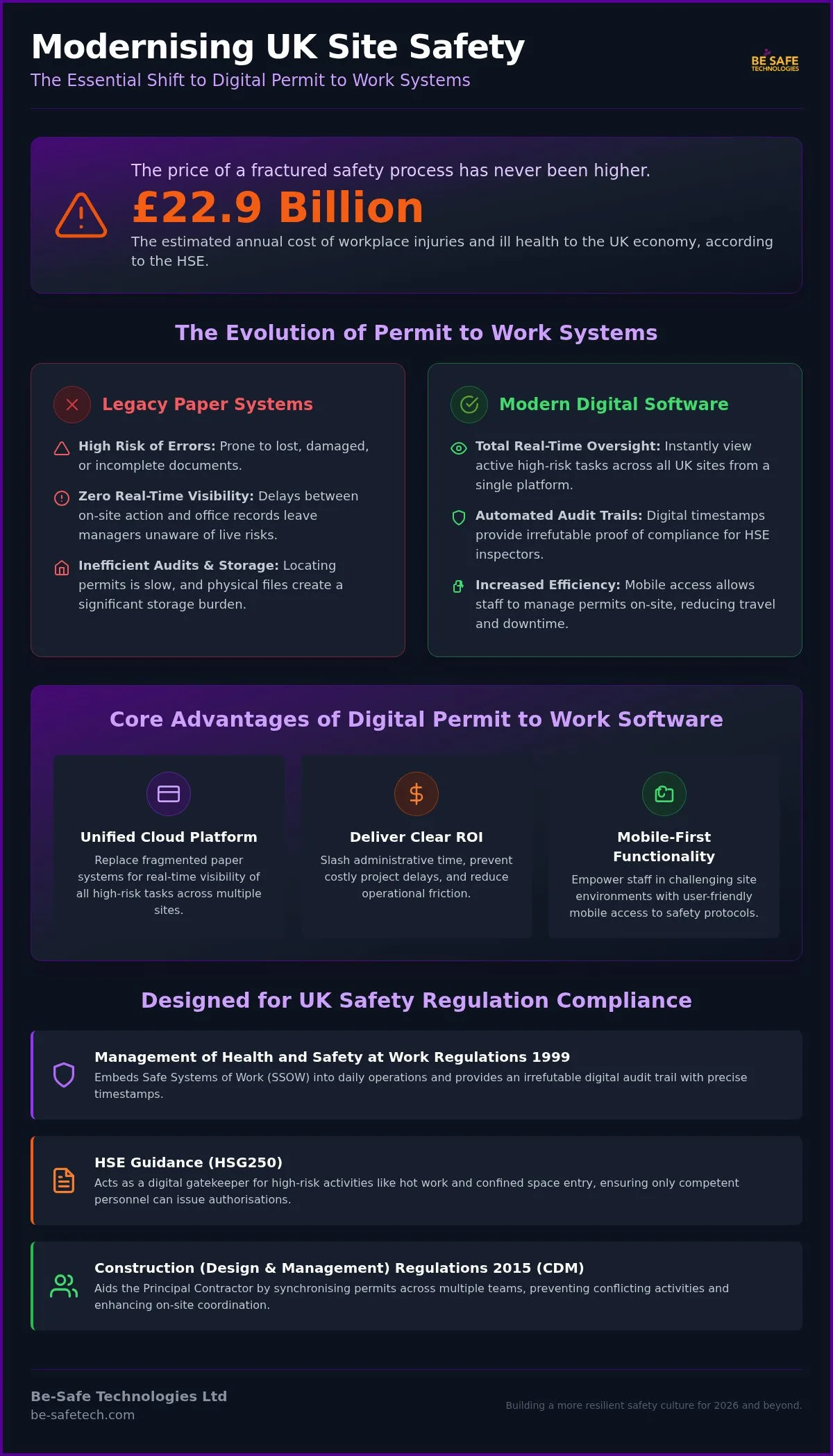
With the HSE reporting that workplace injuries and ill health cost the UK economy an estimated £22.9 billion in a single year, the price of a fractured safety process has never been higher. You likely recognise the daily friction of chasing paper forms across multiple sites or the persistent worry that a contractor might start high-risk work without a valid authorisation. Implementing a robust permit to work software uk solution is no longer just a digital upgrade; it’s a vital step in protecting your workforce and ensuring your business remains compliant with HSG250 standards.
This guide explores how to transition from cumbersome manual filing to a streamlined, digital system that enhances site safety and operational efficiency. By moving to a cloud-based platform, you gain total oversight of high-risk activities and automated audit trails that provide genuine peace of mind. We will examine the essential steps to modernise your safety protocols, reduce administrative time, and build a more resilient safety culture for 2026 and beyond.
Key Takeaways
- Learn how to replace fragmented paper systems with a unified cloud platform for real-time visibility of all high-risk tasks.
- Understand the specific digital requirements for maintaining compliance with UK safety regulations, including HSG250 and CDM 2015.
- Discover how permit to work software uk delivers a clear ROI by slashing administrative time and preventing costly project delays.
- Identify the essential mobile-first features that ensure safety protocols remain user-friendly for staff operating in challenging site environments.
- Explore how a centralised digital ecosystem can seamlessly manage both internal safety standards and external contractor compliance.
The Evolution of Permit to Work Systems in the UK
A Permit to Work system is a formalised management control used to ensure that high-risk work is authorised and performed safely. Traditionally, UK site managers relied on physical folders and carbon-copy pads to track these activities. However, the adoption of permit to work software uk has changed this dynamic, moving the process into a real-time, cloud-based environment. This shift is a key component of modern health and safety compliance software, as it replaces slow, manual filing with instant data access that supports better decision-making.
The Limitations of Paper-Based Permits
Paper records are inherently fragile and difficult to manage across multiple sites. When a permit is signed in the field, there is often a significant lag time before that document reaches the head office for filing. This delay leaves safety managers in the dark about live site risks. If an HSE inspector arrives unannounced, finding a specific historical permit amongst stacks of lever-arch files is a stressful and error-prone task. Lost or damaged documents don’t just create administrative headaches; they represent a failure in your safety audit trail that could lead to substantial legal consequences. Physical storage also presents a logistical challenge, as maintaining years of paper records requires significant office space and makes identifying long-term safety trends nearly impossible.
Why Digital PtW is Essential in 2026
In 2026, the speed of UK business requires safety systems that can keep pace with 24/7 operations. Digital platforms offer real-time oversight, allowing you to see exactly which high-risk tasks are active across the country at any given moment. By implementing a robust permit to work software uk solution, you can set up instant notifications for permit requests and expirations, ensuring that no work continues beyond its authorised window. This standardisation is particularly helpful when managing a diverse, multicultural workforce. Digital templates ensure that every worker, regardless of their background, follows the same rigorous safety protocols. Mobile-first systems also empower workers to complete permit applications directly from their devices whilst on-site. This removes the need for staff to travel back and forth to a central office, significantly reducing ‘unplanned downtime’ and allowing safety to become a proactive tool rather than a bureaucratic hurdle.
Aligning Digital Permits with UK Safety Regulations
Under the Management of Health and Safety at Work Regulations 1999, employers must implement effective arrangements for the planning, organisation, and control of safety measures. A digital permit to work software uk solution provides the structural framework needed to embed these Safe Systems of Work (SSOW) into daily operations. Rather than treating safety as a separate administrative task, software integrates it directly into the workflow, ensuring that no high-risk task begins without a formal risk assessment. Digital timestamps provide an irrefutable audit trail for HSE inspectors by recording the exact second a permit was authorised, issued, and closed. This transparency reduces the stress of inspections, as you can prove compliance with a few clicks rather than digging through paper archives.
Meeting HSE Expectations for High-Risk Activities
The Health and Safety Executive (HSE) often cites poor communication and inadequate monitoring as primary causes of accidents. By Aligning with UK Safety Regulations through HSG250 guidance, digital systems manage high-risk activities like hot work, confined space entry, and working at height with precision. The software acts as a gatekeeper, ensuring that only competent, pre-verified personnel can sign off on these tasks. This effectively prevents the common “permit-to-work failures” often cited in legal cases, such as work starting before isolation is complete or permits being handed over without a physical site check. This level of control gives you professional assurance that every precaution is in place before a spark is struck or a harness is clipped.
CDM 2015 and the Principal Contractor’s Duties
The Construction (Design and Management) Regulations 2015 (CDM) place significant responsibility on the Principal Contractor to coordinate safety amongst diverse groups of workers. When multiple contractors operate on a single site, the risk of conflicting activities increases. Adopting a dedicated permit to work software uk platform allows you to synchronise these permits, ensuring that different teams aren’t inadvertently creating hazards for one another. It also ensures the Health and Safety File is updated with digital records in real-time, providing a transparent history of site activity. This streamlined communication of site-specific risks via mobile apps helps foster a proactive safety culture whilst keeping every worker informed. You can explore how digital tools simplify these complex duties to keep your projects on track and fully compliant.
Analysing the ROI of Digital PtW Software
Investing in permit to work software uk is often viewed as a compliance necessity, yet the financial returns extend far beyond simple regulatory adherence. When you consider that the total cost of workplace injuries and ill health in the UK reached £22.9 billion in the 2023/2024 reference year, the value of preventing a single incident is clear. Transitioning to a digital system removes the hidden costs of paper, such as printing, physical storage, and the administrative hours spent manually cross-referencing records. By following the Health and Safety Executive (HSE) guidance on permit to work systems, businesses can transform their safety protocols into a lean, efficient operation that actively protects the bottom line. This financial logic also applies to your broader safety ecosystem, as you can see in our guide on mastering health and safety risk assessment software.
Time Savings and Operational Efficiency
Mitigating the Financial Risk of HSE Fines
The financial consequences of safety failures in the UK are significant, with recent court cases resulting in six-figure fines for companies that failed to manage high-risk permits correctly. An incomplete paper trail is often the deciding factor in these legal battles. A digital system provides a robust legal defence by maintaining an irrefutable, time-stamped history of every safety check performed. This level of oversight can also lead to lower insurance premiums, as providers recognise the reduced risk profile of a digitally managed site. Knowing your data is secure and ISO 27001 compliant offers an additional layer of professional assurance, ensuring that your safety records are as protected as your workforce.
Selecting the Right PtW Software for UK Operations
Selecting the right permit to work software uk requires a focus on practical site realities rather than just office-based functionality. While many platforms offer basic digital forms, the unique challenges of UK infrastructure projects demand a higher level of technical resilience. For instance, workers wearing heavy PPE or operating in harsh weather conditions need a mobile-first interface that’s intuitive and easy to navigate with gloved hands. Reliability is the cornerstone of safety; you must ensure the technology adapts to the worker’s environment rather than forcing them to struggle with an unsuitable tool. A critical requirement for remote UK infrastructure projects is a robust offline mode that allows safety protocols to continue without interruption when 4G or 5G signals drop.
Essential Technical Features
A truly effective system must include offline synchronisation to ensure data is captured on-site and uploaded automatically once connectivity is restored. This prevents the loss of vital safety information in deep basements or rural utility sites where your permit to work software uk must remain fully functional. Additionally, integrated photo uploads allow teams to provide visual evidence of safety checks before and after high-risk work. These images, combined with legally binding, time-stamped digital signatures, create a comprehensive record that’s far more reliable than a standard paper signature. These features don’t just record safety; they actively encourage a culture of thoroughness amongst your team.
Security and Compliance Standards
UK businesses should prioritise vendors that hold ISO 27001 and ISO 9001 certifications to guarantee data security and quality management. Cloud-based data must be stored in secure, UK-compliant data centres to meet local regulatory expectations and provide peace of mind to corporate stakeholders. For those involved in public sector or large-scale infrastructure, G-Cloud approval is a significant indicator of a vendor’s reliability and ease of procurement. It’s also vital that the software can digitise paper risk assessments seamlessly to ensure a holistic approach to site safety. Choosing a certified, UK-based partner provides the quiet confidence that your safety data is managed to the highest industry standards. You can book a demonstration of our ISO-certified platforms to see these features in action.
Compliance Genie: Modernising Permit to Work Processes
Compliance Genie represents the next generation of permit to work software uk, designed specifically to meet the rigorous demands of British industry. By consolidating your safety protocols into a single, mobile-first platform, you create a definitive “source of truth” for all health and safety data. This centralised approach eliminates the fragmentation often seen with legacy systems, where risk assessments and permits are stored in separate physical or digital silos. Instead, Compliance Genie ensures that every piece of safety information is interconnected, providing your management team with a holistic view of site operations. This transition replaces bureaucratic friction with a streamlined workflow that supports your team instead of hindering them.
Contractor Genie further strengthens this ecosystem by focusing on the complexities of external worker management. It handles site visits, inductions, and external permit compliance with the same level of precision, ensuring that every contractor on your site meets your internal safety standards before they begin work. When coordinating with specialised external safety personnel or fire watch services such as Vita Secure, having clear digital oversight is vital. This level of control is essential for maintaining professional assurance when operating across multiple high-risk environments. Having a unified platform means you no longer have to worry about lost paperwork or unverified credentials, as every detail is captured and stored securely in the cloud.
A Unified Safety Ecosystem
The true power of this digital transition lies in the ability to link risk assessments directly to the relevant Permit to Work. This ensures that the precautions identified during the planning phase are actively enforced on the ground at the moment of authorisation. When these processes are integrated, you can also manage contractor certifications and inductions through Contractor Genie, preventing unauthorised work by untrained personnel. For board-level stakeholders, the system can generate instant compliance reports that demonstrate a proactive safety culture with quantifiable data. You may also find that digital audit checklist software provides the perfect complement to your PtW system by ensuring that regular site checks are conducted with the same digital rigour.
Getting Started with Be-Safe Technologies Ltd
Moving from a paper-heavy process to a digital platform like Compliance Genie is a structured and manageable journey. Our onboarding process is designed to be simple, ensuring that your site operations continue without disruption whilst your team learns the new system. As an ISO 9001 and 27001 certified provider, Be-Safe Technologies Ltd acts as a practical ally, offering ongoing support and regular software updates to keep you ahead of evolving UK regulations. This partnership ensures that your safety management remains modern, reliable, and fully compliant with the latest HSE standards. If you’re ready to gain total oversight of your high-risk activities, organise a consultation with Be-Safe Technologies Ltd today to begin your digital transformation.
Securing Your Future with Digital Safety Innovation
Modernising your approach to high-risk task management is a strategic investment that yields long-term dividends in both safety and productivity. Moving away from fragmented paper records establishes a resilient framework that meets the highest HSE expectations and provides an irrefutable audit trail. Adopting a professional permit to work software uk solution allows your team to focus on safe execution rather than administrative hurdles; it ensures that every precaution is verified in real-time. This digital transition fosters a proactive safety culture whilst protecting your business from the significant financial risks of non-compliance.
Be-Safe Technologies provides the expert support and technical infrastructure needed to make this shift seamless. As an ISO 27001 and ISO 9001 certified provider, we offer a mobile-first cloud architecture that’s built for the realities of UK site environments. You can gain total oversight and quiet confidence by integrating these tools into your daily operations. Request a demo of Compliance Genie and modernise your site safety today. Taking this step ensures your safety management remains as innovative and reliable as the projects you deliver.
Frequently Asked Questions
What is the primary purpose of Permit to Work software in the UK?
The primary purpose of permit to work software uk is to provide a formalised management control for high-risk activities such as hot work, confined space entry, and working at height. It ensures that all safety precautions identified in a risk assessment are physically in place before work is authorised to begin. By digitising this process, businesses create a transparent, time-stamped audit trail that reduces the risk of human error and improves site-wide safety coordination.
Is digital Permit to Work software legally recognised by the HSE?
Digital Permit to Work systems are fully recognised and encouraged by the Health and Safety Executive (HSE) as a valid method of compliance. The HSE’s guidance document, HSG250, outlines the principles of a robust system; digital platforms often exceed these requirements by providing irrefutable timestamps and secure data storage. Using a digital system helps businesses meet their general duties under the Health and Safety at Work etc. Act 1974 more effectively than paper records.
Can Permit to Work software work on sites with no internet connection?
Modern platforms are designed with a robust offline mode specifically for remote UK infrastructure projects or deep basement sites where connectivity is limited. Workers can complete permit applications, capture photos, and record digital signatures without a live signal. Once the device reconnects to a 4G, 5G, or Wi-Fi network, all data synchronises automatically with the central cloud server. This ensures that safety protocols remain uninterrupted regardless of the site’s geographic location or signal strength.
How does digital PtW software improve contractor management?
Digital systems improve contractor management by providing real-time visibility of every external worker on your site. Through tools like Contractor Genie, you can verify contractor certifications, inductions, and insurance documents before a permit is even requested. This prevents unauthorised work and ensures that every individual is competent for the task at hand. It also streamlines the communication of site-specific risks, creating a consistent and reliable safety culture amongst your diverse, multicultural workforce.
What industries in the UK benefit most from PtW software?
While any business performing high-risk tasks benefits, the most significant impact is seen in construction, manufacturing, utilities, and facilities management. These sectors frequently deal with complex environments where multiple contractors operate simultaneously. The use of permit to work software uk is particularly vital in these industries to prevent conflicting activities and ensure that isolation procedures are strictly followed. Where operations involve potentially explosive atmospheres, pairing digital permit controls with certified equipment is essential; discover ExSafe for ATEX-rated lighting, ventilation, and power distribution tailored to hazardous environments. It provides the quiet confidence needed to manage high-hazard operations across national site networks.
How long does it take to transition from paper permits to a digital system?
The transition from paper permits to a digital system typically takes between two to four weeks; this depends on the scale of your operations and the number of active sites. Be-Safe Technologies uses a structured onboarding process to ensure your site operations continue without disruption. We recommend a phased approach, starting with a single site or permit type to build user confidence before rolling the platform out across your entire national infrastructure.
Does Compliance Genie integrate with other health and safety tools?
Compliance Genie is designed as an all-in-one health and safety ecosystem; it integrates naturally with your existing risk assessments, incident reporting, and audit checklists. This creates a single source of truth for all your compliance data, allowing for more accurate reporting and better strategic oversight. By linking these tools, you ensure that every Permit to Work is directly supported by the relevant risk assessment, creating a holistic and reliable safety management environment.