


Health and Safety Reporting Software UK: The 2026 Digital Transition Guide

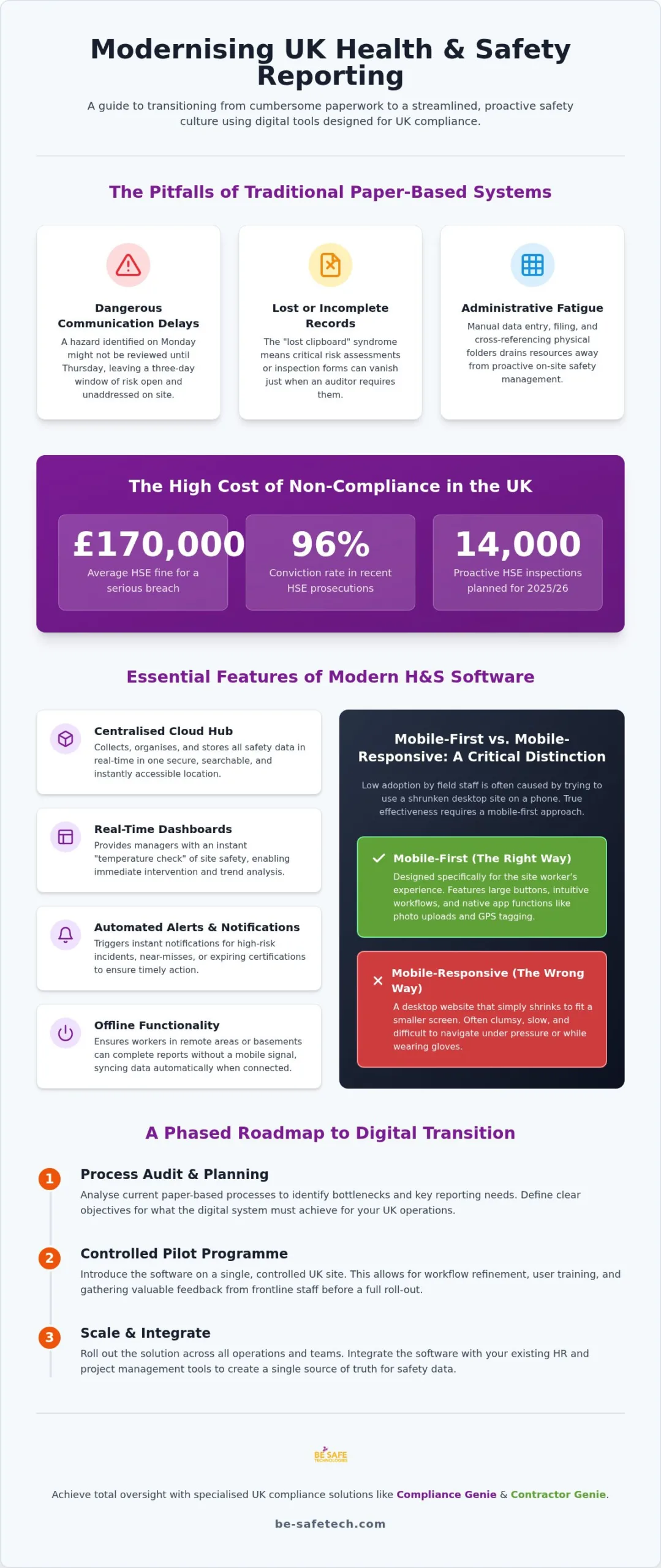
With the average HSE fine for serious breaches reaching £170,000 and a 96% conviction rate in recent prosecutions, the cost of delayed digital adoption has never been higher. You are likely exhausted from chasing smudged paper forms across multiple sites or trying to spot safety trends in data silos that simply don’t talk to each other. It’s frustrating when safety management feels like a bureaucratic burden rather than a streamlined, manageable part of your daily operations. You want to move beyond reactive fixes and establish a culture where every worker feels empowered to report hazards instantly.
This guide will show you how to modernise your processes using the leading health and safety reporting software UK professionals trust to achieve total oversight and full RIDDOR compliance. We will help you transition from paper to digital whilst ensuring you meet the latest 2026 standards, including the new requirements from the independent Building Safety Regulator and Martyn’s Law. By focusing on mobile-first solutions like Compliance Genie, you can reduce administrative weight and foster a proactive safety culture that protects both your people and your business reputation. We will examine the essential features of modern platforms and provide a clear roadmap for a successful digital transition.
Key Takeaways
- Understand how a centralised digital hub transforms safety management from a reactive burden into a proactive, data-driven strategy.
- Identify the essential features of health and safety reporting software UK, specifically prioritising mobile-first designs that work for frontline staff in the field.
- Discover how to evaluate software based on its ability to scale across national operations whilst integrating seamlessly with your current HR and project management tools.
- Learn the practical steps for a phased digital transition, starting with a process audit and moving to a controlled pilot on a live UK site.
- Explore how specialised solutions like Compliance Genie and Contractor Genie provide the total oversight needed to maintain rigorous HSE standards.
Why Digital Health and Safety Reporting is Essential in the UK
Modern digital health and safety reporting software UK acts as a centralised cloud hub that collects, organises, and stores every piece of safety data in real-time. This shift is crucial for UK businesses moving away from reactive management. Instead of simply reviewing accidents after they occur, a proactive approach allows you to identify trends and near-misses before they escalate into serious incidents. This transition isn’t just about changing how you record data; it’s about gaining a clearer, more accurate view of your entire operational risk profile.
With the Health and Safety Executive (HSE) planning approximately 14,000 proactive inspections for the 2025/26 period, digital record-keeping is no longer optional for those seeking to avoid heavy penalties. Moving to a paperless system provides a reliable evidence base for these inspections whilst eliminating the vast administrative hours spent on manual filing. It’s a more efficient, environmentally friendly way to manage compliance that removes the friction from daily safety tasks.
The Limitations of Paper-Based Safety Records
Physical records are inherently fragile and difficult to manage across multiple sites. We’ve all experienced the “lost clipboard” syndrome, where a critical risk assessment or site inspection form vanishes exactly when an auditor asks to see it. Beyond the risk of loss, paper causes dangerous communication delays. If a site worker identifies a hazard on Monday but the form doesn’t reach the office for review until Thursday, you’ve left a window of risk open for three days. This administrative fatigue, driven by manual data entry and cross-referencing physical folders, drains resources that should be spent on active site safety.
Meeting UK Regulatory Standards with Digital Tools
Utilising high-quality health and safety reporting software UK ensures your business remains aligned with the Reporting of Injuries, Diseases and Dangerous Occurrences Regulations (RIDDOR) 2013. This is particularly vital as the Building Safety Regulator (BSR) operates as an independent entity as of January 2026, demanding higher levels of accountability for high-risk buildings. Software creates a time-stamped, unalterable audit trail that proves exactly when a report was made and what remedial action was taken. This level of transparency offers peace of mind during regulatory reviews, as every digital entry serves as a permanent, searchable record of your commitment to the HSE’s “Plan, Do, Check, Act” framework. For property owners, it is also beneficial to visit WS Insurance Brokers to ensure comprehensive protection with specialist landlord insurance.
Key Features of Modern Health and Safety Software
Modern health and safety reporting software UK must prioritise the person on the ground to be effective. It’s not enough to have a complex system in the office if the data from the field is missing or inaccurate. High-performance platforms include real-time dashboards that provide managers with an instant “temperature check” of site safety, alongside automated alerts that trigger notifications for high-risk incidents or expired certifications. These tools allow for immediate intervention, ensuring that safety remains a live conversation rather than a monthly review of past failures.
Given that many UK infrastructure and construction projects occur in remote areas or deep within steel-framed buildings, offline functionality is essential. Workers must be able to complete reports without a mobile signal, with the data syncing automatically once they return to a connected area. This ensures that the UK’s official RIDDOR guidelines are followed without delay, even in the most challenging environments. Platforms like Compliance Genie are designed with these practicalities at their core, providing the quiet confidence that your data is both accessible and protected. You can explore how these features integrate into a single, cohesive safety ecosystem.
Mobile-First vs Mobile-Responsive
Trying to use a desktop-orientated website on a mobile phone screen is a primary cause of low user adoption amongst site teams. Mobile-first is a design philosophy that starts with the site worker, ensuring buttons are large enough for someone wearing high-vis gloves and the interface is intuitive under pressure. Native app features, such as direct photo uploads for hazard identification and GPS tagging for precise incident location, offer a level of detail that paper forms simply cannot match. When the software adapts to the user’s environment, reporting rates naturally increase.
Cloud-Based Security and UK Data Sovereignty
Protecting sensitive employee and incident data requires more than just a password. It’s vital to choose ISO 27001 compliant safety software to ensure your information is managed according to international best practices for information security. Modern systems use encrypted data storage and prioritise UK-based servers to maintain data sovereignty whilst complying with local data protection regulations. Granular user permissions further enhance security by ensuring that sensitive safety reports and personal details are only accessible to authorised personnel, reducing the risk of internal data breaches.
How to Evaluate the Best Reporting Software for Your Business
Selecting the right health and safety reporting software UK requires a strategic look at how the tool fits your long-term business goals. You need a system that offers genuine scalability, growing from managing a single site to overseeing a national operation without any loss in performance. Integration is equally vital; the software should communicate with your existing HR and project management tools to prevent the formation of data silos. Look for platforms that allow for deep customisation, enabling you to create bespoke risk assessments and reporting forms that reflect the unique hazards of your specific industry.
Prioritising providers with recognised certifications like ISO 9001 for quality management and ISO 27001 for information security is essential for long-term peace of mind. These standards ensure that your safety data is managed within a rigorous, audited framework that protects against data loss. By aligning your choice with the overarching guidance from the UK Health and Safety Executive, you ensure that your digital transition supports broader regulatory expectations whilst protecting your company from security breaches. This authoritative foundation allows you to focus on safety outcomes rather than technical troubleshooting.
Assessing User Experience (UX) for Site Adoption
A software’s success depends entirely on whether your team actually uses it. Conduct a “site test” by asking your least tech-savvy worker to navigate the interface; if they can’t understand the icons or navigation immediately, site-wide adoption will likely fail. With the UK’s diverse workforce, multi-language support is a critical feature to ensure every worker can report hazards accurately in their preferred language. Efficiency is also key, so evaluate the submission speed using the “two-minute rule.” If a basic incident report takes longer than two minutes to complete, it becomes a bureaucratic chore that workers will eventually avoid.
Comparing All-in-One Platforms vs Specialist Tools
Choosing between a comprehensive hub and a niche tool depends on your operational complexity and current pain points. For those seeking a total safety ecosystem, an all-in-one platform like Compliance Genie provides a unified solution for all reporting, auditing, and compliance needs. However, if your primary challenge involves managing high volumes of external visitors, you might require specialised contractor management software UK to handle site inductions and permits. Balancing feature depth with ease of implementation ensures you don’t over-complicate the transition whilst still achieving total oversight of your workforce.
The Roadmap: Transitioning from Paper to Digital Reporting
Moving from a legacy paper system to modern health and safety reporting software UK requires a methodical approach to ensure long-term success. The transition shouldn’t be an overnight overhaul that overwhelms your team. Instead, start with Phase 1 by auditing your existing paper processes to identify “quick win” areas for digitisation, such as daily vehicle checks or site inductions. These high-frequency, low-complexity tasks provide immediate proof of value and help build momentum for the project.
Phase 2 involves selecting a pilot team to test the software on a live UK site. This small-scale trial allows you to gather practical feedback and refine your workflows in a controlled environment before a full commitment. In Phase 3, you must standardise your digital forms to ensure data consistency across the entire organisation, which is essential for spotting national safety trends. Finally, Phase 4 focuses on a wider rollout supported by structured training and dedicated support. You can start your digital transition journey by seeing how these phases align with your current site operations.
Overcoming Resistance to Change
It’s natural for some staff to view new technology with suspicion. To ensure high adoption rates, you must frame digital reporting as a tool for individual safety rather than a “big brother” surveillance device. Highlight how the software saves workers significant time by removing the need for tedious, repetitive paperwork at the end of a long shift. Appointing “digital champions” on-site is another effective strategy; having a trusted peer available to help with the transition is often more persuasive than a directive from the head office. When workers see their colleagues using the tool successfully, the barrier to entry disappears.
Digitising Risk Assessments Efficiently
Static PDFs and physical folders often lead to outdated safety information being used on-site. Moving to dynamic, interactive digital risk assessment tools allows your team to update hazards and controls as site conditions evolve. Whilst you move forward, ensure all legacy paper data is archived securely to maintain a complete historical audit trail for regulatory purposes. Digital risk assessments become more accurate and effective when they are continuously refined by real-world site data. This shift ensures that your safety documentation is a living, breathing part of your site management rather than a forgotten document in a filing cabinet.
Achieving Total Oversight with Be-Safe Technologies Ltd
Be-Safe Technologies Ltd provides a sense of professional assurance by offering a partnership based on trust and recognised industry standards. At the centre of this partnership is Compliance Genie, which serves as a comprehensive hub for health and safety reporting software UK firms rely on to maintain total operational clarity. Unlike larger conglomerates that offer generic enterprise tools, Be-Safe Technologies Ltd focuses on the specific intricacies of UK safety regulations. This dedication ensures that your digital transition is supported by British-based development and support teams who understand your local compliance environment. With ISO 9001 and ISO 27001 certifications, you can operate with the quiet confidence that your data is handled with the highest levels of security and quality management.
Compliance Genie: Designed for the Frontline
Safety management only works if the tools are accessible to the people facing the risks. Compliance Genie is built with a mobile-first interface that prioritises ease of use for site workers, allowing them to report hazards or complete inspections whilst on the move. These individual reports feed into a powerful cloud-based system that provides instant, nation-wide safety analytics for management teams. You can customise reporting modules to adapt to your specific industry requirements, ensuring that the software fits your existing workflows rather than forcing your team to adapt to a rigid tool. This flexibility makes safety management feel like a streamlined part of daily business operations rather than an added bureaucratic weight.
Contractor Genie: Solving the Site Visit Puzzle
Managing external workers introduces a unique set of complexities that standard reporting tools often overlook. Contractor Genie solves this by centralising every aspect of the site visit, from initial onboarding and inductions to the verification of safety documentation. It ensures that every external worker is fully compliant and has acknowledged site-specific risks before they set foot on your premises. By automating these checks, you significantly reduce the liability gap often associated with third-party contractors. This creates an ecosystem where everyone on-site, whether a direct employee or an external specialist, operates under the same high safety standards.
The practical impact of implementing these platforms is documented in various case studies where UK firms have successfully reduced incident rates by digitising their safety culture. By moving away from fragmented paper records and into a unified health and safety reporting software UK ecosystem, businesses have achieved a proactive stance on risk. This transition leads to reduced administrative burdens and a more transparent safety environment. Ultimately, the goal is to provide peace of mind for corporate stakeholders whilst ensuring the human element of workplace protection remains the top priority. Choosing a specialist UK provider like Be-Safe Technologies Ltd ensures that your safety infrastructure is as resilient and reliable as the teams you protect.
Securing the Future of Your Workplace Safety
Embracing a digital approach to safety management provides the clarity needed to navigate an increasingly complex regulatory landscape. By moving beyond physical forms and siloed data, your organisation can foster a culture where hazard reporting is instantaneous and administrative burdens are significantly reduced. Implementing high-quality health and safety reporting software UK creates a unified environment where compliance is a natural outcome of daily operations rather than a stressful end-of-month scramble. This transition empowers your site teams and provides leadership with the real-time insights required for informed decision-making.
Be-Safe Technologies Ltd stands as a dedicated partner in this journey, offering award-winning, ISO 9001 and 27001 certified platforms tailored for the British market. Our mobile-first design prioritises site-worker ease of use to ensure 100% adoption across every project. Book a Compliance Genie Demo Today to discover how we can help you achieve total oversight and peace of mind. We’re committed to making your workplace safer and more efficient through modern, reliable technology.
Frequently Asked Questions
Is health and safety reporting software mandatory for UK businesses?
Whilst using specific software isn’t a legal requirement, the Health and Safety at Work etc. Act 1974 mandates that employers record and report workplace accidents. For businesses with five or more employees, these records must be in writing. Digital tools simplify this by ensuring no data is lost or overlooked. As the HSE conducts proactive inspections, having a robust digital system provides the clear evidence of compliance that inspectors expect to see.
How does digital reporting help with RIDDOR compliance?
Digital systems ensure that reportable incidents are flagged immediately according to the specific criteria of the RIDDOR 2013 regulations. By using health and safety reporting software UK, you can set automated reminders for the 10 or 15 day submission deadlines. This prevents the heavy penalties associated with late or incomplete reporting. The software creates a permanent, time-stamped record that serves as an unalterable audit trail, proving your business took immediate and appropriate action following an incident.
Can safety reporting software work without an internet connection on-site?
Leading mobile-first platforms include offline functionality specifically for remote UK sites or areas with poor signal, such as basements or steel-framed warehouses. Workers can complete their reports, take photos, and log GPS coordinates whilst offline. Once the device reconnects to a network, the data synchronises automatically with the central cloud hub. This ensures that safety reporting remains continuous and that no critical information is forgotten during the delay between site work and the office return.
What is the difference between EHS and HSEQ software?
EHS stands for Environment, Health, and Safety, focusing primarily on workplace protection and environmental impact. HSEQ adds a “Quality” component, aligning safety processes with broader quality management standards like ISO 9001. Most modern health and safety reporting software UK providers, such as Be-Safe Technologies Ltd, offer platforms that cover the full HSEQ spectrum. This integrated approach ensures that safety isn’t managed in a vacuum but is instead treated as a vital indicator of overall operational excellence.
How much does health and safety reporting software cost in the UK?
Pricing for safety software in the UK typically follows a Software-as-a-Service (SaaS) model, where costs are based on your number of active users or specific site requirements. Some providers offer tiered packages depending on whether you need basic incident reporting or a full suite including contractor management and asset tracking. Businesses should evaluate the subscription cost against the potential for significant regulatory fines, making digital adoption a strategic long-term administrative saving.
How secure is our safety data when stored in the cloud?
Security depends on the provider’s infrastructure and certifications. You should prioritise software that is ISO 27001 certified, which is the international standard for information security management. This ensures your data is encrypted both at rest and during transmission. Reliable UK providers also use domestic servers to maintain data sovereignty and comply with local data protection laws. Granular user permissions further protect sensitive information by ensuring only authorised personnel can access specific incident reports or personal data.
How long does it take to transition from paper-based reporting to a digital system?
A successful transition usually follows a phased roadmap lasting from a few weeks to several months. The initial audit and “quick win” digitisation phase can be completed quickly, whilst a site-specific pilot usually runs for two to four weeks to gather feedback. Full business integration depends on the size of your workforce and the complexity of your existing forms. Using intuitive, mobile-first tools significantly reduces this timeline by speeding up worker training and adoption.
Does the software support British Standards like ISO 45001?
Yes, digital platforms are designed to provide the structured data and audit trails required for ISO 45001, the international standard for occupational health and safety. The software helps you manage the “Plan, Do, Check, Act” cycle by centralising risk assessments, training records, and incident logs. By having all safety data in one searchable hub, you can easily demonstrate the continuous improvement and worker consultation that auditors require. This makes achieving and maintaining your certification a more manageable, automated process.