



Modernising Site Safety: UK Permit to Work Guide (2026)

What if the greatest risk to your site safety isn’t a physical hazard, but the paper trail meant to manage it? Most UK site managers understand the mounting pressure of maintaining compliance whilst juggling multiple contractors and high-risk tasks. It’s difficult to feel in control when safety documentation is scattered across physical folders or lost in email chains, leaving you vulnerable during an unexpected HSE inspection. Adopting a dedicated permit to work software UK solution replaces this uncertainty with professional assurance, ensuring every risk assessment is visible and every authorisation is verified in real time.
We recognise that you want to prioritise protection without being buried in bureaucracy. This transition doesn’t just tick a regulatory box; it creates a streamlined framework that supports your team instead of slowing them down. In this 2026 guide, we’ll outline the practical steps to digitise your permits, reduce your administrative burden, and create a safer, more organised workplace culture that meets the highest regulatory standards across your UK operations. By moving away from manual processes, you can achieve total oversight of hazardous works and the peace of mind that comes with guaranteed compliance.
Key Takeaways
- Learn how digital authorisation systems align with the Health and Safety at Work etc. Act 1974 to ensure your operations remain legally robust.
- Discover how real-time dashboards and customisable templates provide total oversight of active permits across multiple UK sites simultaneously.
- Identify the hidden risks of manual permit management and how to remove the operational bottlenecks that often slow down your site teams.
- Evaluate the essential security standards, such as ISO 27001, required when selecting the most reliable permit to work software UK for your organisation.
- Understand the benefits of a mobile-first philosophy that bridges the gap between office-based compliance and the practical reality of on-site hazardous work.
Understanding Permit to Work Software within the UK Regulatory Landscape
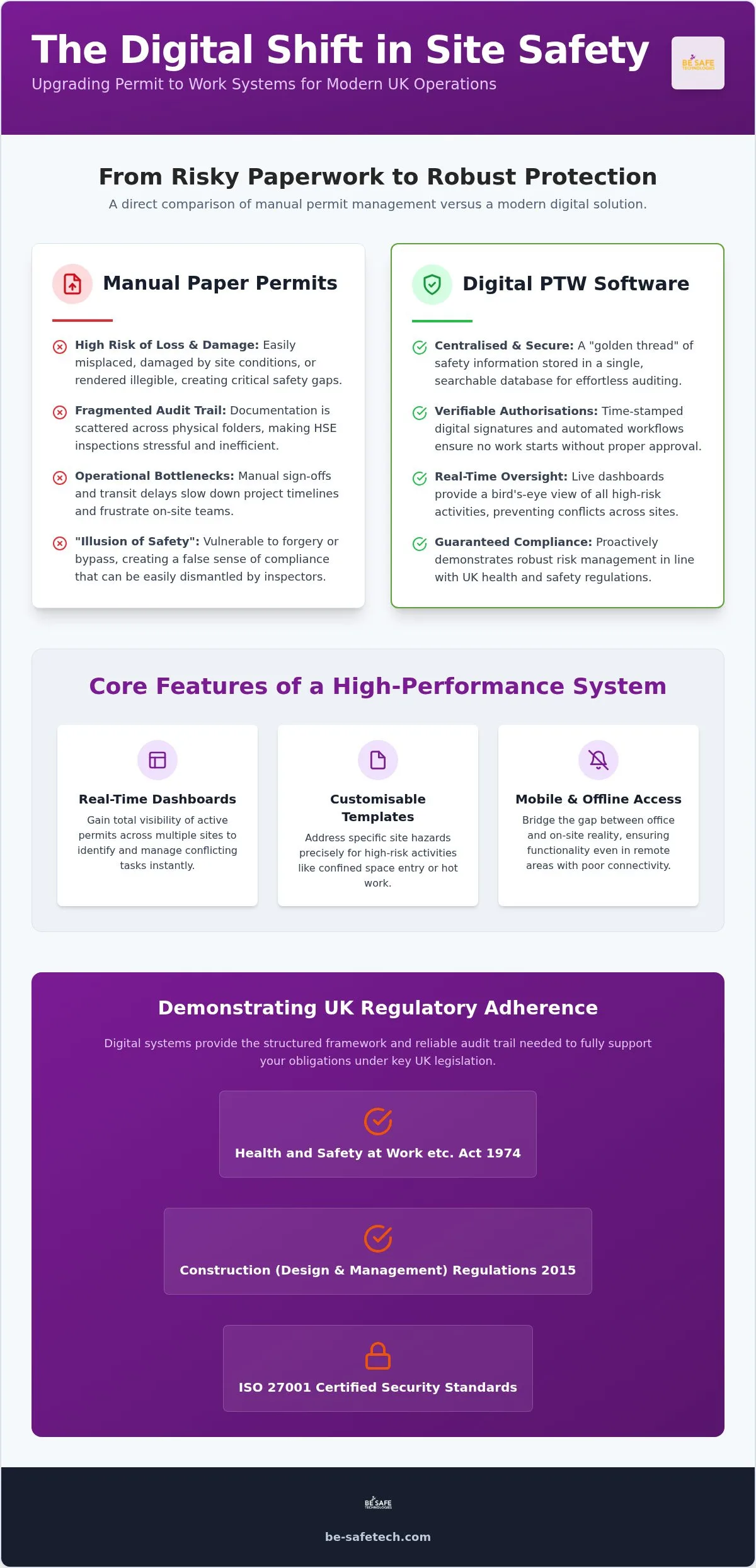
A digital Permit-to-work (PTW) system is more than just an electronic version of a paper form; it’s a robust authorisation framework designed to manage high-risk activities on-site. In the UK, industries ranging from construction to manufacturing rely on these systems to ensure that hazardous tasks, such as hot work or confined space entry, only proceed when specific safety conditions are met. Modern permit to work software UK provides a structured environment where every check is verified and every signature is timestamped, creating a reliable audit trail that manual processes simply can’t match.
This digital shift directly supports your obligations under the Health and Safety at Work etc. Act 1974. The Act places a fundamental duty on employers to ensure the health, safety, and welfare of their employees. By using a digital system, you’re demonstrating a proactive approach to risk management. Similarly, for those in construction, these tools are vital for meeting the Construction (Design and Management) Regulations 2015 (CDM 2015). They help Principal Contractors coordinate health and safety requirements, ensuring that information flows seamlessly between site managers and contractors whilst maintaining total oversight.
Why the UK is Moving Away from Paper Permits
Paper permits are notorious for being lost in transit, becoming illegible due to site conditions, or even being forged to bypass safety delays. These manual failings create an “illusion of safety” that can be dismantled during a routine HSE inspection. Digital systems solve this by creating a “golden thread” of safety information. This means every permit, from initial request to final hand-back, is stored in a central, searchable database. Beyond the safety benefits, removing the need for thousands of printed forms significantly reduces your environmental footprint, aligning your safety goals with modern corporate sustainability targets across your UK operations.
Regulatory Compliance: Beyond the Basics
A high-quality system ensures that essential documents, such as Risk Assessments and Method Statements (RAMS), are always attached to the relevant permit. It prevents work from starting unless these documents have been reviewed and accepted by the appropriate person. Protecting the data of your workforce is equally critical. When choosing permit to work software UK, look for systems that prioritise data integrity whilst providing a user-centric experience. Our Compliance Genie platform is built on ISO 27001 certified standards, ensuring that sensitive contractor information and site data are handled with the highest level of security. This level of rigour is exactly what UK safety inspectors look for; they want to see a pragmatic, reliable system that actually works in the field, not just a folder full of unread paperwork.
Essential Features of a High-Performance Digital Permit System
A high-performance permit to work software UK solution doesn’t just digitise your existing paper forms; it transforms your safety culture by providing tools that actively prevent accidents. The most effective systems offer a real-time dashboard that gives you total oversight of all active permits amongst various sites. This bird’s-eye view is essential for identifying potential conflicts, such as scheduled hot work occurring too close to a chemical delivery. By visualising hazardous tasks on a single screen, site managers can make informed decisions that protect every person on the premises.
In alignment with UK Health and Safety Executive guidance, these digital systems provide the robust technical measures necessary to prevent major accidents. Automated authorisation workflows act as digital gatekeepers, ensuring that work cannot start without the correct sign-off from a qualified authorised person. This eliminates the risk of verbal “go-aheads” that often lead to incidents. Customisable templates for high-risk activities, including confined spaces and work at height, ensure that your specific site hazards are addressed with precision rather than generic, one-size-fits-all checklists.
Mobile Connectivity and Offline Functionality
Site-based work rarely happens next to a reliable Wi-Fi router. A mobile-first approach is critical for UK sites, especially those in remote locations or deep within steel-framed structures where signals drop out. Workers need the ability to complete forms and capture evidence whilst offline, with data syncing automatically once a connection is restored. Capturing photos of safety setups and digital signatures directly on a tablet provides an indisputable record of compliance. Crucially, the interface must be simple and intuitive. This ensures that a diverse, multicultural workforce can navigate the system easily, reducing the stress often associated with complex digital tools.
Integration with Contractor Management
Your permit system shouldn’t exist in a vacuum. For maximum efficiency, it’s vital to link your permits with your contractor management software UK. This integration allows the system to automatically verify contractor competencies, such as valid CSCS cards or specific trade certifications, before a permit is even requested. If a contractor’s insurance has expired or their induction is out of date, the software can block the permit application entirely. Centralising site inductions and permits in one digital location creates a seamless experience for external partners. Exploring how Compliance Genie manages these integrated workflows can help you visualise a more organised, safer site environment.
Paper vs Digital: Overcoming the Hidden Risks of Manual Permit Management
Stacks of paper on a site manager’s desk often create a dangerous “illusion of safety.” Whilst the physical presence of a permit suggests compliance, the reality is that manual systems are prone to being bypassed, lost, or misunderstood. In high-risk environments, the time spent “waiting for the manager” to physically sign a document creates a significant operational bottleneck. This delay often tempts contractors to start work without formal authorisation, introducing behavioural risks that can lead to serious incidents. Transitioning to permit to work software UK eliminates these physical hurdles, replacing the bottleneck with a streamlined, digital workflow that maintains safety without sacrificing speed.
Manual systems also suffer from a lack of legibility and consistency. A permit is only effective if the person carrying out the work can clearly understand the controls in place. Hand-written notes on a rain-damaged form are a recipe for miscommunication. Digital platforms ensure that every instruction is clear, every hazard is explicitly identified, and every safety measure is acknowledged before work begins. This level of rigour moves safety from a passive administrative requirement to an active, site-wide behaviour.
The Real Cost of Administrative Friction
Manual systems are deceptively expensive when you calculate the hours lost to handovers, filing, and searching for historical records during audits. Modern safety management software reclaims this lost time, allowing site supervisors to focus on actual hazard observation rather than shuffling folders. There’s also a direct financial incentive; robust digital record-keeping helps UK businesses avoid the Health and Safety Executive’s “Fee for Intervention” (FFI). By proving compliance through a timestamped digital trail, you reduce the likelihood of costly regulatory disputes and demonstrate a commitment to best practices.
Improving Safety Culture and Accountability
Transparency amongst all stakeholders is the foundation of a proactive safety culture. When permit data is visible in real-time, individual accountability naturally improves because every action is logged and traceable. This level of detail reflects high-standard guidance like the Code of Safe Working Practices, which emphasises the necessity of precise authorisation and clear communication.
Beyond immediate oversight, permit to work software UK allows you to use historical data to identify recurring hazards. By analysing where permits are frequently delayed or where specific risks are constantly flagged, you can refine your RAMS for future projects. This shift from reactive filing to proactive data analysis ensures your safety procedures evolve alongside your operations, creating a workplace that is genuinely safer and more organised.
How to Select and Implement the Right PTW Solution for Your Organisation
Selecting a permit to work software UK solution requires a balance between technical capability and cultural fit. Before you evaluate specific features, it’s vital to audit your current “pain points.” You should identify whether your delays are caused by physical distance between the site office and the work face, or perhaps a lack of clarity on RAMS. Pinpointing these specific friction points allows you to choose a system that actually solves your operational problems rather than just adding another digital layer to your existing processes.
Data security is a non-negotiable factor in the selection process. Any platform you consider must adhere to ISO 27001 standards to ensure that sensitive information, including contractor certifications and worker details, remains protected against modern cyber threats. This level of certification provides the professional assurance required by corporate stakeholders and regulatory bodies alike. A system built on these standards ensures that your transition to digital is as secure as it is efficient.
Criteria for a Future-Proof Choice
You should prioritise health and safety compliance software that is designed to scale alongside your business. A system that works effectively for a single site must also be capable of managing a nationwide portfolio as your operations grow. It’s equally important to choose a vendor that offers UK-based development and support teams. These specialists understand the nuances of local regulations and can provide assistance within your specific time zone. A user-centric interface is vital; it should be intuitive enough for sub-contractors to use with minimal instruction, ensuring that safety never takes a back seat to technical frustration.
Change Management: Bringing the Site Team with You
Resistance to change is a common hurdle in traditional UK industries, especially amongst sceptics who have used paper systems for decades. To overcome this, focus your communication on the tangible benefits: less time spent on administrative paperwork and more time spent on productive work. You can utilise “Safety Champions”—respected site veterans who embrace the digital transition and can mentor their peers on the ground. This peer-to-peer support is often more effective than top-down mandates from the head office. Comprehensive onboarding ensures that everyone feels confident using the new digital workflow from day one.
Once you’ve selected a partner, it’s best to start with a pilot programme on a single, representative site. This allows you to gather feedback from a diverse, multicultural team and iron out any site-specific issues before a full-scale launch. Phasing the rollout in this way ensures that supervisors aren’t overwhelmed and that the system is fully integrated into the daily rhythm of the workplace. If you’re ready to see how a digital framework can simplify your site operations, you can request a Compliance Genie demonstration to explore these features in action.
Future-Proofing UK Site Safety with Compliance Genie
Compliance Genie represents the final step in your journey toward a modern, high-standard safety environment. As the definitive permit to work software UK solution, it acts as a digital bridge between head office strategy and site-based reality. This platform isn’t just a tool for managers; it’s a mobile-first companion designed to put safety directly into the pocket of every worker on the ground. By removing the friction associated with traditional paperwork, you empower your team to focus on the task at hand whilst the software handles the complexities of regulatory oversight.
Peace of mind is built into the very foundation of the platform. Compliance Genie is ISO 9001 and 27001 certified, ensuring that your quality management and data security protocols meet international standards. This level of certification is particularly important for UK firms handling sensitive contractor data and navigating strict HSE expectations. Choosing a certified system means you’re investing in a reliable partnership that prioritises data integrity as much as it does physical site safety. This shift allows you to move from reactive safety to proactive, data-driven management across all your UK operations.
A Centralised Hub for All Your Safety Needs
The true power of the platform lies in its ability to consolidate disparate safety processes into a single source of truth. Compliance Genie seamlessly integrates your permits with digital audit checklist software and incident reporting tools. This holistic approach ensures that all your UK health and safety data is accessible from one centralised dashboard, allowing for deeper analysis and more informed decision-making. You can customise the terminology and workflows to mirror your specific organisational culture, ensuring the software adapts to your team rather than forcing them to learn a new language.
The Be-Safe Partnership: Quiet Confidence in Compliance
Working with a UK-based innovator like Be-Safe Technologies Ltd ensures that your permit to work software UK evolves in step with local legislation and industry trends. Our development team is grounded in the practicalities of site work, resulting in a user-centric experience that respects the day-to-day challenges faced by your workforce. We’re committed to simplifying complex regulatory environments, offering a sense of total control and clarity. If you’re ready to move away from the administrative burden of paper and embrace the optimism of modern efficiency, we’re here to help you lead that change.
Organise a consultation to see how Compliance Genie can digitise your permits today.
Elevating Your Site Safety Culture
Transitioning to a digital permit system is a strategic shift that moves your organisation from reactive filing to proactive protection. By removing the physical bottlenecks of paper-based authorisation, you enable your site teams to work more efficiently whilst maintaining rigorous HSE standards. A high-performance permit to work software UK solution provides the real-time visibility needed to manage hazardous tasks across multiple sites with absolute clarity. This transformation ensures that safety remains a streamlined part of your daily operations rather than a bureaucratic burden.
As an award-winning mobile-first safety platform, Compliance Genie offers the reliability of a partner that is ISO 27001 and 9001 certified. Our UK-based expert support ensures your system evolves alongside local legislation, giving you total peace of mind in your compliance journey. You can replace the uncertainty of manual records with a robust digital framework that protects your workforce and your reputation.
Discover the quiet confidence of digital compliance with Compliance Genie.
Embracing this digital future will help you create a safer, more organised, and ultimately more resilient workplace for every member of your team.
Frequently Asked Questions
Is permit to work software a legal requirement in the UK?
No single piece of legislation in the United Kingdom explicitly mandates the use of permit to work software UK; however, it’s a primary tool for demonstrating compliance with the Health and Safety at Work etc. Act 1974. By digitising the process, you ensure that the formal authorisation systems required for high-risk activities are consistently applied and easily auditable. This proactive approach helps duty holders meet their legal obligations under the Management of Health and Safety at Work Regulations 1999.
Can digital permit software work on sites without an internet connection?
Yes, professional digital permit systems include offline functionality to accommodate remote UK sites or areas with poor mobile signal. Workers can complete forms, capture photos, and collect signatures on their devices even without an active connection. Once the device returns to an area with Wi-Fi or 4G/5G, the data automatically syncs with the central dashboard. This ensures that safety documentation is never delayed by technical connectivity issues on the ground.
How does digital PTW software improve contractor management?
Digital software improves contractor management by integrating competency verification directly into the permit application process. The system can automatically check for valid CSCS cards, trade certifications, and insurance documents before a permit is issued. This prevents unauthorised or unqualified contractors from starting hazardous work. It also provides site managers with real-time visibility into which external teams are on-site and exactly what tasks they are performing.
Is our safety data secure when using a cloud-based PTW system?
Your safety data is highly secure when you utilise a cloud-based system that holds ISO 27001 certification. This international standard ensures that sensitive information, such as contractor records and site incident data, is protected by robust encryption and rigorous security protocols. Using a UK-based provider ensures that your data management aligns with local privacy regulations and provides the professional assurance required by corporate stakeholders.
What industries in the UK benefit most from digital permit to work software?
How long does it take to transition from paper permits to a digital system?
The transition period depends on the size of your organisation, but most businesses can complete a successful pilot programme within two to four weeks. Starting with a single site allows you to gather feedback and refine your digital workflows before a wider rollout. A phased implementation strategy ensures that your supervisors and site teams feel confident using the new system, typically leading to full adoption across all sites within a few months.
Does the software support diverse languages for multicultural site teams?
Modern safety platforms are designed to support a diverse, multicultural workforce by offering multi-language interfaces. This ensures that safety-critical instructions and permit requirements are understood by every worker, regardless of their native language. Clear, digital templates and intuitive icons further reduce the risk of miscommunication, helping to foster an inclusive safety culture where everyone can follow the correct procedures safely.
Can we attach existing Risk Assessments (RAMS) to digital permits?
You can easily attach existing Risk Assessments and Method Statements (RAMS) to your digital permits. Most systems allow you to upload PDF or image files directly to the permit record, ensuring that the relevant safety documentation is always available at the point of work. This link guarantees that the specific controls identified in your risk assessment are physically acknowledged by the team before the hazardous activity begins.