


DSE Assessment Software UK: A Complete Guide to Digital Compliance in 2026

Did you know that musculoskeletal disorders account for nearly a third of all lost-time work-related injuries in the UK? Managing hundreds of paper checklists or static PDF forms feels like a constant uphill battle, especially when you’re struggling to track completion across a hybrid workforce whilst worrying about the risk of HSE fines. It’s why more organisations are adopting dedicated DSE assessment software UK solutions to replace manual oversight with digital precision and professional assurance.
We believe workplace safety shouldn’t feel like a bureaucratic burden, and you deserve the peace of mind that comes from total compliance. This guide will show you how to streamline your Display Screen Equipment obligations and protect your team using the UK’s leading digital assessment platforms. We’ll explore the latest regulatory requirements for 2026, the transition from paper to secure cloud-based records, and how to ensure your competent person has total oversight of every workstation in your business.
Key Takeaways
- Understand how the Health and Safety (Display Screen Equipment) Regulations 1992 apply to your entire workforce, including those in hybrid and remote settings.
- Discover how DSE assessment software UK automates compliance tracking and removes the administrative burden of chasing incomplete checklists.
- Identify the essential digital features needed to close the loop on identified risks, such as mobile-first access and dedicated assessor review modules.
- Learn how to manage your legal obligations for employee eye tests and training whilst maintaining secure, GDPR-compliant digital records.
- Gain a practical framework for implementing a digital safety strategy that prioritises both employee wellbeing and professional oversight.
Understanding DSE Regulations and the Role of Software in the UK
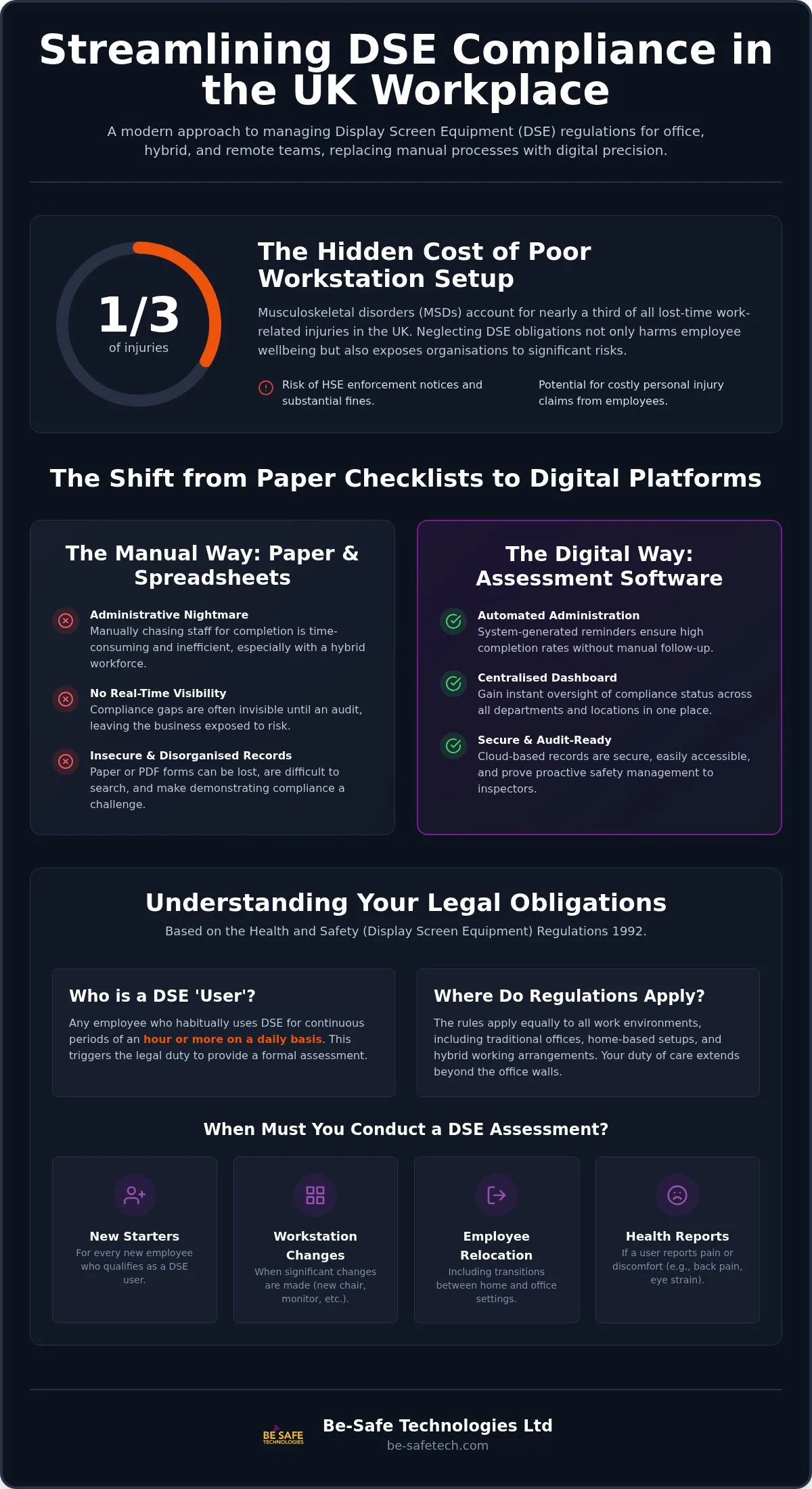
The legal framework governing workstation safety is rooted in the Health and Safety (Display Screen Equipment) Regulations 1992. These rules form a vital component of the broader UK Health and Safety Regulations, designed to protect workers from the physical risks associated with prolonged screen use. Display Screen Equipment (DSE) includes any device with an alphanumeric or graphic display screen, such as desktop computers, laptops, tablets, and smartphones. Whilst the core legislation was drafted decades ago, its application has evolved to meet the demands of our modern, tech-heavy work environments.
A common point of confusion for many employers is the “one hour” rule. Under UK law, an individual is classified as a “user” if they habitually use DSE for continuous spells of an hour or more on a daily basis. Once an employee meets this threshold, the employer has a non-negotiable legal duty to conduct a formal workstation assessment. In our 2026 hybrid work landscape, this obligation extends far beyond the traditional office. The Health and Safety Executive (HSE) confirmed that these regulations apply equally to home and hybrid workers, making the management of distributed teams a significant priority for safety managers.
It’s vital to recognise that DSE assessment software UK is a facilitator for compliance rather than a total replacement for human expertise. Whilst digital tools excel at gathering data and identifying immediate red flags, the law still requires a “competent person” to review the findings. Software streamlines the collection of self-assessments, but your internal experts must use that data to make informed decisions about ergonomic adjustments and equipment provision.
When Must You Conduct a DSE Assessment?
The requirement for an assessment isn’t a one-off event. You must perform an initial check for every new starter or when a new workstation is established. Beyond the initial setup, several triggers necessitate a reassessment of the work environment:
- Significant changes to the workstation, such as a new chair, monitor, or software interface.
- Relocation of the employee, including transitions between office and home settings.
- Reports of health complaints, such as repetitive strain or musculoskeletal disorders (MSDs).
Failing to provide adequate oversight can lead to severe consequences. MSDs account for approximately one-third of all lost-time work-related injuries globally, and UK employers face the risk of HSE enforcement notices, substantial fines, and personal injury claims if they neglect their duty of care.
The Shift from Paper Checklists to Digital DSE Tools
For multi-site organisations, managing hundreds of paper or PDF checklists is an administrative nightmare. Tracking who has completed their forms amongst a mobile workforce often leads to gaps in compliance that only surface during an audit. Manual systems lack the transparency needed for real-time risk management, often leaving safety managers chasing overdue submissions for weeks.
Modern DSE assessment software UK solves this by providing a centralised dashboard where completion rates are visible at a glance. Digital tools significantly improve engagement because they’re accessible on the devices employees already use. When an HSE inspector requests your records, having a secure, cloud-based repository ensures you can demonstrate a proactive approach to safety in seconds, rather than days spent searching through filing cabinets.
Key Benefits of Modern DSE Assessment Software UK
Modern DSE assessment software UK transforms compliance from a static, once-a-year event into a dynamic safety culture. By moving beyond simple digital forms, these platforms offer centralised dashboards that provide real-time visibility across your entire organisation. You can see exactly which departments are compliant and which individuals require urgent attention, all from a single screen. This high-level oversight ensures that no workstation is overlooked, whilst providing the data needed to make informed decisions about equipment procurement and office design.
One of the most immediate advantages is the elimination of manual administration. Automated reminders handle the “chasing” of staff, sending gentle prompts to those who haven’t finished their assessments. This frees HR and safety teams to focus on high-impact tasks rather than managing endless email chains. To ensure these tools are inclusive and effective, modern platforms incorporate training visuals that reflect the multicultural reality of the UK workforce; featuring diverse ethnic representation ensures every employee feels seen and supported within the safety programme.
Streamlining the Workflow for H&S Managers
Transitioning away from fragmented spreadsheets allows you to reduce health and safety paperwork through intelligent digitisation. Instead of manually reviewing hundreds of entries, the software automatically flags high-risk issues, such as poor posture or inadequate lighting. This allows for instant intervention where it’s needed most. When you can identify red-flag issues at the touch of a button, you’re not just ticking boxes. You’re actively managing risk before it leads to injury or a costly HSE intervention.
Enhancing Employee Well-being and Productivity
Proactive workstation management is directly linked to better business outcomes. Following the HSE guidance on DSE helps reduce the prevalence of musculoskeletal disorders (MSDs), which remain a leading cause of absenteeism in the UK. When employees receive instant feedback and ergonomic advice through a mobile-first interface, they feel empowered to take control of their own health. A comfortable workstation isn’t just about avoiding pain; it’s about maintaining a focused, productive workforce that’s less likely to suffer from long-term strain.
Reliable systems provide the foundation for this operational harmony, helping you build a safer environment with quiet confidence. If you’re ready to move away from manual tracking, exploring a comprehensive health and safety platform can provide the total control and clarity your organisation needs to thrive.
Essential Features to Look for in UK DSE Software
Selecting the right tool requires looking beyond a simple digital checklist. The most effective DSE assessment software UK must bridge the gap between employee self-reporting and professional oversight. While many platforms provide a way to record issues, few offer a dedicated assessor review module. This feature is vital because the HSE requires a competent person to evaluate risks and confirm that necessary adjustments have been made. Without this “closing the loop” functionality, your digital records remain incomplete and potentially non-compliant during a formal audit.
Mobile-First and Cloud-Based Infrastructure
Adopting mobile-first safety software is no longer optional for a workforce that splits time between the office, home, and client sites. Cloud-based EHS platforms ensure that data is synchronised in real-time, allowing managers to see updates as they happen. Employees should be able to complete their assessments on any device without the friction of complex installations or VPN requirements. This accessibility directly correlates with higher completion rates and more accurate data, as staff can record their workstation setup exactly where they’re working.
Data Security and ISO Compliance
Protecting sensitive health data is both a legal and ethical priority. Choosing ISO 27001 compliant safety software provides the reassurance that your employee information is managed under the highest international standards for information security. For UK businesses, GDPR compliance is a non-negotiable factor when storing workstation feedback. UK-based hosting and development teams offer an extra layer of peace of mind, ensuring that support is aligned with local time zones and specific regulatory nuances.
Finally, look for customisability. A laboratory workstation has different ergonomic requirements than a standard office desk or a temporary home setup. The ability to tailor assessment forms ensures that the questions remain relevant to the specific industry context. When your DSE assessment software UK adapts to your specific environment, the resulting data becomes more accurate and useful for the safety manager. By combining these features, you create a robust ecosystem that moves beyond box-ticking and into genuine, proactive workplace protection; to learn more about professional IT support and PC repair services for your office or home setup, expert guidance can help maintain the technology your team relies on.
How to Implement a Digital DSE Strategy Successfully
Successful implementation of a digital strategy relies on moving beyond a “one-and-done” mentality. It’s about creating a living system that adapts as your business grows. Integrating your chosen DSE assessment software UK with your wider health and safety risk assessment software ensures that workstation safety isn’t siloed from your broader organisational risk profile. This holistic approach allows you to see how ergonomic trends might be impacting overall employee health and absenteeism rates across different departments. It’s about strategy.
Step 1: Integration and Setup
The first stage involves mapping your organisational structure within the platform. This isn’t merely an administrative task. It’s about ensuring that the right managers have visibility over the right teams. You should customise your DSE questions to reflect your specific work environment, whether that’s a high-tech laboratory or a flexible home-office setup. By linking these results to your broader risk management strategy, you create a unified data set that makes reporting to board-level stakeholders far more straightforward. This structure provides the grounded reliability needed to manage complex regulatory requirements with total clarity.
Step 2: Engagement and Review
Safety management is a continuous cycle of improvement. You must iterate and reassess whenever significant changes occur, such as office refurbishments or equipment upgrades. Maintaining this rhythm ensures your compliance remains airtight and your workforce stays protected. If you’re ready to digitise your processes, discover how Compliance Genie can transform your workstation safety management today.
Why Compliance Genie is the Premier DSE Solution for UK Businesses
Compliance Genie is designed to be more than just a digital version of a paper form. It functions as a centralised health and safety hub that brings order to complex regulatory environments. Whilst many transactional providers focus on selling individual assessment credits, our approach centres on building a long-term partnership with your organisation. By choosing a robust DSE assessment software UK platform, you gain the peace of mind that comes from recognised industry standards. Our ISO 9001 and 27001 certifications ensure that your quality management and data security protocols are airtight, providing a level of professional assurance that smaller, standalone tools cannot match.
One of the most significant advantages of this platform is the built-in audit trail. Every action, from the initial employee submission to the final assessor sign-off, is recorded with precision. This makes the integration of digital audit checklist software seamless, as all your compliance data is already structured for review. If an HSE inspector requests evidence of your DSE management, you can provide a complete, chronological history of every intervention across your entire UK workforce in seconds.
A Holistic Approach to Workplace Safety
Safety management is most effective when it isn’t fragmented. Within Compliance Genie, your DSE data sits alongside COSHH assessments, fire safety records, and incident reporting. This creates “one version of the truth” for your entire organisation, allowing you to identify cross-departmental risks that might otherwise be missed. As your business grows across the UK, the platform scales with you, ensuring that your safety culture remains consistent whether you have fifty employees or five thousand. This integrated ecosystem reduces the stress of managing multiple systems and provides total clarity for safety directors.
Trusted by UK Organisations
Be-Safe Technologies Ltd acts as an authoritative yet practical ally for businesses navigating the intricacies of UK law. We understand that a modern workforce is multicultural and diverse, which is why our mobile-first platform is designed for accessibility and ease of use for everyone. Our award-winning UK-based support and development teams are always on hand to help you configure the system to your specific scale and industry needs. You don’t have to manage these burdens alone; we provide the tools to make workplace safety a streamlined part of your daily operations.
Reliability and total control are within reach. If you’re ready to move away from manual checklists and embrace a more sophisticated, integrated approach to workstation safety, book a demo of Compliance Genie today.
Future-Proof Your Workplace Safety Strategy
Transitioning to a digital-first approach ensures your organisation remains compliant with the Health and Safety (Display Screen Equipment) Regulations 1992 whilst protecting your team’s long-term health. By moving away from fragmented paper systems, you gain real-time visibility and a clear audit trail that stands up to HSE scrutiny. The right DSE assessment software UK doesn’t just collect data; it empowers your competent assessors to make meaningful interventions that reduce musculoskeletal risks and absenteeism across your entire workforce.
As an award-winning UK-based SaaS platform, Compliance Genie offers a mobile-first design that drives 100% employee engagement across your hybrid workforce. Our ISO 27001 and 9001 certifications provide the technical reliability and data security your business demands in 2026. This allows you to manage compliance with quiet confidence, knowing your records are secure and your processes are industry-aligned.
Request a Compliance Genie Demo to Organise Your UK DSE Compliance
Let’s turn your safety obligations into a streamlined, manageable part of your daily operations and give your team the support they deserve.
Frequently Asked Questions
Is DSE assessment software a legal requirement for UK businesses?
Workstation assessments are a legal requirement under the Health and Safety (Display Screen Equipment) Regulations 1992, but using specific software is not. However, DSE assessment software UK is the most efficient method for managing these duties at scale across multiple sites. It ensures that you meet your legal obligations whilst maintaining an organised, digital audit trail that is easily accessible for HSE inspectors during an audit or site visit.
Can employees perform their own DSE assessments using software?
Employees can certainly complete their own self-assessment questionnaires through a digital platform, but this is only the first step of the process. The law requires that these submissions are reviewed by a competent person who has the training to identify risks. Software streamlines this by flagging issues automatically, allowing your internal assessors to focus their expertise where it’s most needed to protect staff health.
How often should DSE assessments be carried out in a hybrid work model?
Assessments should be carried out whenever an employee’s workstation changes significantly, which is common in hybrid models. You must conduct an initial assessment for both the home and office setup. Reassessments are also required if an employee reports discomfort or if there are changes to their equipment. Maintaining a regular review cycle, such as every 12 to 24 months, helps ensure long-term compliance and employee well-being.
What should I look for in DSE software to ensure it is GDPR compliant?
You should prioritise platforms that hold ISO 27001 certification and offer secure, UK-based data hosting. Since DSE assessments involve sensitive health-related information, the software must provide clear data processing agreements and robust encryption. Look for features that allow you to manage data retention periods and provide employees with total transparency over how their workstation feedback is stored and used within the organisation.
Does DSE software replace the need for a trained health and safety assessor?
Software does not replace the need for a trained assessor; it acts as a powerful tool to enhance their effectiveness. The platform identifies red flags and organises data, but a competent person must still verify the findings and recommend specific ergonomic adjustments. This combination of digital efficiency and human expertise is what ensures your business remains fully compliant with UK health and safety standards whilst protecting your workforce.
What happens if an employee flags a problem during a digital DSE assessment?
When an employee flags a problem, the software should trigger an immediate notification to your health and safety team for review. This allows the assessor to examine the specific issue, such as a lack of lumbar support or screen glare, and implement a practical solution. Closing this loop is a critical part of your duty of care and demonstrates a proactive approach to preventing musculoskeletal disorders.
Can I use DSE software for both office and home-based workers?
Yes, modern cloud-based tools are specifically designed to support both office and home-based workers through a single interface. A mobile-first approach allows employees to complete their checks on any device, regardless of their physical location. This flexibility is essential for UK businesses managing diverse teams, ensuring that every workstation meets the required safety standards whether it’s in a central city office or a remote home setup.
How does DSE software integrate with other health and safety records?
Effective software integrates with your broader compliance ecosystem by sitting within a unified health and safety hub. This allows DSE data to be viewed alongside incident reports and other risk assessments, providing one version of the truth for your organisation. This integration simplifies reporting for stakeholders and ensures that workstation safety is managed as a core part of your overall business operations rather than an isolated administrative task.