


Digitalising Safety: 2026 Digital Transformation Guide

Did you know that as of April 2026, the Health and Safety Executive (HSE) increased the Fee for Intervention (FFI) rate to £188 per hour? When you’re drowning in manual paperwork and struggling to track contractor safety documents across several locations, the risk of a missed deadline or an overlooked hazard feels constant. Transitioning to modern health and safety incident management software is no longer just a technical upgrade; it’s a vital safeguard for your operational continuity and your team’s wellbeing in an increasingly scrutinised regulatory environment.
We understand that moving away from familiar, albeit fragmented, paper systems can feel like a daunting task for any safety professional. This guide will show you exactly how to transition into a unified digital safety ecosystem that ensures total compliance whilst significantly reducing your administrative burden and improving site visibility. We’ll explore the shift from reactive data logging to proactive risk intelligence, providing a clear, methodical roadmap for your 2026 digital transformation and long-term peace of mind.
Key Takeaways
- Distinguish between simply digitising paper and creating a dynamic digital ecosystem that provides real-time operational clarity across all your sites.
- Discover why mobile-first accessibility is the cornerstone of effective risk assessments, allowing your team to record vital data whilst they are active on-site.
- Evaluate the limitations of spreadsheets and learn how dedicated health and safety incident management software offers the scalability required for modern UK businesses.
- Master a five-step roadmap to audit your existing processes and present a compelling case for the digital return on investment to your stakeholders.
- Explore how a unified digital platform can seamlessly manage both your internal safety protocols and the unique complexities of external contractor oversight.
What Does it Mean to Digitalise Safety Processes?
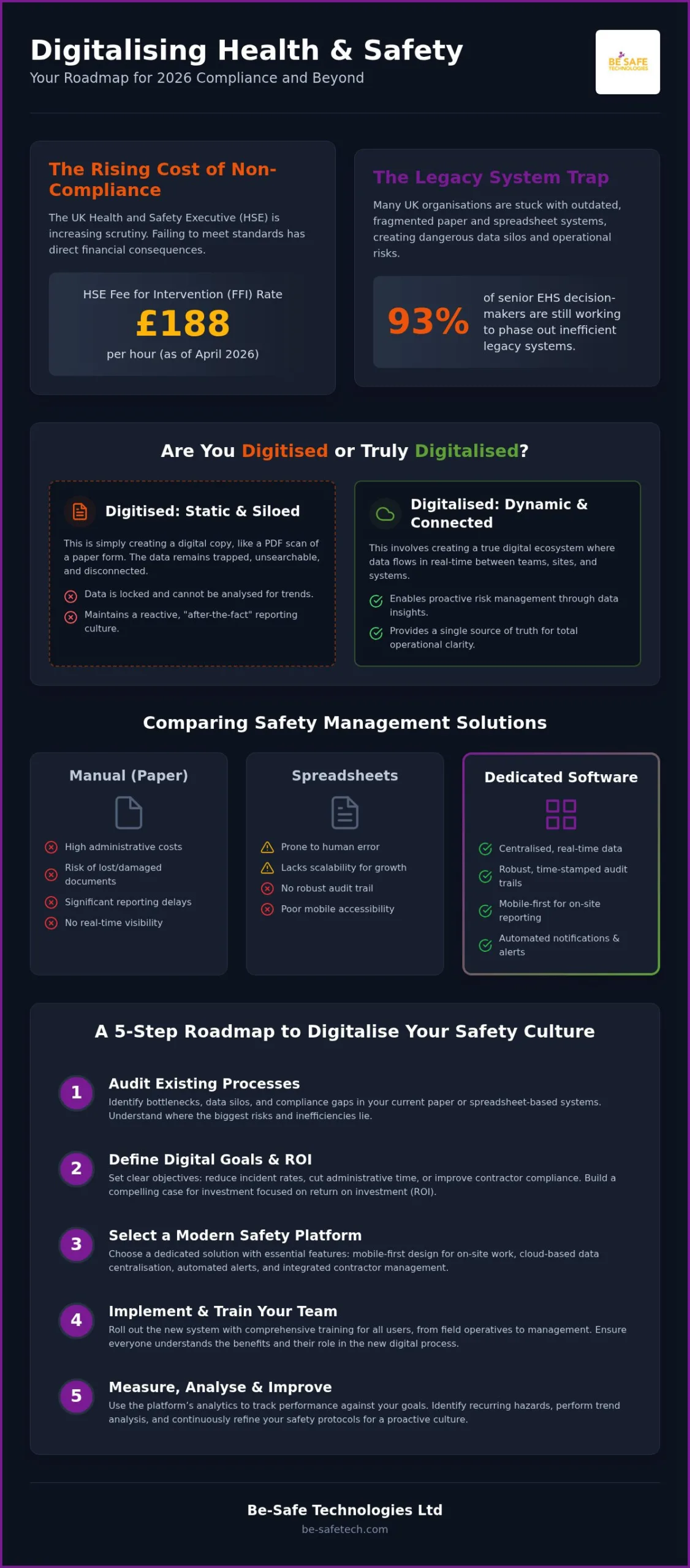
Digital safety transformation involves integrating cloud-based technology directly into your Environmental, Health, and Safety (EHS) workflows. It’s vital to distinguish between being ‘digitised’ and being ‘digitalised’. Digitising is simply the act of creating a static PDF scan of a paper form. Whilst this removes physical bulk, the data remains trapped and unsearchable. True digitalisation uses health and safety incident management software to create a dynamic, connected ecosystem where data flows between departments in real-time.
The UK Health and Safety Executive (HSE) increasingly supports digital record-keeping. As long as the data is accurate, accessible, and protected from unauthorised changes, digital logs meet the stringent requirements of UK safety legislation. This shift allows businesses to move away from reactive, “after-the-fact” reporting and towards a model of proactive risk management and operational harmony.
The Limitations of Paper and Legacy Systems
Many UK organisations still rely on fragmented paper processes. Research suggests that approximately 93% of senior EHS decision-makers are still working to phase out these legacy systems. Paper creates dangerous data silos where critical safety information is locked away in filing cabinets or disparate spreadsheets. This lack of accessibility often leads to:
- High administrative costs stemming from manual data entry and physical storage requirements.
- Increased risk of lost, illegible, or damaged compliance documents that are difficult to recover during an audit.
- Significant delays in reporting that prevent management from taking immediate corrective actions on-site.
When information is trapped in physical files, it’s impossible to gain a holistic view of safety performance across different regions or sites. This fragmentation often results in missed deadlines and a reactive safety culture that struggles to keep pace with modern regulatory changes.
The Core Benefits of a Digital Safety Ecosystem
Adopting a modern platform shifts your focus from reactive reporting to proactive risk management. By using dedicated health and safety incident management software, you gain instant visibility across every site in your portfolio. This transparency ensures that every incident or near-miss is logged with a secure digital signature and a time-stamped entry, providing a robust audit trail for regulatory bodies.
Beyond simple compliance, these systems provide data-driven insights. Instead of relying on gut feelings, safety managers can perform trend analysis to identify recurring hazards before they lead to serious accidents. This creates a culture of operational harmony where safety is a streamlined part of daily work rather than a bureaucratic hurdle. This level of oversight reduces the stress of managing complex sites and ensures your team remains protected, productive, and compliant.
The Essential Components of a Modern Safety Platform
A robust digital safety ecosystem relies on several interconnected components that work together to provide total operational clarity. Central to this is a cloud-based infrastructure, which serves as the single source of truth for multi-site operations across the UK. By centralising data, management can ensure that safety standards remain consistent, regardless of geographical location. Automated notifications further enhance this by providing real-time alerts for upcoming inspections or overdue actions, effectively removing the risk of human error in compliance tracking.
Mobile-First Design for Field Operations
Desktop-only solutions often fail the site test because they force frontline workers to return to an office to log data. This delay leads to inaccurate reporting or, worse, missed entries. Effective health and safety incident management software must be mobile-first, allowing workers to complete risk assessments and incident reports directly on their devices whilst they’re on-site. In the UK, where remote locations or basement works often suffer from poor connectivity, offline functionality is essential. This ensures data is captured immediately and synced once a signal is restored. For a deeper look at these requirements, you can read the ultimate guide to health and safety compliance software in 2026.
One often overlooked element is the integration of contractor management. External workers shouldn’t operate in a vacuum; they must be part of your central health and safety incident management software to ensure they follow the same protocols as your employees. Providing a unified portal for contractors to upload documents and complete inductions ensures that every person on your site adheres to the same high standards. If you’re looking to bridge this gap, exploring a tailored digital safety platform can help unify your workforce.
Information Security and ISO Standards
Protecting sensitive digital safety data requires more than just a password. ISO 27001 certification is non-negotiable, specifically the 2022 edition which is now the mandatory standard for information security management. This framework ensures that employee health records and incident logs are handled with the highest level of confidentiality, maintaining strict GDPR compliance. For those in the public sector, G-Cloud approval is equally vital. It provides a pre-vetted, transparent procurement route that guarantees the software meets the UK government’s rigorous security and operational standards.
Comparing Manual, Spreadsheet, and Dedicated SaaS Solutions
Choosing the right framework for your safety data is a strategic decision that directly affects your organisation’s risk profile. Whilst many UK businesses start with physical folders, they quickly find that manual systems cannot scale. The sheer volume of paperwork required to manage RIDDOR reporting and COSHH assessments often leads to administrative gridlock. Transitioning to health and safety incident management software represents a shift from simply storing records to actively using data to protect your workforce.
Why Spreadsheets Fail the Compliance Test
Spreadsheets are often viewed as a convenient middle ground, yet they frequently become a liability in high-stakes environments. They lack the robust audit trails required during a Health and Safety Executive (HSE) investigation, particularly when the Fee for Intervention (FFI) now stands at £188 per hour for material breaches. Without time-stamped logs or secure digital signatures, proving exactly when a risk was identified and who took action becomes nearly impossible. Multiple users accessing a single file also introduces the risk of version control errors or accidental data deletion. To ensure your records are legally defensible, many firms are now adopting digital audit checklist software to maintain a single, unalterable source of truth.
The SaaS Advantage: Compliance as a Service
A dedicated SaaS platform offers scalability that spreadsheets simply cannot match. As your business grows across multiple UK sites, a cloud-based system ensures that every manager follows the same protocols and sees the same real-time data. This centralised oversight replaces several disconnected legacy tools, reducing the total cost of ownership by cutting down on manual admin hours and physical storage needs. Key benefits of this approach include:
- Automatic Regulatory Alignment: Software updates ensure your workflows stay current with 2026 changes to RIDDOR and updated COSHH workplace exposure limits.
- Insurance and Stakeholder Confidence: Demonstrating a proactive safety culture through detailed digital records can lead to more favourable insurance terms and improved standing with corporate clients.
- Behavioural Impact: User-friendly interfaces encourage frontline workers to report near-misses, shifting the company culture from “tick-box” compliance to genuine hazard awareness.
The transition to health and safety incident management software isn’t just about technical efficiency; it’s about fostering a safer working environment. By removing the friction of manual entry, you empower your team to focus on safety rather than bureaucracy. This investment provides peace of mind that your compliance is secure, your data is protected, and your staff are operating under the highest standards of modern protection.
A 5-Step Roadmap to Digitalise Your Safety Culture
Digitalising your safety culture is a methodical journey that requires more than just a software purchase. It begins with a thorough audit of your existing processes to identify exactly where paper is causing friction. You might find that site-to-office reporting delays or illegible handwriting are your primary bottlenecks. Once these pain points are clear, you can present a compelling case for health and safety incident management software to your board. Focus on the reduction of the £188 per hour HSE Fee for Intervention (FFI) risk and the potential to lower the costs associated with the 40.1 million lost working days across the UK.
Choosing the right platform is the third step. Reliability is paramount, so prioritise providers with ISO 27001 certification and G-Cloud approval. These credentials prove that the system can handle sensitive data securely and meet the procurement standards of UK public sector organisations. After selection, begin with a pilot phase. By digitising a single process, such as your site inspections, you can iterate based on real-world feedback before a full-scale rollout.
Overcoming Resistance to Change
A successful transition depends on how well you empower your diverse, multicultural workforce. In the UK, site teams often span several generations, each with varying levels of digital confidence. Selecting a tool with an intuitive, user-centric interface is essential for high adoption rates. When the software adapts to the user’s workflow rather than the other way around, resistance fades. For those looking to start with a specific focus, exploring health and safety risk assessment software can provide a manageable entry point into digitalisation.
Measuring Success and ROI
The final step is to track your progress using concrete data. Digitalisation should lead to a measurable reduction in the time between an incident occurring and the report being filed. You should also calculate the administrative hours saved by automating manual compliance checks. By using health and safety incident management software, you can move away from reactive fixes and use digital audits to identify recurring hazards before they escalate. If you’re ready to start your journey towards total operational clarity, you can explore our digital safety solutions today.
Future-Proofing Compliance with Be-Safe Technologies
Selecting a long-term partner is as critical as the technology itself when you’re moving away from fragmented paper systems. Working with a UK-based, ISO-certified provider ensures that your data remains secure and your support is grounded in local regulatory expertise. Be-Safe Technologies Ltd provides the infrastructure needed to transition to a unified digital safety ecosystem with professional assurance. By choosing a partner with G-Cloud approval, you’re investing in a platform that meets the rigorous transparency and procurement standards required for the UK public sector.
Compliance Genie: Total Safety Control
Compliance Genie serves as the primary tool for internal digitalisation, offering a mobile-first approach that’s essential for active site work. This award-winning platform provides a significant trust signal for EHS professionals who require a reliable, cloud-based system. Unlike legacy tools that often demand extensive training, this health and safety incident management software is designed to be flexible and user-centric. It’s built to adapt to your specific operational workflows rather than forcing your team to change their established, safe behaviours. By centralising risk assessments, incident logs, and audits in one environment, you achieve total control over your internal safety standards and site-wide visibility.
Contractor Genie: Seamless External Oversight
Managing external site visits presents a unique set of challenges that internal systems often overlook. Contractor Genie solves this by providing a centralised, secure location to manage visitor inductions and contractor compliance. It’s vital to verify external safety documents and insurance certifications before any work begins on a UK site to maintain strict regulatory standards. This platform ensures that every contractor entering your premises has been vetted and briefed, significantly reducing the risk of third-party incidents. Contractor Genie is the definitive tool for UK contractor site visit management, offering the same level of oversight for external workers as you have for your own employees.
The combination of these tools creates a complete, well-rounded ecosystem where every data point is tracked and every person on-site is accounted for. By choosing a partner with both ISO 9001 and ISO 27001 certifications, you gain the peace of mind that your information security and quality management meet the highest international standards. This holistic approach to health and safety incident management software allows you to move away from the stress of manual admin and into a future of operational clarity. We invite you to experience the quiet confidence that comes from total digital oversight and a streamlined, modern safety culture.
Securing Your Operational Future Through Digitalisation
Transitioning from fragmented paper systems to a unified digital ecosystem is the most effective way to ensure total compliance and operational clarity. By adopting modern health and safety incident management software, you move away from reactive data logging and towards a proactive culture of hazard intelligence. This shift doesn’t just reduce your administrative burden; it provides the site-wide visibility and defensible audit trails required in an increasingly scrutinised regulatory environment.
Choosing a partner like Be-Safe Technologies means you’re supported by an award-winning UK support team. We’re ISO 27001 and 9001 certified and G-Cloud approved, ensuring your information security and quality management meet the highest standards. It’s time to replace bureaucratic stress with the quiet confidence of total oversight. You can book a Compliance Genie demo to start your digital transformation and protect your team with a platform built for the modern workplace. We look forward to helping you build a safer, more efficient future.
Frequently Asked Questions
Is it legally acceptable in the UK to have digital-only safety records?
Digital records are fully acceptable under UK law. The Health and Safety at Work etc. Act 1974 and Management of Health and Safety at Work Regulations 1999 don’t mandate paper documentation. As long as your health and safety incident management software provides data that’s retrievable, legible, and protected from unauthorised changes, it satisfies HSE inspectors. This digital approach often provides a more robust audit trail than physical files by preventing retrospective alterations to safety logs.
How does digitalising safety processes improve our insurance premiums?
Digitalisation can lead to more favourable insurance terms by providing underwriters with verifiable evidence of a proactive safety culture. When you present accurate, real-time data on near-miss reporting and closed-out actions, you demonstrate a significantly lower risk profile. This transparency helps insurers assess your business more accurately. Many UK firms find that the ability to identify and eliminate recurring hazards through data analysis leads to fewer claims, which naturally puts downward pressure on annual premiums.
What is the difference between digitising and digitalising a safety process?
Digitising is the simple act of converting physical documents into a digital format, such as scanning a risk assessment into a PDF. Digitalising is far more comprehensive. It involves using health and safety incident management software to transform the entire workflow into a dynamic, connected process. Whilst a scan is just a static image, a digitalised process allows data to trigger automatic alerts, generate real-time reports, and provide site-wide visibility that static files cannot offer.
Can digital safety software work on remote sites without an internet connection?
Modern safety platforms are designed with offline functionality to support teams working in remote UK locations or areas with poor signal. Workers can complete assessments, log incidents, and capture photos directly on their mobile devices without a live connection. Once the device reconnects to Wi-Fi or 4G, the software automatically syncs the data to the central cloud. This ensures that no critical safety information is lost or delayed due to connectivity issues whilst working on-site.
How long does it typically take to transition from paper to a digital safety system?
The transition period typically ranges from a few weeks to several months depending on your organisation’s complexity. Most businesses find success by using a phased roadmap, starting with a pilot site or a single high-friction process like risk assessments. This allows your team to get comfortable with the new interface before a wider rollout. A methodical approach ensures that you don’t overwhelm staff whilst allowing you to iterate on your digital workflows based on real-world feedback.
Is our data secure in a cloud-based safety management system?
Your data is highly secure in a cloud-based system that adheres to recognised international standards. You should prioritise providers with ISO 27001 certification, which confirms they follow rigorous information security management protocols. For UK public sector organisations, G-Cloud approval provides an additional layer of trust and procurement transparency. These certifications ensure that sensitive employee health records and incident logs are protected by enterprise-grade encryption and strict access controls at all times, providing total peace of mind.
How do we ensure all staff, regardless of tech-savviness, can use the software?
Ensuring staff adoption starts with selecting a platform that prioritises a user-centric, mobile-first design. When software is intuitive and mirrors familiar smartphone behaviours, the learning curve is significantly reduced. You can further support adoption by providing short, practical training sessions tailored to different roles. Focusing on how the digital tool makes their daily tasks easier, rather than just being another compliance hurdle, helps build confidence across a diverse and multi-generational workforce on your sites.
Does the software automatically update when UK safety regulations change?
Dedicated SaaS safety platforms are designed to stay aligned with evolving UK regulations automatically. When the HSE announces changes to RIDDOR reporting requirements or updates COSHH workplace exposure limits, the software provider updates the underlying workflows. This removes the administrative burden of manually updating paper forms or spreadsheets. It ensures that your organisation remains compliant with the latest legal standards without requiring constant internal monitoring of legislative shifts, allowing you to focus on operational safety rather than bureaucracy.