



Visitor Management vs Contractor Management: Why UK Businesses Need Both
Here is the introduction for your blog post:
If you have ever typed “visitor management software” into a search engine hoping to solve a contractor compliance headache, you are not alone. It is one of the most common mix-ups in workplace technology purchasing, and it is a mistake that can leave UK businesses quietly exposed to serious liability gaps.
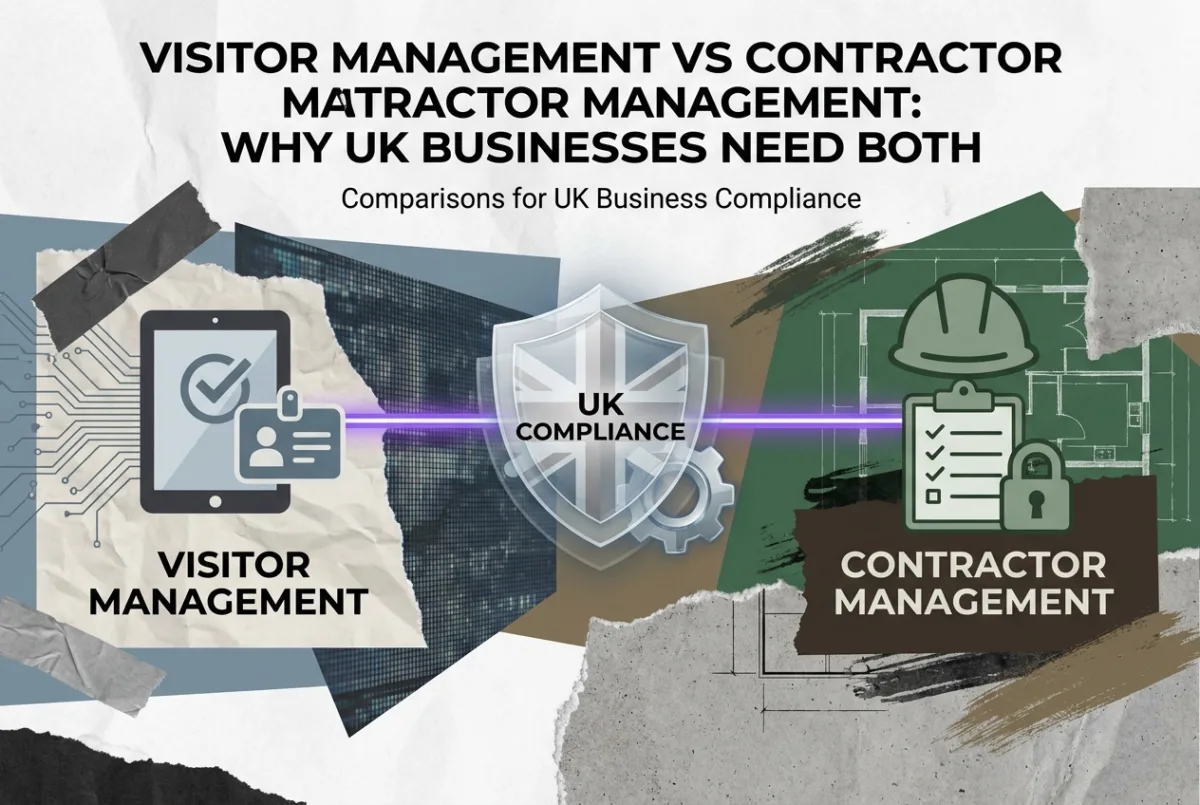
The two categories sound similar, and some vendors are happy to let that confusion linger. But visitor management software and contractor management software do fundamentally different jobs. One tells you who walked through the door. The other tells you whether that person was qualified, inducted, and legally permitted to do the work you hired them for. Conflating the two is a bit like using a smoke detector as a fire extinguisher; both belong in the building, but they solve completely different problems.
In this post, we will untangle the confusion, walk through what each system actually does, and explain why the UK regulatory landscape means most businesses genuinely need both. By the end, you will know exactly where the gaps in your current setup might be hiding.
The Confusion That Costs Businesses

Many UK businesses searching for visitor management software are solving the wrong problem. They search for a solution, purchase a sign-in tool, and assume the box is ticked. It is not.
A sign-in app records who arrived and when. That is useful, but it tells you nothing about whether that person holds a valid CSCS card, has completed a site-specific induction, or is authorised to carry out the work they have been engaged to do. Those are different questions, and no visitor management system is built to answer them.
The gap between these two categories is not a technicality. It is a liability exposure. If an incident occurs and the HSE investigates, a sign-in log cannot demonstrate due diligence. It shows presence; it cannot show competence.
The stakes are real. HSE data for April 2024 to March 2025 recorded 35 fatal injuries in construction, with falls from height, being struck by moving objects, and being trapped by collapsing structures among the most common causes. These are precisely the scenarios where documented contractor competence matters most, and where the absence of that documentation causes serious legal and regulatory problems.
Understanding health and safety training as a legal obligation is a good starting point, but the software question matters too. This piece separates the two categories clearly so buyers can choose the right solution rather than assuming a solved problem they have not actually solved.
What Visitor Management Software Actually Does
At its core, visitor management software handles building access: logging who enters and exits, issuing visitor badges, notifying hosts when guests arrive, and keeping a real-time record of everyone on the premises.
The feature set is purpose-built for that access layer. Most systems include pre-registration, digital sign-in via tablet or kiosk, ID capture, and emergency evacuation lists showing exactly who needs to be accounted for if the building clears. Many integrate with access control hardware such as door entry systems, tying the digital record to physical movement through the building.
These tools work well for the people they are designed to manage: guests, clients, delivery personnel, and other short-term visitors who turn up, do what they came to do, and leave. None of those individuals carry ongoing compliance obligations your business needs to track or verify.
That is the important boundary to understand. A visitor management system is a security and facilities tool. Its job is to answer one question: who is in the building? It is not designed to answer whether someone is competent, certified, or authorised to carry out a specific type of work on your site.
Used in the right context, visitor management software delivers real operational value. It keeps everyone safe and impresses your visitors, professionalises the front-of-house experience, cuts front-desk admin, and produces a clean audit trail of building access. The problem only arises when businesses expect it to do something it was never built to do.
What Contractor Management Software Actually Does
Contractor management software operates in an entirely different category to the visitor tools described above. Its purpose is to verify, record, and maintain evidence of contractor competence, certification, induction status, and ongoing site-visit compliance.
The core question changes entirely. A visitor management system asks who is here? Contractor management software asks are they qualified to be here, have they been properly inducted, and are their certifications still valid? Those are not variations of the same question; they require fundamentally different data.
What it actually tracks
The HSE’s guidance on using contractors is clear that employers must verify competence before work begins, and maintain records that demonstrate this. In practice, that means storing and tracking documentation such as CSCS cards, COSHH awareness certificates, confined space competency records, public liability insurance, and method statements.
Beyond pre-qualification, contractor management software tracks site-specific induction completion for each individual contractor, records site visit history with compliance checkpoints at each visit, and flags certification expiry dates before they lapse. These are living records, not snapshots.
Why this matters under audit
If an HSE inspector arrives or an insurance claim is raised, a visitor log showing someone signed in at 08:47 proves nothing about competence, induction, or authorisation. Contractor management software produces the structured, exportable audit trail that demonstrates a business took its duty of care seriously. As part of any robust approach to safety solutions that genuinely protect a business, this documentation layer is not optional.
Be Safetech’s Contractor Genie is built precisely for this, giving UK businesses one place to manage all contractor records, site visits, and compliance documentation.
Where the Two Systems Diverge: A Direct Comparison
The difference between the two systems isn’t a matter of degree; it’s a matter of purpose.
Presence vs competence. A visitor management system records that someone arrived at 08:30 and left at 16:45. Contractor management software records whether that person holds a valid CSCS card, has completed a site-specific induction, and is authorised to carry out the precise tasks they have been engaged to do. One confirms a body in a building; the other confirms a qualified, authorised operative.
Access control vs compliance control. Visitor management answers “who is here?” Contractor management answers “should they be starting work?” Those are fundamentally different questions, and confusing them is where liability gaps open.
Static data vs living records. A visitor log captures a moment in time and never changes. Contractor compliance records are dynamic; they update as certifications expire, renewals come through, and new inductions are completed. A sign-in app has no mechanism to flag that a contractor’s confined space competency certificate lapsed last Tuesday.
Response vs prevention. After a workplace incident, a visitor log proves someone was on site. Contractor management documentation proves due diligence was exercised before they started work, or it exposes precisely where it wasn’t. That distinction matters enormously to HSE investigators and to managing your safety processes without guesswork.
Insurance and legal weight. Employer’s liability and public liability insurers increasingly expect active, documented competence management. A sign-in record does not meet that standard. Contractors are your legal responsibility, and insurers know it.
The Regulatory Reality for UK Businesses
The practical differences above become legally significant once you understand what UK law actually requires.
Under the Health and Safety at Work Act 1974 and the Management of Health and Safety at Work Regulations 1999, employers have a clear duty to ensure contractors on their premises are competent to carry out work safely. That is not a general obligation to keep records; it is a specific obligation to verify competence before work begins.
When the HSE inspects, auditors examine the adequacy of safety management systems, not just whether an incident occurred. They want evidence that contractor competence was confirmed in advance. A sign-in record showing someone arrived at 8:47 am proves nothing about their qualifications, induction status, or authorisation to perform the task. Understanding what advanced safety practice actually requires makes clear why documentation depth matters so much at this level.
Regulatory pressure is also tightening. The Building Safety Regulator is moving towards a unified construction regulator model, with new Innovation and Remediation Enforcement Units signalling closer scrutiny of contractor compliance documentation across the industry. Businesses that rely on a visitor management system to fulfil contractor compliance obligations face genuine regulatory exposure as that scrutiny increases.
The long-term consequences of poor contractor management are stark. In 2023, 2,218 mesothelioma deaths were recorded in Great Britain, the majority among men with building industry backgrounds. Those deaths resulted from asbestos exposures that may have occurred decades earlier; a reminder that the damage from inadequate contractor oversight does not always surface immediately.
What an HSE Inspector Actually Wants to See
So what does tighter regulation actually mean in practice? It means that when an inspector arrives, whether following a routine visit or an incident investigation, they will want more than a sign-in log.
Pre-qualification evidence comes first. Inspectors will typically ask to see contractor certifications, public liability insurance documentation, and evidence that competence was assessed before work began. Schemes such as CHAS provide a recognised framework for this, but the underlying requirement is straightforward: you must be able to prove the contractor was qualified before they set foot on site.
Next, they will look for site-specific induction records. Each contractor must have been briefed on the hazards particular to that site, the emergency procedures in place, and the method statements covering their work. A general company induction does not satisfy this; the record must be specific to the site and the individual.
Ongoing monitoring is the third strand. Were certifications re-checked at each visit, or only captured once at onboarding? If a certificate lapsed, was work paused? Inspectors distinguish between businesses that manage compliance continuously and those that ticked a box once and moved on.
This is precisely where a visitor management system log falls short. A record showing “J. Smith signed in at 08:47” cannot confirm that Smith held a valid qualification, completed the site induction, or was operating under an approved method statement.
Contractor management software produces structured, timestamped, exportable records that answer every one of those questions directly, turning an HSE audit from a scramble into a straightforward process.
Why UK Businesses Genuinely Need Both
So the answer is not choosing one over the other. It is recognising that they solve entirely different problems, and most UK businesses have both problems.
A visitor management system handles the access layer: who is in the building, why they are there, and who authorised their entry. That is a genuine operational need. Knowing your reception is managed, your evacuation list is accurate, and your client visits are logged professionally matters, and no contractor compliance tool replaces it.
Contractor management software handles the compliance layer: are the people carrying out work on your site qualified, inducted, insured, and operating under documented safety controls? You can review the essential features of a modern contractor management system to see how far beyond a sign-in sheet that function extends.
Using a visitor management system to cover both creates a visible gap. Insurers, HSE inspectors, and legal representatives are experienced at spotting the difference between an access log and a compliance record. In the event of an incident, that distinction matters enormously.
The resolution is straightforward. Use a visitor management system for visitors. Use a dedicated contractor management platform such as Contractor Genie for the contractors who require active competence and compliance oversight. The two tools sit alongside each other, each doing the job it was built for, and together they close the liability gap that neither can close alone.
Signs Your Current Setup Has a Gap
How do you know which side of this line your business is on? Check your setup against these warning signs now.
Your contractors and visitors share the same sign-in process. If contractors are processed identically to a client visiting for a meeting, you have no compliance record for them. A name and a time stamp is not contractor management.
Your certification records live in inboxes and folders. Emailed PDFs, spreadsheet tabs, a lever-arch file in the site office: if that is where your contractor documentation sits, it is neither version-controlled nor audit-ready. You likely cannot confirm quickly what you actually hold.
You cannot say with confidence whether active contractor certifications have expired. Without an automated alert system flagging upcoming expiry dates, the answer to “are all our contractors currently compliant?” is essentially a guess. Our Frequently Asked Questions page covers what a robust expiry-tracking process should include.
You could not produce a two-year compliance history for a named contractor today. If that request would involve trawling emails and spreadsheets for an hour, your audit trail is not fit for purpose.
Your system records presence, not compliance. You know the contractor was on site. You cannot demonstrate what induction they completed, what method statement governed their work, or whether their public liability insurance was valid on that date.
Any one of these gaps creates a liability exposure. Several together represent a significant risk.

Two Tools, One Coherent Compliance Strategy
If any of those warning signs landed close to home, the good news is that the path forward is clear.
Visitor management software and contractor management software are not interchangeable. That is not a marketing distinction; it reflects a genuine difference in what each tool is engineered to do. One manages building access. The other manages competence, certification, induction status, and ongoing compliance. Both matter, and neither substitutes for the other.
UK businesses carry a legal duty on both fronts. The Health and Safety at Work Act 1974 and the Management of Health and Safety at Work Regulations 1999 require active contractor competence management, not simply a record of who walked through the door. Treating a visitor management system as a catch-all does not satisfy that duty. It creates a documented gap in due diligence, one that becomes visible quickly during an HSE inspection, an insurance claim, or legal proceedings following an incident.
Contractor Genie from Be Safetech is built to close exactly that gap. It gives UK businesses a single, audit-ready platform to manage contractor certifications, induction records, site visits, and compliance documentation, all in one place.
If your business has contractors on site and no dedicated contractor management software, the practical next step is straightforward: review what your current setup can actually prove. If the answer is presence but not competence, that is the gap to close, and the time to close it is before something goes wrong.
Conclusion
Visitor management and contractor management are distinct tools that solve distinct problems. One records who entered your building; the other proves they were qualified, inducted, and compliant before they did. UK law requires both, and closing the gap between them is not optional.
The businesses that fare best during HSE inspections, insurance reviews, and incident investigations are those that can demonstrate competence, not just presence. A joined-up compliance strategy built on the right tools for each purpose is what makes that possible.
Contractor Genie from Be Safetech gives UK businesses exactly that foundation: audit-ready contractor compliance management in a single, accessible platform.
Do not wait for an inspection or incident to expose what your current setup cannot prove. Review your contractor management processes today, identify where the gaps are, and take the step that protects your business, your workforce, and your peace of mind.