


Streamlining Workplace Safety Audits: A 2026 Guide to Digital Efficiency

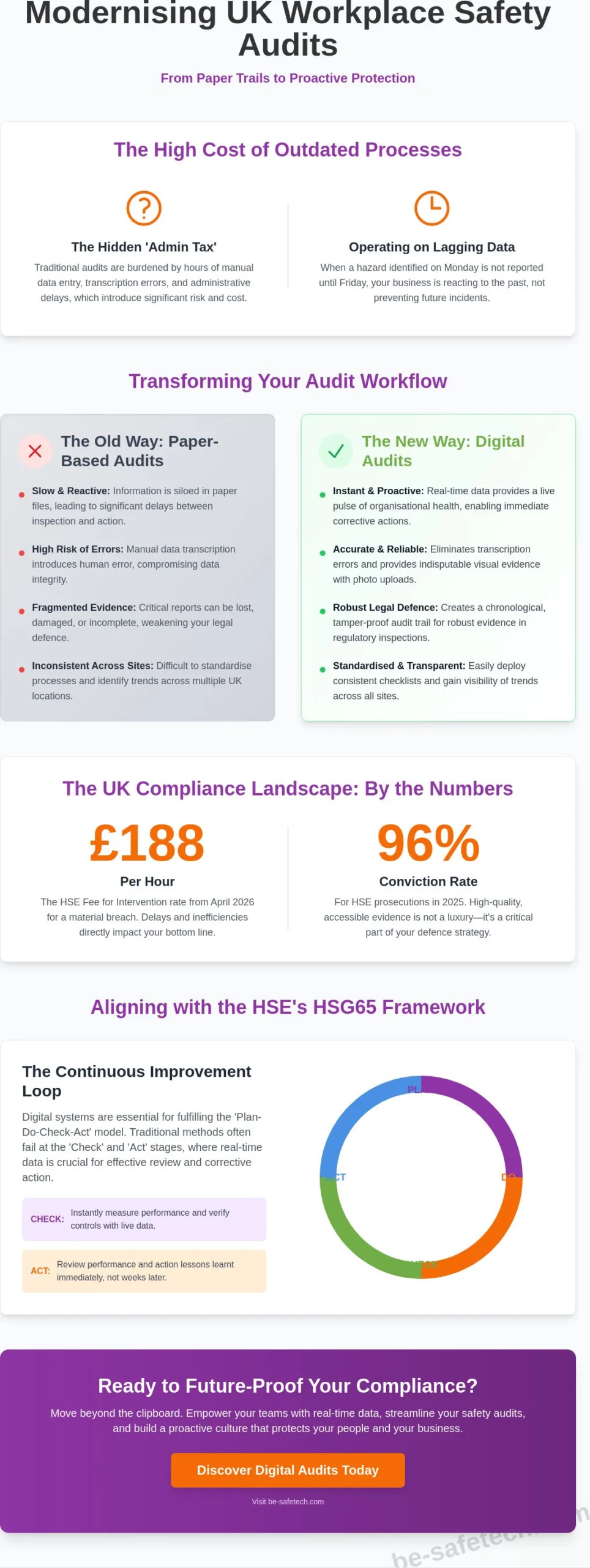
With the HSE Fee for Intervention rate reaching £188 per hour in April 2026, the financial impact of a material breach is a stark reminder of the need for operational precision. You’re likely all too familiar with the weight of paperwork and the manual data entry that often follows a site inspection. It’s a common frustration to find that by the time a report is processed, the risk has already escalated. To protect your team and your reputation, you need to streamline workplace safety audits so that they provide instant, actionable insights rather than administrative delays.
We understand that you want a safety system that works with you, not against you. This guide will show you how to transform your audits from a paper-heavy burden into a high-performance, data-driven engine for UK compliance. We’ll examine how transitioning to digital tools provides the real-time visibility you need to stay ahead of risks and standardise your approach across multiple locations. By the end of this article, you’ll discover how to reduce administrative costs and build a proactive safety culture that offers genuine peace of mind for everyone in your organisation.
Key Takeaways
- Learn how to move beyond traditional paper-based inspections by adopting a continuous, tech-enabled process that eliminates the hidden ‘admin tax’ of manual data entry.
- Understand how to streamline workplace safety audits to align with the HSE’s HSG65 framework, ensuring you have the robust evidence required for a reliable legal defence.
- Discover how real-time data and transparent feedback loops can transform safety from a policing exercise into a proactive culture that empowers your site teams.
- Master a practical roadmap to optimise your inspection workflow by identifying existing bottlenecks and standardising your safety checklists across all UK sites.
- Explore the benefits of mobile-first digital tools like Compliance Genie, which offer the reassurance of ISO-certified data security to future-proof your H&S processes.
Beyond the Clipboard: Why Traditional Safety Audits Need Modernising
To truly streamline workplace safety audits, we must first redefine what an audit actually is. In a modern British workplace, an audit is no longer a static, once-a-quarter event recorded on a clipboard. Instead, it has evolved into a continuous, tech-enabled verification process that provides a live pulse of organisational health. When you move away from paper, you replace fragmented snapshots with a consistent stream of data that allows for immediate correction. This shift is essential for maintaining high Occupational safety and health standards whilst ensuring that your safety team spends their time on the shop floor rather than behind a desk.
Traditional methods carry a heavy ‘admin tax’. This is the hidden cost of manual data entry, where supervisors spend hours transcribing handwritten notes into digital formats. This process is not only expensive but also introduces significant risks through human transcription errors. If a hazard is identified on a Monday but the report isn’t filed until Friday, your business is operating on lagging indicators. You’re effectively looking in the rear-view mirror to steer the company. Modernising your approach ensures that data is accurate, legible, and, most importantly, available the moment the inspection ends.
The Limitations of Manual Inspection Regimes
Managing safety across multiple UK sites becomes a logistical nightmare when relying on paper. It’s incredibly difficult to track recurring issues or identify trends when critical information is trapped in physical files. We often see the ‘lost in the van’ syndrome, where vital reports go missing before they can be actioned. Whilst some firms try to bridge the gap with spreadsheets, these are rarely a viable long-term solution. Spreadsheets lack version control, are prone to accidental deletion, and cannot provide the automated alerts needed for modern compliance.
Meeting the Demands of 2026 Regulatory Expectations
The regulatory environment in 2026 has become significantly more demanding. The HSE now expects firms to demonstrate real-time oversight of safety risks, moving the industry toward a ‘digital-first’ standard. This means your documentation must be as agile as your operations. By choosing to streamline workplace safety audits through digital platforms, you move from a reactive stance to a proactive one. You aren’t just waiting for an incident to happen so you can check your files; you’re using live data to prevent the incident from occurring in the first place. This level of transparency is now the benchmark for any responsible UK business looking to protect its workforce and its reputation.
The Framework of Efficiency: Mapping Digital Audits to UK HSE Standards
The Health and Safety Executive (HSE) provides a definitive roadmap for safety management through the HSG65 framework. To effectively meet these rigorous standards, businesses are increasingly looking at how digital systems can mirror the ‘Plan-Do-Check-Act’ cycle. Traditional paper systems often struggle with the ‘Check’ and ‘Act’ stages, as information becomes siloed, delayed, or lost in transit. By choosing to streamline workplace safety audits, you create a transparent environment where every inspection contributes directly to this continuous improvement loop. This structured approach ensures that safety is treated as a core business function rather than an isolated administrative task.
A digital audit trail provides the robust evidence required to demonstrate that you have managed risks so far as is reasonably practicable. In the event of a regulatory visit or a legal challenge, having a chronological, tamper-proof record of every audit performed is invaluable. It moves the conversation from anecdotal claims to verified, timestamped data. Given the 96% conviction rate for HSE prosecutions in 2025, the ability to produce high-quality evidence is a critical component of your legal defence strategy. When you streamline workplace safety audits, you ensure that your documentation is not only compliant but also easily accessible during a snap inspection by the authorities.
Satisfying the ‘Check’ Phase with Real-Time Data
Modern tools allow for instant photo uploads, giving an indisputable visual record of site conditions at a specific moment. When combined with GPS coordinates and automatic timestamping, the validity of an audit is beyond question. This eliminates any doubt regarding when or where an inspection took place. This isn’t just about policing; it’s about providing a digital health and safety monitoring approach that reassures management that standards are being met across all UK locations. It provides the peace of mind that comes from total operational clarity and verified compliance.
Automating Corrective Actions and Follow-ups
The ‘Act’ phase of the safety cycle is where many manual systems fail. A streamlined digital system solves this by automatically assigning corrective tasks to the relevant person as soon as a non-conformance is flagged on-site. A centralised action register allows you to track these tasks until they are closed out, ensuring that minor hazards don’t escalate into significant incidents. This automated oversight means nothing falls through the cracks. It allows your team to focus on proactive safety improvements rather than chasing outstanding paperwork. By closing the loop between identifying a problem and verifying its solution, you build a more resilient and reliable organisation.
From Administrative Burden to Safety Culture: The Impact of Streamlined Data
When you choose to streamline workplace safety audits, the primary benefit isn’t just a cleaner filing cabinet; it’s a fundamental shift in how your workforce perceives safety. In many traditional UK workplaces, auditing is viewed as a policing exercise designed to catch people out. By digitising the process, you transform it into a collaborative tool for empowerment. When safety information is accessible, it becomes a shared responsibility rather than a top-down mandate. This transparency aligns your internal standards with the Health and Safety Executive’s (HSE) 2026 strategy, which prioritises building public trust and ensuring workers feel safe and protected in their environment.
The most significant cultural change comes from the ‘feedback loop’. In a paper-based system, an employee might report a hazard only to see no visible action for weeks, which often leads to apathy. Digital systems ensure that when a report is filed, the progress of the rectification is visible to those on the ground. Showing employees that their input leads to tangible change on-site builds immense trust. With 1.9 million workers in the UK suffering from work-related ill health in 2024/2025, according to HSE statistics, fostering an environment where people feel safe to speak up is more than a legal duty; it’s a moral and operational necessity.
Reducing the administrative burden also has a direct impact on the visibility of your safety leadership. Instead of being tethered to a desk for hours of manual data entry, your safety officers can spend more time on the shop floor. This presence allows them to mentor staff, identify emerging risks, and reinforce positive behaviours. It moves the safety professional from the role of an administrator to that of a strategic coach. By removing the friction of paperwork, Be-Safe Technologies Ltd allows your most qualified people to do what they do best: keep people safe.
Improving Employee Engagement Through Ease of Use
Field-based teams need tools that fit their working environment. A mobile-first design is essential for operatives who are often wearing PPE or working in challenging conditions. Features like voice-to-text and instant photo uploads remove the dread of completing a report. When you use a safety inspection app UK teams find intuitive, completion rates naturally increase. It makes the right way to work the easiest way to work, ensuring that to streamline workplace safety audits is a benefit felt by everyone, not just management.
Visualising Safety Performance for the Boardroom
Streamlined data allows executives to move away from gut feelings toward evidence-based decisions. Real-time dashboards provide a high-level overview of performance, whilst heatmaps can pinpoint high-risk areas across multiple sites. This level of clarity is vital when discussing safety at a board level. It allows for the targeted allocation of resources, ensuring that investments are made where they will have the most significant impact on reducing the 40.1 million working days lost annually in the UK to injury and ill health.
A Practical Roadmap to Optimising Your Workplace Inspection Workflow
Moving from a paper-based system to a digital one requires more than just a change of hardware. To successfully streamline workplace safety audits, you need a methodical plan that respects your existing operational strengths whilst addressing systemic weaknesses. A structured transition ensures that your team feels supported rather than overwhelmed by new technology. By following a logical roadmap, you can transform your safety inspections into a seamless part of the working day.
- Step 1: Audit your current audit. Identify where the bottlenecks exist. Is it the time taken to file reports, or perhaps the delay in assigning corrective actions?
- Step 2: Standardise your checklists. Ensure consistency across all UK regions so that a site in Glasgow meets the same high standards as one in London.
- Step 3: Select a comprehensive platform. Choose a solution like Compliance Genie for your internal teams, whilst utilising Contractor Genie to manage third-party risks.
- Step 4: Pilot the system. Test the digital workflow on a single site first. This allows you to gather feedback and make minor adjustments before a wider rollout.
- Step 5: Full implementation. Focus on the ‘why’. Explain to your staff how these tools reduce their admin burden and improve their personal safety on-site.
A successful transition relies on clear communication. When workers understand that a digital system is designed to protect them rather than just monitor them, adoption rates increase significantly. You can start your digital transition today by evaluating which of your current processes are ripe for automation.
Standardising Checklists for UK Compliance
Consistency is the foundation of reliable safety data. We recommend creating standardised templates that specifically address UK regulations such as RIDDOR, COSHH, and Fire Safety. Utilising digital audit checklist software allows you to build ‘smart forms’. These forms use conditional logic to only show relevant questions based on previous answers, which keeps inspections focused and efficient. This targeted approach prevents ‘form fatigue’ and ensures that no critical safety checks are overlooked.
Integrating Contractor Audits into the Workflow
Contractor management often represents a significant compliance gap for many UK firms. Auditing external parties requires a system that can verify credentials, such as CSCS cards or insurance documents, at the point of inspection. A unified system allows you to track both staff and third-party performance in one place, providing a holistic view of site safety. This integration ensures that everyone on your premises, regardless of their employer, adheres to your organisation’s safety standards. It removes the friction of managing separate paper files for different contractors, creating a single, reliable source of truth for your compliance records.
Future-Proofing Compliance with Be-Safe Technologies Ltd
Whilst many systems offer digital forms, few provide the comprehensive oversight required to truly streamline workplace safety audits in a high-stakes regulatory climate. Compliance Genie, developed by Be-Safe Technologies Ltd, serves as a mobile-first solution that simplifies the transition from paper to digital. By centralising your data, the platform provides a single source of truth that is accessible from the site office or the boardroom. This level of integration is essential for businesses navigating the stricter enforcement and increased oversight seen throughout 2026.
Data security is a critical concern that is often overlooked in the rush to digitise. Be-Safe Technologies Ltd provides the reassurance of ISO 9001 and ISO 27001 certifications, which confirm that your sensitive safety information is managed according to the highest international standards for quality and security. These credentials offer the peace of mind that your compliance data is both secure and legally robust. Our G-Cloud approved status makes our software a trusted choice for both private enterprises and public sector bodies, ensuring suitability for the most stringent procurement requirements. For a comprehensive overview of how to evaluate and select the right HSE compliance management tools for your organisation, our dedicated 2026 guide explores the full landscape of digital safety systems available today.
Beyond your internal team, Contractor Genie addresses the specific challenges of third-party management. It allows you to streamline site visits by verifying contractor credentials and safety performance in real-time. This ensures that every individual on your premises adheres to your organisation’s safety culture, reducing the risk of incidents involving external partners. By unifying staff and contractor oversight, Be-Safe Technologies Ltd creates a complete ecosystem of protection that leaves no room for error.
To further bolster site security and monitor occupancy levels in real-time, many organisations also integrate insights from Smart Urban Sensing Ltd into their visitor management strategies. By combining physical safety audits with automated footfall data, businesses can ensure comprehensive oversight of all personnel movement across their facilities.
The Compliance Genie Advantage
Adopting new technology shouldn’t lead to site disruption. Compliance Genie is built for a seamless rollout, allowing your team to move away from paper without halting operations. We support this transition with a dedicated UK-based support team and local data hosting, ensuring that help is always available within your time zone. The platform’s award-winning user experience is designed to be intuitive, which encourages high adoption rates amongst field-based staff. It’s a tool that adapts to your existing workflows whilst providing the digital enhancements needed for modern efficiency.
Taking the First Step Towards Streamlined Safety
If your current audit process feels like a bureaucratic burden, it’s time to evaluate your safety maturity. We invite you to book a discovery call or a platform demonstration with Be-Safe Technologies Ltd to see how our tools can be tailored to your specific industry requirements. This is an opportunity to move beyond reactive management and embrace a proactive, data-driven approach. For more detailed insights on selecting the right tools for your organisation, you can consult the ultimate guide to health and safety compliance software. Taking this step today ensures that your business remains resilient, compliant, and, most importantly, safe for years to come.
Securing Your Operational Future with Digital Precision
Modernising your safety regime is a strategic move that transcends simple record-keeping. By choosing to streamline workplace safety audits, you’re not just digitising forms; you’re building a resilient framework that protects your most valuable assets. This transition ensures that your safety standards remain consistent across all sites, providing a level of oversight that traditional paper systems simply cannot match. It empowers your team to focus on meaningful risk reduction rather than the pursuit of missing paperwork.
Be-Safe Technologies Ltd stands as a dedicated partner in this journey toward digital efficiency. Our status as an ISO 9001 and ISO 27001 certified organisation, combined with our G-Cloud approved provider standing, ensures that your data is handled with the utmost security and professionalism. Backed by an award-winning UK support team, we provide the technical expertise and local knowledge required to future-proof your compliance efforts in an increasingly digital world.
Book a Compliance Genie discovery call today to see how we can streamline your audits and help you reclaim control over your safety management. Embracing these advanced tools is a powerful statement of commitment to your team’s welfare and your organisation’s long-term success. Your transition to a more efficient, safer workplace is a manageable step that begins with the right technology.
Frequently Asked Questions
What does it mean to streamline a workplace safety audit?
Streamlining a workplace safety audit involves removing administrative friction by replacing manual paperwork with automated digital workflows. This process allows for real-time data capture and immediate corrective actions. By choosing to streamline workplace safety audits, you ensure that the transition from identifying a hazard to verifying its resolution is as fast and accurate as possible. It moves your safety team away from the site office and back onto the shop floor where they can be most effective.
Is digital safety audit software compliant with HSE requirements?
Digital systems are fully compliant with HSE expectations and often exceed the standards set by manual records. The Management of Health and Safety at Work Regulations 1999 require employers to have effective arrangements for monitoring and reviewing protective measures. Digital tools provide the robust, timestamped evidence needed to satisfy these legal requirements. They demonstrate proactive risk management by creating a clear, tamper-proof record of all site inspections and subsequent actions.
How long does it take to move from paper audits to a digital system?
The transition from paper to digital typically takes between two to six weeks, depending on the complexity of your existing checklists. Most UK businesses begin with a pilot site to refine their digital templates before an organisation-wide rollout. This phased approach ensures that your site teams are comfortable with the new technology. It allows you to standardise your approach without causing disruption to your daily operational tasks or safety regimes.
Can we use digital audit tools on sites with poor internet connectivity?
Professional digital tools like Compliance Genie are designed with an ‘offline mode’ specifically for remote UK sites or areas with poor signal. You can complete the entire inspection, capture photos, and record notes whilst disconnected from the internet. Once your device reconnects to Wi-Fi or mobile data, the information syncs automatically to the central dashboard. This ensures that safety data is never lost, regardless of your location’s connectivity.
How do streamlined audits help with ISO 45001 certification?
Streamlined audits provide the structured, objective evidence required for Clause 9 of the ISO 45001 standard. This clause focuses on performance evaluation and requires businesses to monitor and measure their safety performance. When you streamline workplace safety audits, you ensure that your monitoring is consistent and data-driven across all locations. This makes the external certification process much smoother as all records are organised, searchable, and demonstrably linked to the necessary corrective actions.
Are digital audit records legally admissible in UK courts?
Digital audit records are legally admissible in UK courts provided they are stored in a secure, tamper-proof environment with a clear audit trail. In a legal setting, a timestamped digital report with attached photographic evidence is often considered more reliable than a handwritten note. It provides a clear, chronological account of the actions taken to manage a specific workplace risk, proving that you have fulfilled your legal duty of care.
How does streamlining audits improve my business’s safety culture?
Streamlining audits improves safety culture by making reporting a quick and helpful part of the working day rather than a bureaucratic chore. When employees see that their digital reports lead to instant notifications and visible site improvements, their engagement naturally increases. This transparency builds a partnership based on trust between management and site teams. It encourages everyone to take a proactive role in hazard identification and overall workplace protection.
What should I look for in a safety inspection app for the UK market?
You should prioritise a platform with UK-based data hosting and a support team that understands local regulations such as RIDDOR. It’s essential to look for a solution that is G-Cloud approved and holds ISO 27001 certification for data security. The app must also be user-centric, offering features like voice-to-text and offline capabilities. These tools ensure the software adapts to your team’s needs rather than forcing them to change their working habits.