

Safety Meeting Tracking and Attendance: A 2026 UK Compliance Guide

Imagine an HSE inspector arrives at your site and requests the attendance records for a critical safety briefing held three months ago. If your heart sinks at the thought of digging through filing cabinets or deciphering smudged signatures on damp paper, you’re not alone. Many UK safety managers spend hours every week managing safety meeting tracking and attendance manually, only to find that vital records have vanished before an audit begins. It’s a stressful process that often feels more like a bureaucratic burden than a genuine safety measure.
We understand that maintaining 100% compliance shouldn’t mean drowning in administrative tasks. In this 2026 guide, you’ll discover how to digitise your records to ensure total HSE compliance and improve worker engagement. By moving to a digital system, you can maintain a robust, ISO-compliant audit trail whilst significantly reducing your workload. We’ll examine how automated reminders for missed sessions and a single source of truth can transform your safety culture from a series of tick-box exercises into a streamlined, proactive operation that protects both your people and your business.
Key Takeaways
- Understand how the Management of Health and Safety at Work Regulations 1999 mandate clear records of safety briefings to protect your business during HSE audits.
- Learn why switching to digital safety meeting tracking and attendance eliminates the risk of lost paper records and provides a single source of truth for all training data.
- Identify the essential data points required for a legally defensible record, including the vital link between meeting notes and your site-specific RAMS.
- Discover practical strategies to boost worker engagement through inclusive communication techniques tailored for a diverse, multicultural UK workforce.
- Explore how mobile-first digital solutions reduce administrative burden by automating reminders and capturing instant signatures from site-based teams.
Why Safety Meeting Tracking and Attendance is Essential for UK Compliance
Effective safety meeting tracking and attendance is the systematic recording of every safety briefing, toolbox talk, and training session conducted within your organisation. It’s more than just a list of names; it’s a verifiable log that proves your workforce is informed about the specific risks they face. In the UK, this isn’t just good practice; it’s a core component of meeting the duties set out in the Health and Safety at Work etc. Act 1974. By maintaining accurate records, you ensure that safety information is actually reaching the people who need it most.
The Legal Framework: HSE Expectations
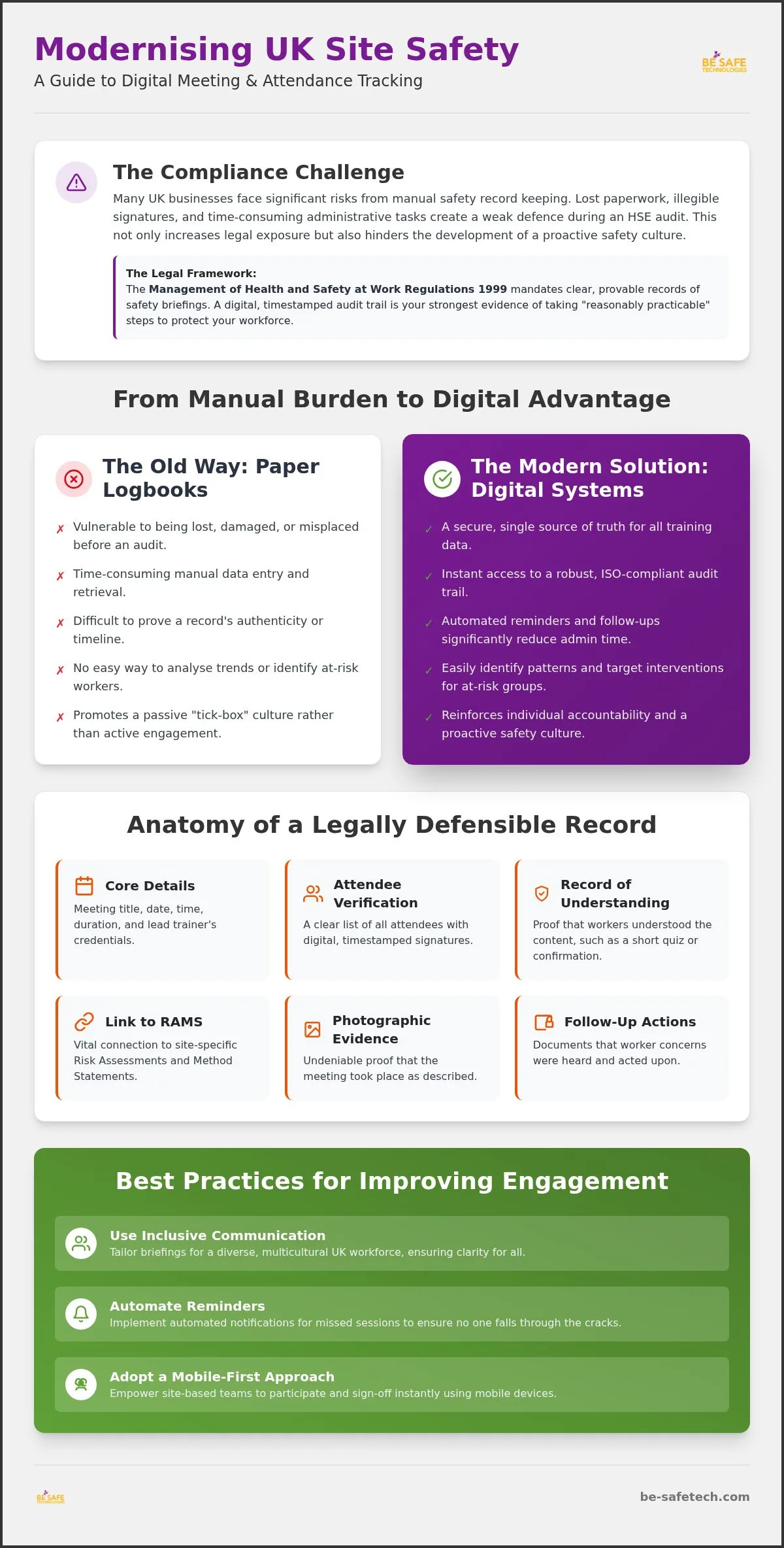
The Management of Health and Safety at Work Regulations 1999 places a clear burden on employers to ensure their staff are “competent” to carry out their work safely. You can’t prove competence without evidence that you’ve provided the necessary information, instruction, and training whilst on-site. If an incident occurs and the Health and Safety Executive (HSE) launches a RIDDOR investigation, the first thing they’ll ask for is your training records.
Digital records provide a clear, timestamped audit trail that is much harder to dispute than a tattered paper logbook. These records are vital when building a defence against personal injury claims or potential HSE prosecutions. They demonstrate that you’ve taken “reasonably practicable” steps to protect your workers. Without robust safety meeting tracking and attendance data, your business is exposed to significant legal and financial risks.
Beyond Compliance: Building a Proactive Safety Culture
Compliance is the floor, not the ceiling. Modern UK safety culture is moving away from “passive attendance”, where workers simply stand in a circle and nod, towards “active engagement”. Digital tracking allows you to see patterns that paper systems often hide. For instance, you can quickly identify “at-risk” groups or specific subcontractors who consistently miss briefings, allowing for targeted interventions before an accident happens.
Using a formalised, digital system also has a psychological impact on the workforce. When workers sign into a briefing via a mobile device, it reinforces the gravity of the information being shared. It creates a sense of individual accountability. You aren’t just ticking a box; you’re building a data-driven safety environment that values every individual’s contribution. By monitoring engagement metrics rather than just attendance, you can refine your briefings to ensure they’re actually hitting the mark for your team. This focus on data-driven people management is shared by modern HR platforms like humae.io, which help organisations manage their workforce with greater precision and care.
What to Include in a Robust Safety Meeting Record
A complete record captures the topic, date, attendees, trainer, and verified understanding in one cohesive document. This definition sets the standard for any organisation aiming for total compliance. In the UK, a simple list of names on a piece of paper no longer suffices to prove that a meaningful briefing occurred. Effective safety meeting tracking and attendance must provide context, showing not just who was present, but exactly what they learned and how it relates to their specific site duties.
Linking these records to your site-specific Risk Assessments and Method Statements (RAMS) is a vital step. It demonstrates that the briefing was relevant to the high-risk activities occurring on-site that day. Without this connection, a record exists in a vacuum, making it difficult to prove that workers were properly prepared for their environment. Capturing follow-up actions is equally important. It shows that you’ve listened to worker concerns and taken steps to mitigate risks, which is a key part of your legal duty to consult with employees on safety matters.
Critical Data Points for UK Site Records
Your records must include mandatory fields such as the meeting title, date, time, duration, and the lead trainer’s credentials. In 2026, the “Record of Understanding” has become a critical requirement. A simple signature can be forged or signed without reading the content. A robust system requires a way to verify that the worker actually understood the briefing, perhaps through a short digital quiz or a recorded verbal confirmation. Adding photographic evidence of the meeting or a specific safety demonstration further strengthens your audit trail, providing undeniable proof that the session occurred as described.
Managing Missing Attendees and Follow-ups
The danger of “ghost attendees”, where workers are signed in by colleagues despite being absent, remains a significant liability. Digital systems mitigate this by using individual logins or geo-location data to verify actual presence. You must also have a standardised process for briefing workers who were absent due to leave or sickness. No one should start work without receiving the same level of safety information as their peers.
Assigned follow-up actions must be tracked and closed out within the system. If a worker identifies a faulty guard or a tripping hazard during a toolbox talk, the record should show who is responsible for fixing it and when the task was completed. By digitising these workflows, you can ensure that safety meeting tracking and attendance remains a simple, stress-free part of your daily routine whilst maintaining the highest standards of site safety.
Comparing Methods: Paper Logbooks vs Digital Tracking Systems
Traditional paper sign-in sheets have been the industry default for decades, but they carry significant operational risks that modern businesses can no longer ignore. Whilst a notebook is inexpensive to buy, the hidden costs of physical storage, manual data entry, and the risk of damage on a wet UK construction site quickly add up. Moving to a SaaS solution like Compliance Genie replaces these fragmented processes with a centralised digital hub. This transition isn’t just about technology; it’s about shifting from a reactive “paper chase” to a proactive strategy for safety meeting tracking and attendance.
The Hidden Administrative Burden of Paper
Health and safety managers often spend hours every week chasing physical signatures and typing up hand-written notes from various sites. This administrative drain pulls specialists away from high-value tasks like risk assessment or site inspections. There’s also the “Audit Panic” to consider. When an inspector asks for a specific record from three years ago, finding a single sheet of paper in a physical archive is a stressful, time-consuming ordeal. Adopting paperless health and safety records removes this friction entirely. Every record is searchable, timestamped, and instantly accessible from any location.
Real-time Analytics and Remote Oversight
Cloud-based systems provide head office with a bird’s-eye view of compliance across the entire UK. You don’t need to visit every site to know if briefings are happening. Automated alerts notify management if attendance levels drop below a set threshold, allowing for immediate intervention. This level of oversight ensures that no team is left behind and that every worker receives critical safety information. Data integrity is also guaranteed through ISO 27001 secure storage protocols, which offer a level of protection that a locked filing cabinet simply cannot match.
Some managers worry that older or less tech-savvy site workers might struggle with new tools. However, modern mobile-first platforms are designed for simplicity. Capturing a digital signature or scanning a QR code is often faster and easier than finding a pen that works in the rain. By prioritising user-centric design, digital safety meeting tracking and attendance becomes an intuitive part of the working day rather than a technical hurdle. It provides peace of mind for the management team and clarity for the workers on the ground.
Best Practices for Improving Attendance and Engagement in Safety Briefings
Capturing signatures is only half the battle. If your workers aren’t engaged, the most sophisticated safety meeting tracking and attendance system won’t prevent accidents. To move beyond a simple tick-box exercise, you need a framework that makes safety briefings relevant and accessible. High-impact meetings are usually short, focused, and held in a quiet environment where everyone can hear clearly. Toolbox talks are an excellent alternative to long classroom sessions; they allow for specific, site-based instruction that workers can apply immediately to their current tasks.
Interactive elements can transform a dry lecture into a meaningful discussion. Instead of just reading from a script, use your digital platform to display diagrams or short videos that illustrate the point. This approach caters to different learning styles and keeps the team focused. By making the process more dynamic, you’ll likely see a natural increase in attendance and a genuine improvement in site safety standards across your organisation.
Inclusive Safety Communication for Diverse Teams
The modern UK workforce is multicultural, and your communication strategy must reflect this. Language barriers shouldn’t be a reason for poor safety outcomes. Use visual aids and universal diagrams to ensure that critical information is understood by everyone, regardless of their native language. It’s vital to encourage participation from workers of all ethnicities and backgrounds. They are the ones on the front line, and their site observations are invaluable. Ensuring the meeting environment is accessible and welcoming builds trust and encourages a more open safety culture where everyone feels empowered to speak up about hazards.
Measuring Engagement, Not Just Attendance
Knowing someone was in the room isn’t the same as knowing they understood the message. Use quick digital quizzes at the end of a session to verify comprehension. This data provides a much more accurate picture of your site’s safety readiness than a simple signature ever could. A robust “Feedback Loop” is also essential. Ask workers for their input on current site hazards during the briefing and record these concerns directly into your management software. This shows that their voice matters and that you are taking action based on their feedback.
Recognising and rewarding teams with high engagement levels or perfect attendance records can further boost morale. It turns compliance into a positive achievement rather than a chore. To see how a digital platform can simplify this entire process for your team, book a demo of Compliance Genie today.
Streamlining Compliance with Compliance Genie
Be-Safe Technologies Ltd is a premier UK-developed solution designed to handle the complexities of modern safety meeting tracking and attendance. As a comprehensive safety management software, it bridges the gap between site-level activity and corporate oversight. The platform replaces fragmented, manual processes with a single, secure digital hub that ensures every briefing is recorded accurately and stored safely. By focusing on the specific needs of UK businesses, it provides a level of reassurance that generic, international tools often fail to deliver.
Mobile-First Attendance Tracking in the Field
Site leads and supervisors are rarely tethered to a desk, so they need tools that work where they do. Be-Safe Technologies Ltd’s mobile-first design allows site leads to use their own devices to log attendees in seconds. This removes the need for bulky hardware or shared kiosks that can slow down the start of a shift. Workers can provide digital signatures instantly, creating an unshakeable audit trail that includes precise timestamping and location data.
Reliability is critical, especially when working in remote UK areas with poor mobile signal. The platform’s offline functionality ensures that attendance can be recorded even in “dead zones”. Once the device reconnects to a network, the data syncs automatically with the central system. This ensures that no record is lost and that your compliance data remains complete, regardless of site conditions. Additionally, the platform integrates seamlessly with contractor management software UK, allowing you to track the attendance of external visitors and subcontractors with the same rigour as your direct employees.
The Reassurance of UK-Based Expertise
Choosing a safety platform is a matter of trust. Be-Safe Technologies Ltd is built specifically for the UK regulatory landscape, ensuring that your safety meeting tracking and attendance procedures align with HSE expectations. The platform holds both ISO 9001 and ISO 27001 certifications, which guarantees a high standard of quality management and data security. This is particularly important for businesses handling sensitive worker information and those who must demonstrate a robust safety culture to external auditors.
For organisations operating within the public sector or high-security environments, Be-Safe Technologies Ltd’s G-Cloud approval provides an extra layer of peace of mind. It signifies that the software has met rigorous government standards for security and reliability. You can manage your safety briefings with the confidence that your data is hosted securely and is always ready for inspection. To see how these tools can transform your site operations and reduce your administrative burden, organise a demo of Be-Safe Technologies Ltd today.
Future-Proofing Your UK Site Safety
Transitioning from antiquated paper logs to a digital framework is no longer just an operational preference; it’s a strategic necessity for maintaining HSE compliance. By focusing on active engagement and linking briefings directly to site RAMS, you protect your workforce and your business from the risks of passive attendance. Modern safety meeting tracking and attendance systems provide the unshakeable audit trail required to navigate the complex regulatory environment of 2026 with total confidence.
Compliance Genie offers a streamlined path to digital clarity. As a G-Cloud approved and ISO 27001 certified platform, it provides the security and reliability that UK organisations demand. You’ll benefit from our award-winning UK-based support team, joining a network of trusted organisations across the UK and Europe. Book a personalised demo of Compliance Genie and transform your safety tracking today. It’s time to replace administrative stress with the peace of mind that comes from total oversight and operational harmony.
Frequently Asked Questions
Is a digital signature legally valid for safety meeting attendance in the UK?
Yes, digital signatures are legally valid in the UK for recording safety meeting attendance. The Electronic Communications Act 2000 establishes the legal framework for electronic signatures, making them as binding as physical ones. Using a digital system ensures that the signature is timestamped and linked to a specific version of the briefing material. This creates a more robust audit trail than a traditional paper sign-in sheet, which is often difficult to verify during a legal challenge.
How long must safety meeting and training records be kept under UK law?
Most health and safety training records should be kept for at least three years to align with the statutory limitation period for personal injury claims. However, some specific regulations require much longer retention. For example, records related to hazardous substances like asbestos or lead must be stored for 40 years. Maintaining a digital archive for safety meeting tracking and attendance ensures these records remain legible and accessible for decades without requiring physical storage space.
Can I use a digital system to track attendance for external contractors?
You can certainly use a digital system to manage attendance for external contractors through Contractor Genie. This specialised software streamlines the oversight of external workers, ensuring they receive the same level of safety instruction as your direct employees. It centralises their site visit data and training history in one location. This makes it easier to verify that every contractor on your site is fully compliant with your internal safety standards and UK regulations.
What happens if an employee refuses to sign a safety meeting attendance record?
If an employee refuses to sign a record, you should document the refusal along with the reason given and have a witness verify that the briefing was delivered. Under the Health and Safety at Work etc. Act 1974, employees have a legal duty to cooperate with their employer on safety matters. A refusal to sign a record of understanding is often a disciplinary issue. It’s vital to record that the information was provided, even if the individual declines to sign.
How does digital tracking help during an HSE inspection?
Digital tracking provides an instant, searchable audit trail that demonstrates you’ve taken “reasonably practicable” steps to ensure worker safety. During an HSE inspection, being able to retrieve specific attendance records in seconds shows a proactive and organised approach to compliance. It removes the stress of searching through paper files and proves that your safety briefings are consistently delivered and understood. This transparency builds trust with the regulator and reduces the risk of enforcement action.
Is it possible to track safety meeting attendance offline on remote sites?
It is entirely possible to track attendance offline on remote sites using Compliance Genie. The mobile-first platform allows site leads to capture signatures and attendance data even in areas with no mobile signal. Once the device returns to an area with connectivity, the information syncs automatically with the central cloud database. This ensures that safety meeting tracking and attendance remains consistent across all UK sites, regardless of their geographic location or infrastructure.
What is the best way to handle safety briefings for workers with limited English proficiency?
The best approach involves using visual aids, universal diagrams, and translation features within your digital platform. You must ensure that the core safety message is understood, not just delivered. Using short digital quizzes with images can help verify comprehension for workers with limited English proficiency. This inclusive method ensures that everyone on-site remains safe and that you’ve fulfilled your legal duty to provide “adequate” training to all members of your diverse workforce.
How does Compliance Genie ensure our safety data is secure?
Compliance Genie protects your data through rigorous security protocols, including ISO 27001 and ISO 9001 certifications. These international standards ensure that we manage your information with the highest levels of security and quality control. Additionally, the platform is G-Cloud approved, meaning it has met the strict security requirements set by the UK government for cloud software providers. Your safety records are hosted in secure environments, giving you total peace of mind regarding data integrity.