



Health and Safety at Work Act 1974: 2026 UK Business Guide

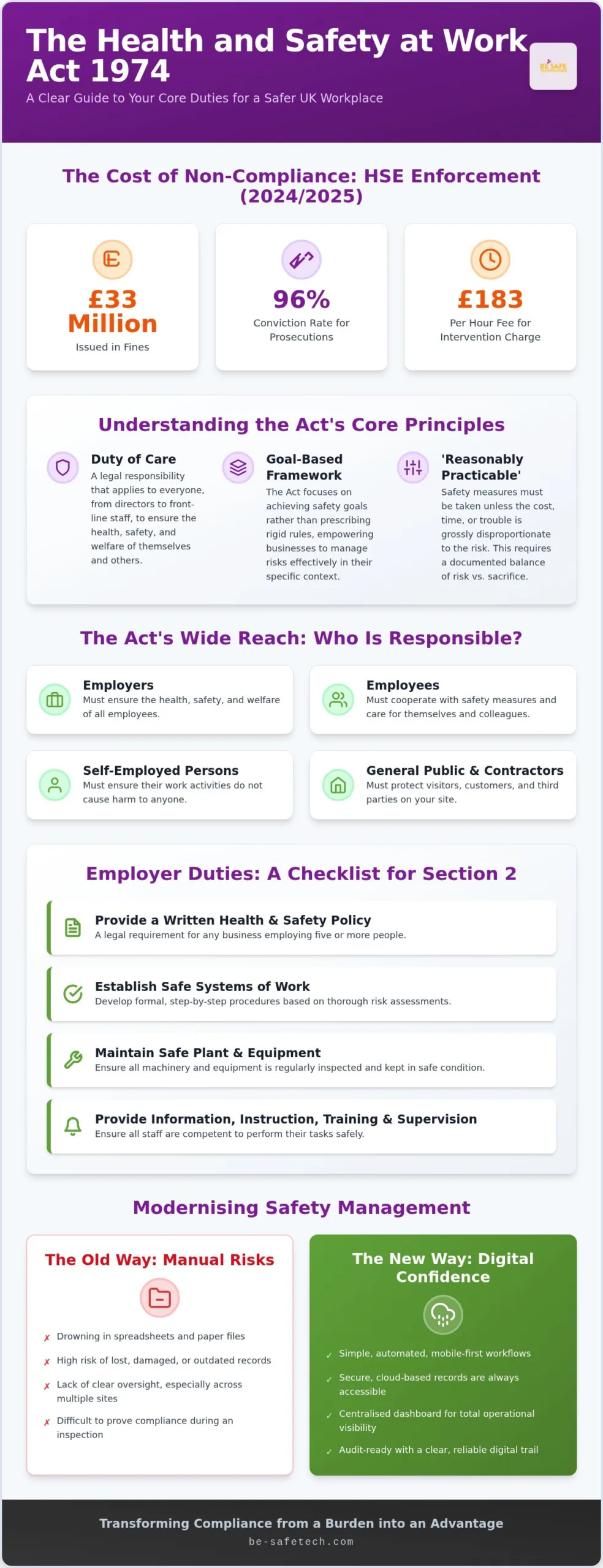
Did you know that the Health and Safety Executive (HSE) issued over £33 million in fines during the 2024/2025 period, maintaining a conviction rate of 96%? Accessing a clear health and safety at work act 1974 summary is the first step in ensuring your business remains on the right side of these statistics. For many UK leaders, the daily reality involves drowning in spreadsheets and outdated paper files whilst worrying that a single missed training record could lead to a Fee for Intervention charge of £183 per hour. It is a common struggle to balance operational demands with the rigid requirements of the law.
We promise to show you how to manage these obligations efficiently by moving away from manual tracking toward modern digital oversight. This guide explores your primary legal duties and the latest 2026 regulatory shifts, such as the independence of the Building Safety Regulator. You will discover how tools like Compliance Genie turn risk assessments into a simple, automated process, giving you the clarity and confidence needed to face any audit with total peace of mind.
Key Takeaways
- Understand the core “Duty of Care” that applies to every person in your organisation, ensuring that safety is managed as a shared responsibility.
- Review this health and safety at work act 1974 summary to clarify your specific legal obligations under Section 2, including the provision of safe systems of work and staff training.
- Learn how to encourage employee cooperation by helping staff understand their duty to take reasonable care of themselves and their colleagues.
- Explore how moving from manual paperwork to digital management systems reduces the administrative burden and improves oversight across multi-site operations.
- Find out how Compliance Genie turns complex legal requirements into simple, mobile-first workflows that ensure you are always prepared for an HSE inspection.
What is the Health and Safety at Work Act 1974?
The Health and Safety at Work etc. Act 1974, often abbreviated to HASAWA, serves as the cornerstone of all workplace protection in Great Britain. It isn’t just a rigid set of rules; it’s a flexible framework designed to evolve alongside changing industries. This health and safety at work act 1974 summary highlights its role as “enabling legislation.” This means the Act provides the broad legal powers that allow the government to introduce specific regulations, such as those governing hazardous substances (COSHH) or accident reporting (RIDDOR), without needing a new Act of Parliament every time. It establishes a clear “Duty of Care” that reaches from the boardroom to the front line.
Before 1974, safety laws were often prescriptive and focused on specific machines or narrow industries. The 1974 Act changed this by moving to a goal-based system. Instead of telling you exactly how to guard every single piece of equipment, it places the responsibility on you to manage risks effectively. This shift empowers businesses to find their own paths to safety, provided they meet the required standards of protection. It transforms safety from a tick-box exercise into a core part of business operations.
The Core Principle: ‘So Far as is Reasonably Practicable’
This phrase is the heartbeat of the Act. It acknowledges that safety isn’t an absolute at any cost. Instead, it requires a careful balance between the level of risk and the sacrifice involved in reducing it, whether that involves time, trouble, or money. If the cost of a safety measure is grossly disproportionate to the risk it prevents, you aren’t legally required to implement it. This flexibility is what allows the Act to work across diverse sectors, from high-stakes construction to quiet office environments. Documenting your reasoning for this balance is vital. Without a clear digital trail of your risk assessments, proving you’ve acted “reasonably” during an inspection becomes significantly harder.
Who Does the Act Apply To?
The scope of the Act is intentionally broad to ensure no one is left unprotected. It applies to every person involved in or affected by a business. This includes:
- Employers: You must ensure the health, safety, and welfare of all your staff.
- Employees: Workers have a legal duty to cooperate with safety measures and look after themselves and their colleagues.
- Self-employed: Individuals must ensure their work activities don’t harm themselves or others.
- General Public: You have a duty to protect visitors, customers, or passers-by who might be affected by your business activities.
Managing the safety of contractors is also a key requirement. You are responsible for ensuring that anyone working on your site, even if they aren’t your direct employees, follows safe practices. This is where tools like Contractor Genie provide essential oversight, helping you manage third-party risks and verify safety credentials without the stress of manual paperwork.
Employer Duties Under Section 2 of the Act
Section 2 of the Act is where the broad “Duty of Care” is translated into specific operational requirements for every UK business owner. It places a clear legal obligation on employers to ensure, so far as is reasonably practicable, the health, safety, and welfare of all employees. This health and safety at work act 1974 summary focuses on the proactive measures you must take to maintain a secure environment. In highly regulated sectors such as clinical healthcare, maintaining safe operations often depends on specialised technical competency, where resources like Mbawine Consultant Services support professionals preparing for sterile processing certifications. One of the first milestones for any growing firm is the requirement for a written health and safety policy, which becomes mandatory once you employ five or more people.
This policy must be more than a static document sitting in a drawer. It should reflect your actual processes and be regularly updated to match your current operations. For a broader look at the legislative landscape, the HSE summary of the Health and Safety at Work Act provides a useful baseline for these expectations. Meeting these duties isn’t just about avoiding fines; it’s about building a culture of reliability and trust within your team.
Safe Systems of Work and Plant Maintenance
A “safe system of work” is a formal, step-by-step procedure that results from a detailed risk assessment. It identifies potential hazards and outlines the exact methods staff should use to stay safe. Parallel to this is the non-negotiable duty to maintain “plant” (machinery and equipment) in a condition that is safe and without risks to health. Regular inspections are essential. By moving away from paper checklists and adopting cloud-based maintenance logs, you ensure that these critical records are never lost, damaged, or tampered with. This digital oversight provides a sense of total control, ensuring your equipment is always fit for purpose. For organisations that also require professional assistance managing physical workplace risks and statutory property compliance across the UK, click here to explore expert support.
Information, Training, and Supervision
Legal compliance requires that every worker understands the risks associated with their specific tasks. You must provide adequate information, instruction, training, and supervision to ensure they can work safely. Proving that this training has actually taken place is often the hardest part of an HSE audit. Digital systems allow for instant signatures and time-stamped records, creating unshakeable proof of compliance. Mobile-first tools are particularly effective here, as they allow staff to access safety manuals and training videos directly on their devices whilst on-site. If you want to simplify how these records are captured, you might find that digitising your safety workflows removes the administrative burden entirely.
Employee Responsibilities and HSE Enforcement
While the burden of compliance often sits with the leadership, the Official text of the Health and Safety at Work etc. Act 1974 makes it clear that safety is a collective effort. Section 7 of the Act outlines that employees have a legal duty to take reasonable care of their own health and safety, as well as that of any colleagues or visitors who might be affected by their actions. This health and safety at work act 1974 summary emphasises that compliance isn’t a one-way street; it requires active participation from every level of your organisation to be truly effective.
Section 7 and 8: The Worker’s Role
Employees are legally required to cooperate with their employer to ensure all statutory duties are met. Under Section 8, workers must not intentionally or recklessly interfere with or misuse anything provided in the interests of health, safety, or welfare. Building a positive safety culture means moving beyond simple obedience. When staff feel empowered to report hazards immediately, the entire business becomes more resilient. Using mobile-first digital reporting tools makes this cooperation effortless, allowing workers to flag risks in seconds rather than filling out tedious paper forms.
Powers of the Health and Safety Executive (HSE)
HSE inspectors possess significant authority to ensure businesses are following the law. They can enter premises at any reasonable time, often without a warrant, and have the power to seize documents, take samples, or dismantle equipment for testing. If an inspector finds a breach, they may issue an Improvement Notice, giving you a specific timeframe to fix the issue. For more serious risks, a Prohibition Notice can stop work immediately until the danger is removed. This can lead to significant downtime and lost revenue.
Since April 2025, the Fee for Intervention (FFI) rate has stood at £183 per hour. This means that if you’re found in material breach of the law, you’ll be charged for the inspector’s time spent identifying the fault and helping you rectify it. Penalties for non-compliance are severe, with the courts able to issue unlimited fines and even hand down custodial sentences to directors in extreme cases. Maintaining a state of constant audit-readiness through digital oversight is the most effective way to manage these risks and ensure you aren’t caught off guard by a surprise visit.
Modern Safety Management in 2026
While the 1974 Act provides the framework, the way we apply it has transformed. In 2026, managing a workforce isn’t limited to a single factory floor. Employers now oversee remote workers and multi-site operations across the UK. This health and safety at work act 1974 summary highlights that your duty of care extends to the home office. You must conduct risk assessments for employees using display screen equipment (DSE) at home. Relying on physical folders in a central office is no longer practical or compliant for a distributed team. It’s about ensuring safety is accessible to everyone, everywhere.
Protecting safety data is as critical as the safety itself. Digital systems backed by ISO 27001 certification ensure that sensitive employee health records and incident reports remain secure and GDPR compliant. Unlike paper logs, digital audit trails provide chronological, unalterable evidence of your compliance. If an inspector requests proof of a 2025 risk assessment or a training record, a cloud-based system retrieves it in seconds. This level of transparency provides a sense of total oversight that manual systems simply cannot match, especially during high-pressure audits.
Reducing the Paperwork Burden
Manual safety administration carries a heavy hidden cost in time, physical storage, and human error. With 1.9 million workers suffering from work-related ill-health in 2024/2025, the stakes for accurate record-keeping have never been higher. Research indicates that 40.1 million working days were lost during that same period, making efficient management vital for business continuity. Digital forms prevent staff from skipping mandatory fields, ensuring every risk assessment is thorough and consistent. Transitioning to health and safety compliance software allows you to automate reminders and track completion rates in real-time, removing the burden of manual follow-ups.
Managing Contractors and Third Parties
Your legal liability doesn’t end with your direct employees. You are responsible for any contractors working under your control, and failing to verify their safety standards can lead to severe penalties. Using contractor management software UK allows you to verify insurance, certifications, and safety credentials before a third party even arrives on site. This ensures that site inductions are completed and recorded digitally for every visitor, creating a robust record for your files. It creates a seamless safety ecosystem where everyone on your premises is accounted for. To see how these tools can transform your compliance, you can explore our digital safety solutions today.
How Compliance Genie Simplifies the 1974 Act
Compliance Genie is designed to bridge the gap between high-level legal duties and daily operational reality. It transforms the principles discussed in this health and safety at work act 1974 summary into practical, automated workflows that remove the stress of manual tracking. By centralising your safety data, you gain real-time visibility of performance across your entire organisation. This ensures that no training renewal or equipment inspection ever slips through the cracks, providing a level of oversight that is impossible to achieve with paper-based systems.
The platform provides instant access to risk assessments and safety policies via mobile devices, allowing staff to consult vital instructions exactly when they need them. Automated alerts keep your team informed of upcoming compliance deadlines, reducing the risk of a material breach. This proactive approach helps you maintain the “reasonably practicable” balance required by law, ensuring safety remains a streamlined part of your business operations rather than a bureaucratic burden.
Digitising Your Risk Assessments
Moving from cumbersome paper files to digital audit checklist software ensures that every assessment follows a standardised, high-quality format. This consistency is essential for meeting your legal obligations under Section 2 of the Act. Using health and safety risk assessment software allows your team to complete inspections on-site using mobile apps, with mandatory fields preventing incomplete or inaccurate entries. These digital records are instantly available as professional reports, providing the unshakeable evidence needed to satisfy HSE inspectors or demanding corporate clients during an audit.
A Secure, ISO-Certified Solution
Be-Safe Technologies understands that safety data is highly sensitive and must be handled with the utmost care. We prioritise your data security by maintaining ISO 9001 and ISO 27001 certifications, ensuring your information is managed according to the highest international standards for quality and security. This commitment to data integrity, combined with our expert UK-based support team, offers a level of reliability that manual systems simply cannot match. As you look toward The Future of Safety Management Software, digitising your compliance becomes a strategic advantage. It provides the peace of mind that comes from knowing your business is protected by a system that adapts to your specific needs.
Future-Proofing Your Workplace Safety Strategy
The 1974 Act remains a flexible framework that rewards businesses for being proactive rather than reactive. As this health and safety at work act 1974 summary has shown, your duty of care isn’t a static obligation but a goal-based system that evolves with your operations. By moving away from paper-heavy processes and embracing digital oversight, you gain total control over your compliance landscape. It’s about turning a legal necessity into a streamlined operational advantage that protects both your people and your reputation.
Managing risk assessments, training records, and contractor credentials doesn’t have to be a bureaucratic burden. Our award-winning UK EHS software provides mobile-first site safety tools that ensure your team stays protected and your records remain audit-ready. With ISO 27001 certification for data security, you can trust that your sensitive information is always handled with professional care. This reliability allows you to focus on growth whilst we handle the complexities of regulation.
Ready to transform your approach to workplace protection? Book a Compliance Genie demo to see how we simplify UK safety law and start building a safer, more efficient future for your organisation today.
Frequently Asked Questions
What is the main purpose of the Health and Safety at Work Act 1974?
The main purpose of the Health and Safety at Work etc. Act 1974 is to provide a comprehensive framework that protects the health, safety, and welfare of everyone in the workplace. It shifted the UK away from prescriptive rules toward a goal-based system. This means businesses are responsible for identifying and managing risks themselves. This health and safety at work act 1974 summary clarifies that the Act serves as the legal foundation for all specific safety regulations.
What are the 5 main duties of an employer under the Act?
Employers hold five primary duties under Section 2 of the Act to ensure staff protection. These include providing safe plant and systems of work, ensuring the safe use and storage of articles and substances, and offering adequate information, training, and supervision. To fulfil this training requirement, employers often work with accredited providers like You Can Do It Training Ltd to deliver certified health and safety courses. Additionally, you must maintain a safe place of work with secure access and provide a working environment that includes adequate welfare facilities. These core obligations form the basis of your daily safety operations.
Do I need a written health and safety policy if I have fewer than 5 employees?
You aren’t legally required to have a written health and safety policy if you employ fewer than five people. However, you still have the same legal “Duty of Care” to ensure a safe working environment as larger organisations. Even without a written document, you must be able to demonstrate that you’ve identified hazards and implemented safe systems of work. Many smaller firms choose to digitise their records early to build a culture of reliability.
What happens if a business breaches the Health and Safety at Work Act?
Breaching the Act can lead to severe financial and legal consequences for your business. HSE inspectors may issue Improvement or Prohibition Notices, and you’ll likely face Fee for Intervention charges, currently set at £183 per hour. In the 2024/2025 period, UK courts issued over £33 million in fines. For the most serious failures, directors can face unlimited fines or even custodial sentences, making it vital to maintain unshakeable proof of your compliance at all times.
How does the HASAWA 1974 affect self-employed people?
Self-employed individuals have a legal duty to conduct their work in a way that doesn’t put themselves or others at risk. If your work activities pose a potential hazard to employees, clients, or the general public, the Act’s requirements apply fully. You must ensure that your equipment is safe and that you follow proper risk management procedures. Maintaining digital records of your safety checks provides essential protection if your methods or equipment are ever questioned by the authorities.
Can an employee be prosecuted under the Health and Safety at Work Act?
Yes, employees can be prosecuted under Section 7 of the Act if they fail to take reasonable care of themselves or others. Workers have a specific legal duty to cooperate with their employer on safety matters and must not misuse any equipment provided for their protection. If an employee’s reckless behaviour leads to an incident, they can face individual fines or prosecution. This highlights why safety must be treated as a shared responsibility across the entire organisation.
What is ‘reasonably practicable’ in UK safety law?
“Reasonably practicable” involves weighing the level of risk against the time, money, or effort required to avert that risk. You aren’t expected to eliminate every possible danger if the cost of doing so is grossly disproportionate to the safety benefit. This principle allows for a flexible approach across different industries. However, you must be able to justify your decisions with clear evidence and risk assessments to satisfy an inspector’s scrutiny during a site visit.
How can digital software help with HASAWA compliance?
Digital tools like Compliance Genie turn complex legal duties into manageable, automated workflows. By using mobile-first software, you can track risk assessments, equipment checks, and training renewals in real-time across multiple sites. This creates a secure, unalterable audit trail that provides far superior evidence than manual logs. It reduces the administrative burden on your team whilst giving you the peace of mind that your business remains fully compliant with the latest 2026 safety standards.