



Digital Risk Assessment Software UK: 2026 Guide

What if your next HSE inspection wasn’t a source of dread, but a chance to showcase total operational clarity? For many safety managers across the country, the reality is often far more stressful, involving a frantic search through overflowing filing cabinets whilst an inspector waits for proof of compliance. You know that managing safety across multiple sites shouldn’t feel like a constant battle against paperwork, which is why the shift toward digital risk assessment software UK wide is becoming the standard for modern firms. It’s a heavy administrative burden that distracts from the vital work of keeping people safe.
By adopting a smarter approach, businesses can finally move away from these cumbersome manual processes and regain peace of mind. This 2026 guide will show you how to transition to a streamlined, HSE-compliant digital framework that protects both your workforce and your business reputation. We’ll explore how a centralised, mobile-first safety hub can automate your reminders, generate professional RAMS instantly, and provide the real-time data you need to maintain total control of your operations from any location.
Key Takeaways
- Learn how to replace static, paper-based documents with dynamic digital records that provide real-time oversight across all your UK sites.
- Discover the essential features of modern digital risk assessment software UK businesses use to enable on-site hazard reporting and customisable risk matrices.
- Understand how to implement a phased digital transition that minimises disruption to your daily site operations whilst ensuring full HSE compliance.
- Identify the critical security standards, such as ISO 27001, and integration capabilities you must prioritise when evaluating new safety technology.
- See how mobile-first platforms like Compliance Genie drive higher engagement from site teams and simplify complex health and safety management.
The Evolution of Digital Risk Assessment Software in the UK
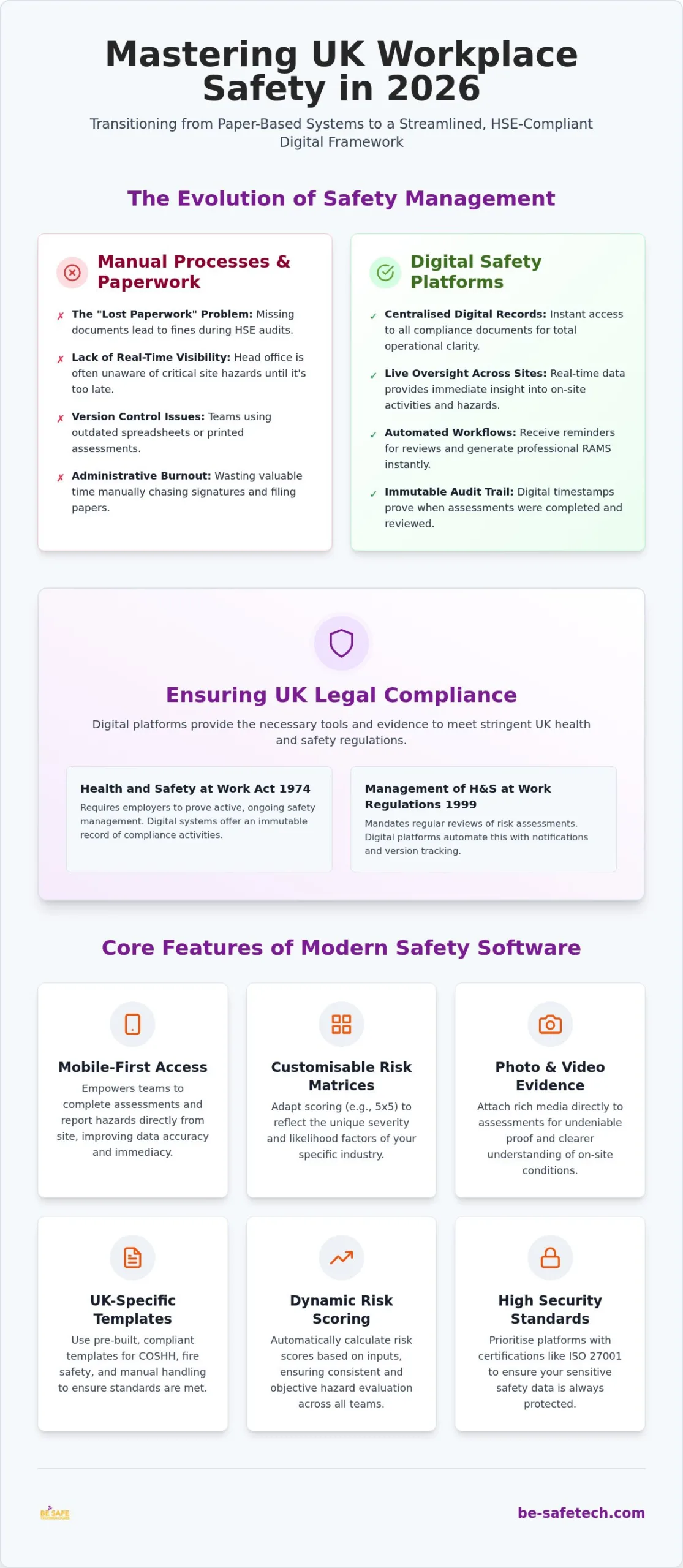
The landscape of workplace safety has undergone a profound transformation. In the past, safety management relied on physical folders and static documents that often gathered dust until an incident occurred. Today, digital risk assessment software UK businesses utilise has evolved into a centralised cloud platform designed for the proactive identification, evaluation, and mitigation of hazards. By aligning technology with fundamental risk assessment principles, these platforms transform safety from a reactive checkbox exercise into a dynamic, real-time pillar of business operations. The Health and Safety Executive (HSE) has increasingly encouraged this digital adoption, recognising that transparency and data accuracy are significantly higher when records are managed electronically.
In 2026, mobile-first technology has become the definitive standard for UK site safety. If a safety tool isn’t in a worker’s pocket, it isn’t being used to its full potential. Modern platforms allow teams to capture photos, record GPS coordinates, and log digital signatures at the exact moment a hazard is identified. This shift ensures that safety data is a living record rather than a historical archive, providing managers with a level of oversight that was previously impossible to achieve with manual systems.
Why Spreadsheets and Paper No Longer Suffice
Relying on Excel or physical paper creates invisible gaps in your safety net. Version control is a persistent problem in spreadsheet-based systems; it’s all too easy for a site team to work from an outdated assessment whilst the revised version sits on a manager’s hard drive. Some of the primary risks include:
- The “Lost Paperwork” Problem: During a high-stakes HSE audit, missing documents can lead to immediate fines or improvement notices.
- Lack of Real-Time Visibility: Traditional systems mean head office is often the last to know about a critical site hazard.
- Administrative Burnout: Manually chasing signatures and filing papers drains resources that should be spent on active risk reduction.
Legal Compliance: The Health and Safety at Work Act 1974 and Beyond
UK law demands that employers ensure the safety of their workforce “so far as is reasonably practicable.” Meeting this standard under the Health and Safety at Work Act 1974 involves more than just having a policy; it requires proof of active, ongoing management. The Management of Health and Safety at Work Regulations 1999 further mandate suitable and sufficient assessments that are regularly reviewed and updated. Digital platforms ensure these reviews happen through automated workflows and notifications, preventing any assessment from becoming obsolete. Digital timestamps provide an immutable audit trail that proves exactly when an assessment was completed or reviewed for UK inspectors.
Core Features of a Modern UK Risk Assessment Platform
Choosing the right digital risk assessment software UK providers offer ensures your tools adapt to your specific operational environment. While a standard 5×5 matrix is common, complex industries often require more nuanced scoring. Modern platforms allow you to customise these matrices to reflect the unique severity and likelihood factors of your sector, whether you’re in construction, healthcare, or logistics. This flexibility ensures that the data you collect is relevant and actionable, rather than just a generic estimate of danger.
Mobile-first design is no longer a luxury; it’s a necessity for accurate data capture. When workers can complete assessments on-site whilst hazards are visible, the quality of information improves significantly. This immediacy eliminates the “memory lag” that occurs when staff wait until they’re back at a desk to log their findings. Integrating photo and video attachments directly into the assessment provides undeniable evidence for your records, making it easier to demonstrate compliance with UK law on risk assessments.
Dynamic Hazard Identification and Scoring
Automation simplifies the complex task of calculating risk. By selecting pre-defined values for likelihood and severity, the software instantly generates a risk score and suggests appropriate mitigation measures. This consistency is vital for maintaining standards across different teams. Staff don’t have to worry about inconsistent manual calculations. Pre-built UK-specific templates for COSHH, fire safety, and manual handling ensure that your staff are asking the right questions from the start. If you want to streamline your safety processes, look for tools that combine these assessments with Method Statements to create a unified RAMS document.
Real-Time Reporting and Safety Intelligence
Comprehensive digital risk assessment software UK platforms provide centralised dashboards that offer a bird’s-eye view of your entire organisation’s safety health. You can see at a glance which sites have outstanding reviews and which teams are performing best. This “Safety Intelligence” goes beyond mere record-keeping; it identifies recurring hazard trends before they result in an accident. For example, if data shows a spike in slips and trips at a specific regional hub, you can intervene with targeted training immediately. Imagine a diverse team of professionals reviewing these insights on a tablet during a weekly briefing, moving from reactive fire-fighting to proactive safety leadership.
Automated review cycles ensure that no document is left to expire. The software sends notifications to responsible persons well ahead of time, maintaining a continuous chain of compliance. This structured approach removes the stress of manual tracking and guarantees that your safety framework remains robust and up to date throughout the year. It’s about creating a reliable rhythm of safety that protects everyone.
Transitioning from Paper to Digital Without Site Disruption
The most common objection to modernising safety processes is the fear that technology will create more work than it saves. Many UK safety managers worry that digitisation is too complex or that site teams will resist changing their established routines. Whilst the initial prospect of moving away from familiar physical folders may seem daunting, a structured change management strategy ensures the process remains manageable and productive. Safety doesn’t have to stop for technology. In fact, the right digital risk assessment software UK firms choose should integrate so quietly into daily operations that it feels like a natural upgrade rather than a disruptive overhaul.
Success lies in avoiding a “big bang” switch-over that risks overwhelming your staff. Instead, a phased approach allows you to iron out any site-specific challenges before a wider rollout. For a deeper look at managing this change, you can read our guide on How to Transition from Paper-Based Risk Assessments to Digital Compliance without affecting your site operations.
The 3-Step Digitisation Roadmap
A methodical transition protects your data integrity and keeps your teams focused on their primary tasks. Follow this three-step process to ensure a smooth migration:
- Step 1: The Audit. Review your existing paper forms and identify the most critical or high-frequency assessments. Start by digitising these “quick wins” to demonstrate immediate value.
- Step 2: The Pilot. Select a single site and a small, diverse group of “Safety Champions” to test the platform. This group should represent a cross-section of your workforce to ensure the software meets various user needs and technical abilities.
- Step 3: National Rollout. Once the pilot site is running smoothly, expand the system nationally. Provide ongoing digital support and create feedback loops so frontline workers can suggest improvements to the workflow.
Winning Buy-In from On-Site Personnel
The secret to high adoption rates is focusing on what is in it for the worker. When staff realise that digital risk assessment software UK platforms mean less time spent on tedious handwriting and more time working safely, resistance usually vanishes. Mobile apps are particularly effective because they reduce the need for workers to return to the site office centre just to sign a document or file a report. Everything can be handled on the spot, whilst the task is fresh in their minds.
How to Evaluate and Choose Your Digital Risk Assessment Tool
Selecting the right digital risk assessment software UK solution involves looking beyond the user interface to the technical foundations that keep your business safe. It’s about finding a partner that understands the nuances of British legislation and the specific pressures of managing safety in a high-stakes environment. Your choice should reflect a long-term strategy that prioritises reliability and data integrity over a quick, low-cost fix. For a deeper dive into these criteria, explore our comprehensive Mastering Health and Safety Risk Assessment Software: A 2026 Buyer’s Guide.
Data Security and ISO Standards
When you store sensitive safety data in the cloud, security is a non-negotiable requirement. ISO 27001 certification serves as a global benchmark for information security management, ensuring that your provider has rigorous controls in place to protect against data breaches and maintain business continuity. For UK-based firms, ensuring your data is stored in UK-located centres is often essential for maintaining full GDPR compliance. Additionally, look for ISO 9001 certification; this indicates that the software developer follows a consistent quality management system during the creation and maintenance of their platform.
Scalability and Multi-Site Management
Your chosen platform must be able to grow alongside your business. Whether you’re managing three sites or thirty, the software should handle an increasing number of users without a drop in performance. Effective multi-site management requires granular permission levels, allowing you to define exactly what a Site Manager can see compared to a Managing Director. If you work with external partners, it’s beneficial to choose a system that offers dedicated contractor management features. Solutions like Contractor Genie allow you to integrate visitor safety data directly into your wider compliance framework, ensuring a holistic view of site safety.
Finally, consider the human element of support. A provider with UK-based teams will understand the specific legislative nuances of the Health and Safety at Work Act and provide assistance during your local business hours. They should also be able to demonstrate how their software integrates with your existing HR or project management tools, preventing the creation of new data silos. If you’re ready to see how a professional platform can transform your oversight, you can book a demo of our award-winning software to explore these features in action.
Future-Proofing Safety with Compliance Genie
Building a resilient safety culture requires more than just meeting today’s minimum standards; it requires a platform built for the future of the British workforce. Compliance Genie stands as the premier UK-built solution for comprehensive health and safety management, designed specifically to address the complexities of modern site operations. By choosing a partner that understands the local regulatory landscape, you ensure that your digital risk assessment software UK implementation remains legally defensible and operationally efficient. Be-Safe Technologies Ltd acts as a long-term ally in your journey toward a more transparent and proactive safety environment.
The platform’s mobile-first architecture is a deliberate choice to ensure high engagement from site teams. When workers can easily log hazards or complete audits on their phones whilst the work is in progress, the quality of your safety data improves. This accessibility removes the traditional friction associated with compliance, turning safety from a chore into a seamless part of the daily workflow. By unifying risk assessments, audits, and contractor oversight in one centralised hub, you eliminate the fragmented spreadsheets that often lead to oversight errors.
Why Compliance Genie is the All-in-One Choice
Our award-winning platform provides the peace of mind that comes with recognised industry standards. With ISO 9001 and 27001 certifications, your data is protected by the highest levels of security, whilst the software itself is maintained to a rigorous quality standard. The key benefits of the system include:
- User-Centric Design: An intuitive interface that site teams actually enjoy using, which reduces the need for extensive training.
- Legal Assurance: Immutable audit trails that satisfy HSE requirements and provide clear proof of due diligence.
- Organisational Oversight: Instant visibility across all your sites from a single dashboard, allowing for faster, data-driven intervention.
The integration with Contractor Genie further strengthens this ecosystem, allowing you to manage external site visitors with the same level of precision as your internal workforce. This creates a complete and well-rounded safety environment where nothing is left to chance.
Taking the Next Step Toward Digital Excellence
Transitioning to a digital framework is a strategic journey, and Be-Safe Technologies Ltd ensures you don’t have to navigate it alone. Expert support is available to help you configure the platform to your specific industry needs, ensuring that the technology adapts to your people rather than forcing them to change how they work. Whether you’re looking to automate your RAMS generation or gain deeper safety intelligence, the first step is seeing the system in action.
We encourage you to book a demo to discover how the “Genie” can simplify your complex tasks and provide total clarity. Explore how Compliance Genie can revolutionise your UK risk assessments today and join the growing number of organisations that have successfully future-proofed their safety operations.
Elevating Your Safety Standard for 2026
Transitioning from fragmented spreadsheets to a unified digital framework is no longer a choice but a necessity for modern business resilience. As we’ve explored, the right digital risk assessment software UK firms choose must balance ease of use with rigorous technical standards. By prioritising mobile-first data capture and automated review cycles, you ensure that your safety protocols remain dynamic and fully compliant with HSE expectations. It’s about moving beyond the limitations of paper to achieve a level of oversight that protects both your workforce and your reputation.
Compliance Genie provides an award-winning, mobile-first platform that is both ISO 27001 and 9001 certified, ensuring your data is managed with the highest degree of security. With our UK-based expert support, your team can confidently navigate the shift to a more efficient, centralised safety hub. It’s time to replace the administrative burden of manual filing with the quiet confidence of total operational clarity. Book a Compliance Genie Demo to Organise Your UK Safety Strategy and take the first step toward a safer, more streamlined future.
Frequently Asked Questions
Is digital risk assessment software legally recognised by the HSE?
Digital records are fully recognised by the Health and Safety Executive (HSE) provided they meet the criteria of being “suitable and sufficient.” UK law, specifically the Management of Health and Safety at Work Regulations 1999, requires employers to record the significant findings of their assessments. Modern digital platforms often exceed manual standards by providing immutable timestamps and clear version control, which inspectors value for transparency and proof of due diligence.
How much does digital risk assessment software typically cost in the UK?
Costs for safety technology vary based on the number of licenses required and the complexity of the features included. Most providers in the UK market utilise a subscription-based SaaS model, with pricing structures often tiered to accommodate small businesses or larger enterprise organisations. It’s common to find models based on a per-license or per-administrator fee, allowing for scalability as your workforce grows without unpredictable costs.
Can I use digital risk assessment tools offline on remote sites?
Most modern mobile-first platforms include offline functionality to support work on remote sites with limited connectivity. You can complete your assessments and log hazards whilst offline; the data then automatically synchronises with the central cloud hub once a stable internet connection is restored. This ensures that safety data capture is never interrupted by poor signal in rural areas or underground locations.
What is the difference between generic H&S software and specialist risk assessment tools?
Specialist tools focus deeply on the workflow of identifying and mitigating hazards, whereas generic software may offer broad but shallow features. High-quality digital risk assessment software UK providers ensure their tools include specific modules for RAMS, COSHH, and fire safety. These dedicated platforms often provide more granular reporting and customisable risk matrices that adapt to specific industry requirements rather than offering a one-size-fits-all approach.
How do I migrate my existing paper risk assessments into a new digital system?
Migration usually involves a phased approach where existing paper forms are audited and then recreated using digital templates. Many systems allow you to upload legacy documents as PDFs for historical record-keeping whilst you transition new assessments into the dynamic digital format. This process ensures a continuous audit trail without losing valuable historical safety data during the switch-over to a more efficient system.
Is my data secure when using a cloud-based safety management system?
Data security is maintained through rigorous encryption and adherence to international standards like ISO 27001. For UK businesses, it’s vital to ensure that your provider utilises UK-based data centres to remain fully compliant with GDPR requirements. These cloud systems offer significantly better protection against data loss than physical paper files, which are vulnerable to physical damage, misplacement, or unauthorised access.
Does the software provide templates for specific UK industries like construction or retail?
Leading platforms provide a comprehensive library of pre-built templates tailored to specific UK sectors, including construction, manufacturing, and healthcare. These templates are designed to meet local legislative standards for common tasks such as manual handling, working at height, and COSHH assessments—for example, when managing laundry solutions like those from safiwash.com. You can also customise these templates to reflect the unique operational risks found at your specific sites, ensuring the content is always relevant.
Can I manage external contractors using the same risk assessment software?
Yes, many advanced platforms offer integrated modules specifically for managing external contractors and site visitors. This allows you to verify their credentials and ensure they have read and signed relevant risk assessments before they begin work on your site. Using a unified system like Contractor Genie ensures that all safety data, whether from employees or contractors, is stored in one centralised location for total oversight.