



COSHH Risk Assessment Reviews: The Cycle Employers Miss
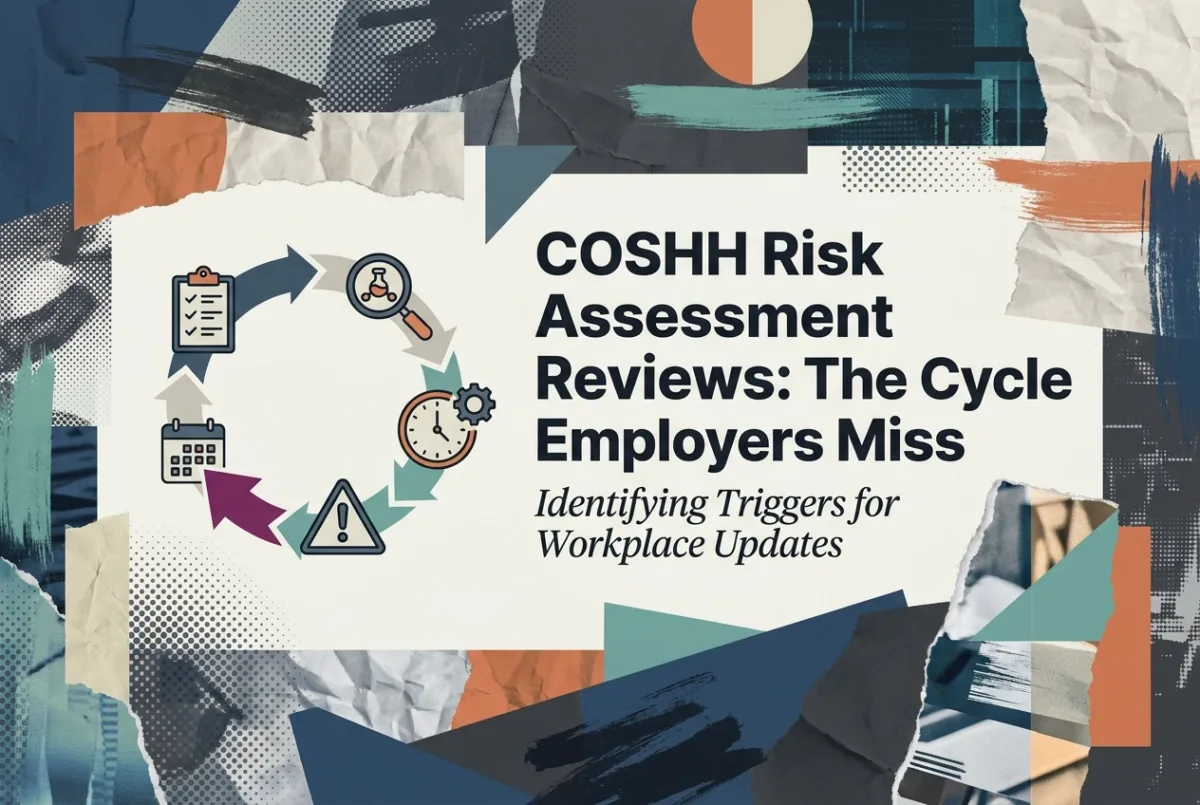
Most COSHH assessments do not fail on the day they are written. They fail later, quietly, when a substance changes, a process is adjusted, or a near miss shows that the controls on paper no longer match the work on the floor. The first draft is rarely the weak point. The first change usually is.
That is why this post focuses on the review and revision duty at the centre of your COSHH risk assessment obligations, rather than on the initial form. You will start with the COSHH duties most employers already meet, and the one that slips. Then we look at when a COSHH risk assessment should be reviewed and revised, before working through three practical triggers: new substances and new hazard information, changed processes, tasks and controls, and incidents, near misses and ill health. We will separate a document review cycle from an assessment review cycle, explain who should own each assessment, describe what a review-ready assessment looks like, and set out the evidence that proves a review actually happened. By the end, you should be able to make the change your trigger, not your surprise.
The COSHH Duty You Already Meet, and the One That Slips
Under COSHH, you must not carry out work that could expose employees to hazardous substances before considering the risks. The regulations set out eight steps: assess, decide precautions, control exposure, maintain controls, monitor, provide health surveillance where needed, plan for emergencies, and inform and train employees.
That is what you do once. Separately, the COSHH Regulations and HSE’s Approved Code of Practice L5 (sixth edition, 2013), which reflects the REACH and CLP changes, set out the duty to keep assessments under review, confirm the exact trigger wording against the current L5 text before publication. Hazards are not static. COSHH covers substances the work generates as well as those brought in, so welding fumes and biological agents sit under the same duty as bottled chemicals. Change the process and the hazard profile moves with it.
A COSHH assessment is a live record of a changing workplace: the moment something changes is the moment the paperwork stops matching the job. Our COSHH assessments and workplace responsibilities guide sets out the wider duty.
When Should a COSHH Risk Assessment Be Reviewed and Revised?
A COSHH risk assessment should be reviewed whenever anything it depends on changes: the substance, the process, the people exposed, or the controls. Scheduled checks are a backstop, not the system itself.
The logic follows the regulations. Under the COSHH Regulations and HSE’s Approved Code of Practice L5, assessment is required before work that could expose employees to hazardous substances, so it must also be updated when that work stops being the work you assessed.
Three review types get blurred together:
- Trigger review: a specific change, handled immediately.
- Scheduled check: nothing known has changed, so you confirm that and review, repeat and update on a fixed date.
- Full rewrite: the task itself is redesigned.
Here is a practical test. If you cannot say what changed and when the assessment was updated in response, it is out of date regardless of the date printed on it.
If you have a specific change in mind, the next three sections cover the triggers: new substances, changed processes, and incidents.
Trigger 1: New Substances and New Hazard Information
The first and most common trigger is new or updated hazard information.
- New, substituted or re-sourced substances. A new product, different supplier or like-for-like replacement arrives with its own safety data sheet, exposure limits and control requirements. The assessment must reflect these before use.
- Reclassification and new information. A substance already in the cupboard can change status through updated classification, revised workplace exposure limits or new HSE guidance. This is why the review duty is not a one-off event.
- Substances the work generates. Fumes, dusts and biological agents are in scope even when nothing new was purchased. A process change that increases what the work releases is a trigger in its own right.
Two practical steps make these triggers visible. Keep one register of substances with the safety data sheet version date recorded against each, so supplier updates do not disappear into an inbox. When a register entry changes, list the assessments that reference that substance, so the review is targeted rather than blanket. Our guide to Safety Statements applies the same linking logic.
Trigger 2: Changed Processes, Tasks and Controls
Substances covered, but processes move. A new method, a relocated task, more frequent use, longer exposure, higher volumes handled, or a task moved into a smaller or worse ventilated space all shift the exposure picture, leaving the assessment describing work that no longer happens.
Controls drift quietly too. Local exhaust ventilation removed or poorly maintained, extended maintenance intervals, a different respirator or glove type, or an enclosure modified for other reasons can invalidate the original control decision. HSE’s COSHH guidance includes ensuring control measures are used and maintained properly, so maintenance and ventilation records belong in the review.
Who does the work matters: new starters, agency and contract staff, lone working, or a shift pattern exposing more people for longer. So does how exposure is checked: monitoring frequency cut, health surveillance altered, or a control check dropped because nobody reread the assessment.
Actionable step: add COSHH to your management of change questions, so whoever raises a process change also raises the assessment that owns it. Transitioning from paper to digital COSHH assessments can help keep that link visible.
Trigger 3: Incidents, Near Misses and Ill Health
Process changes are one trigger; incidents are another. When a spill, splash or accidental exposure occurs, that is the clearest evidence your assessment missed something. Treat it as an automatic review trigger, not just an incident investigation to close off.
The same applies when harm emerges over time. Reports of dermatitis, respiratory symptoms or an unexpected health surveillance result show exposure is not being controlled as the assessment assumed. Ulster University’s COSHH procedure notes that ill health from hazardous substances is ‘normally preventable’, which makes these reports hard to dismiss.
Then there are results that fall outside expectation:
- Air sampling above the assumed level
- A local exhaust ventilation examination finding a fault
- A broken extraction arm or damaged container
Each leaves your assessment describing a control arrangement that no longer exists. The practical fix is linking substance-related incident reports to your assessment register, so a report opens a review that feeds your wider safety culture, rather than waiting for the next scheduled audit.
A Document Review Cycle Is Not an Assessment Review Cycle
Incidents show when an assessment missed something. The same trap applies to calendar reviews. The Hywel Dda COSHH policy (discussed above) illustrates this: a three-year document cycle governs the policy, not the assessments beneath it. Its revision history shows a new policy in 2018, an extension in 2021, and full reviews in 2022 and 2025. A policy can be current while the assessments beneath it describe work that no longer happens. Policy is reviewed on a calendar; assessments are reviewed on events. Managing assessments by calendar alone guarantees a gap between the form and the job. The NHS example names an owning group and an executive director job title, and has a document-level compliance and audit section, but says nothing about who owns each assessment. Keep the two cycles separate: the policy on its own review date, and every assessment with its own review date plus written early-review triggers. See our guide to writing a health and safety policy.
The Real Failure Point: Who Owns Each COSHH Assessment?
The failure is rarely the missing assessment. It is the inability to evidence who owns its review, and that they carried it out. That document-level ownership model leaves per-assessment responsibility unnamed. Per-assessment named ownership is good practice, not a legal requirement the regulations impose on every assessment. Operationally, a department name, team or shared drive gives a new manager, auditor or inspector nothing to follow and no one to hold to account. A workable owner is a named post holder, not an individual who may leave, with defined review triggers and a recorded date of last review. Put an owner field on the assessment itself and revisit the owner list whenever someone changes role, so ownership survives turnover and handover. Holding that in a digital COSHH assessment tool makes the owner and date visible rather than buried in a folder.
An Example of a COSHH Risk Assessment Built to Be Reviewed
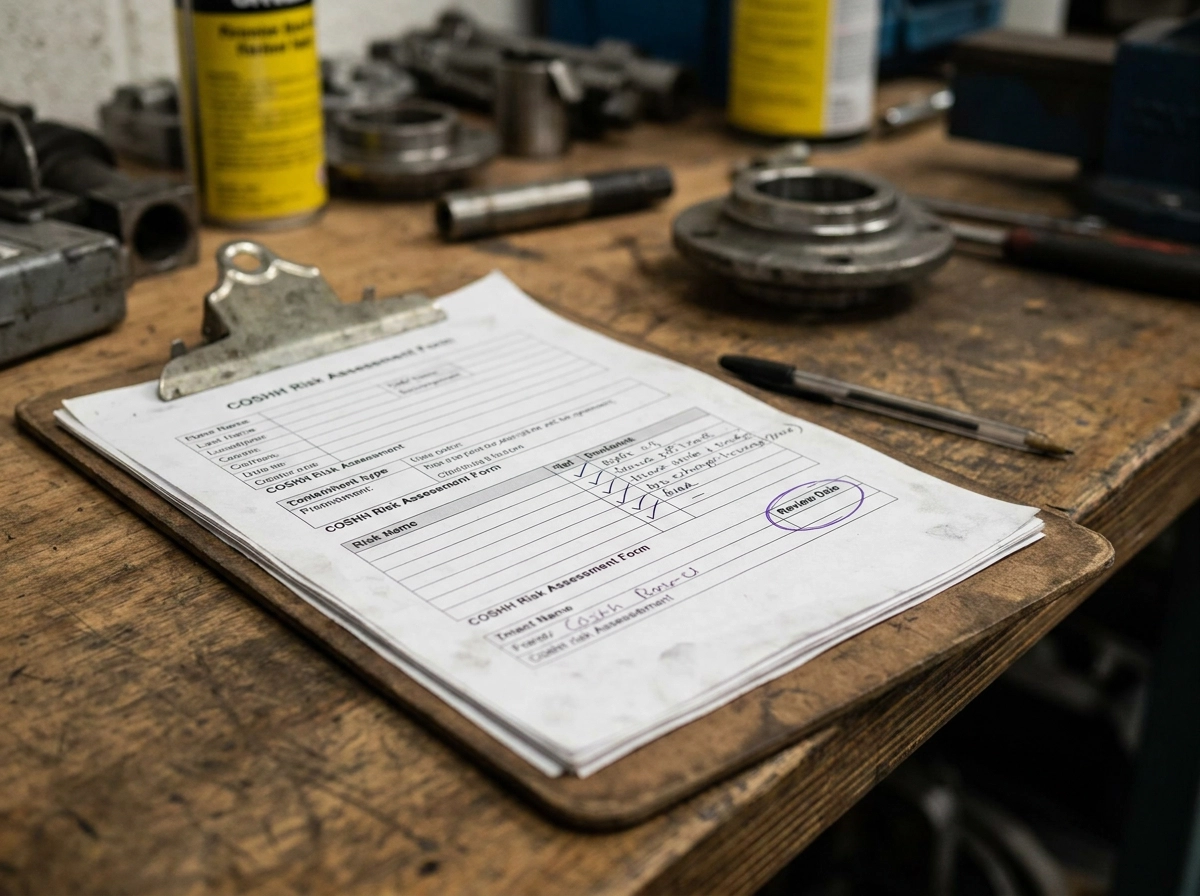
This COSHH risk assessment example is illustrative, not a real client or site. A workshop degreases metal parts with a solvent containing xylene. Hazard: harmful by inhalation, skin irritant. Two operators, 30 minutes per shift. Exposure route: inhalation and skin. Existing controls: local exhaust ventilation, nitrile gloves, training. Are they adequate? No: extraction has not been tested and the gloves are unsuitable. Additional controls: substitute a water-based cleaner if suitable, test the LEV, provide correct gloves, add a spill kit.
Fields: version 1.0; assessed 1 May 2025; review 1 May 2026; owner: Workshop Supervisor. Early triggers: substitution, process change, new safety data sheet, incident, LEV fault.
Review: on 10 September 2025 the solvent is substituted. The reviewer updates the exposure section to negligible inhalation, skin contact only, revises controls, adds a revision line explaining what changed and why, and resets the review date. This feeds information, instruction and training, exposure monitoring where controls cannot be confirmed, health surveillance for dermatitis, and emergency spill or release arrangements. For the wider method, see The Core Steps of a High-Quality Risk Assessment.
Keeping a COSHH Risk Assessment Template Alive, Not Just Filed
That worked example only stays current if the form itself forces the review. A template is a control, not stationery, when it carries fields for owner, version, review date, date of last review and a change log on the form itself, not in a spreadsheet someone else maintains.
The substance-register linking logic described in Trigger 1 makes this traceable.
Paper systems fail at exactly this point: nobody notices the date pass, nobody is named, so nothing happens until an incident or an audit surfaces it.
Our Health and Safety App can digitise a company’s health and safety processes, holding a COSHH process in one place, as the practical next step where that evidence gap exists. Software does not satisfy the duty; it records who reviewed what and when, which is the part employers are least able to evidence.
The Evidence That the Review Actually Happened
That record only proves its worth if it shows the review itself. The worked example above shows the fields a defensible record needs. It points to supporting evidence: safety data sheets with version dates, LEV examination and test records, exposure monitoring results, health surveillance outcomes and training records.
A signed form dated last year with no revision line proves filing, not reviewing. Evidence of review shows the trigger, the decision and the alteration.
Run a simple test this week: pick five assessments at random. Ask who owns each one and what has changed since it was written. The answers reveal where your system is thin, and they are the same answers an auditor would seek.
Treat this as good practice for demonstrating the duty has been met. Check record-keeping expectations against current HSE guidance rather than fixed legal requirements.

Conclusion: Make the Change the Trigger, Not the Surprise
If the audit test showed gaps, the fix is straightforward. COSHH assessments rarely fail at the first draft; they fail at the first change. And a review system you cannot evidence counts as no system at all.
Start with three actions. Give every assessment a named post holder owner and its own review date. Write down the triggers for an early review: new substances, process change, new hazard information, incidents. Log each review with the date and the reason it happened.
Keeping those two cycles separate remains the central point.
Finally, if reviews slip because nothing flags them, consider holding the COSHH process in a digital system that records the date, the owner and what changed. Then the evidence exists before anyone asks for it.