


The Definitive Guide to Customisable Health and Safety Software in 2026

If your digital safety system feels like a rigid straightjacket, is it actually protecting your workforce or just creating a new kind of risk? Many safety leaders across the UK find themselves trapped between clunky templates that don’t match their site reality and the mounting pressure of HSE Fee for Intervention rates, which rose to £188 per hour in April 2026. Transitioning to customisable health and safety software solves the common frustration of low staff adoption caused by non-relevant interfaces and repetitive data entry. You deserve a system that works the way your teams do, rather than forcing them to adapt to a developer’s idea of a workflow.
In this guide, you’ll discover how platforms like Compliance Genie can transform your safety culture by mirroring your unique operational processes. We’ll show you how to build a centralised digital hub that ensures total HSE compliance whilst reducing administrative burdens. From managing multi-site operations in real-time to preparing for upcoming legislative shifts like Martyn’s Law, this article provides a roadmap to a more flexible, legally defensible, and efficient safety ecosystem that scales with your business needs.
Key Takeaways
- Learn why generic, rigid templates often fail and how to eliminate inefficient “shadow systems” like spreadsheets that compromise your safety data.
- Discover how to select customisable health and safety software that allows you to configure workflows and reporting without the need for complex coding.
- Increase frontline staff adoption by removing irrelevant data fields and ensuring your digital forms mirror your actual site-specific safety behaviours.
- Master the process of digitising your paper-based forms through a structured safety workflow audit that prevents operational friction during implementation.
- Future-proof your compliance by integrating internal safety management with external contractor oversight for a centralised, legally defensible digital hub.
Why Rigid Safety Systems Fail UK Businesses in 2026
Many UK organisations start their digitisation journey with high hopes, only to find that their chosen tools are too rigid for their actual site conditions. When software forces a manufacturing team to follow a construction-based checklist, or vice versa, the friction is immediate. This mismatch creates a dangerous gap between what the software records and what actually happens on the ground. If your digital tools don’t reflect the reality of your operations, they become a hindrance rather than a help.
The True Cost of ‘One-Size-Fits-All’ Compliance
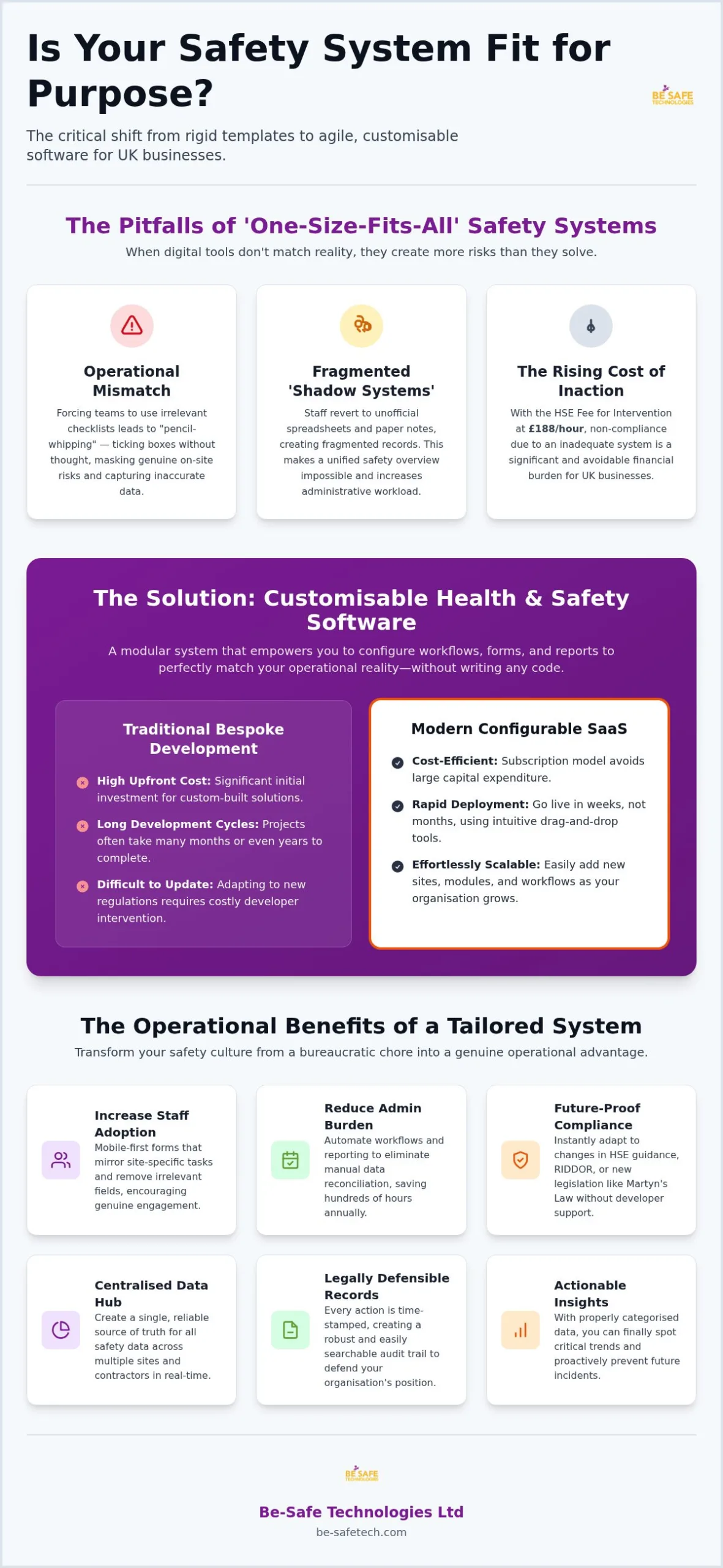
Rigid digital templates often lead to “pencil-whipping,” where workers mindlessly tick boxes just to clear a notification. This behaviour results in inaccurate data capture that masks real risks. If a digital form doesn’t allow for specific site nuances, staff naturally revert to “shadow systems” like unofficial spreadsheets or paper notes. These fragmented records make it impossible to maintain a unified customisable health and safety software approach, leading to a breakdown in your overall safety management system. The administrative burden of manually reconciling these disparate data sources is immense, often costing businesses hundreds of hours in lost productivity every year. Poor data categorisation also means you miss critical trends that could prevent future incidents.
Navigating HSE Regulations with Operational Agility
The regulatory environment in 2026 is less forgiving than ever. With the HSE Fee for Intervention (FFI) rate now at £188 per hour, the financial penalty for non-compliance is significant. Static digital checklists can’t keep pace with the rapid shifts in HSE guidance or new legislation like the Terrorism (Protection of Premises) Act, known as Martyn’s Law. Businesses need more than a digital tick-box; they require a system that evolves alongside these legal duties, which is why many also rely on H&T Experts Ltd for professional security and emergency response services.
Choosing customisable health and safety software allows your organisation to pivot instantly. When RIDDOR reporting requirements change or new occupational health standards for remote workers are introduced, a modular system lets you update your workflows without waiting for a developer. This agility ensures that every record is date-stamped and audit-trailed, providing a legally defensible position that generic platforms simply cannot offer. By aligning your digital tools with your specific safety culture, you foster genuine engagement rather than bureaucratic resentment. This streamlined approach gives you total control over your safety data whilst ensuring every site remains compliant with the latest UK standards.
True customisable health and safety software is a modular SaaS platform that allows users to configure data fields, operational workflows, and reporting structures without writing a single line of code. It moves away from the “all-or-nothing” approach of legacy systems; instead, it offers a flexible framework where safety managers can toggle features on or off based on their specific site requirements. By choosing a configurable platform, you secure the operational benefits of safety systems without the technical debt or long lead times associated with traditional custom coding.
Modular Architecture vs. Bespoke Development
- Rapid Deployment: Modular systems can be configured and launched in weeks rather than months.
- Cost Efficiency: You avoid the expense of dedicated developers whilst benefiting from regular, platform-wide updates.
- Scalability: As your business grows, you can add new modules or adjust workflows to accommodate additional sites or different industry standards.
Mobile-First Configuration for Site-Based Workers
For customisation to be effective, it must translate perfectly to the mobile devices used by workers in the field. A desktop-only configuration often fails because it doesn’t account for the environmental challenges of a live site. True flexibility means the mobile app interface should adapt to the worker’s role, showing only the forms and fields relevant to their current task. This reduces “app fatigue” and ensures that data capture remains accurate even in areas with poor connectivity. Mobile-first configuration is the ability to sync site reality with head office oversight instantly.
Security remains the foundation of these flexible workflows. ISO 27001 certification ensures that even when you modify forms or create new data pathways, your information remains protected by international standards. Exploring a modular approach like Compliance Genie allows you to start with the essentials and build a comprehensive digital ecosystem that grows alongside your safety culture.
The Operational Benefits of Tailored Digital Workflows
Tailoring a digital workflow isn’t just about aesthetics; it’s about operational clarity. When you implement customisable health and safety software, you move away from generic terminology that confuses staff. Instead, your digital hub can consolidate audits, incident reports, and RAMS into a single interface that reflects your specific industry vocabulary. This psychological alignment makes the tool feel like a partner in the work rather than a bureaucratic hurdle. By using language that workers recognise, you reduce the cognitive load required to complete safety tasks, which leads to more accurate data and fewer errors on the front line.
Improving User Adoption and Safety Culture
User engagement hinges on simplicity. If a site worker has to skip ten irrelevant fields to report a near-miss, they simply won’t do it. Low-friction interfaces encourage proactive reporting because they respect the user’s time. For example, imagine a diverse team of site workers using a mobile tablet to complete a tailored risk assessment in minutes; they’re more likely to engage with the process if the questions are directly relevant to their immediate environment. This personalised approach builds employee “buy-in” by demonstrating that safety protocols are designed for their protection, not just for a paper exercise. When workers see that the software adapts to their needs, it reinforces a positive safety culture where reporting is viewed as a value-add rather than a chore. This culture is further strengthened when workers are provided with the correct physical tools for their environment; for instance, you can learn more about ExSafe and their range of Ex-certified equipment designed for hazardous industrial environments.
A robust safety culture is most effective when combined with a comprehensive approach to risk management. For instance, MyGen Insurance Brokers provide tailored insurance solutions that ensure a business is protected against the unforeseen, perfectly complementing a proactive on-site safety strategy.
Managing safety across multiple locations often leads to fragmented data, especially when regional sites have unique operational nuances. A tailored system allows you to centralise this information whilst still permitting local configurations for specific site risks. This creates a “birds-eye view” of national compliance levels through custom dashboards that highlight trends in real-time. By getting the right data to the right people instantly, you can intervene before a minor trend becomes a major incident. This level of oversight is a core component of The Ultimate Guide to Health and Safety Compliance Software in 2026, which details how modern platforms bridge the gap between local site wisdom and corporate governance. Consolidating these functions ensures that your safety intelligence is always current, accurate, and actionable across the entire organisation.
Implementing a Customisable System Without Operational Friction
Transitioning to customisable health and safety software doesn’t have to be a disruptive “big bang” event that halts your production lines. A successful migration begins with a comprehensive safety workflow audit. This process involves examining every touchpoint where data is currently collected, from site inductions to incident reports. You must identify who captures the data, why they do it, and where that information eventually resides. By understanding these paths, you can pinpoint bottlenecks that a digital system can easily eliminate, ensuring your new platform fits like a glove from day one. For businesses managing broader digital infrastructure alongside safety platforms, working with tailored IT solution providers such as distemicha.com can help streamline system integration and ensure technical alignment across all departments.
Mapping Your Existing Paper Processes to Digital
Effective digitisation is more than just turning a paper form into a static PDF. It’s an opportunity to optimise your processes. During the mapping phase, you’ll likely find that some paper forms are redundant, whilst others require digital enhancement to be truly useful. You can replicate complex risk assessment logic within a tailored framework, ensuring that a “yes” or “no” answer triggers the correct follow-up actions automatically. For a deeper dive into selecting the right tools for this task, consult Mastering Health and Safety Risk Assessment Software: A 2026 Buyer’s Guide. This approach ensures your digital transition adds value rather than just moving a paper-based burden onto a screen.
Establishing Secure, ISO-Compliant Data Frameworks
Establishing a secure, ISO-compliant framework for your customisable health and safety software ensures that data integrity and security standards remain uncompromised. It’s essential to choose a provider that offers UK-based data storage and holds ISO 27001 certification. These credentials guarantee that your sensitive safety records are protected by international best practices. Within a tailored system, you can manage user permissions with precision, ensuring that site workers see only what they need whilst senior managers retain a birds-eye view of national compliance. This granular control is vital for maintaining a legally defensible position in the event of an HSE inspection.
To minimise disruption on active sites, consider a phased roll-out starting with a single department or location. This allows you to gather feedback and refine the interface before a wider release. Remember that the human element is just as important as the technology. Providing hands-on training and having access to UK-based support teams will ensure your staff feel confident using the new tools. If you’re ready to see how a tailored approach can work for your business, you can book a personalised demo of Compliance Genie today.
Future-Proofing with Compliance Genie and Contractor Genie
The regulatory landscape for 2026 and 2027 shows the Health and Safety Executive prioritising work-related ill health, with a specific focus on mental health and occupational risks such as dust and asbestos. These shifting priorities require a system that can evolve without the need for expensive, time-consuming technical overhauls. Using customisable health and safety software provides your organisation with the agility to update risk assessment criteria or health monitoring forms as soon as new guidance is published. Compliance Genie serves as this flexible foundation, allowing you to build a proactive safety infrastructure that anticipates future legal duties rather than simply reacting to them.
Integrated Oversight with Contractor Genie
Managing the risks associated with third-party workers is often the most challenging part of a safety system, yet it’s vital for maintaining a legally defensible position. Contractor Genie provides a centralised hub that manages the synergy between your internal protocols and external contractor behaviours. You can create tailored onboarding flows that require contractors to submit specific safety documents or complete site-specific inductions before they are granted access. This level of integrated oversight is detailed further in our guide to Contractor Management Software UK: The 2026 Guide to Safety and Compliance. Having this real-time visibility ensures that every visitor on your site meets your high standards for safety and compliance.
Scaling Your Safety Infrastructure
As your organisation grows from a single site to a national operation, your digital tools must scale accordingly. Modular software allows you to add new departments or regional hubs without losing the centralised oversight that head office requires. Because Be-Safe Technologies Ltd provides UK-based development and technical support, your system remains aligned with British standards and the latest G-Cloud 14 framework requirements. Regular platform updates ensure your customisable health and safety software stays current with both technological advancements and legislative shifts.
Safety management should never be a static exercise. It’s a continuous journey of improvement that requires a vehicle capable of navigating changing terrain. By partnering with Be-Safe Technologies Ltd, you gain a system that adapts to your unique operational wisdom whilst providing the security of ISO 27001 certification. This balance of flexibility and reliability ensures that your safety culture remains strong, your data remains secure, and your business remains fully compliant for the decade ahead.
Securing Your Operational Future with Tailored Safety Systems
Embracing a digital transformation in 2026 requires more than just moving paper forms online. It demands a system that mirrors your specific operational DNA. By choosing customisable health and safety software, you eliminate the friction of rigid templates and empower your workforce to engage with safety protocols naturally. This tailored approach not only boosts staff adoption but also ensures your organisation remains resilient against evolving HSE standards and rising Fee for Intervention rates.
Whether you’re centralising multi-site data or managing complex contractor onboarding, the right tools provide the clarity and control needed for a legally defensible position. Be-Safe Technologies Ltd offers this peace of mind as an ISO 9001 and 27001 certified provider and a G-Cloud approved supplier. Supported by our award-winning UK support team, we help you build a safety ecosystem that works for you, rather than against you.
Book a tailored demonstration of Compliance Genie today to discover how easy it is to digitise your site wisdom. Taking this step ensures that your safety management remains a streamlined, manageable part of your ongoing business success.
Frequently Asked Questions
What is the difference between configurable and bespoke health and safety software?
Configurable software uses a modular SaaS framework, whilst bespoke is built from scratch. Configurable systems allow you to adjust workflows and fields using existing tools, whereas bespoke requires dedicated developers and long lead times. Choosing a modular approach provides the flexibility you need without the technical debt. It’s often more sustainable for UK businesses because it receives platform-wide updates automatically, ensuring your system never becomes obsolete.
How long does it take to set up customisable H&S software for a UK business?
Setting up a new system typically takes between two and six weeks, depending on the complexity of your workflows. This timeline includes the initial safety workflow audit and mapping your existing processes to the digital environment. While enterprise-level implementations can take longer, the modular nature of SaaS allows for a phased roll-out. This ensures your most critical safety functions are digitised quickly without disrupting live site operations.
Can I migrate my existing paper-based risk assessments into Compliance Genie?
Yes, you can migrate your existing paper-based risk assessments into Compliance Genie with ease. The platform is designed to replicate your unique paper logic whilst adding digital enhancements like automated triggers and date-stamping. You don’t have to abandon the site wisdom captured in your current forms. Instead, you can refine these processes within the software to ensure they are more efficient and legally defensible for HSE inspections.
Is customisable software more expensive than standard off-the-shelf options?
Configurable customisable health and safety software is generally more cost-effective than standard off-the-shelf options when you consider the total cost of ownership. While generic tools might have lower initial license fees, they often lead to shadow systems and low adoption rates. A tailored system reduces administrative burdens and eliminates the need for expensive manual data entry. By investing in a system that fits your business, you avoid the hidden costs of operational friction.
How does customisable software help with RIDDOR reporting requirements?
Customisable software streamlines RIDDOR reporting by ensuring all required data is captured accurately at the point of the incident. You can configure specific fields that mirror the HSE’s reporting requirements, making it easier to identify reportable occurrences. Automated notifications can alert safety leads instantly when a reportable event is logged. This ensures your organisation meets strict reporting deadlines whilst maintaining a clear, date-stamped audit trail for every incident.
Does customisable safety software work offline on remote UK sites?
Yes, our mobile-first platforms are designed to work offline on remote UK sites where connectivity is often unreliable. Workers can complete risk assessments or incident reports in the field, and the data will sync automatically once a connection is restored. This ensures that safety documentation is captured in real-time, regardless of location. It’s a critical feature for maintaining compliance on construction sites, offshore installations, or rural operational centres.
Is my data secure when using a cloud-based customisable safety platform?
Your data is highly secure when using a cloud-based platform like Compliance Genie. We hold ISO 27001 and ISO 9001 certifications, which are the international standards for information security and quality management. All data is stored in UK-based centres, ensuring full compliance with UK GDPR requirements. This infrastructure provides a more robust level of protection than traditional on-site servers or paper-based filing systems, giving you total peace of mind.
Do I need technical or coding skills to customise the Compliance Genie platform?
You don’t need any technical or coding skills to customise the Compliance Genie platform. The software features a user-friendly interface that allows safety managers to configure fields and workflows using simple drag-and-drop tools. This empowers your safety team to lead the digital transition without relying on an IT department. You can adjust your customisable health and safety software settings instantly to reflect new site conditions or changes in HSE guidance.