


SaaS Risk Assessment Software: The UK 2026 Guide

If your entire software stack is built for the 2030s, why is your health and safety compliance still stuck in the 1990s? It’s a frustrating paradox that many of the UK’s most innovative tech firms still rely on fragmented spreadsheets or paper-based trails to manage workplace safety. You likely agree that whilst your hybrid workforce is your greatest strength, managing DSE compliance for high-intensity developers and tracking mental health risks across a decentralised team can feel like a bureaucratic burden. Modern risk assessment software for saas companies offers a way out of this friction, replacing outdated manual processes with a streamlined, digital-first system that aligns with your agile culture.
In this guide, you’ll learn how to navigate the latest UK health and safety regulations for the technology sector, including the HSE’s 2026 focus on psychosocial risks and musculoskeletal disorders. We will show you how to achieve total compliance and protect your team from the 1.9 million cases of work-related ill health reported annually across the country. By the end of this article, you’ll understand how to implement a safety ecosystem that prioritises developer wellbeing and retention without the traditional overhead, giving you the quiet confidence that your organisation is both protected and productive.
Key Takeaways
- Understand how the Health and Safety at Work etc. Act 1974 applies to modern tech environments, shifting the focus from physical hazards to psychological and ergonomic wellbeing.
- Identify the mandatory legal requirements for Display Screen Equipment (DSE) and mental health assessments to protect your developers and ensure HSE compliance.
- Discover why risk assessment software for saas companies is essential for moving beyond fragmented spreadsheets and manual processes that hinder agile operations.
- Learn how to manage the safety of a hybrid or remote workforce whilst maintaining a clear, digital audit trail that meets UK regulatory standards.
- See how a cloud-based, ISO 27001 certified system can provide total oversight and peace of mind without creating unnecessary bureaucratic overhead.
The UK Landscape of Health and Safety for Tech and SaaS Companies
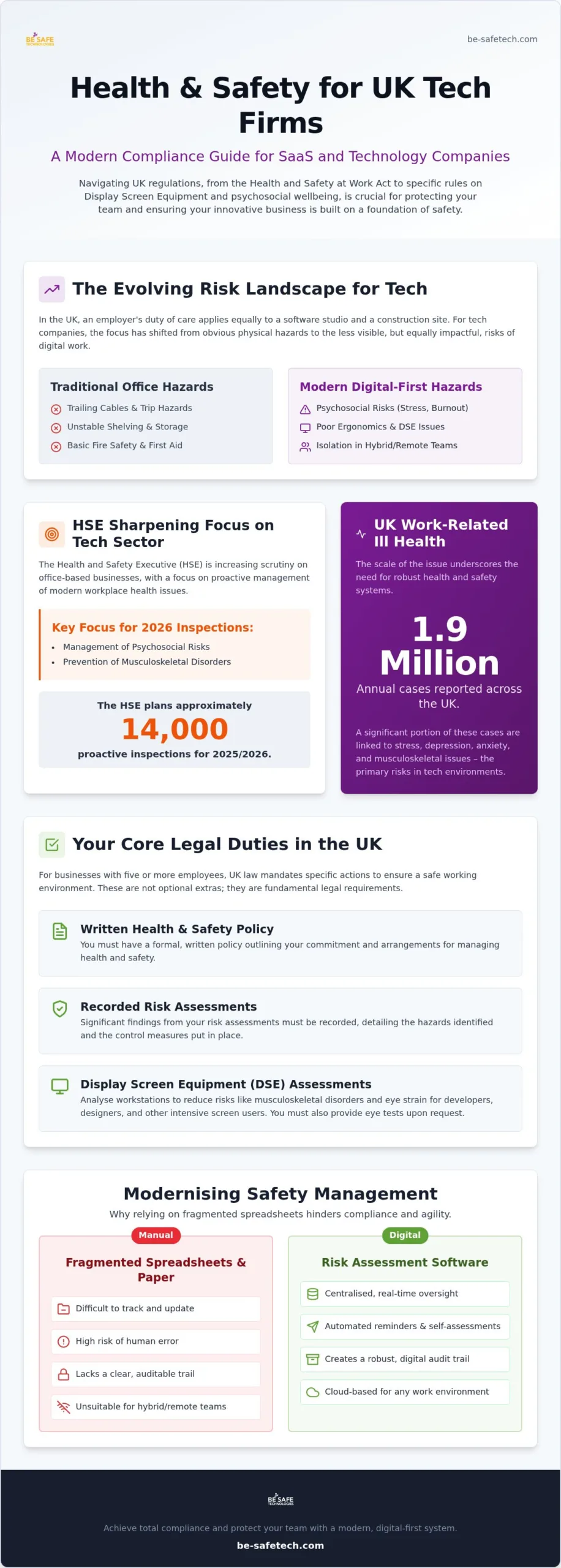
The Health and Safety at Work etc. Act 1974 remains the bedrock of UK workplace law. Many tech founders mistakenly believe their “low risk” office environment exempts them from stringent oversight. In reality, the law doesn’t distinguish between a construction site and a software studio; it requires all employers to ensure the health, safety, and welfare of their staff so far as is reasonably practicable. This includes conducting a thorough risk assessment to identify potential harm. In 2026, the Health and Safety Executive (HSE) has sharpened its focus on digital-first businesses, acknowledging that modern hazards are often invisible but equally damaging to a company’s bottom line.
Why Tech Firms Are No Longer Under the HSE Radar
The days of the HSE only visiting factories or building sites are over. With the HSE planning approximately 14,000 proactive inspections for the 2025/2026 period, tech firms are increasingly finding themselves subject to digital audits and remote inspections. These interventions focus on how companies manage the health of their workforce, particularly regarding stress and musculoskeletal disorders. A single reportable incident, such as a work-related injury or a formal complaint regarding mental health, can trigger a full-scale investigation into a startup’s safety culture. Under UK law, every employer has an absolute duty to provide a safe working environment and protect employees from foreseeable risks to their physical and mental health.
From Physical Hazards to Digital Wellbeing
Safety management in the tech sector has undergone a fundamental shift. Whilst traditional offices once worried about trailing cables or unstable shelving, the primary hazards for developers and product managers are now mental fatigue, burnout, and poor ergonomics. Transitioning safety from a tick-box exercise into a core business pillar is essential for long-term growth. This is where modern risk assessment software for saas companies becomes a strategic asset rather than a bureaucratic hurdle. By digitising these processes, founders can move away from physical “trip hazard” checklists toward a holistic model of digital wellbeing that supports a high-performing culture.
Core responsibilities for tech leaders include:
- Conducting and recording formal risk assessments if you employ five or more people.
- Proactively managing psychosocial risks like excessive workload or isolation in hybrid teams.
- Ensuring ergonomic standards are met for high-intensity coding sessions to prevent long-term injury.
- Maintaining a clear, digital audit trail of all safety interventions to demonstrate compliance during an inspection.
(Visual suggestion: A diverse team of developers, including individuals of South Asian, Black, and Caucasian descent, collaborating in a bright, ergonomic workspace that features adjustable desks and natural lighting.)
Statutory Requirements: DSE, Mental Health, and Office Safety
Meeting legal standards shouldn’t feel like a distraction from your product roadmap. In the UK, if you employ five or more people, you’re legally required to have a written Health and Safety Policy and record your risk assessments. For modern tech hubs, this often means looking beyond fire extinguishers and first aid kits to the specific risks of digital work. Whilst open-plan offices seem low-risk, the cumulative impact of poor ergonomics and high-pressure environments can lead to significant compliance gaps if they aren’t managed with precision.
Mastering DSE Assessments for Developers and Designers
The Health and Safety (Display Screen Equipment) Regulations 1992 are particularly relevant for high-intensity roles like data scientists or coders. These professionals often spend eight or more hours a day at a workstation, making them susceptible to musculoskeletal disorders. As an employer, you’re also obligated to provide eye tests upon request and basic corrective equipment, such as glasses, if they’re required specifically for DSE work. Implementing risk assessment software for saas companies can automate annual self-assessments, ensuring your team’s setup remains compliant as you scale.
A standard ergonomic checklist for your tech team should include:
- Screens positioned at eye level to prevent neck strain.
- Forearms kept horizontal with wrists in a neutral position.
- Adjustable chairs that provide adequate lower back support.
- Sufficient space under the desk for legs to move freely.
Addressing Mental Health as a Legal Compliance Issue
Mental health is no longer a “soft” HR topic; it’s a core legal requirement. Under the Management of Health and Safety at Work Regulations 1999, you must formally assess psychosocial risks. Tech firms are often susceptible to stress-related compliance failures due to intense sprint cycles and the “always-on” nature of remote deployments. The HSE actively enforces these standards, focusing on how you manage workload, role clarity, and peer support. When choosing your digital tools, ensure they can track these nuances. For a deeper look at your options, you might find our guide on mastering health and safety risk assessment software helpful.
Fire safety and first aid also remain vital. Even in shared co-working spaces, you must ensure your specific area has designated fire wardens and accessible first aid kits. When digitising these records, it’s wise to follow the UK government’s guidance on SaaS tools to ensure your safety data is stored securely. If you’re looking to simplify these statutory duties, you can explore how our digital-first platform helps tech teams stay compliant with minimal friction.
Digital vs Manual: Modernising Safety Management in Tech
The Problem with Paper and Spreadsheets in an Agile Culture
In a high-growth environment, friction is the enemy of engagement. If you ask a developer to step away from their IDE to fill out a physical form, compliance will inevitably slip. Manual systems are also prone to version control errors; a spreadsheet saved locally on one manager’s laptop doesn’t help the rest of the organisation. During an HSE audit, these gaps become liabilities. Implementing a system focused on reducing health and safety paperwork improves operational speed and ensures every record is timestamped and accurate. It transforms safety from a chore into a seamless part of the daily routine, ensuring that your data is always ready for inspection.
SaaS Benefits: Visibility, Scalability, and Quiet Confidence
Cloud-based systems like Compliance Genie provide a single source of truth that physical folders simply can’t match. As your firm grows from 10 to 200 employees, your safety needs change. A digital platform scales with you, allowing you to deploy new assessments across multiple locations or remote teams instantly. One major advantage is the use of automated notifications; these reduce the risk of missed assessments by ensuring that every DSE check and mental health review is completed on schedule without constant manual chasing. This automation provides directors with the quiet confidence that the business remains protected.
Real-time dashboards offer stakeholders a high-level view of the company’s safety health. Instead of digging through emails, leaders can see completion rates and identify trends at a glance. This level of oversight aligns perfectly with official Health and Safety Executive guidance, which emphasises the need for clear, manageable safety policies. By digitising these processes, you’re not just ticking a box; you’re building a more resilient, data-driven business that values the wellbeing of its most important asset: its people.
Managing Safety for Hybrid and Remote Tech Teams
In the UK, an employee’s home is legally considered an extension of the workplace when they work there on a regular basis. This means your duty of care doesn’t stop at the office door. Under the Health and Safety at Work etc. Act 1974, you’re responsible for ensuring that remote staff have a safe environment that doesn’t pose a risk to their health. For many SaaS firms, the challenge lies in conducting these evaluations without invading an employee’s privacy or creating a mountain of paperwork. Using risk assessment software for saas companies allows you to deploy self-guided, digital assessments that staff can complete at their own pace, providing you with the necessary documentation whilst respecting their personal space.
Remote DSE and Home Office Compliance
Providing ergonomic equipment isn’t just a perk; it’s often a legal duty. If a remote DSE assessment identifies a risk, such as a lack of lumbar support or a screen at the wrong height, you’re responsible for providing the necessary adjustments. This process must be consistent across your entire workforce to remain compliant. For businesses that rely on external tech consultants or freelancers, managing these disparate locations becomes even more complex. You can streamline this by using contractor management software UK to ensure that every person contributing to your code base, whether internal or external, is working within a safe framework.
To ensure high completion rates for home assessments, consider these steps:
- Utilise digital checklists that allow employees to upload photos of their workstation.
- Provide clear, visual guidance on what a “good” ergonomic setup looks like.
- Automate follow-up reminders to ensure assessments are reviewed and updated annually.
- Link equipment request forms directly to the assessment results for a seamless workflow.
Communication and Incident Reporting from Anywhere
A decentralised team needs a unified way to report issues. Relying on email or physical forms is impossible when your staff are spread across the country. A mobile-first app allows for instant reporting of near-misses or incidents, ensuring that data is captured in real-time. This is especially critical for lone workers, such as technicians visiting remote data centres where the risks of physical injury or equipment failure are higher. Integrating safety reminders into Slack or Microsoft Teams helps keep compliance top of mind without it feeling like a separate, burdensome task.
Maintaining a cohesive safety culture in a hybrid world requires tools that match your team’s digital habits. If you’re ready to digitise your remote safety strategy, you can start your transition to a cloud-based compliance system today to ensure your team remains protected, regardless of where they log in.
Future-Proofing Your Tech Firm with Compliance Genie
Adopting Compliance Genie is about more than just meeting a legal requirement; it’s about integrating health and safety into the very fabric of your business operations. As a digital-first solution, it functions as a natural extension of your existing SaaS stack, providing a level of operational harmony that legacy systems cannot achieve. For tech firms managing high-growth trajectories, this risk assessment software for saas companies offers the scalability needed to move from a small startup to an industry leader without compromising on safety standards. The platform is designed to handle the complexities of the modern workplace, from office-based ergonomics to the security requirements of external site visits. To complement your digital safety strategy with a robust and secure IT infrastructure, you can discover Cornerstone Business Solutions and their expertise in cloud-based desktop environments.
Managing third-party relationships is often a point of friction for tech companies, particularly when consultants need access to secure environments like data centres. The Contractor Genie module simplifies this by allowing you to manage site visits, inductions, and security clearances within the same ecosystem. This ensures that every person representing your brand or accessing your infrastructure adheres to your specific safety protocols, reducing the risk of third-party liability whilst maintaining a clear audit trail. If you are looking to hire verified contract or permanent specialists for your technical team, you can learn more about TrustTech Recruitment for dedicated technology staffing solutions. Transitioning from paper-heavy legacy systems to our mobile-first platform is designed to be a frictionless experience, mirroring the intuitive user journeys your own developers strive to create.
For a technology company, data is the most valuable asset. Be-Safe Technologies Ltd prioritises information security, ensuring that Compliance Genie is ISO 27001 certified. This certification demonstrates our commitment to protecting sensitive employee data and ensuring the integrity of your safety records. Whilst many competitors focus solely on templates, we provide a secure, cloud-based infrastructure that aligns with your internal security standards. Understanding the future of safety management software means recognising that data protection and workplace safety are now inextricably linked.
Getting Started: A Reassuring Path to Total Compliance
Our onboarding process is tailored for fast-paced tech environments where time is a premium resource. We focus on a phased implementation that adapts to your existing workflows, ensuring high adoption rates amongst developers and designers who value user-centric tools. By removing the bureaucratic burden, we allow your team to focus on innovation whilst our system handles the background compliance tasks. If you’re ready to move toward a more streamlined, digital-first safety culture, our UK-based team is here to support your transition. We invite you to book a consultation to see how Compliance Genie can provide your business with the quiet confidence of total regulatory oversight.
(Visual suggestion: A group of diverse tech leads, including East Asian, Black, and Mixed-race professionals, reviewing a clean, modern compliance dashboard on a tablet in a collaborative, high-tech office environment.)
Elevating Your Safety Culture for the Digital Age
Managing health and safety in the tech sector doesn’t have to be a bureaucratic burden that slows down your sprints. By prioritising ergonomic DSE standards and addressing the legal requirements for mental health, you protect your team’s wellbeing and your company’s reputation. Moving away from fragmented spreadsheets toward a unified, digital system ensures that your safety data is as agile as your code deployments. Implementing risk assessment software for saas companies provides the total oversight needed to maintain compliance whilst supporting a decentralised, hybrid workforce.
As an ISO 9001 and 27001 certified partner, Be-Safe Technologies Ltd offers a cloud-based, mobile-first architecture designed specifically for modern business needs. Our UK-based award-winning support team is ready to help you transition from outdated manual processes to a streamlined, secure platform. You can achieve total peace of mind and operational harmony without the traditional overhead of safety management. Book a Compliance Genie Demo to Digitise Your Tech Safety Management and take the first step toward a safer, more efficient future for your organisation.
Frequently Asked Questions
Do tech startups with fewer than five employees need a written health and safety policy?
No, you don’t legally need a written policy if you have fewer than five employees, but you must still manage risks effectively. Even without a formal paper trail, you’re responsible for your team’s safety under the Health and Safety at Work etc. Act 1974. Once you hire your fifth person, you must document your safety policy and risk assessments. Many growing firms choose to digitise early to avoid a compliance bottleneck later.
Is an employer responsible for the health and safety of a remote worker in the UK?
Yes, UK employers are legally responsible for the health and safety of staff who work from home on a regular basis. You must ensure their home workstation is safe and conduct a DSE assessment to prevent long-term injury. Using risk assessment software for saas companies simplifies this by allowing remote staff to self-certify their setups digitally, ensuring you have a valid audit trail without needing to visit every home.
What are the specific DSE requirements for employees using multiple monitors?
DSE assessments must account for the entire workstation, including every screen in use. For developers using multiple monitors, the primary screen should be directly in front of the user to prevent constant neck twisting. Secondary monitors should be at the same height and distance. You must also ensure the desk is wide enough to accommodate all equipment whilst allowing for horizontal forearm positioning and neutral wrist alignment.
How often should a tech company conduct a fire risk assessment?
There is no fixed legal timeframe, but the Regulatory Reform (Fire Safety) Order 2005 requires you to review your assessment regularly. In a fast-moving tech environment, an annual review is considered standard practice. You must also update the assessment if you change your office layout, increase headcount significantly, or move to a new co-working space. Keeping these records in a cloud-based system ensures they’re always accessible during inspections.
Can digital signatures be used for UK health and safety risk assessments?
Yes, digital signatures and electronic records are fully accepted for UK health and safety documentation. The HSE accepts digital formats provided they’re accessible, legible, and protected against unauthorised changes. Transitioning to a mobile-first platform allows you to capture signatures instantly on-site or remotely. This creates a secure, timestamped record that proves you’ve communicated risks to your team and obtained their acknowledgement in real-time.
What happens if a tech company fails an HSE inspection?
Failing an inspection often results in a Fee for Intervention (FFI), where the HSE charges for their time spent identifying and correcting the breach. If the inspector finds a material breach, they may issue an improvement or prohibition notice. In 2025, the HSE carried out 246 prosecutions with a 96% conviction rate. Maintaining a robust digital safety system helps you demonstrate proactive compliance and avoid these costly legal penalties.
Does health and safety software need to be ISO 27001 compliant?
Whilst ISO 27001 isn’t a legal health and safety requirement, it’s essential for protecting the sensitive employee data stored within your platform. Tech companies should prioritise software that meets this standard to ensure their safety records are secure and resilient against cyber threats. Using risk assessment software for saas companies that is ISO 27001 certified provides stakeholders with confidence that your compliance data is handled with the same rigour as your own product data.
How do I manage the safety of contractors visiting our office or data centre?
You must ensure that any contractors visiting your premises are properly inducted and aware of your specific safety protocols. This involves reviewing their own risk assessments and providing them with information on fire exits and first aid. Using a dedicated module like Contractor Genie allows you to automate this process, ensuring that external technicians or consultants have completed their safety checks before they even set foot in your data centre or office.