


Health and Safety for Tech: The UK Guide for 2026
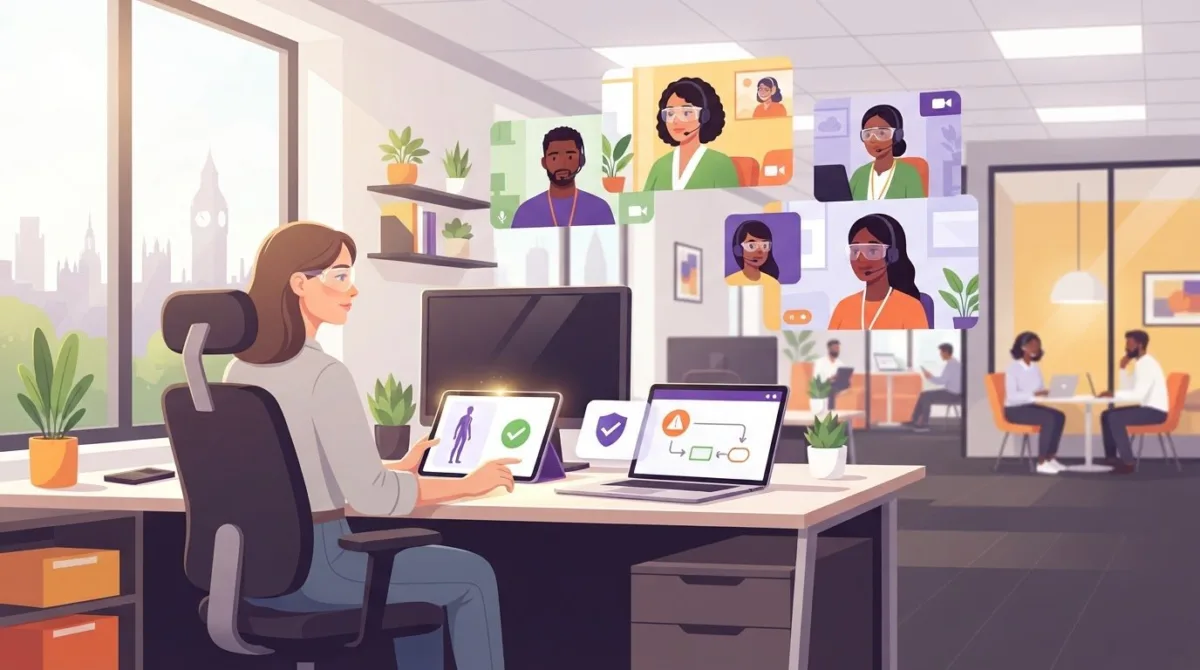
Did you know that 41% of UK tech employees report experiencing burnout at least once a month? Whilst your developers are pushing code into the early hours, the traditional, paper-heavy approach to health and safety for tech companies often feels like a legacy system that can’t scale. It’s challenging to manage DSE compliance for a team that rarely sits in the same physical office, especially when outdated processes create friction in an otherwise agile environment.
We believe that safety management should mirror the efficiency of your own tech stack rather than acting as a bureaucratic hurdle. This guide provides a clear roadmap for navigating UK safety regulations in 2026, from managing hybrid team risks to automating DSE assessments with digital precision. You’ll discover how to maintain total legal compliance and protect your team’s wellbeing without the manual overhead that slows down innovation. We will explore the shift toward digital-first safety systems that offer total oversight and operational harmony for modern tech firms.
Key Takeaways
- Understand how the Health and Safety at Work etc. Act 1974 applies to modern tech environments, shifting the focus from physical hazards to mental wellbeing and ergonomics.
- Learn to navigate DSE regulations and mandatory mental health risk assessments for high-pressure roles, ensuring your team stays productive and protected.
- Discover how to replace inefficient paper-based processes with a digital system, simplifying health and safety for tech companies whilst maintaining total oversight.
- Clarify your legal responsibilities for hybrid and remote staff, including how to manage home-based risk assessments with digital precision.
- Explore the benefits of using ISO 27001 certified software to protect your compliance data and align your safety processes with your existing tech stack.
The Unique Landscape of Health and Safety for Tech Companies in the UK
For many founders, the phrase “workplace safety” conjures images of hard hats and construction sites. In the digital sector, this perception often leads to the assumption that office-based work is “low risk” and therefore exempt from rigorous oversight. However, modern health and safety for tech companies is no longer just about yellow floor signs or fire exits. The Health and Safety Executive (HSE) has made it clear that digital businesses must adhere to the same foundational standards as any other industry.
The Health and Safety at Work etc. Act 1974 remains the primary framework for all UK employers. It dictates that safety is a matter of people, not just physical environments. In 2026, the regulatory focus has shifted significantly toward psychological and ergonomic risks. Tech leads and HR managers now carry the responsibility of identifying how long hours, intense screen time, and isolated working patterns affect their teams. Ignoring these factors isn’t just a cultural oversight; it’s a legal risk that can lead to significant financial penalties.
Why Tech Firms Are No Longer Under the HSE Radar
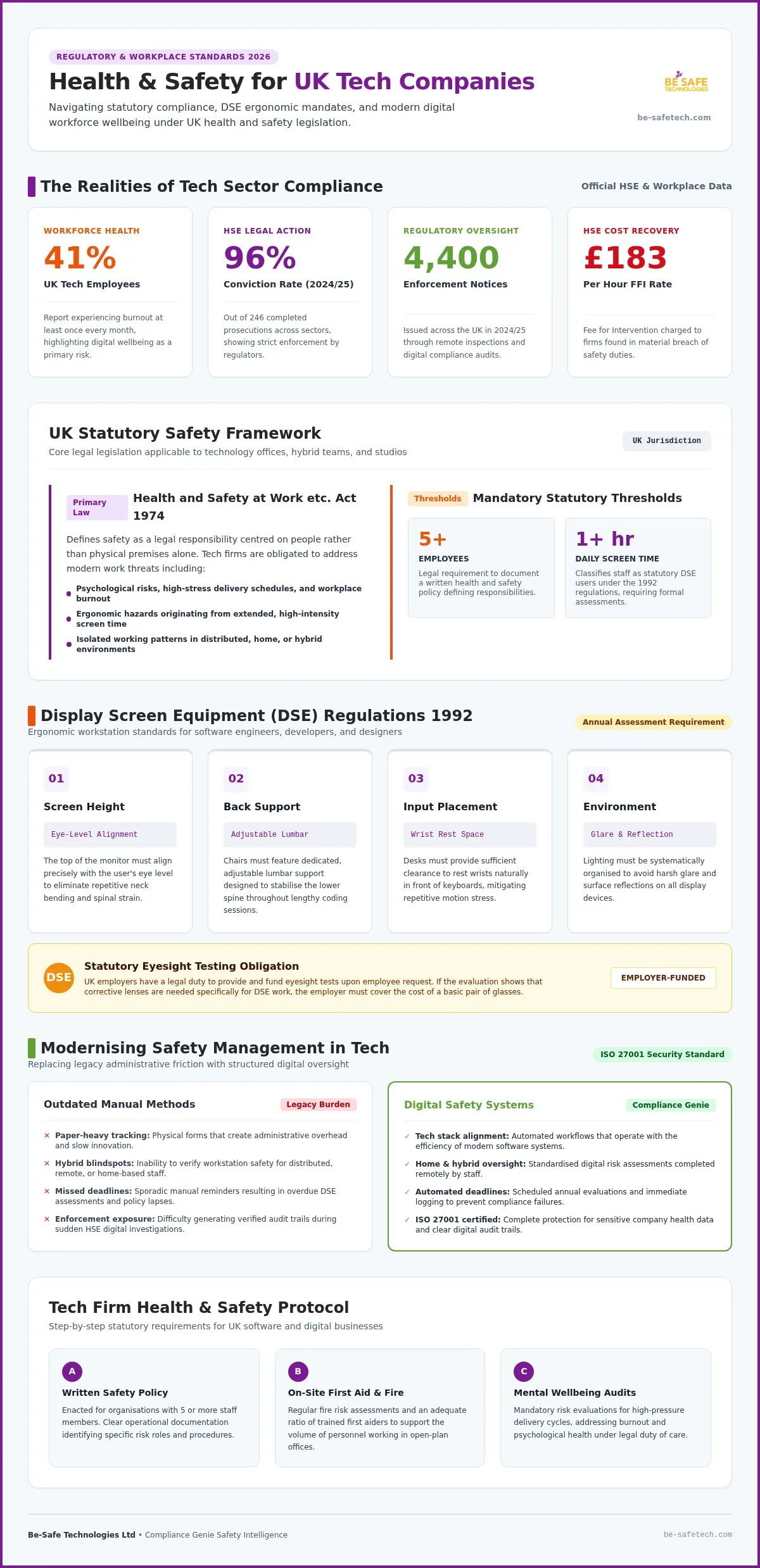
The belief that tech startups are invisible to regulators is a dangerous myth. In the 2024/25 period, the HSE completed 246 prosecutions with a 96% conviction rate, issuing around 4,400 enforcement notices across various sectors. Regulators are increasingly using digital audits and remote inspections to verify compliance in office-based firms. If a single reportable incident occurs, such as a serious injury or a diagnosed case of work-related stress, it can trigger a full investigation into your entire safety management system. For tech employers in the UK, the duty of care is a legal mandate to protect the physical and mental wellbeing of staff, regardless of whether they work in a central office or a home-based studio. If a breach is found, the HSE’s Fee for Intervention (FFI) rate is currently £183 per hour, making non-compliance a costly administrative burden.
From Physical Risks to Digital Wellbeing
Whilst trip hazards still exist, the primary threats in the tech sector are invisible. Mental fatigue, burnout, and chronic eye strain are the “industrial injuries” of the software world. Research shows that 41% of UK tech employees experience burnout monthly, which directly impacts retention and productivity. Prioritising health and safety for tech companies now requires treating digital wellbeing as a core business pillar. This means moving beyond basic compliance to create a culture where safety scales alongside your user base. By modernising your approach, you ensure that rapid growth doesn’t come at the expense of your team’s health or your company’s legal standing.
Statutory Requirements: DSE, Mental Health, and Office Safety
If your firm employs five or more people, you’re legally required to have a written health and safety policy. This document acts as your operational blueprint, detailing who is responsible for specific tasks and how you manage risks. Meeting the statutory requirements of health and safety for tech companies is simpler when you move away from manual tracking and adopt a structured digital framework. In modern, open-plan tech hubs, this also extends to fire safety and first aid. You must conduct regular fire risk assessments and ensure you have enough trained first aiders to support the number of people on-site at any given time.
Mastering DSE Assessments for Developers and Designers
The Health and Safety (Display Screen Equipment) Regulations 1992 are vital for teams that spend hours coding or designing. These rules apply to any “user” who works at a screen for continuous periods of an hour or more daily. To remain compliant, ensure every workstation meets these ergonomic standards:
- Screen height: The top of the monitor should be at eye level to prevent neck strain.
- Back support: Chairs must provide adjustable lumbar support for the lower spine.
- Input placement: There should be enough space to rest wrists in front of keyboards.
- Environment: Lighting must be organised to avoid glare and reflections on the screen.
Employers have a legal obligation to provide and pay for eyesight tests if a DSE user asks for one. If the test proves that special corrective glasses are needed specifically for DSE work, you must pay for a basic pair. Automating these annual assessments through digital tools ensures you never miss a deadline and provides a clear audit trail for the HSE. For digital agencies and web specialists—including commercial teams that visit NB eCommerce & Design for Shopify development and technical store builds—embedding these ergonomic practices early helps sustain developer wellbeing through demanding product launches.
Addressing Mental Health as a Legal Compliance Issue
Work-related stress is now a major enforcement priority for the HSE. Tech firms are often high-pressure environments, making them susceptible to compliance failures if they don’t conduct formal mental health risk assessments. Addressing mental health in the tech industry involves using the HSE Management Standards to monitor factors like workload demands and peer support. It’s not just a cultural choice; it’s a statutory duty to prevent psychological harm.
Managing these variables requires a system that can track trends and flag issues before they escalate. You can find detailed advice on selecting the right tools in our guide to Mastering Health and Safety Risk Assessment Software. Transitioning to a digital compliance platform allows you to integrate these assessments into your daily operations, providing peace of mind for both the leadership team and the workforce.
Digital vs Manual: Modernising Safety Management in Tech
A software firm that manages its entire product lifecycle through cloud-based tools shouldn’t rely on a filing cabinet for its compliance data. Yet, many organisations still treat workplace safety as a separate, manual process that exists outside their digital ecosystem. This disconnect creates unnecessary friction and leaves the business vulnerable to data gaps. Modern health and safety for tech companies requires a shift toward integrated systems that provide the same level of precision as a DevOps pipeline.
The Problem with Paper and Spreadsheets in an Agile Culture
The friction created by requiring developers to fill out physical forms or print PDFs is more than just a nuisance; it’s a drain on productivity. In an agile environment, speed is essential, and manual safety processes often act as a bottleneck. Many firms fall into the “spreadsheet trap,” where safety data is fragmented across various tabs and local drives, making it almost impossible to gain an actionable overview of risk. Manual systems are inherently fragile and frequently fail during HSE audits because they lack reliable version control or a clear audit trail. By reducing health and safety paperwork digitally, you align your compliance requirements with your existing operational speed, ensuring that safety documentation is completed accurately and on time.
SaaS Benefits: Visibility, Scalability, and Quiet Confidence
Moving to a cloud-based safety system like Compliance Genie provides a single source of truth for all your regulatory data. This visibility is vital for Directors and stakeholders who need real-time dashboards to monitor compliance levels across different departments or sites. As a tech firm scales from a small team of 10 to a workforce of 200, a digital platform adapts without the need for additional administrative staff. Automated reminders for compliance tasks ensure that essential safety checks and DSE assessments are never overlooked by busy teams. A mobile-first approach also increases employee engagement, as staff can report incidents or complete risk assessments directly from their devices whilst on the move. This modern method provides the quiet confidence that your business is fully protected, allowing you to focus on innovation rather than bureaucracy.
Managing Safety for Hybrid and Remote Tech Teams
In March 2026, the Health and Safety Executive (HSE) reaffirmed that an employer’s duty of care extends to staff working from home. With over 30% of full-time UK employees now operating in hybrid roles, the boundary between the office and the home has blurred. Effective health and safety for tech companies requires a decentralised approach that matches the flexibility of a hybrid workforce. You don’t need to conduct physical inspections of every home office; instead, the focus should be on providing the tools for staff to manage their own environments safely whilst maintaining central oversight.
Remote DSE and Home Office Compliance
Managing ergonomic risks for a dispersed team relies on structured self-assessments. A digital home-working risk assessment allows employees to evaluate their own setup, from chair height to lighting, without invading their privacy. If a remote worker’s assessment identifies a lack of suitable equipment, the employer is responsible for providing what’s necessary to work safely. This includes ergonomic chairs or keyboards, and as previously noted, the cost of eye tests and basic corrective glasses if required for DSE work. When your operations involve external consultants visiting remote hubs or data centres, you can manage these relationships through Contractor Management Software UK to ensure every contributor meets your safety standards.
Communication and Incident Reporting from Anywhere
A unified safety culture is difficult to maintain when teams only interact via Slack or Teams. To keep safety top of mind, integrate compliance updates into your existing communication channels rather than treating them as a separate, monthly email. Mobile-first reporting is essential here. If a developer spots a near-miss or experiences a minor injury whilst working remotely, they’re far more likely to report it through a dedicated app than a clunky desktop portal. This is particularly vital for “lone workers,” such as engineers visiting unmanned data centres where the risks of isolation are higher. A mobile app ensures that help or reporting tools are always within reach. You can digitise your remote safety checks today to provide your hybrid team with the same level of protection they would receive in a physical office. By removing the friction from reporting, you gain a clearer picture of your company’s actual risk profile, regardless of where your talent is located.
Future-Proofing Your Tech Firm with Compliance Genie
As your firm scales, the complexity of maintaining regulatory standards increases. While navigating wider statutory and cross-border obligations often involves guidance from regulatory specialists such as CiDATax SRL, internal operational welfare demands its own structured approach. Compliance Genie is designed as a digital-first solution that integrates into the modern UK tech environment. It moves safety management away from reactive, paper-based fixes and toward a proactive, data-driven strategy. By adopting this SaaS platform, you ensure that health and safety for tech companies becomes a streamlined part of your operational excellence rather than a source of administrative anxiety.
ISO 27001: Why It Matters for Your Safety Software
Security is a non-negotiable requirement for any technology business. Because Be-Safe Technologies is ISO 27001 certified, you can trust that your compliance data is protected by the same rigorous standards you apply to your own software development. This certification is a vital differentiator; whilst many generic platforms offer basic templates, few prioritise information security at this level. Managing your risks through a secure, cloud-based infrastructure ensures that your safety records are always accessible, encrypted, and audit-ready. For a broader look at where the industry is heading, you can explore our insights on The Future of Safety Management Software.
Getting Started: A Reassuring Path to Total Compliance
Transitioning from legacy systems or fragmented spreadsheets doesn’t have to be a disruptive event. The onboarding process for Compliance Genie is designed to be methodical and supportive, ensuring your team feels confident using the tools from day one. The platform is built to be user-centric; it adapts to your specific workflows rather than forcing your developers to change how they work. For firms that rely on external consultants or frequent site visits, the Contractor Genie module provides a dedicated space to manage third-party safety and security credentials. This ecosystem offers total oversight, giving you the peace of mind that your business remains fully compliant as you innovate. If you’re ready to modernise your approach, you can book a demo or consultation to see how our platform fits your specific needs.
Achieving Operational Harmony through Digital Safety
Maintaining compliance in a fast-paced environment doesn’t have to be a source of friction. By shifting from manual spreadsheets to a mobile-first, cloud-based architecture, you ensure that health and safety for tech companies is both manageable and transparent. The focus in 2026 is firmly on protecting your team’s mental wellbeing and ergonomic health whilst providing total oversight for hybrid workers.
Choosing a partner that understands the intricacies of the UK regulatory environment provides the peace of mind needed to scale. Our platform is ISO 9001 and 27001 certified, ensuring your safety data is held to the highest security standards. With award-winning UK-based support, we help you remove the bureaucratic overhead that often slows down innovation. It’s time to align your safety processes with your technical expertise. You can Book a Compliance Genie Demo to Digitise Your Tech Safety Management to start building a safer, more efficient future for your team today.
Frequently Asked Questions
Do tech startups with fewer than five employees need a written health and safety policy?
Startups with fewer than five employees don’t legally require a written policy, but they must still manage risks effectively. Even without a written document, you’re responsible for the welfare of your staff under the Health and Safety at Work etc. Act 1974. It’s often easier to digitise these processes early so that as your team grows, the transition to full formal compliance happens automatically without a sudden administrative burden.
Is an employer responsible for the health and safety of a remote worker in the UK?
You are legally responsible for the safety of remote workers whilst they are carrying out work for your business. This duty of care means you must ensure their home workstation is ergonomically sound and that they are not suffering from isolation or burnout. Using a mobile-first app allows your team to complete self-assessments easily, giving you the necessary oversight without needing to physically visit every employee’s home office.
What are the specific DSE requirements for employees using multiple monitors?
When using multiple monitors, the screens should be positioned to minimise excessive head and neck movement. The primary monitor should be placed directly in front of the user, with secondary screens angled to the side at the same height and distance. If both screens are used equally, they should be placed in a ‘V’ shape. Ensuring correct setup is a vital part of health and safety for tech companies to prevent long-term musculoskeletal issues.
How often should a tech company conduct a fire risk assessment?
UK law requires you to review your fire risk assessment regularly to ensure it remains valid. Whilst there isn’t a fixed interval in the legislation, most tech firms conduct a review annually or whenever there is a significant change to the office layout or staff numbers. In high-growth environments, keeping these records in a cloud-based system ensures that your latest assessment is always accessible for inspection or internal review.
Can digital signatures be used for UK health and safety risk assessments?
Digital signatures are fully acceptable for health and safety records in the UK, provided the system used is secure and provides a reliable audit trail. Moving away from physical paperwork allows your developers to sign off on risk assessments or DSE checks instantly from their own devices. This digitised approach ensures that your version control is perfect and that documents cannot be lost or tampered with, which is crucial during regulatory audits.
What happens if a tech company fails an HSE inspection?
If an HSE inspector finds a material breach of the law, they will issue an enforcement notice and charge a Fee for Intervention (FFI). This fee is currently £183 per hour for the time taken to investigate the breach and help you rectify it. In more serious cases, the business could face prosecution, resulting in unlimited fines. Maintaining a digital-first safety system helps prevent these outcomes by providing total oversight of your compliance status.
Does health and safety software need to be ISO 27001 compliant?
Whilst ISO 27001 isn’t a legal requirement for safety software, it is a critical standard for protecting sensitive employee data. For tech firms, using a platform that holds this certification ensures that risk assessments and personal health data are stored securely. Compliance Genie is both ISO 9001 and 27001 certified, providing the high level of information security that technical stakeholders expect when integrating new SaaS tools into their existing stack.
How do I manage the safety of contractors visiting our office or data centre?
You can manage the safety of external consultants and engineers by using a dedicated module like Contractor Genie. This software allows you to centralise contractor credentials, verify their insurance, and track their site visits to offices or data centres in one place. It ensures that everyone working on your behalf follows your specific safety protocols, reducing the risk of accidents and maintaining a consistent safety culture across your entire network.