


COSHH Assessment Software: Streamlining UK Chemical Safety in 2026

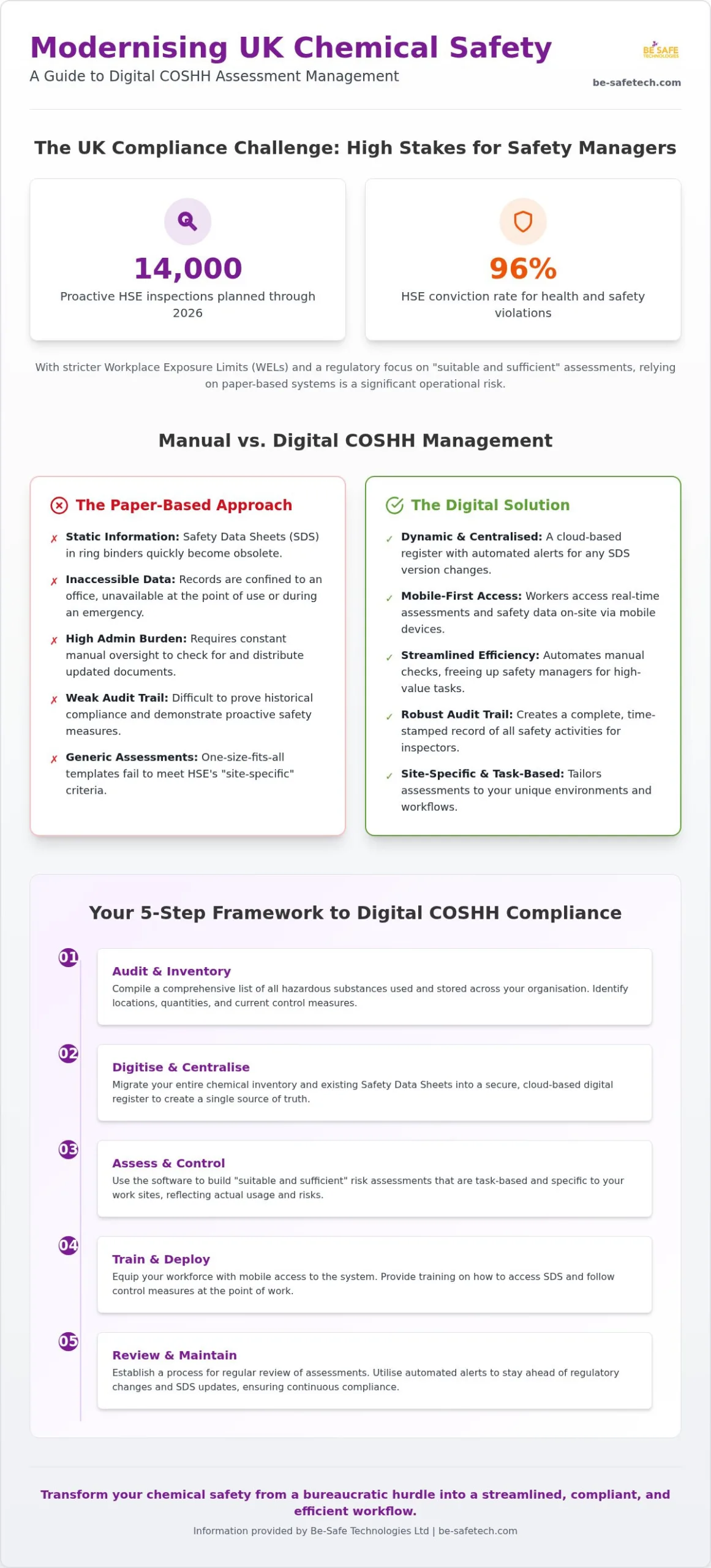
With the Health and Safety Executive planning 14,000 proactive inspections through 2026 and maintaining a 96% conviction rate for health and safety violations, the margin for error in chemical safety has never been smaller. It is a sobering reality for many UK safety managers who still feel they’re drowning in ring binders and outdated paper records. You likely recognise the stress of trying to keep Safety Data Sheets current whilst managing risks across several different sites. It’s easy to feel that compliance is a bureaucratic hurdle rather than a genuine safety measure.
This guide shows you how to transition to a modern coshh assessment software system that replaces manual guesswork with digital precision and professional assurance. We’ll explore how a centralised register and automated alerts provide total oversight, ensuring your team has real-time access to assessments on their mobile devices at the point of use. You’ll discover how to build a safety culture that prioritises both HSE compliance and operational efficiency, turning complex regulatory requirements into a streamlined part of your daily workflow.
Key Takeaways
- Understand how digital systems meet the HSE criteria for “suitable and sufficient” risk assessments whilst navigating the updated 2026 workplace exposure limits.
- Learn how to automate Safety Data Sheet management to ensure your chemical information remains current without the burden of constant manual oversight.
- Discover how coshh assessment software provides site-based workers with real-time, mobile-first access to vital safety data exactly when and where they need it.
- Identify the hidden operational costs of paper-based records and the tangible ROI gained from transitioning to a centralised, cloud-based digital register.
- Master a practical five-step framework to audit your existing chemical inventory and successfully migrate your safety processes to a secure digital environment.
What is COSHH Assessment Software? Navigating UK Regulations in 2026
Digital COSHH software is more than a simple storage tool; it acts as a comprehensive ecosystem designed to manage the entire lifecycle of hazardous substances. Instead of static documents gathering dust in a ring binder, it provides a dynamic register that connects chemical risks directly to the people working with them. This system addresses the “Big Three” pillars of workplace protection: health risks like respiratory disease, safety risks including flammability or explosions, and the long-term environmental impact of chemical disposal and spillages. In high-risk industrial settings, this oversight often extends to electrical safety, where specialist providers like firstpowerandsurgeprotection.com help mitigate the risk of surges or lightning strikes that could ignite hazardous materials. By centralising this data, businesses move away from reactive, fragmented safety checks toward a model of total operational oversight.
The legal foundation for this remains the Control of Substances Hazardous to Health Regulations 2002. In 2026, the Health and Safety Executive (HSE) has sharpened its focus on whether assessments are “suitable and sufficient”. This means businesses can no longer rely on generic, one-size-fits-all templates. They must demonstrate a specific understanding of how substances are used on their own unique sites. Modern coshh assessment software bridges this gap by allowing managers to create tailored, site-specific records that update automatically whenever regulations or substances change.
The Legal Framework: HSE Compliance and EH40
Compliance in 2026 requires a precise approach to Workplace Exposure Limits (WELs). The latest EH40/2005 updates have introduced stricter limits, such as reducing the WEL for respirable crystalline silica to 0.05 mg/m³. Digital systems track these shifting thresholds in real time. If an assessment doesn’t reflect the current EH40 standards, the software flags it immediately. This creates a robust audit trail, proving to inspectors that your organisation maintains continuous oversight rather than just performing a yearly check.
Why 2026 is the Year to Go Paperless
The administrative burden of manual record-keeping has reached a tipping point for UK industry. With the HSE conducting 14,000 proactive inspections this year, the risk of missing a single update is too high. Digital records provide essential protection against historical liability claims by documenting safety measures accurately. By using mobile technology, workers can capture “point-of-work” data instantly. This moves safety from the office to the site, ensuring that coshh assessment software serves as a practical tool for protection.
Essential Capabilities of a Digital COSHH System: SDS Libraries and Mobile Reporting
Modern safety management requires a shift from simply holding data to actively using it. Effective coshh assessment software serves as the central nervous system for chemical safety, ensuring that every Safety Data Sheet (SDS) and risk assessment is accurate, accessible, and actionable. Whilst paper systems rely on manual updates that are easily missed, digital platforms automate the lifecycle of these documents, providing a level of oversight that protects both the workforce and the business. This transition ensures that your safety data is never more than a few taps away.
The Power of a Centralised SDS Register
One of the most persistent challenges in chemical safety is the “missing folder” problem. When an SDS is tucked away in a physical file, it’s rarely available during an emergency or a routine safety check. A centralised digital register eliminates this risk by hosting all documents in a secure cloud environment. These systems offer automated alerts for version changes, ensuring you are never working from an obsolete document. By linking SDS data directly to specific risk control measures, you provide employees with clear, concise instructions that go beyond the raw technical data.
Context matters in risk management. A substance-based assessment tells you what a chemical is, but a task-based assessment tells you how it behaves in your specific environment. Whether you are decanting fluids in a workshop or applying coatings on a construction site, your software should allow for customisable workflows that mirror these unique UK site operations. Following official HSE guidance ensures these assessments remain “suitable and sufficient” for the work at hand. Choosing the right coshh assessment software means looking for tools that prioritise the end-user experience over simple data storage.
Mobile-First Design for the Modern Workforce
Safety shouldn’t stop because the Wi-Fi does. In remote UK locations or deep within industrial facilities, offline functionality is a critical capability. A mobile-first approach allows workers to view assessments and report incidents even without a signal. Many organisations now use QR codes on chemical storage lockers, enabling staff to scan and instantly view the relevant COSHH data on their own devices. This provides a significant psychological benefit; it gives workers “safety in their pocket” and fosters a culture where compliance is a shared responsibility. Adopting a user-centric platform like Compliance Genie ensures that these digital tools adapt to your team’s daily reality rather than forcing them into rigid, office-bound processes.
Comparing Manual vs. Digital COSHH Management: Efficiency and Compliance ROI
The transition from manual folders to a digital system represents a fundamental shift in how UK businesses approach their safety obligations. Manual COSHH management often leaves safety officers trapped in a cycle of administrative “dead time,” where hours are lost to filing, printing, and cross-referencing Safety Data Sheets. By digitising chemical inventory and assessments, organisations reclaim this time for active risk management on the shop floor. This move doesn’t just improve efficiency; it provides a level of operational harmony that paper-based systems simply cannot match.
Paper records carry significant hidden costs that often go unrecognised until an audit occurs. Beyond the price of printing and physical storage space, the risk of lost or damaged records creates a critical vulnerability. If an inspector from the Health and Safety Executive (HSE) arrives, a missing assessment can lead to a “Fee for Intervention” (FFI), which is the cost-recovery mechanism for businesses found in material breach of safety laws. Whilst earlier sections highlighted the high conviction rates in the UK, the immediate financial drain of FFI invoices makes a compelling case for modern coshh assessment software. Digital systems ensure that a single source of truth is available to the head office and site managers alike, providing total visibility across multiple locations.
Data Security: The ISO 27001 Advantage
In 2026, data security is as vital as physical safety. Storing sensitive employee health data or proprietary chemical information on unencrypted local drives or in unlocked cabinets poses a significant GDPR risk. UK businesses must prioritise platforms that meet recognised industry standards to ensure long-term peace of mind. Compliance Genie is ISO 27001 and ISO 9001 certified, providing a secure, cloud-based environment that protects your data against unauthorised access. This level of certification ensures that your compliance records are not only accurate but also handled with the highest tier of information security.
Calculating the Return on Investment
Within the safety sector, ROI is defined as the measurable decrease in workplace risk and liability achieved by replacing manual administrative burdens with precise, real-time digital oversight.
Five Steps to Transitioning from Paper to Digital COSHH Assessments
Moving from a fragmented paper system to a unified digital model requires more than just a software purchase; it demands a structured approach to change management. Transitioning to coshh assessment software is a journey that replaces manual uncertainty with digital clarity. By following a logical sequence, you ensure that the technology adapts to your business needs rather than creating new administrative hurdles. This methodical progression builds confidence amongst your team and ensures a smooth migration of vital safety data.
- Step 1: Audit your existing chemical inventory. Begin by identifying every substance currently on-site and ensuring you have the latest Safety Data Sheets. This is the ideal time to verify your records against the 2026 EH40 workplace exposure limits, such as the reduced limit for respirable crystalline silica.
- Step 2: Define your user hierarchy. Determine who needs to view assessments, who has the authority to edit them, and who must provide final approval. A clear structure ensures accountability across your organisation.
- Step 3: Choose an integrated platform. Select a system that connects with your wider health and safety risk assessment software to avoid data silos and ensure a single source of truth.
- Step 4: Pilot the system. Implement the software on a single site first. This allows you to gather practical feedback from the shop floor and refine your digital workflows before a full-scale launch.
- Step 5: Roll out nationally. Deploy the system across all sites, supported by clear training materials that reflect the multicultural nature of the modern UK workforce.
Engaging the “Deskless” Worker
Successful adoption depends on the people using the chemicals, not just the office-based safety team. Overcoming resistance starts with providing simple, intuitive interfaces that don’t require extensive IT knowledge. Appointing “Safety Champions” amongst your site-based teams helps bridge the gap between management goals and daily reality. These mentors can demonstrate how the coshh assessment software makes their own jobs safer and easier. Training materials must be inclusive, utilising diverse visual aids and clear language to ensure every employee, regardless of background, feels confident using the new system.
Integrating COSHH into Your Wider EHS Strategy
A siloed approach to chemical safety often leads to missed opportunities for risk reduction. By linking COSHH data to your broader EHS strategy, you can use data insights to identify trends, such as recurring exposure risks or high-usage substances that could be substituted for safer alternatives. This creates a holistic “Safety Genie” environment where every piece of data contributes to total operational harmony. When your digital tools work together, you move from simply managing compliance to actively improving the health and safety culture of your entire business. Start your digital journey today by exploring how Compliance Genie can transform your safety processes.
Compliance Genie: The All-in-One Solution for UK Chemical Safety
Compliance Genie provides a unified platform that transforms chemical safety from a complex regulatory burden into a manageable, transparent process. By digitising the entire workflow, this coshh assessment software ensures that every assessment is suitable, sufficient, and accessible to the workers who need it most. It serves as a secure digital vault for your Safety Data Sheets, providing real-time updates and automated alerts that keep your organisation ahead of HSE expectations. This approach gives safety managers the peace of mind that comes from knowing their data is accurate and their workforce is protected.
Unlike generic global applications, Compliance Genie was built to address the specific nuances of the UK regulatory environment. It integrates seamlessly with contractor management software UK, allowing for total site oversight that includes both permanent employees and external partners. This cloud-based system ensures that whether you are managing a single workshop or a national network of construction sites, your safety data remains synchronised and secure. The mobile-first design means your team can access vital information at the point of work, reducing the risk of incidents caused by inaccessible or outdated safety records.
Award-Winning UK Innovation
Compliance Genie is a product of UK-based development, designed by professionals who understand the gravity of British workplace safety standards. This award-winning platform evolves alongside user feedback and the latest HSE updates, ensuring it remains at the forefront of digital safety technology. Our UK-based support team provides a partnership based on trust, offering the technical proficiency needed to simplify even the most complex compliance environments. This commitment to local expertise ensures that the software adapts to your unique operational needs rather than forcing your team to change their behaviour to fit a rigid tool.
Ready to Modernise Your Safety Processes?
Moving beyond the limitations of spreadsheets and paper folders allows your safety systems to grow alongside your business. Compliance Genie provides the clarity and control required to manage chemical risks with total confidence. By centralising your records in an ISO 9001 and 27001 certified environment, you protect your organisation from both physical hazards and data vulnerabilities. It is time to replace administrative stress with a streamlined, mobile-first solution that prioritises the safety of your people. Book a demo of Compliance Genie today and discover how our coshh assessment software can bring operational harmony to your business.
Modernising Your Approach to Chemical Safety
Navigating the stricter workplace exposure limits of 2026 requires a move away from manual, fragmented record-keeping. By adopting a modern coshh assessment software system, you replace administrative burdens with a streamlined digital register that ensures your site-based workers are always protected. This transition provides the total oversight needed to manage hazardous substances across multiple sites with absolute clarity, ensuring your assessments remain suitable and sufficient at all times.
Compliance Genie offers a robust, cloud-based solution developed specifically for the unique challenges of British industry. It provides ISO 27001 certification for ultimate data security and a mobile-first design for real-world site use, bridging the gap between office-based compliance and shop-floor reality. Supported by a 100% UK-based development team, the platform evolves with your business to provide long-term peace of mind and operational harmony.
Discover how Compliance Genie can revolutionise your COSHH management and take the first step towards a more efficient, safer workplace today. Building a proactive safety culture starts with the right digital tools, and there’s never been a better time to modernise your processes and secure your business.
Frequently Asked Questions
What does COSHH stand for and why is it important in the UK?
COSHH stands for the Control of Substances Hazardous to Health Regulations 2002. It is a vital legal framework in the UK that requires employers to protect staff from illnesses like asthma, dermatitis, or lung disease caused by workplace substances. By identifying risks and implementing specific control measures, businesses ensure they meet their legal duty of care and avoid costly interventions from the Health and Safety Executive.
Is digital COSHH assessment software fully HSE compliant?
Digital coshh assessment software is fully compliant with HSE standards provided it facilitates “suitable and sufficient” risk evaluations. The software helps ensure that all necessary regulatory criteria are met by providing a structured, guided approach that is often more reliable than manual templates. It creates a robust digital audit trail that demonstrates your organisation’s commitment to continuous safety monitoring and data accuracy.
How does the software handle updates to Safety Data Sheets (SDS)?
The software automates the management of Safety Data Sheets by providing a centralised library that tracks version changes from manufacturers. When a substance’s safety data is updated, the system flags the change and sends automated alerts to the relevant safety managers. This ensures your risk assessments always reflect the most current chemical information without the burden of manual tracking and cross-referencing.
Can I use COSHH assessment software on my mobile or tablet whilst on-site?
Modern coshh assessment software is designed with a mobile-first approach specifically for use on tablets and smartphones whilst on-site. This allows workers to access vital safety data or complete assessments at the point of work, even in areas with poor signal. It moves safety information from a remote office directly to the shop floor where it provides the most practical protection for your team.
How does digital COSHH software improve data security compared to paper?
Digital systems offer superior security through encrypted cloud storage and user-specific access controls that paper records cannot match. Unlike physical folders that can be lost, damaged, or accessed by unauthorised personnel, digital platforms like Compliance Genie are ISO 27001 certified. This ensures that sensitive employee health data and proprietary site information are protected to the highest international standards of information security.
Will my staff find the software easy to use for daily assessments?
User-centric design ensures that staff find the software intuitive and straightforward for their daily safety tasks. By using clear, logical workflows and simple interfaces, the platform reduces the technical barriers often associated with compliance. This encourages higher levels of engagement from site-based workers, making safety a collaborative part of the working day rather than a bureaucratic hurdle.
Can COSHH software integrate with my other health and safety systems?
Yes, the software is built to integrate seamlessly with wider Environmental, Health, and Safety (EHS) ecosystems. It can link directly to your contractor management and general risk assessment tools to provide a single source of truth for your entire organisation. This holistic view allows you to manage diverse risks across multiple sites from a centralised and organised digital dashboard.
What are the costs associated with implementing COSHH software?
Implementation costs for digital safety systems typically follow a subscription-based SaaS model tailored to your organisation’s specific scale and needs. Whilst the investment varies based on user numbers and site requirements, it is often offset by significant administrative time savings and improved operational efficiency. Most businesses see a clear return through reduced risk and the avoidance of potential fines from regulatory non-compliance.