


The Hidden Costs of Paper-Based Safety Management: What UK Businesses Should Count
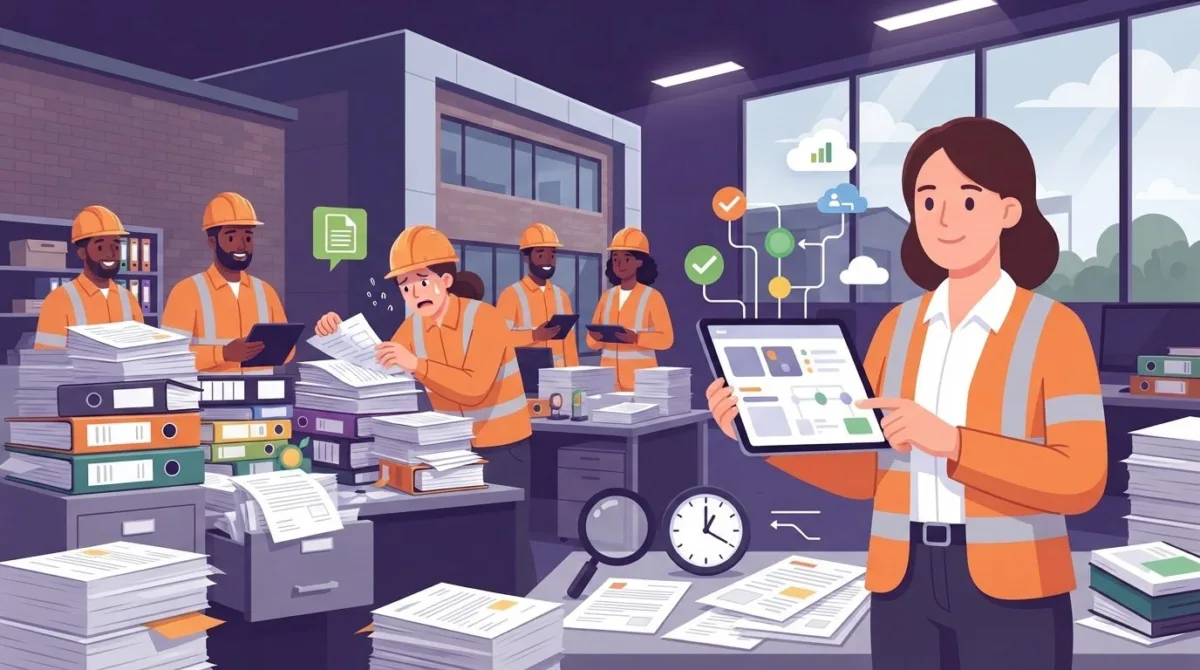
What if the biggest cost of paper-based safety management isn’t the paper itself, but the time spent moving each record through the process? Printing and filing may seem like small tasks, yet completing forms, finding the right version and following up actions all take staff time. These are the hidden costs of paper-based safety management that can be easy to overlook.
It’s understandable to focus on visible expenses such as folders and printing. The full cost also includes the work of storing, retrieving and checking records, and keeping track of whether documents are current and actions are progressing.
This article helps you identify recurring costs across the paper workflow and compare them with a digital process using the same measures. You’ll assess staff time, administration and oversight, then weigh those demands against software costs and transition work. Compliance Genie is a mobile-first, cloud-based platform for digitising health and safety processes and risk assessments. Measure your current workload first, then decide whether it fits your organisation’s needs.
Key Takeaways
- Map the hidden costs of paper-based safety management by looking beyond supplies to the staff time and process effort each record requires.
- Trace how documents move between people and tasks to spot avoidable handling and version confusion.
- Compare paper and digital workflows across creation, access, review, action tracking and retrieval, using the same measures.
- Build a practical cost baseline by recording staff roles, document volumes, retrieval requests, review follow-up and rework.
- Use your findings to assess whether Compliance Genie’s mobile-first, cloud-based approach to safety processes and risk assessments fits your organisation.
The hidden costs of paper-based safety management go beyond printing
Paper can feel familiar and inexpensive: a form is printed, completed and placed in a folder. But the purchase price is only one part of the process. Staff still need to check details, pass records to the right person, organise files and find information when it’s needed. These repeat tasks are easy to miss because the time is spread across different roles and days.
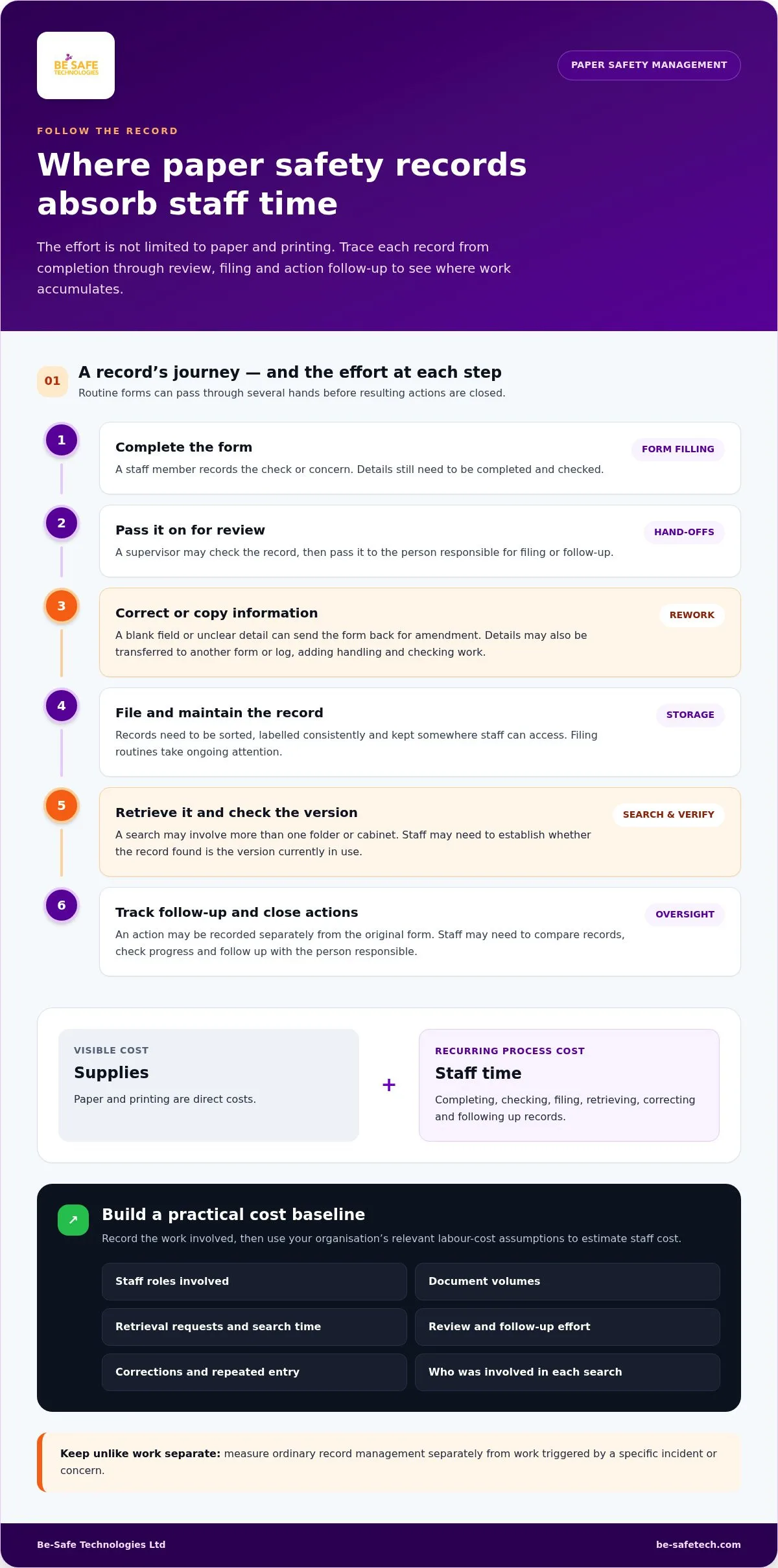
The hidden costs of paper-based safety management are the staff time and process effort involved in managing records, beyond buying paper and printing. To see where that effort goes, trace a record from completion through review and filing to the point when any resulting actions are closed. Along the way, it may need correction, retrieval or follow-up.
Which paper-based safety tasks consume staff time?
Even a routine form can pass through several hands. Someone completes it, a supervisor checks it and an administrator files it. If a field is blank or information needs clarification, the form may go back for amendment. Staff may also transfer details from one form or log to another, adding handling time and another opportunity for information to be missed.
Routine administration is different from investigating an incident or concern. An investigation may require people to gather and review relevant records, establish what happened and track resulting actions. Paper doesn’t create the need for that work, but locating and assembling records can add steps. Measure ordinary record management separately from work triggered by a specific issue.
Paper and printing are direct supply costs. The staff time spent completing, checking, filing and retrieving records is a separate, recurring process cost.
Why are storage and record retrieval easy to overlook?
A filing system needs ongoing attention. Records must be sorted into the right folders, labelled consistently and kept somewhere people can access. As files accumulate, staff may need to check more than one cabinet or folder. If a record is out for review or filed under an unexpected name, the search can take longer.
Version checks add another step. A team member may find a relevant-looking form but still need to establish whether it is the version currently in use. Clear naming, filing and review routines can reduce confusion, but they take time to maintain.
A Safety Management System (SMS) brings together the processes an organisation uses to manage safety. Records support those processes when staff can locate and understand them. For each retrieval request, note the search time, who was involved and whether the right record was found first time. To estimate the staff cost, apply your organisation’s relevant labour-cost assumptions to the time recorded.
How paper workflows create extra effort and weaker oversight
Paper records often move between people and tasks before anyone can see the full picture. A completed inspection form might go to a supervisor for review, then to an administrator for filing, while an action is noted separately in a register. If teams work in different areas, the original document may also need to be passed on or copied. Each hand-off depends on someone knowing what to send, where it should go and what needs to happen next.
These steps can make the hidden costs of paper-based safety management harder to spot. Paper records are not automatically unreliable. The challenge is that separate records can make the current status harder to establish, especially when updates sit in different folders or with different people.
Where do hand-offs and duplicated entries arise?
Consider a UK workplace where a staff member completes a safety check, records a concern on a form and passes it to a manager. The manager may copy the concern into an action register, then ask another colleague to record when it has been addressed. The same detail now appears in more than one place.
Duplicated entry creates checking work. Someone must compare the records to see whether the description, date or action status matches. If one copy is amended and another isn’t, colleagues may need to establish which version is current. Clear procedures can reduce this risk, but they still need attention.
When records are fragmented across forms, folders and people, establishing the current status takes extra effort. A quick review may become a search for the original record, a check of the action register and a follow-up with the person responsible. Delayed access doesn’t necessarily mean an action has been missed, but it can make progress harder to check promptly.
How can paper records affect audit preparation?
Preparing records for an internal review or other examination can involve gathering documents from different files, sorting them into a useful order and locating supporting information. Staff may also need to check whether records are complete and whether follow-up is recorded. These are administrative preparation tasks; assembling paperwork does not, by itself, establish that an organisation meets its legal obligations.
For UK guidance on managing workplace health and safety, refer to the Health and Safety Executive (HSE). Its guidance can help organisations understand relevant expectations. Consider your own records and arrangements in context.
Assess the oversight effort by timing how long it takes to answer routine questions: Which version is current? Who is handling this action? Has the review been recorded? If answering requires several calls or searches, record each step. This evidence will help you compare the existing process with alternatives. Compliance Genie safety management software helps organisations digitise health and safety processes and risk assessments.
Paper versus digital safety management: compare the full workflow
A fair comparison looks at the work each approach requires, not just the price of supplies or software. Comparing the same task from start to finish makes the hidden costs of paper-based safety management easier to identify, including time spent on review, updates and follow-up. Digital processes also involve setup and administration, so measure those tasks rather than assuming a change will reduce effort.
Use the table to identify what staff actually do at each stage. The digital column describes process differences to assess, not guaranteed outcomes. The workload depends on the system, its setup and how your organisation uses it.
| Workflow stage | Paper process | Digital process |
|---|---|---|
| Creation | Complete a printed form, then check it is legible and has the required details. | Enter information into a digital process; include time for setup, familiarisation and any required adjustments. |
| Access | Locate the file and arrange to pass or copy it to the people who need it. | Consider how authorised users access the information and whether the process suits their working conditions. |
| Review | Circulate the record, collect comments and file any revised copy. | Record the steps needed to review and maintain the process, including staff time and ongoing administration. |
| Action tracking | Check forms, registers or notes to establish what remains outstanding. | Assess how the system records progress and what manual checks or follow-up are still needed. |
| Retrieval | Search folders or filing locations, then confirm the record is relevant. | Search digitally and verify that the result is the right record for the task. |
What should a fair paper-versus-digital comparison include?
Keep the comparison like-for-like: use the same sites, processes, time period and user groups. Record how many staff take part and the time spent at each workflow stage. Separate one-off transition work, such as preparing records or helping colleagues learn a new process, from recurring administration. Write down your assumptions, including which tasks are included, and use your own observations rather than unsupported industry averages.
When might paper still suit a particular process?
An existing paper process may remain workable if staff can complete and review it reliably in their working conditions. Consider access needs, the task itself and people’s experience with the process. Then check whether the records connect clearly to wider oversight: can relevant colleagues establish what has been reviewed, what needs follow-up and where the current information sits? Choose a proportionate approach, rather than changing to digital for its own sake.
Once you have recorded the work on both sides, compare recurring effort with transition requirements and ongoing administration. If you’re assessing a digital option, explore health and safety compliance software as part of that evidence-led review.
How to calculate your organisation’s paper safety management costs
To estimate the hidden costs of paper-based safety management, start with the work your organisation actually does. A measured baseline is more useful than a broad industry average because processes, staff roles and record volumes vary. Keep the exercise practical: choose a defined set of processes, observe the work and record what happens when details are missing or records need to be found.
- Choose the processes. Select the safety activities you want to assess and define the sites, teams and period covered. Include enough detail to compare the same work later, rather than mixing unrelated processes.
- Observe the time. Record completion, checking, filing, retrieval, review and action-follow-up time separately. Note each staff role involved, including time spent chasing missing information or moving details between forms.
- Count volumes and handling. Record how many documents are created, how often information is re-entered, how many retrieval requests arise and how many times a record changes hands. Include repeat work and corrections.
- Record rework and follow-up. Note incomplete forms, searches that take more than one attempt, review reminders and time spent establishing whether actions have progressed. Keep this activity distinct from investigation work triggered by a particular issue.
Which measures should you record before deciding?
Use a representative period that reflects ordinary activity, and explain any seasonal or workload variation that could affect the result. A worksheet can include the process, staff role, document volume, minutes spent by task, retrieval requests, repeated entries, review follow-up and rework. Keep measures separate so you can see which stages account for the effort, rather than relying on one blended estimate.
To translate time into an internal cost, apply your organisation’s approved staff-cost assumptions to the hours recorded for each role. Use the same basis consistently and state what it includes. A useful estimate depends on measured local workflows, not generic averages.
How can you compare costs without overstating savings?
Assess a digital process against the same activities and period. Estimate the time it would take to complete, access, review and follow up records, then include one-off transition work such as preparing information and helping staff become familiar with the process. Keep recurring administration separate from these initial tasks.
Show your assumptions and distinguish observed figures from estimates. If you include software pricing, use a published price from a public source and compare it with your organisation’s measured paper effort. Don’t present a projected reduction in time or cost as guaranteed; review the estimate against actual experience.
Once your baseline is clear, you can assess whether a digital approach fits your processes. Explore Compliance Genie for health and safety processes and risk assessments.
How Compliance Genie can help move safety processes beyond paper
Once you’ve measured the work involved in your current processes, use the results to decide what to change. The hidden costs of paper-based safety management differ between organisations, so base your next step on your own records, priorities and practical needs.
Compliance Genie is a mobile-first, cloud-based platform for digitising health and safety processes and risk assessments. Compare the tasks and oversight needs in your baseline with the work your staff would carry out in the platform. This keeps the decision grounded in your processes rather than an assumption that paper must always be replaced.
Which paper processes could Compliance Genie digitise?
Start with activities that your baseline shows require the most administration, repeated handling or follow-up. For each one, note what information is needed, who uses it and what happens next. Then assess how the process could be digitised in Compliance Genie and whether that approach suits your priorities and working conditions. You don’t need to assume every paper form should be replaced.
What should a considered next step look like?
Use your baseline to select a process where the administrative burden is clearest. Compare its current steps with the digital workflow, including transition tasks and the time staff may need to become familiar with a different way of working. Where wider upskilling is needed to support the rollout of new software, partnering with digital learning specialists like Knowledgefront can help staff build confidence. Consider staff adoption alongside possible workflow improvements, and treat expected changes as estimates rather than guaranteed savings.
Be-Safe Technologies Ltd holds ISO 9001 and ISO 27001 certifications. These are company certifications, not certifications of Compliance Genie itself. Consider them alongside your measured needs and assessment of the platform’s fit.
A proportionate decision might be to retain a workable paper process, improve how it is managed or digitise selected safety work. Use your evidence to decide where change could bring greater clarity, while accounting for the effort involved. Explore Compliance Genie for a digital approach to health and safety processes and risk assessments.
Turn your findings into a practical next step
Your assessment doesn’t need to lead to an organisation-wide change. Choose a process where staff effort or delays are most apparent, then decide what a workable improvement would look like for the people who manage and use it. You might refine how records are handled or evaluate a digital approach against the same measures you used for paper.
Set a point to review the decision using real experience, not assumptions. Consider whether the chosen process is easier to manage, whether staff can use it as intended and whether the effort of maintaining records has changed. This keeps the hidden costs of paper-based safety management in perspective and helps you make adjustments that suit your organisation.
If a digital approach fits your priorities, take the next step at a pace that lets your team assess the process and its practical demands. Explore Compliance Genie to manage health and safety processes and risk assessments digitally. Your baseline gives you a clear starting point.
Frequently Asked Questions
Can paper-based safety management meet UK health and safety requirements?
Paper can be used to record safety information, but the format alone doesn’t show whether an organisation’s arrangements are suitable. Check whether a colleague can tell what a record relates to, when it was completed and who is responsible for any review. Keep entries legible and organise them so they can be understood in context. Requirements depend on the organisation’s circumstances, so don’t treat paper as automatically acceptable or unacceptable.
Is digital safety management always cheaper than paper?
No, the result depends on how the system will be used and the work it replaces. A process used rarely may offer little scope to reduce routine administration, while a frequently repeated process may present a different case. Consider whether staff will use the digital process consistently and whether it fits their tasks. Treat projected changes as estimates, then review them against experience after the process has been adopted.
How much time does paper-based safety administration take?
It varies with the records, people and activities involved, so an organisation-specific figure is more useful than a universal estimate. Consider whether your observations are representative: a quiet period may not reflect a busy review cycle or an unusual influx of records. State the period covered and any workload conditions that could affect the result. That context helps decision-makers judge whether the estimate reflects normal operations.
What happens to safety records when the person responsible leaves?
The organisation needs to maintain continuity, including knowing where records are kept and who will take responsibility for outstanding work. Test the handover by asking a colleague who hasn’t managed the process to follow its written instructions and identify who is responsible for the next step. If they cannot do so, note what guidance is missing and update the handover information before responsibilities change.
Are handwritten risk assessments valid?
Handwriting alone doesn’t determine whether a risk assessment is useful or appropriate. Check that the wording is legible, the work being assessed is clearly identified and any changes can be understood by the people who need the information. A digital document also needs careful preparation and review; changing the format cannot, by itself, make an assessment accurate or suitable. Seek appropriate UK advice if you need a legal interpretation for your circumstances.
How should a business decide which safety records to digitise first?
Choose a manageable starting point that can be assessed clearly. For instance, begin with one defined process rather than changing several unrelated record types at once. Agree what a successful trial would mean for your organisation, such as staff being able to complete the process and understand its records. Use feedback to make adjustments before deciding whether to extend the approach. For broader administrative demands across an organisation, Australian companies often turn to all-in-one solutions such as Mooov to unify digital workflows.