



HSE Risk Assessments: What a Template Cannot Capture
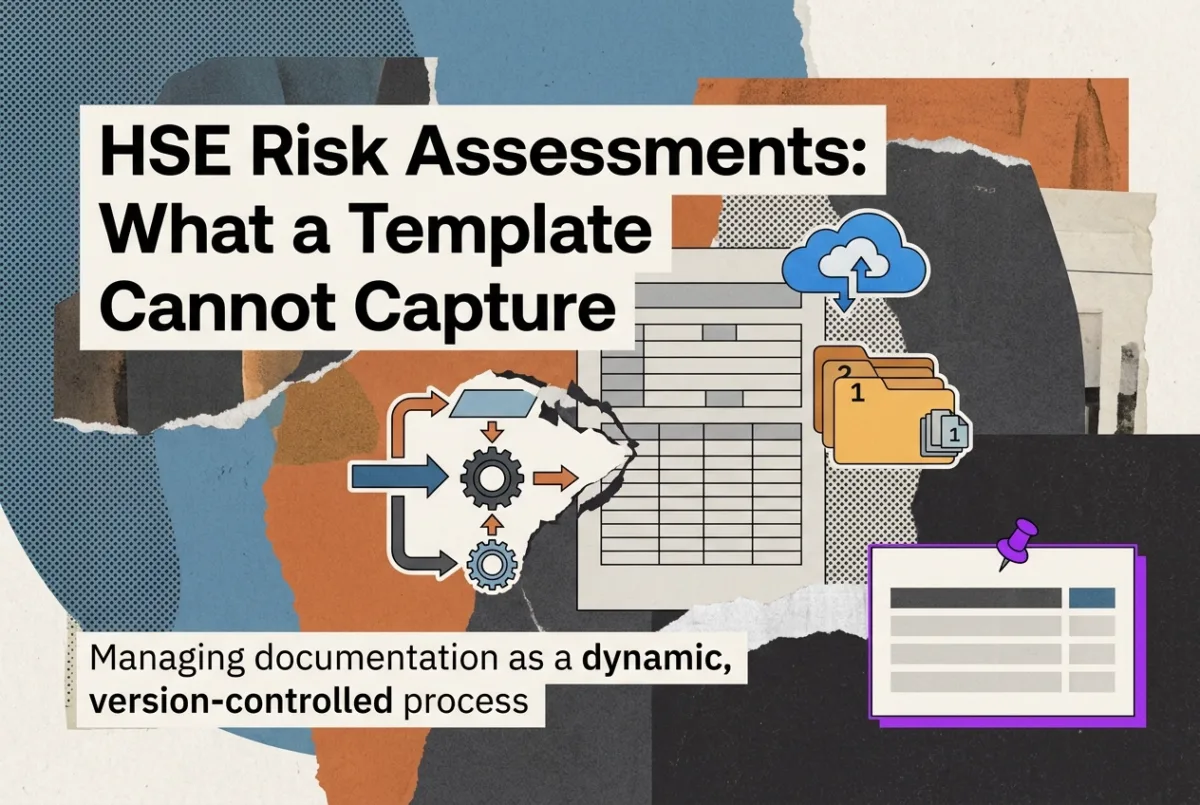
Downloading a template feels like progress. You fill in the boxes, save the file, and move on. But an HSE risk assessment is not a one-off form. It is a living record of how you identify hazards, judge likelihood and severity, and decide what controls are needed. A template captures a moment. A working system has to hold the version history, the named owner, the review trigger, and every method statement or RAMS that depends on it. HSE itself describes risk assessment as just one part of the overall process used to control risks, so the assessment must connect to the work it governs.
In this post, we will look at why a risk assessment is a living document, what the Management of Health and Safety at Work Regulations require, and how version history, ownership, review triggers, downstream links, and the risk register fit together. We will also explain why a template cannot hold all of this. Finally, we will cover what to check before you reuse that old template.
Why a Risk Assessment Is a Living Document, Not a Form

A risk assessment template is a page. The assessment itself is a working argument about one task, carried out in one set of conditions, by one group of people. Conditions move on. The page does not.
The HSE’s simple guidance puts it plainly: assessing risk is “just one part of the overall process used to control risks in your workplace” (Managing risks and risk assessment at work). If your paperwork stops at the completed form, the job is unfinished.
That difference is why safety solutions tend to fail at the same point, when assessments multiply faster than anyone can track them.
Run a self-test on your own paperwork. If a task changed last month, who knew? What changed? Which version is in force on site this morning? If you cannot answer all three without searching, the gap is structural, not clerical.
One honest note on evidence: the case here rests on the duty and how it is administered. No verified figures on assessment quality were available for this piece, so nothing below is dressed up as statistics.
The Legal Baseline: What an HSE Risk Assessment Must Do
Regulation 3 of the Management of Health and Safety at Work Regulations 1999 sets the floor. Employers must identify hazards, judge how likely harm is and how serious it could be, then act to eliminate the hazard or control the risk. The HSE’s simple health and safety guidance is the plain English route into that duty, and for a practical walkthrough of the steps themselves, see our guide to the five steps of risk assessment.
That duty sits superimposed over all other workplace health and safety legislation, so it covers every workplace risk, not only those named in specific regulations. INDG218, the HSE guide to risk assessment requirements, is the usual starting reference; cite the HSE original rather than a mirror copy.
That breadth creates overlap. Several regulations can cover the same risk, and precautions already assessed elsewhere can be treated as checked so effort is not duplicated. That shortcut only works if you can show which assessment already covers what.
Of those steps, review is the focus of what follows.
One caveat on dates: several supporting regulations date from 1987 to 1999 and remain in force even as guidance updates around them. Age is not the same as obsolescence.
Version History: Proving Which Assessment Was in Force
The harder question is proving what an assessment actually said on a particular day. That is a version history problem, and it is where many records quietly fail.
A working version history captures four things: what changed, who approved the change, when it took effect, and which version applied on a given date or shift. If any of those is guesswork, the record is not evidence.
Legislation.gov.uk is a useful behaviour model here, presented as an analogy rather than H&S guidance. It publishes “Latest Available (revised)” alongside “Original (As made)”, with a timeline of changes. That is the minimum a risk assessment record should be able to do for its own history.
The test that exposes the gap is simple: if an incident happened in March, can you produce the assessment exactly as it stood in March, complete with the controls listed then? Most teams cannot. Templates get overwritten in place, fields get cleared, and a saved file replaces the only copy of what was previously agreed.
So put one question to whoever stores your assessments: are superseded versions retained, dated and attributed, or simply archived into a folder nobody opens?
Named Ownership: Who Is Accountable for Each Assessment
Ownership is the next question: who is accountable for keeping the assessment true?
Here the guidance is quiet. The HSE places the duty on the employer as an organisation. That gap is a large part of why ownership goes missing. An assessment with no owner has nobody to update it when the task changes, and nobody to notice when it stops matching the work.
Record three roles against every assessment, each with a date: who wrote it, who approved it, and which competent person advised on it. Capture the role as well as the person. Owners leave, change job titles or go on long leave, and an assessment tied to one individual quietly becomes orphaned.
Tie ownership into the risk register. That is where reviews that have drifted, assessments with no approver and documents with no owner stop being buried in folders and start showing as gaps.
The principle travels well: a document that names nobody is defended by nobody.
Review Triggers: What Should Force a Re-Assessment
Triggers answer the remaining question: when must the assessment be revisited?
Practitioners commonly work to a familiar set: a change in process, plant or premises; a near miss or incident; new or amended regulation or guidance; new equipment or substances; a change in who carries out the task; and a scheduled periodic review. Treat those as practice-level prompts, not a legal checklist. HSE review guidance is where an authoritative list belongs, and it should be checked rather than assumed here.
Once a trigger fires, a system has to hold four things: the trigger itself, the date it was raised, the decision taken, and the outcome. That includes the decision that no change was needed, which is easy to leave unrecorded. It should not be. A no-change note proves the assessment was considered after an event, which is exactly what an inspector or a client will want to see. It also shows your review, repeat and update cycle is genuinely running.
The silent failure mode is the date nobody acts on. A review date that passes without action does not pause the assessment; it turns a live document into an assumption. The longer that runs, the harder it is to defend, because the gap between what the paperwork says and what the site does grows quietly in the meantime.
Downstream Links: Method Statements and RAMS That Depend on the Assessment
A risk assessment method statement turns the findings of an assessment into the sequence of work itself. As practitioners commonly define it, RAMS is the risk assessment and method statement issued together as one pack.
Here’s the problem: one assessment frequently underpins several method statements across sites, shifts and subcontractors. Change the parent assessment and you can leave a whole set of RAMS describing controls that no longer match it.
A system therefore has to show which method statements and RAMS cite which assessment, and flag every dependent document the moment the parent changes. HSE requires duty holders to have systems in place so the required paperwork is in order and available to inspectors, which is hard to prove when those relationships live in people’s heads.
Contractors sit on the same chain. Submitted RAMS need checking against your own assessment and linking to it, so both parties work from the same version at the same time. That starts before anyone reaches site: Contractor Genie keeps contractors and their submitted RAMS in one system, so the verification step has a home before work begins.
The failure is quiet. An updated assessment sitting alongside untouched method statements looks like a complete pack while the work is still governed by an older set of controls.
The Risk Register Is the Index, Not the Assessment

Once you can trace which RAMS depend on which assessment, you need somewhere that holds those relationships. That is the risk register: a list of the assessments a business holds, who owns each one, its review status, and which method statements and RAMS depend on it.
Be clear on the boundary. A register indexes assessments so they can be found, tracked and checked; it does not replace the assessment or hold hazard detail. The reasoning stays in the assessment itself, including how likely and how serious harm could be.
Here is the overlap payoff. Because several regulations can cover the same risk, a register is where duplicated coverage and orphaned assessments become obvious at portfolio level.
The practical test is simple. A working register answers one question in a single view, without anyone opening a document: what is out of date today? A register that passes that test is doing something a folder of documents never can.
Why an HSE Risk Assessment Template Cannot Hold All of This
The register exposes the gaps, but it cannot create the evidence. That is a structural limit, not a design flaw in forms. A template produces a document, and a document cannot hold state on its own: fields do not remember who filled them or what the previous version said.
Each of the four gaps, version history, ownership, review triggers, and downstream links, has the same root cause: a file cannot hold state.
Templates remain a reasonable starting structure for an hse risk assessment template, standardising headings and prompts. The argument is about where the evidence lives, not whether forms help.
In our experience, spreadsheets and shared drives behave the same way at scale, holding many documents without holding the relationships between them. If you are managing these dependencies across sites, the same principles apply equally to manufacturing and other multi-site operations.
Conclusion: What to Check Before You Reuse That Template
A template is still a sensible starting point. The question is where the evidence lives once the form leaves someone’s hands. Before you reuse one, run it through five checks.
- A named owner and an approving role. Not “Operations” typed at the top of a form. A person accountable for keeping the assessment true to the task.
- Retained superseded versions, dated and attributed, available on demand.
- Defined review triggers, with decisions recorded. That includes the decision that nothing needed to change, which is still evidence that the assessment was considered after an event.
- Visible dependencies. You can see which method statements and RAMS cite each assessment, and a change to the parent flags them immediately.
- A risk register that answers what is out of date today in a single view.
If any of those fail, you are holding a record of what someone once thought rather than proof of control.
For teams who would rather hold all of this in one place than across folders, our Health and Safety App, the Compliance Genie, digitises health and safety processes, and Contractor Genie keeps contractors and their site visits, including submitted RAMS, in one system.