



Workplace Hazard Reporting Software UK: A Comprehensive Guide to Digital Compliance in 2026
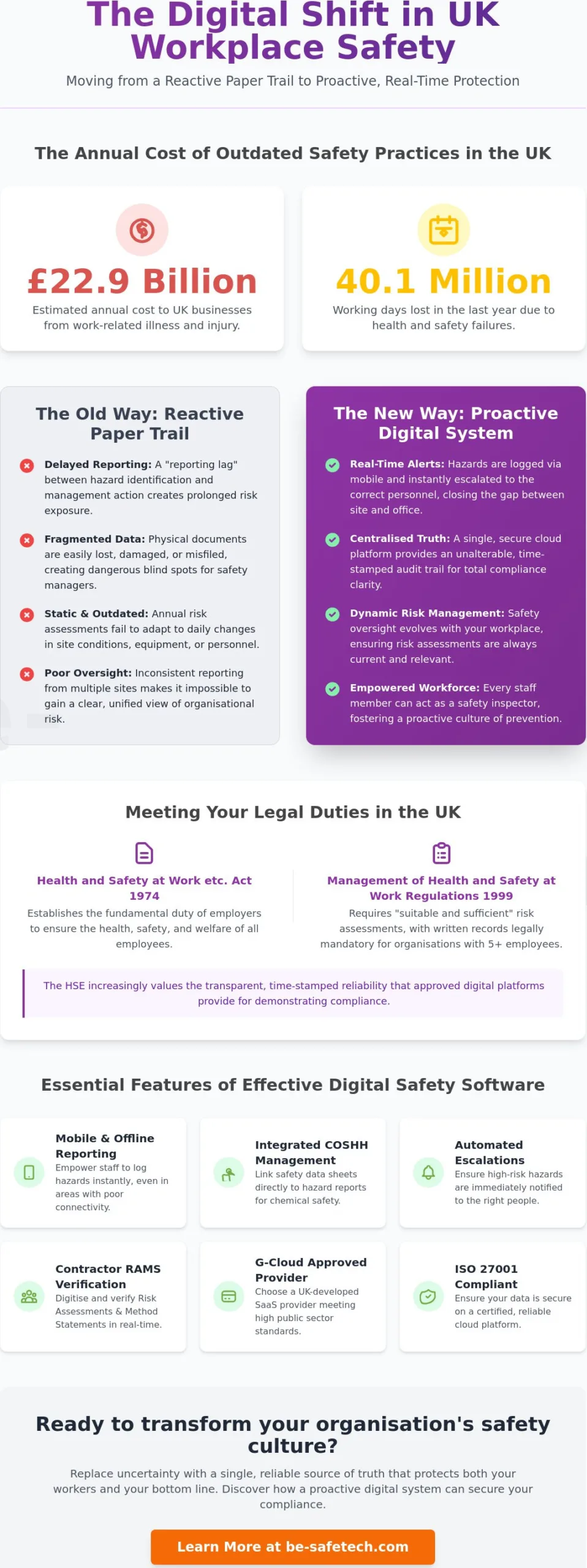
With 40.1 million working days lost to work-related illness and injury in the last year, the traditional “wait and see” approach to safety is costing UK businesses an estimated £22.9 billion annually. You likely recognise the frustration of chasing inconsistent reports from site-based staff or worrying about a gap in contractor compliance that could trigger an HSE intervention. It’s exhausting to manage safety through a fragmented paper trail that only tells you what went wrong after the damage is already done.
This guide demonstrates how to transform your health and safety culture by adopting digital workplace hazard reporting software to move from reactive fixes to real-time, proactive management. By centralising your data, you can reduce the administrative burden of RIDDOR and COSHH compliance whilst gaining total clarity over your operational risks. We will examine how modern platforms like Compliance Genie provide the oversight you need to protect your workforce and your reputation as we move through 2026.
Key Takeaways
- Understand how digital systems align with the Management of Health and Safety at Work Regulations 1999 to ensure robust regulatory compliance across your organisation.
- Learn how modern workplace hazard reporting software empowers site-based staff through mobile-first interfaces and integrated COSHH management for chemical safety.
- Discover strategies to close the contractor safety gap by digitising the verification of Risk Assessments and Method Statements (RAMS) in real-time.
- Follow a structured roadmap to transition from paper-based systems to secure, ISO 27001-compliant cloud platforms without disrupting your daily operations.
- Explore why selecting a G-Cloud approved, UK-developed SaaS provider like Compliance Genie offers the reliability needed to meet high-level safety standards.
Workplace Hazard Reporting Software UK: The Regulatory Landscape
Effective workplace hazard reporting software serves as a digital nervous system for your organisation. It is a comprehensive system designed to identify, record, and mitigate risks before they escalate into costly incidents. Whilst traditional safety management often relied on reactive measures, modern digital tools focus on prevention. They allow every member of staff to act as a safety inspector, capturing data that would otherwise be lost in a sea of paperwork. This proactive approach aligns with core Occupational safety and health principles, ensuring that protection is woven into the daily fabric of your business operations.
The Health and Safety Executive (HSE) has increasingly signalled its support for digital record-keeping. In an era where data integrity is paramount, the HSE values the transparency and “time-stamped” reliability that digital platforms provide. Moving from static, annual risk assessments to dynamic, real-time reporting ensures that your safety data is always current. This shift is vital because a risk assessment created in January might be entirely irrelevant by June if site conditions or equipment have changed. Digital systems ensure your oversight evolves at the same pace as your workplace.
The Legal Duty of UK Employers
Under the Health and Safety at Work etc. Act 1974, employers have a fundamental duty to ensure the health, safety, and welfare of their employees. This responsibility is further detailed in the Management of Health and Safety at Work Regulations 1999, which requires “suitable and sufficient” assessments of risks. If your business employs five or more people, you’re legally required to have these records in writing. In 2026, a static document is rarely considered “sufficient” if it fails to account for daily operational changes. Failing to meet these standards doesn’t just invite HSE intervention; it opens the door to significant fines, legal fees, and a damaged reputation that can take years to recover.
Why Paper Systems Fail in 2026
Paper-based systems are inherently flawed due to the delay between a hazard being spotted and a manager receiving the report. Physical documents are easily lost, damaged, or filled out incorrectly, creating dangerous “blind spots” for safety managers, especially those overseeing multiple sites. These manual processes often result in a “reporting lag” where a trip hazard identified on a Monday isn’t addressed until the following Friday. Digital reporting bridges the gap between site activity and head office oversight by providing a transparent, unalterable record of every hazard identified and the subsequent actions taken to resolve it. By implementing workplace hazard reporting software, you replace uncertainty with a single, reliable source of truth that protects both your workers and your bottom line.
Key Features of Effective Hazard Reporting Software
To move beyond simple incident logs, your workplace hazard reporting software must act as a preventative tool that identifies risks before they lead to injury. The most effective platforms focus on reducing the friction between a worker spotting a danger and a manager receiving the data. Whilst many legacy systems wait for an accident to occur, modern digital solutions prioritise the reporting of near-misses and unsafe conditions. This proactive approach ensures that your safety team isn’t just reacting to the latest entry in the accident book but is actively closing the loops on potential threats.
A critical feature for UK businesses is the seamless integration with specific regulatory requirements, such as COSHH. Managing chemical hazards requires precise data, and digital tools allow for the instant linking of safety data sheets to specific hazard reports. This level of detail is essential for maintaining compliance with UK workplace accident reporting regulations, as it provides a clear audit trail of how risks were identified and controlled. When high-risk hazards are logged, automated escalation paths ensure that the right person is notified immediately, preventing critical information from sitting in an unread inbox.
For firms operating in remote areas or large industrial complexes, offline reporting is a non-negotiable requirement. Workers shouldn’t be discouraged from logging a hazard because of a poor mobile signal. Effective software caches the data locally on the device and syncs it the moment a connection is restored. This ensures no data point is lost, providing a complete picture of safety across every corner of your operation.
Mobile-First Hazard Identification
Empowering staff on the shop floor starts with a user-centric interface. By using workplace hazard reporting software that supports photo uploads, employees can provide visual context that a text description simply can’t match. Many UK sites now use QR codes placed on machinery or at entry points. When scanned, these codes trigger location-specific forms, making it incredibly easy for a worker to report an issue in seconds. This simplicity is the key to increasing reporting volumes and building a more transparent safety culture.
Data Analytics and Hotspot Mapping
Once data is collected, the software should transform it into actionable intelligence. Hotspot dashboards allow health and safety managers to visualise where hazards are occurring most frequently, whether it’s a specific department or a particular time of day. This clarity helps you prioritise preventative maintenance or targeted training where it’s needed most. If you’re looking to move away from manual tracking, exploring comprehensive safety software solutions can provide the analytical oversight required to manage multi-site risks effectively.
By identifying systemic issues through trend analysis, you can address the root causes of recurring hazards. This shift from “fixing the problem” to “preventing the pattern” is what defines a mature safety organisation. It turns your safety data into a strategic asset that supports long-term operational efficiency.
The Contractor Safety Gap: Managing External Risks
Contractors represent one of the most complex risk categories for UK businesses. Unlike permanent staff, external workers may be unfamiliar with the specific nuances of your site’s layout or internal safety protocols. This lack of familiarity can lead to “invisible” hazards where contractors inadvertently introduce risks to your team or themselves. When third-party accidents occur on your premises, the legal liabilities often fall on the host employer; this makes it essential to have a robust, unalterable audit trail of all safety communications. It is not enough to assume a contractor is working safely; you must be able to prove it with data.
For businesses that rely on external partners like Simplepack Ltd, this data-driven approach is vital for ensuring that every stage of the contract packing process adheres to stringent safety protocols.
The traditional method of verifying contractor RAMS (Risk Assessment and Method Statement) is often a manual, paper-heavy process that is prone to human error. H&S managers frequently find themselves chasing expired insurance documents or unverified training certificates minutes before a contractor is due to start work. By implementing workplace hazard reporting software, you can automate these checks, ensuring that every external worker is fully qualified and inducted before they even set foot on site. This digital gatekeeping is vital for maintaining compliance with the Reporting of Injuries, Diseases and Dangerous Occurrences Regulations, as it provides the documented evidence required by the HSE in the event of an incident or inspection.
Onboarding and Competency Verification
Moving to a digital onboarding process allows you to verify contractor insurance, certifications, and training records well in advance of their arrival. You can require contractors to read and digitally sign site-specific hazard reports as part of their induction, ensuring they are aware of the risks unique to your environment. Utilising a specialised tool like Contractor Genie simplifies this oversight across multiple sites, creating a centralised database of approved partners. This system ensures that only those who meet your rigorous safety standards are permitted to work, reducing the administrative burden on your internal teams whilst raising the bar for safety.
Monitoring Contractor Behaviour on Site
Once a contractor is on site, the challenge shifts to ensuring they adhere to your established safety protocols. Digital audits and real-time reporting allow your internal safety team to track contractor behaviour whilst they are actively working. If a contractor is spotted working at height without the correct harness or failing to segregate a work area, a report can be logged instantly via your workplace hazard reporting software. Real-time oversight reduces the risk of “invisible” contractor hazards by providing immediate visibility into how external teams are interacting with your safety systems. This constant feedback loop encourages a higher standard of work and ensures that your safety culture remains intact, regardless of who is performing the task on any given day.
Transitioning to Digital: A Roadmap for H&S Managers
Moving from a paper-based system to a cloud-based EHS platform requires a methodical approach to ensure long-term success. It’s not simply a case of installing an app; it’s about refining how your team perceives and records risk daily. A successful roadmap begins with auditing your current manual forms to identify exactly where delays and data gaps occur. Once you’ve mapped these pain points, selecting the right workplace hazard reporting software becomes a logical next step to bridge the gap between site activity and management oversight. This transition allows you to move away from the stress of missing paperwork and towards a culture of quiet confidence in your safety data.
To ensure a smooth implementation, consider following this structured path:
- Audit and Map: Review current workflows to see how information moves from the site floor to the head office.
- Provider Selection: Choose a partner that offers ISO 27001 compliance and a user-centric interface.
- Safety Champions: Nominate influential staff members to lead the digital transition on the ground.
- Pilot Phase: Run the software on a single site or department to gather feedback and refine reporting forms.
- Full Rollout: Scale the system across the organisation once the process is proven and staff are comfortable.
Before a full rollout, conducting a pilot allows you to iron out any procedural kinks. This phase is essential for reviewing how the software adapts to your specific workflows. You can then use the initial reporting data to refine your forms, making them even more intuitive for the wider workforce. By the time you scale to the rest of the business, the system will be a proven asset rather than a new experiment.
Overcoming the “Digital Divide” on Site
Resistance often stems from a fear that digital tools will add complexity to an already busy workday. To combat this, you should prioritise software that mirrors the simplicity of everyday consumer apps. When staff see they can log a hazard in seconds rather than minutes, adoption rates naturally climb; this mirrors the philosophy of Hindigo, which helps people overcome mental hurdles by transforming intentions into small, immediate actions. Safety champions play a vital role here; these are respected team members who lead by example, demonstrating the practical benefits of the new system to their peers whilst providing hands-on support during the initial rollout.
Ensuring Data Integrity and Compliance
Data security is a critical concern for UK businesses, particularly when handling sensitive safety records and personal information. You must prioritise providers that hold ISO 9001 and 27001 certifications to ensure your data is managed to recognised international standards. Cloud storage provides a permanent, unalterable audit trail that physical filing cabinets simply can’t match. This digital structure simplifies the process of RIDDOR reporting, as all necessary evidence is already organised and ready for submission to the HSE. If you’re ready to start your transition, you can explore our digital compliance tools to see how they fit your specific site requirements.
Compliance Genie: Leading UK Workplace Safety in 2026
Compliance Genie stands as the premier UK-developed SaaS platform for health and safety management. It’s designed to meet the specific rigours of British industry. As a G-Cloud approved provider, it offers a level of security and reliability that’s essential for both public and private sector organisations. This certification ensures that the software meets stringent government standards for data residency and protection. By choosing a native solution, you’re investing in a platform built with a deep understanding of the HSE’s expectations. This local expertise provides a sense of professional assurance that global, generic platforms often struggle to match.
The mobile-first design of our workplace hazard reporting software directly addresses the reporting gap that often plagues complex sites. It bridges the distance between the frontline worker and the safety manager. Whether you’re managing full-time employees or external teams, the platform creates an integrated ecosystem of protection. This holistic approach ensures that every person on your site is part of a unified safety culture. The software doesn’t just record hazards; it organises them into actionable insights that drive better business decisions. You gain a birds-eye view of every activity on your premises, ensuring that no risk goes unnoticed.
By combining employee logs with contractor oversight, Compliance Genie eliminates the data silos that lead to safety failures. This integration is particularly valuable for high-risk sectors where the boundary between internal and external teams is often blurred. It provides a consistent standard of safety that applies to everyone, regardless of their contract type. You can trust that your documentation is always audit-ready, reducing the stress associated with potential regulatory inspections.
A UK-Centric Approach to Safety
Selecting a UK-based partner means your safety systems are always in sync with local regulations and industrial standards. You benefit from local support teams who understand the specific challenges of the British market, from manufacturing hubs in the Midlands to construction projects in the City. This alignment supports the UK’s broader “digital shift” in health and safety, helping businesses move away from fragmented legacy systems. It ensures your organisation remains resilient and compliant as regulatory requirements evolve. Choosing a partner that understands the nuances of British health and safety law provides a layer of reassurance that “one-size-fits-all” alternatives lack.
Ready to Modernise Your Hazard Reporting?
Moving to a digital system provides the peace of mind that comes from having total oversight of your operations. You can finally replace the stress of unorganised records with a streamlined “single source of truth” for all your safety data. For a more detailed exploration of how these tools can support your business, read our Pillar Article on the latest safety compliance trends for 2026.
The journey towards a safer, more efficient workplace starts with the right tools. You can organise a demo of Compliance Genie and transform your hazard reporting today.
Building a Resilient Safety Culture for the Future
The transition from reactive paper-based logs to proactive digital management is no longer a luxury for UK businesses; it’s a strategic necessity. By implementing workplace hazard reporting software, you move beyond the limitations of manual filing and gain a centralised, unalterable source of truth. This shift ensures that every hazard spotted on the shop floor or by a contractor on-site is addressed with the speed and clarity that modern HSE standards demand.
Adopting a platform that’s G-Cloud approved and ISO 9001 and 27001 certified provides the security and quality assurance required for total peace of mind. As an award-winning UK-based EHS platform, we understand the intricacies of British regulation and the practical needs of site-based teams. You can now replace administrative burdens with streamlined efficiency, ensuring your organisation remains protected and compliant throughout 2026 and beyond.
Discover how Compliance Genie can digitise your workplace hazard reporting.
Taking the first step towards a digital-first mindset will transform how you protect your people and your reputation. We look forward to helping you create a safer, more transparent workplace.
Frequently Asked Questions
What is the primary benefit of workplace hazard reporting software?
The primary benefit is the transition from reactive to proactive safety management by identifying risks before they lead to injuries. By capturing near-misses and unsafe conditions in real-time, you can implement controls immediately rather than waiting for an incident to occur. This foresight significantly reduces the likelihood of workplace accidents and the associated operational costs that impact your bottom line.
How does digital hazard reporting help with HSE compliance?
Digital reporting ensures that your records are “suitable and sufficient” as required by the Management of Health and Safety at Work Regulations 1999. It provides an unalterable, time-stamped audit trail that demonstrates your active commitment to safety during an HSE inspection. Having real-time data allows you to prove that you are identifying and mitigating risks across all sites consistently.
Is it difficult to train site-based staff on hazard reporting apps?
Training site-based staff is straightforward when the software prioritises a user-centric, mobile-first design. Most employees find these apps as intuitive as the social media or banking tools they use daily. Using QR codes on-site further simplifies the process by taking workers directly to the correct form for their specific location, which removes the friction often associated with traditional reporting.
Can hazard reporting software help reduce insurance premiums in the UK?
Whilst software doesn’t guarantee a discount, many UK insurers look favourably on businesses that use digital systems to manage risk. Providing clear data on hazard mitigation demonstrates a lower risk profile and a mature safety culture to your provider. This transparency can be a powerful tool during premium negotiations or when defending a liability claim in court.
What is the difference between an incident report and a hazard report?
A hazard report identifies a potential danger, such as a trailing cable or a missing machine guard, whilst an incident report records an event that has already occurred. Effective workplace hazard reporting software focuses on the former to prevent the latter from ever happening. Focusing on hazards allows you to address the root cause of accidents before any staff member is harmed.
How does cloud-based safety software ensure data security?
Cloud-based platforms ensure data security by utilising encrypted servers and adhering to international standards like ISO 27001. These systems provide automated backups and restricted access controls, which are far more secure than physical filing cabinets or local spreadsheets. For UK firms, choosing a G-Cloud approved provider ensures that your data residency and management meet strict government requirements.
Does the software support RIDDOR reporting requirements?
The software supports RIDDOR requirements by centralising the data needed for a formal report to the Health and Safety Executive. It allows you to gather witness statements, photos, and time-stamped evidence in one place, making the submission process much faster. This organisation ensures you meet the strict reporting deadlines and provide accurate information to the authorities without administrative delays.
How do I manage contractor hazards using a digital system?
Managing contractor risks is achieved through centralised onboarding and real-time digital audits. You can use workplace hazard reporting software to verify contractor RAMS and insurance documents before they arrive on your premises. Once they are working, digital checklists allow your team to monitor their behaviour and ensure they adhere to your site-specific safety protocols at all times.
For more information about Be-Safe’s Health and Safety Software go here –
https://be-safetech.com/compliance-genie-health-and-safety-software/