



Safety Standards History: How UK Workplace Protection Evolved
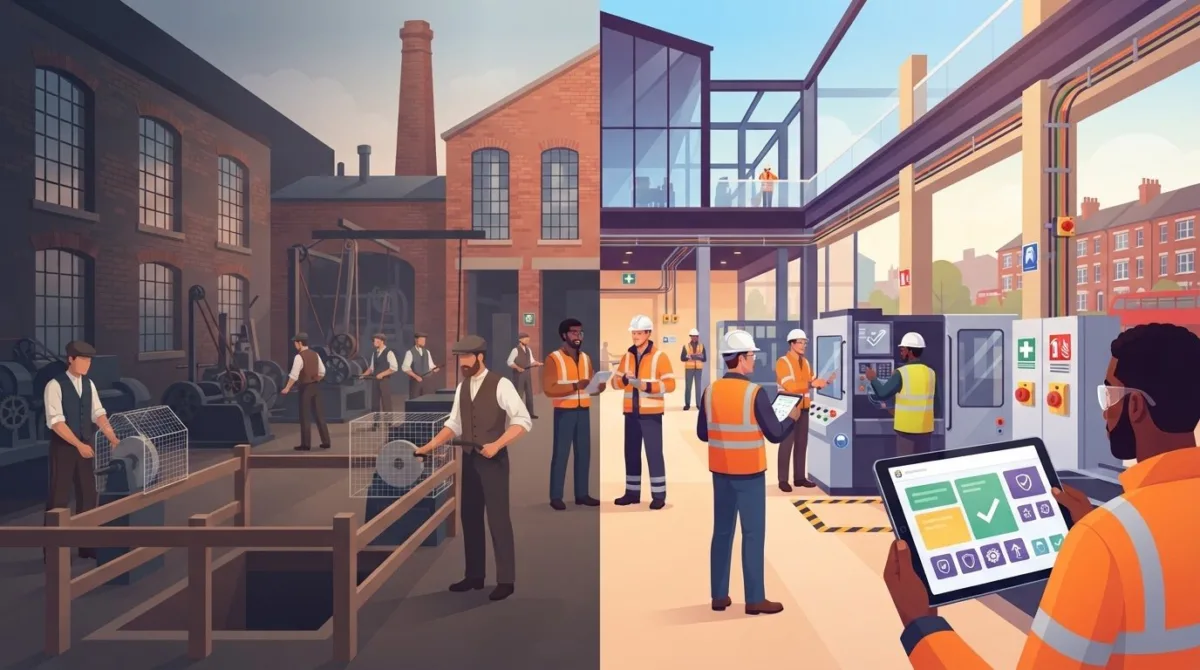
What changed workplace safety from a patchwork of factory protections into a system built around managing risk? The safety standards history in the UK shows how workplace protection expanded over time. The Health and Safety at Work etc. Act 1974 established a central framework that still shapes safety management today.
It can be hard to follow the milestones through dense legal material, especially when legislation, standards and guidance are discussed as if they mean the same thing. They serve different purposes: legislation sets legal duties, formal standards provide agreed benchmarks, and guidance helps explain how to approach particular risks.
This article traces key stages in UK workplace safety, from early protections to the 1974 Act and the Management of Health and Safety at Work Regulations 1999. It explains how standards and guidance fit alongside the law, and why that history matters now. Understanding the shift towards risk-led management can help organisations check their arrangements, keep safety information clear and make it relevant to everyday work.
Key Takeaways
- The safety standards history traces a shift from specific workplace protections towards a broader, risk-led approach.
- Key UK milestones show how changing workplaces and hazards influenced protection over time.
- Legal duties, formal standards, regulator guidance and an organisation’s own procedures have different roles.
- Use historical lessons to review how your organisation identifies hazards, assigns responsibility and responds to change.
- Clear, accessible safety records support day-to-day management. Digital tools can help organise information, but don’t replace legal duties or human judgement.
Safety standards history: what changed as UK workplaces developed?
Safety standards history is the development of workplace protections, rules and accepted practices over time. It is more than a timeline of laws. It shows how changes in work, public concern and approaches to managing hazards shaped expectations for safer workplaces.
This section focuses on UK workplace health and safety, not the history of product specifications or equipment standards. It begins with industrialisation and early protections, then follows changes in legislation and safety oversight before considering the later role of formal standards. That distinction makes a long history easier to follow and clarifies why a historical overview is not a list of every requirement an organisation must meet today.
Why did workplace safety become a public concern?
As industrial work expanded, people faced hazards in settings where protections were limited and working conditions varied. Child workers were among those affected. Parliament’s Health and Morals of Apprentices Act 1802 addressed conditions for apprentices in certain factories. It was part of the sequence of early Factory Acts aimed at regulating industrial employment. These measures reflected a growing recognition that workplace conditions were not only a private matter between an employer and worker. They had become a subject of public and political attention.
Early laws addressed particular problems and groups. Workplace protection later developed through further legislation and changes in how safety was overseen. This is not a simple progression from unsafe to safe. It is a record of responses to workplace risks and changing expectations as industries and working practices evolved.
What does “safety standards history” include?
The phrase covers several kinds of protection. They should not be treated as interchangeable:
- Legislation is law. It sets legal requirements, and organisations need to check which provisions apply to their work.
- Formal standards set out agreed specifications or management approaches. A standard isn’t automatically legislation or a legal requirement, though its relevance may depend on the context in which it’s used.
- Official guidance explains risks or ways to approach safety. It can help interpret expectations, but guidance and law are not the same thing.
- Workplace practices are the organisation’s procedures for putting safety arrangements into operation. They should reflect applicable legal duties and the risks involved.
The historical story connects these categories, but doesn’t make them equivalent. A law, standard or piece of guidance may change, and its scope can depend on the work and circumstances. When making a current decision, check relevant UK sources and the document’s scope rather than relying on a historical summary alone.
From early Factory Acts to 1974: milestones in UK safety standards history
The story is not a straight line from weak protections to a finished system. Early measures focused on particular industries, working conditions and groups of workers. Later reforms widened the focus, building towards a framework that placed greater emphasis on preventing harm across different types of work.
How did early factory protections and inspection develop?
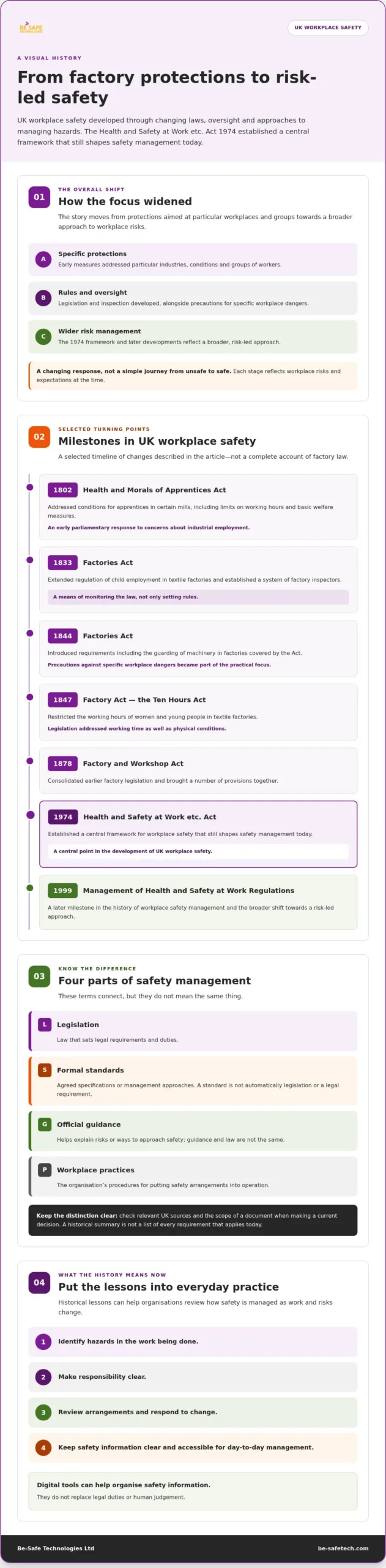
These milestones show how the response widened over time. They’re selected turning points, not a complete account of factory law:
- 1802, Health and Morals of Apprentices Act: addressed conditions for apprentices in certain mills, including limits on working hours and requirements for basic welfare measures. It marked an early parliamentary response to concerns about industrial employment.
- 1833, Factories Act: extended regulation of child employment in textile factories and established a system of factory inspectors. Inspection gave the law a means of being monitored, rather than relying only on rules written into legislation.
- 1844, Factories Act: introduced requirements including the guarding of machinery in factories covered by the Act. The practical emphasis was beginning to include precautions against specific workplace dangers.
- 1847, Factory Act: the Ten Hours Act restricted the working hours of women and young people in textile factories. It showed how legislation could address working time as well as physical conditions.
- 1878, Factory and Workshop Act: consolidated earlier factory legislation and brought a number of provisions together, helping make a complex body of rules more organised.
Each measure had a defined scope. Their value in this history is not that they created today’s system by themselves. They show regulation responding to identified problems and developing alongside methods of oversight.
Why is the Health and Safety at Work etc. Act 1974 a turning point?
By the twentieth century, workplace risks extended well beyond the factory settings addressed by earlier laws. The Robens Committee’s 1972 report examined how health and safety could be organised more effectively. The Health and Safety at Work etc. Act 1974 then established a wider framework, setting general duties and creating the basis for a more coordinated approach to workplace protection.
The Act marked a major transition in scope, not an overnight cancellation of every earlier law. Specific regulations and legal provisions continued to develop, so the history should not be used as a shortcut for identifying current requirements. Organisations need to check the legislation and guidance that apply to their activities. When workplace incidents occur and safety standards are breached, specialist practices such as Scotland Claims Injury Lawyers help affected workers understand their rights under the law. This overview provides historical context, not legal advice.
A wider approach makes clear, organised safety processes increasingly useful in day-to-day management. Digital health and safety software can help organisations keep information accessible, while legal responsibilities and professional judgement remain essential.
Legislation, guidance and formal standards: what is the difference?
In the safety standards history, the terms law, standard and guidance are connected, but they don’t mean the same thing. Before deciding what a document means for your organisation, first identify what type of document it is and what work it covers.
| Category | Purpose | Status |
|---|---|---|
| Legislation | Sets legal requirements and duties. | Law. Check the relevant provisions and how they apply to the work. |
| Formal standards | Set agreed specifications or approaches to a topic. | Not automatically law. Their relevance depends on the specific standard and context. |
| Regulator guidance | Explains risks and offers information on meeting or understanding safety expectations. | Helps inform practice, but isn’t interchangeable with legislation. |
| Organisational procedures | Set out how an organisation manages safety in its own activities. | Workplace arrangements, which should reflect applicable law and relevant risks. |
Are safety standards the same as health and safety law?
No. They’re related, but differ in purpose and status. Act 1974 is legislation. A formal standard, by contrast, sets out an agreed approach or specification. It doesn’t become law simply because it’s called a standard. Its relevance can depend on factors such as the instrument itself and the context in which it’s used. Check its status and applicability rather than assuming it’s either mandatory or irrelevant.
Regulator guidance has another role. The Health and Safety Executive (HSE) provides guidance to help people understand health and safety matters. It can inform decisions, but guidance and legislation remain distinct categories. Organisational procedures translate relevant expectations into arrangements for particular work. People within the organisation are responsible for applying them.
How did standardisation become part of workplace safety?
As workplace protection developed, shared specifications and management approaches offered a way to organise expectations consistently across different organisations. The British Standards Institution (BSI) is the UK’s national standards body and publishes British Standards. A standard can provide a common reference point, but it doesn’t replace legislation, regulator guidance or sound workplace procedures.
Check the title, scope and current status of the specific standard you’re considering. Also distinguish occupational health and safety standards from other kinds of certification. Be-Safe Technologies states that it holds ISO 9001 and ISO 27001 certifications. These are not occupational health and safety standards. Clear distinctions help organisations understand what each document is for and avoid treating every benchmark as a legal duty.
What can the history of safety standards teach organisations today?
The safety standards history is useful not because past rules can be copied into today’s procedures, but because it highlights a recurring challenge: work changes, hazards change, and protective measures need to keep pace. The move from targeted factory rules to wider workplace oversight also raises practical questions about prevention, accountability and how an organisation knows its controls are working.
Which historical lessons remain useful in modern workplaces?
Three broad lessons still apply. First, identify hazards before harm occurs, rather than relying only on responses after an incident. Second, use incidents and near misses to review how work is organised and whether safeguards are effective. Third, revisit controls when tasks, equipment, materials or working arrangements change. These are practical principles, not a substitute for checking the requirements that apply to your organisation now.
Past reforms also underline the value of clear responsibility. Teams should understand who monitors risks, who acts when something changes and how concerns are raised. Developing competent teams through professional industry instruction, such as the accredited programmes provided by insightsecurity.ie, helps ensure personnel can meet modern safety and security standards in practice. For example, when a task or piece of equipment changes, review whether the existing assessment and controls still fit the work, then make sure relevant staff can find the updated procedure. The right arrangements depend on the work, so historical examples should inform questions, not dictate answers.
How should organisations use historical context responsibly?
Use history to understand why prevention and oversight developed, then assess your present workplace on its own terms. Before changing a procedure, check current legislation and relevant Health and Safety Executive guidance. A historical summary cannot confirm whether a particular rule remains in force or applies to your activities. Nor can it replace a current, suitable risk assessment or informed professional judgement.
For a practical review, ask:
- Have the work, people, equipment or materials changed since risks were last reviewed?
- Are responsibilities for maintaining controls clear to those involved?
- Can staff find the current procedure and understand what action it requires?
- Are incidents, actions and review decisions recorded clearly enough to support follow-up?
Good records help make decisions and actions visible, but a record alone doesn’t show that a control is effective. Digital systems can help organise risk assessments, actions and audit information. They should support suitable procedures and human oversight, not stand in for them. For related reading, see Mastering Health and Safety Risk Assessment Software: A 2026 Buyer’s Guide and How to Implement Digital Audit Checklist Software for UK Compliance in 2026.
To organise health and safety processes and risk assessment information, explore health and safety software from Be-Safe Technologies.
From historical records to today: keeping safety management clear
As workplace oversight developed, records helped make inspections, hazards and follow-up actions visible. Today, organisations can use paper or digital methods to organise safety information. The format has changed, but the purpose remains practical: keep a reliable account of what was identified, what action followed and whether arrangements need review.
How has safety record-keeping changed over time?
Historical inspection records and modern digital systems belong to different working contexts, so they shouldn’t be treated as equivalent. Earlier oversight depended on the inspection and documentation methods available at the time. Current organisations may manage risk assessments, procedures, audit findings and actions across paper files or digital records.
Whichever method is used, records are useful only if they’re accurate, accessible to the people who need them and kept up to date. A record should help staff understand what action is required and give those responsible a clear way to follow up. Storing information is not the same as carrying out the work or checking that controls remain suitable.
Where can digital safety software fit?
Digital systems are one option for organising safety information. Compliance Genie is a cloud platform for managing health and safety processes and risk assessments. It can support the organisation of records, but it doesn’t guarantee compliance or replace suitable procedures, legal review, competent people or site-specific judgement. Organisations remain responsible for making sure their arrangements reflect their work and current requirements.
Before adopting a system, consider what information needs to be maintained, who needs to access it and how updates or actions will be reviewed. If contractor oversight is part of your process, consider how contractor details and site visits are managed alongside other safety information. Contractor Genie is a specialised SaaS package for managing a company’s contractors and their site visits in one central location. The aim is not to digitise every record for its own sake, but to make relevant information easier to find and use. For a wider introduction to this topic, see The Ultimate Guide to Health and Safety Compliance Software in 2026.
The history of safety standards shows how oversight has grown more organised. Clear records help organisations put that learning into practice without confusing documentation with effective safety management. To explore a digital option for organising health and safety processes and risk assessments, visit Be-Safe Technologies.
Put the lessons of workplace safety into practice
The safety standards history shows how workplace protection grew in response to changing risks, from focused factory laws to a wider framework for managing safety. It also makes one distinction clear: legislation sets legal requirements, while formal standards, regulator guidance and workplace procedures serve different purposes.
For organisations today, the lasting lesson is to keep identifying hazards, reviewing controls and maintaining clear records as work changes. Historical milestones offer useful context, but current requirements and the needs of each workplace must guide decisions.
Digital tools can help organise safety processes and risk assessment information without replacing legal duties, competent people or professional judgement. Compliance Genie supports digital management of health and safety processes and risk assessments. Be-Safe Technologies Ltd states that it holds ISO 9001 and ISO 27001 certifications; these are not occupational safety standards.
To explore Be-Safe Technologies Ltd’s software, visit Explore Be-Safe Technologies Ltd. Clear information and thoughtful oversight help organisations build on the lessons of the past and manage safety with confidence.
Frequently Asked Questions
When did workplace safety standards begin in the UK?
Early statutory workplace protections appeared in 1802 with the Health and Morals of Apprentices Act. It addressed conditions for apprentices in certain mills, making it an early parliamentary response to concerns about industrial employment. It wasn’t a modern, general workplace safety system: its scope was limited, and later Factory Acts addressed further issues. The UK Parliament’s historical material and the legislation itself provide context for this early milestone.
What was the first UK health and safety law?
The answer depends on what you mean by “health and safety law”. If you mean an early Act directed at factory working conditions, the Health and Morals of Apprentices Act 1802 is commonly identified as a starting point. It applied to apprentices in certain mills, not all workers or workplaces. UK Parliament historical material can help explain its context, while legislation.gov.uk provides the Act’s legal text.
Why was the Health and Safety at Work etc. Act 1974 introduced?
Act 1974 followed concern that workplace protection was spread across numerous laws and approaches. The Robens Committee’s 1972 report recommended a broader framework, with greater responsibility for organisations to manage health and safety. The Act established general duties and a basis for a more coordinated system. It didn’t instantly replace every earlier law or remove the need for later regulations.
Are health and safety standards legally binding in the UK?
Not necessarily. Legislation sets legal requirements, whereas a formal standard usually sets out an agreed specification or approach and isn’t automatically law. Its status and relevance must be checked individually, including whether legislation refers to it or it forms part of another requirement. The Health and Safety Executive’s guidance can help explain workplace safety matters, but guidance, standards and legislation have different purposes.
How have workplace safety standards changed over time?
Workplace protections developed from targeted measures for particular industries and groups, including early factory legislation, towards broader workplace safety management. Act 1974 was a key transition, establishing a wider framework. Later laws and guidance continued to address changing risks. This safety standards history is best understood as an evolving system, not a single set of rules that replaced every earlier measure at once.
What is the difference between a safety standard and a regulation?
A safety standard sets out an agreed specification or approach; a regulation is a legal requirement made under the relevant legislative framework. A standard isn’t automatically legally binding, and a regulation’s scope depends on its wording and application. The terms shouldn’t be used interchangeably. This is general information, not legal advice, so organisations should check the status and current wording of any document relevant to their work.
Who sets workplace health and safety standards in the UK?
Different bodies have different roles. Parliament and government make legislation, while the Health and Safety Executive regulates workplace health and safety in Great Britain and publishes guidance. In Northern Ireland, the Health and Safety Executive for Northern Ireland has the regulatory role. The British Standards Institution develops British Standards. A standard, regulator publication and law are distinct, so check each document’s status and scope before relying on it.