


ISO Certification for EHS Software: 2026 UK Guide

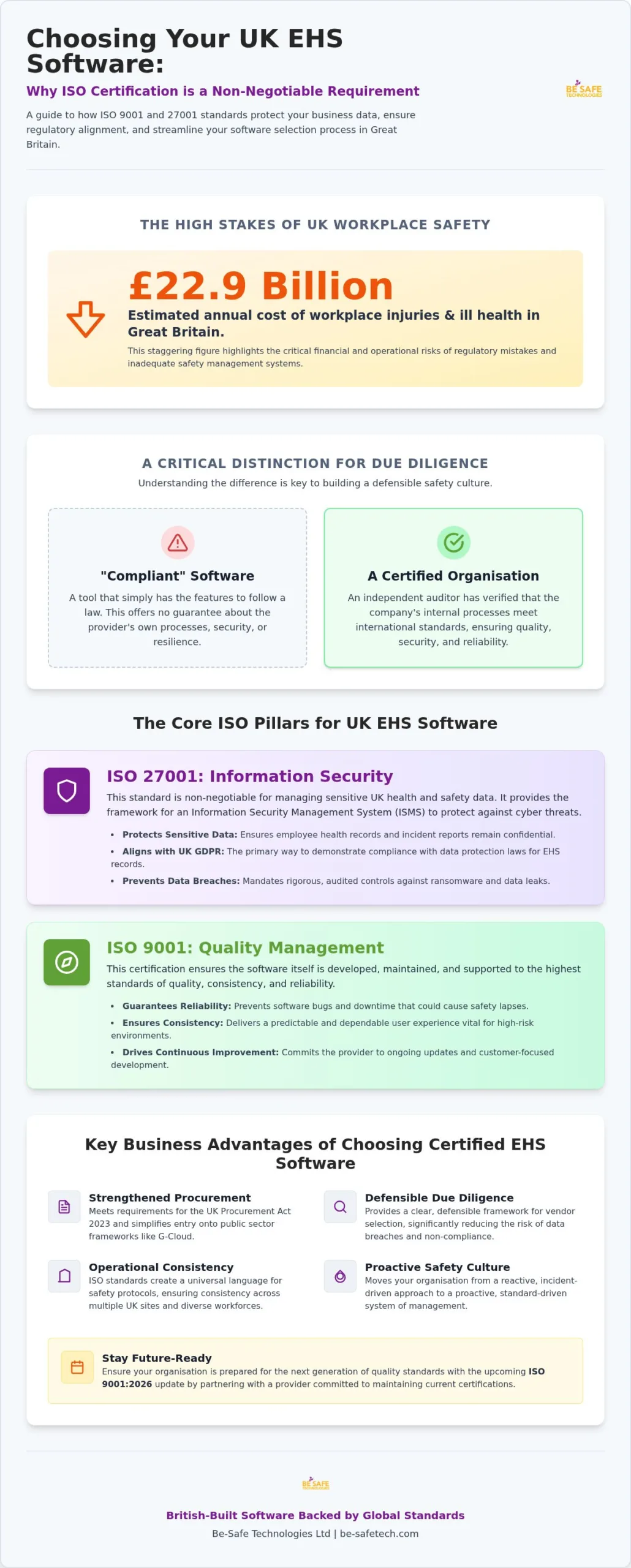
With the annual cost of workplace injuries and ill health in Great Britain reaching an estimated £22.9 billion, can your business afford to rely on unverified digital tools? This staggering figure highlights the critical importance of ISO certification for EHS software in an environment where regulatory mistakes are increasingly costly. You likely find that maintaining UK GDPR compliance whilst preparing for rigorous HSE audits feels like a heavy bureaucratic burden. It’s natural to worry about the security of sensitive employee health records or the resilience of your internal systems when the legal stakes are this high.
This guide explains how ISO 9001 and 27001 certifications protect your business data, ensure regulatory alignment, and simplify your software selection process. You’ll discover a defensible framework for choosing a platform that streamlines compliance with UK health and safety laws. We also look ahead to the upcoming ISO 9001:2026 update, ensuring your organisation stays prepared for the next generation of quality standards. By the end, you’ll have the clarity needed to transform safety management from a source of stress into a pillar of operational excellence.
Key Takeaways
- Learn why ISO 27001 is essential for protecting sensitive health records and ensuring your organisation remains fully aligned with UK GDPR requirements.
- Understand how ISO 9001 certification guarantees software reliability and consistent quality, which is vital for maintaining safety in high-risk UK workplaces.
- Discover the importance of ISO certification for EHS software when navigating the UK Procurement Act 2023 and securing positions on public sector frameworks like G-Cloud.
- Gain a defensible framework for vendor due diligence that simplifies the software selection process and reduces the risk of data breaches.
- Explore the benefits of partnering with a UK-based, double-certified provider to ensure your digital tools are built for local regulatory demands.
Understanding the Role of ISO Standards in Modern EHS Management
ISO, or the International Organisation for Standardisation, acts as a global benchmark for quality and safety. Within the British corporate environment, these standards represent more than just a badge on a website. They provide a structured framework that ensures a business operates with consistency and reliability. As UK firms move away from paper-based filing towards digital platforms, the importance of ISO certification for EHS software becomes clear. Digital systems manage vast amounts of sensitive data, and without a standardised benchmark, there’s no objective way to verify the software’s integrity.
The Health and Safety Executive (HSE) expects organisations to maintain “suitable and sufficient” records. Whilst the HSE doesn’t officially endorse specific software, they do require evidence of robust management. Using a platform from a certified organisation provides this evidence. There’s a vital distinction between software that is “compliant” and an organisation that is “certified”. Compliance often means the tool has the features to follow a law. Certification, however, means an independent auditor has verified that the company’s internal processes actually meet international requirements. This ensures the software provider has the resilience to support your business during a crisis.
The Core ISO Pillars for UK Safety Software
Two specific standards form the foundation of any reliable safety platform. ISO 9001 focuses on quality management, ensuring that the software is developed, maintained, and supported with a focus on customer satisfaction and continuous improvement. It prevents the bugs and downtime that could lead to safety lapses in high-risk environments. Equally critical is the ISO/IEC 27001 standard, which governs information security. For UK businesses, this standard is the primary way to prove that sensitive employee health data and incident reports are protected against modern cyber threats. Together, these certifications represent the minimum viable requirement for any serious EHS software provider in 2026.
Beyond the Badge: Why Certification Matters in 2026
Certification helps businesses move from a reactive safety culture to a proactive, standard-driven approach. In 2026, UK companies often manage multiple sites with diverse workforces. ISO standards provide a universal language that ensures safety protocols remain consistent across every location. This consistency reduces operational risk by removing the guesswork from safety management. When you choose a certified provider, you’re investing in a partnership built on transparency. You gain the peace of mind that your digital infrastructure is as resilient as the physical safety measures you have on-site. It’s about building a defensible safety culture that stands up to internal and external scrutiny.
Why ISO 27001 is Non-Negotiable for UK Health and Safety Data
Safety data isn’t just a list of incident dates. It contains sensitive employee health records, medical histories, and detailed accident reports that fall under the most stringent categories of the UK GDPR. For an EHS Manager, a data breach isn’t merely an IT headache; it’s a significant legal and personal liability risk. This reality underscores the importance of ISO certification for EHS software. ISO 27001 provides the necessary framework for an Information Security Management System (ISMS) that ensures your safety audits and compliance records remain confidential and untampered with at all times.
Cloud-based platforms offer remarkable efficiency for remote UK sites, but they also represent a concentrated target for cyber threats. Without the rigorous, audited controls of ISO 27001, your business remains vulnerable to ransomware or data leaks that could cripple your operations. Whilst ISO 27001 focuses specifically on data, many organisations also seek a provider that follows the international standard for Quality Management to ensure that the provider’s broader operational processes are equally reliable. Combining these standards creates a foundation of trust between you and your software partner.
Managing Data Integrity and Confidentiality
Risk assessments are the backbone of your legal defence. If an unauthorised party can alter these digital records, your entire safety culture is compromised. ISO 27001 mandates strict access controls and encrypted storage, which are essential in today’s mobile-first working environments where employees access data from various locations across the UK. ISO 27001 prevents data loss in EHS software by establishing a systematic approach to managing sensitive information through a rigorous cycle of risk identification and mitigation. This ensures that when you need to produce a record for a safety inspector, that record is exactly as it was when first signed off. For organisations looking to extend this level of security to their entire network, partnering with a specialist like CyberOne provides the robust protection required for modern digital operations.
What happens if your safety system goes offline during a major site incident? ISO 27001 requires robust business continuity plans that ensure your critical systems stay online or recover quickly. This involves regular penetration testing and vulnerability assessments to identify technical weaknesses before they can be exploited. Modern UK insurers now frequently view “secure health and safety data storage” as a prerequisite for professional indemnity and liability coverage. They require proof that your digital records are defensible and accessible even during a wider cyber event. Choosing a provider like Be-Safe Technologies ensures your data resides in a double-certified environment designed specifically to meet these high-stakes UK regulatory demands.
Ensuring Operational Excellence with ISO 9001 Quality Management
ISO 9001 is frequently viewed through the lens of traditional manufacturing, yet its application in the digital sector is transformative. For safety professionals, the importance of ISO certification for EHS software lies in the predictable excellence it demands from the developer. By embedding the “Plan-Do-Check-Act” cycle into their operations, software providers ensure that their platforms evolve alongside shifting UK regulations. This systematic approach reduces the friction often associated with digital transformation, leading to higher user adoption rates and a significant drop in reporting errors. When a provider commits to these standards, they’re not just building a tool; they’re refining a service that supports your organisation’s long-term resilience. For businesses looking to extend this level of operational excellence to their entire IT network, even on a global scale, you can discover ITS Canada Inc for managed services that prioritise system reliability and security.
Software Reliability as a Safety Feature
In high-risk environments, a software failure is more than a technical inconvenience. It is a direct safety risk. If a field engineer cannot access a COSHH assessment because an app has crashed, they might proceed with a task without vital protection. ISO 9001 mandates a disciplined Software Development Life Cycle (SDLC) where bug fixes and updates are strictly controlled. This prevents the “break-fix” cycle that plagues uncertified tools. Whilst an organisation benefits from being ISO 27001 certified through enhanced data protection, ISO 9001 ensures the software actually works when it matters most. This synergy is the hallmark of a mature SaaS provider. It means your security measures are built on a foundation of operational stability, ensuring that your safety oversight never blinks.
Standardising Risk Assessments Across the UK
Maintaining a “single version of truth” across a multi-site UK operation, from Aberdeen to Exeter, is a significant challenge. ISO 9001 provides the framework for standardising digital templates, ensuring that a risk assessment completed in Manchester carries the same weight and quality as one in London. This standardisation is a core pillar of mastering health and safety risk assessment software. It eliminates the confusion of version control and prevents sites from using outdated or non-compliant forms. By enforcing these quality benchmarks, the software helps you build a more resilient organisation, proving that the importance of ISO certification for EHS software goes far beyond a simple certificate on a wall. You gain the peace of mind that every safety check is performed to a high standard, backed by a provider that treats your safety data with the same rigour as a precision engineering firm.
How ISO-Certified EHS Software Strengthens Your Procurement and Tendering
Procurement processes in the UK are becoming more complex, especially with the implementation of the Procurement Act 2023. For companies vying for public sector work or Tier 1 private contracts, the importance of ISO certification for EHS software is a significant commercial differentiator. Organisations today don’t just want a safety tool; they want a partner whose digital infrastructure has already passed the most rigorous global tests. By choosing a certified provider, you essentially outsource the heavy lifting of technical due diligence, allowing your procurement team to focus on strategic value rather than chasing security questionnaires.
Winning Public and Private Sector Contracts
Tier 1 contractors and government bodies now mandate high standards of data security and quality management as a baseline. ISO 27001 is often a non-negotiable requirement for frameworks like G-Cloud. When you use Compliance Genie, you’re leveraging a platform that already meets these stringent benchmarks. This simplifies the Pre-Qualification Questionnaire (PQQ) process, as you can provide verified evidence of your provider’s certifications. This “peace of mind” is a powerful selling point for your own clients, demonstrating that you take supply chain safety and data integrity seriously. It transforms safety from a cost centre into a clear competitive advantage during the tendering phase.
Reducing Insurance Premiums through Verified Compliance
UK insurers are increasingly factoring digital maturity into their risk assessments. They view ISO-certified EHS tools as a proactive risk-reduction measure because they ensure data is accurate, time-stamped, and tamper-proof. This level of verified compliance is invaluable if you ever need to defend against HSE enforcement actions or civil claims. Having a “single version of truth” backed by ISO 9001 quality standards provides the defensible evidence insurers need to offer more competitive premiums. The ROI of ISO-certified software in UK insurance negotiations is often realised through lower annual costs and broader coverage terms for businesses that can prove their safety data is managed within a certified framework. If you’re ready to strengthen your commercial position, explore our certified safety solutions today.
Compliance Genie: British-Built Software Backed by Global Standards
Be-Safe Technologies prioritised ISO 9001 and ISO 27001 from the very beginning because we believe safety management should be built on a foundation of trust. We recognise that for our clients, the importance of ISO certification for EHS software isn’t just about ticking a box for a tender. It’s about knowing that the platform used to manage life-critical information is resilient, secure, and maintained to the highest international standards. Because our development and support teams are based entirely in the UK, we offer a level of regulatory alignment that global providers often struggle to match. This local expertise ensures that our tools are always tuned to the specific nuances of UK health and safety law.
Our user interface reflects this commitment to order and clarity. We’ve integrated ISO principles directly into the workflow of Compliance Genie, making it easier for your staff to follow best practices without needing to be experts in the standards themselves. This design philosophy reduces the cognitive load on site managers and ensures that data is captured accurately the first time. By embedding quality and security into the user experience, we help you maintain a defensible safety culture with minimal friction.
A Reassuring Partnership for UK Businesses
Transitioning to a paperless environment can feel daunting, but we act as a practical ally throughout the process. Our cloud-based architecture ensures total data sovereignty within the UK, giving you peace of mind that your sensitive information remains within our borders. For those managing external workforces, Contractor Genie extends this certified oversight to your entire supply chain. It allows you to manage permits, inductions, and compliance for third-party workers with the same rigour you apply to your own team. This holistic approach ensures that your safety standards are never diluted, regardless of who is performing the work on your site.
Organise Your Compliance with Confidence
Moving away from fragmented spreadsheets and paper folders into a certified digital ecosystem is a significant step towards organisational resilience. Compliance Genie is built with a mobile-first approach, encouraging a site-wide culture where reporting is immediate and transparent. This shift doesn’t just improve data quality; it empowers your employees to take ownership of their own safety. When safety tools are this accessible and reliable, they become a natural part of the working day rather than a bureaucratic hurdle. You can finally replace guesswork with verified, time-stamped data that stands up to any audit. Experience our ISO-certified safety software today and see how a British-built platform can simplify your compliance journey.
Future-Proofing Your Safety Strategy with Certified Digital Tools
Integrating certified technology into your safety culture does more than simplify audits; it builds a foundation for long-term organisational resilience. You’ve seen how these standards protect sensitive health records whilst streamlining your presence on competitive UK tendering frameworks. By choosing an award-winning, G-Cloud approved provider, you ensure your digital infrastructure meets the highest benchmarks for security and quality. This commitment to excellence makes safety management a manageable part of your business operations rather than a bureaucratic burden.
Recognising the importance of ISO certification for EHS software is the first step toward a more secure, paperless future. It’s about gaining peace of mind that your data is defensible. It also ensures your processes remain consistent across every site. As an ISO 9001 and 27001 certified partner, Be-Safe Technologies is ready to support your transition to a more efficient safety ecosystem. Book a Compliance Genie demo to see our ISO-certified standards in action. We look forward to helping you achieve total control and operational harmony.
Frequently Asked Questions
Is ISO certification a legal requirement for EHS software in the UK?
ISO certification isn’t a strict legal requirement under the Health and Safety at Work etc. Act 1974. However, the HSE expects businesses to maintain “suitable and sufficient” records of their safety activities. ISO certification provides the objective evidence that your digital records are managed within a reliable, high-quality framework. Many UK public sector contracts now mandate these certifications as a baseline for any software supplier to ensure data integrity and operational quality.
What is the difference between ISO 9001 and ISO 27001 for a software provider?
ISO 9001 focuses on quality management and consistent service delivery. It ensures that software is developed and updated through a disciplined, customer-focused process. In contrast, ISO 27001 is the international standard for information security management. It specifically protects the confidentiality and integrity of your data. Both standards are essential for demonstrating the importance of ISO certification for EHS software, as they combine technical reliability with the rigorous protection of sensitive employee safety records.
How does ISO 27001 help with UK GDPR compliance?
ISO 27001 provides the technical and organisational controls necessary to meet the security requirements of the UK GDPR. It establishes a structured Information Security Management System (ISMS) that protects sensitive personal data from unauthorised access or loss. By using a certified provider, you ensure that employee health records and incident reports are handled according to the best practices recognised by the Information Commissioner’s Office (ICO), reducing your risk of a breach.
Can using ISO-certified software help my business achieve its own ISO 45001 accreditation?
Using certified software significantly supports your own ISO 45001 accreditation efforts. ISO 45001 requires evidence of a structured occupational health and safety management system with clear documentation and version control. A certified platform like Compliance Genie ensures your risk assessments and incident logs are time-stamped and tamper-proof. This provides the defensible data that auditors look for, proving that your organisation manages its safety obligations through a reliable and verified digital ecosystem.
Does ISO certification affect the price of EHS software?
ISO certification requires ongoing investment in audits, security infrastructure, and process refinement. Whilst certified providers might have different pricing structures than uncertified ones, they offer a lower risk profile for your business. The true value lies in organisational resilience and the avoidance of costly data breaches or safety failures. You’re investing in a partnership that has already done the heavy lifting of verification, ensuring your safety data remains a reliable business asset.
What should I look for in a software provider’s ISO certificate to ensure it is valid?
You should verify that the certificate is issued by a UKAS-accredited body, which is the gold standard for accreditation in the UK. Carefully check the “scope” of the certification to ensure it actually covers the software development and cloud hosting services you are using. Always confirm the expiry date and use the issuing body’s online portal to verify the certificate number. This ensures the provider’s quality and security claims are genuinely audited and currently valid.
How often do EHS software providers need to be audited for their ISO certifications?
Software providers undergo a comprehensive recertification audit every three years to maintain their ISO status. Between these major assessments, they must pass annual surveillance audits conducted by an independent body. These frequent checks ensure that the provider’s management systems remain effective and continue to improve over time. This cycle of regular oversight is vital for the importance of ISO certification for EHS software, as it guarantees that security measures keep pace with modern threats.
Does ISO 27001 cover the physical security of the data centres where my safety data is stored?
ISO 27001 includes specific controls for physical and environmental security. This requires the provider to ensure that the data centres housing your safety records have restricted access, 24/7 monitoring, and protection against physical hazards like fire or power failure. For UK clients, this usually means data is stored in highly secure, Tier-standard facilities. This ensures your safety data is protected from physical theft or site-wide disasters just as rigorously as it is from cyberattacks.