



How UK Construction Teams Use Digital H&S Software to Cut Incident Rates on Site
One in every forty construction workers in the UK sustained a non-fatal injury over the past three years. Twenty-five lost their lives on site in 2025/26 alone. These are not abstract statistics; they represent a sector carrying a disproportionate safety burden that no responsible contractor can afford to ignore.
The uncomfortable truth is that most preventable incidents share a common thread: a lag between identifying a hazard and acting on it. Paper-based risk assessments, manually circulated toolbox-talk records and informal near-miss logs all introduce friction into that critical window. Construction health and safety software removes much of that friction, but the genuine question for site managers and safety professionals is not whether the technology exists. It is what actually changes on the ground when teams use it consistently.
This analysis works through that question in practical terms. It examines why construction remains statistically the UK’s most hazardous sector, where paper processes quietly create the conditions for incidents, and what the data shows when formalised digital safety management replaces them. It also covers the tightening regulatory environment and sets out a clear path forward for teams ready to make the shift.
Why Health and Safety in Construction UK Remains a Disproportionate Risk
Construction employs roughly 6% of the UK workforce yet accounts for approximately 20% of all workplace fatalities, a disproportion that has persisted for decades. This is not a pattern of isolated bad luck; it signals systemic failure in how hazards are identified, communicated, and corrected across the sector. For further context on fatal injuries and high-risk sectors in Great Britain, the scale of this imbalance becomes even clearer against the broader occupational landscape.
The numbers are stark. The fatal injury rate in construction stands at 1.92 per 100,000 workers, roughly 4.8 times the all-industry average of 0.37 per 100,000. In 2025/26, 25 construction workers were killed, the highest provisional fatality count of any sector.
Non-fatal injury data compounds the picture. Falls from height account for 33% of reportable non-fatal injuries; slips, trips, and falls add a further 30%. Together they represent nearly two-thirds of all non-fatal incidents, concentrated in hazard categories that are well understood and, critically, preventable. The causes are not obscure; the failures are in detection and response.
RIDDOR figures tell only part of the story. Approximately 50,000 construction workers self-reported a non-fatal injury over the three-year period 2022/23 to 2024/25, equivalent to roughly 1 in every 40 workers. Reviewing accident statistics and workplace safety trends across comparable periods illustrates how consistently this hidden burden outpaces formal reporting.
The financial cost is substantial. The HSE estimates that injuries and ill health from current working conditions cost £22.9 billion in 2023/24 across Great Britain. The regulatory environment is also tightening, a development covered in detail later in this piece.
Where Paper-Based Safety Processes Create the Conditions for Incidents
The statistics above describe what is happening on UK construction sites. The more pressing question is why preventable incidents keep occurring despite decades of regulation, and the honest answer points squarely at the processes used to manage safety day to day.
The core failure is lag. A near-miss logged on a clipboard on Thursday morning, reviewed by the site manager on Friday afternoon, and actioned by a corrective memo on Monday leaves a live hazard unaddressed for up to four working days. That window is precisely where preventable incidents occur. The hazard does not wait for the paperwork to catch up.
Paper toolbox talk records compound this. A sign-in sheet completed at Monday’s briefing tells you who attended Monday’s briefing. It cannot confirm that operatives who joined site on Wednesday received the relevant safety information, understood it, or acknowledged it before starting work. There is no reliable mechanism to close that gap within a paper-based system.
Risk assessments present a different but equally serious problem. Documents stored in site folders or circulated as PDF attachments create version-control failures that are difficult to detect. When scope changes mid-project, an updated assessment may reach the H&S manager’s inbox without ever replacing the printed copy on the site cabin wall. Teams continue working from superseded documents without knowing it. The hidden cost of manual risk assessments in these situations extends well beyond administrative inconvenience.
Sub-contractor compliance is where paper systems fail most completely. According to Build UK’s 2024/25 Accident Survey Report, 62% of operatives across Tier One contractor sites, some 106,855 of 173,189 workers, are sub-contractors. Paper systems offer no reliable mechanism to verify inductions, track certification expiry, or confirm that each sub-contractor has received and acknowledged site-specific risk information. The scale of this blind spot is explored further in the context of paper-based health and safety management costs.
Finally, paper records are analytically inert. Incident and near-miss data filed in folders cannot be queried for patterns. A cluster of near-misses around a specific task, location, or shift remains invisible until it produces a reportable injury.
What Actually Changes on Site When Teams Adopt Construction Health and Safety Software
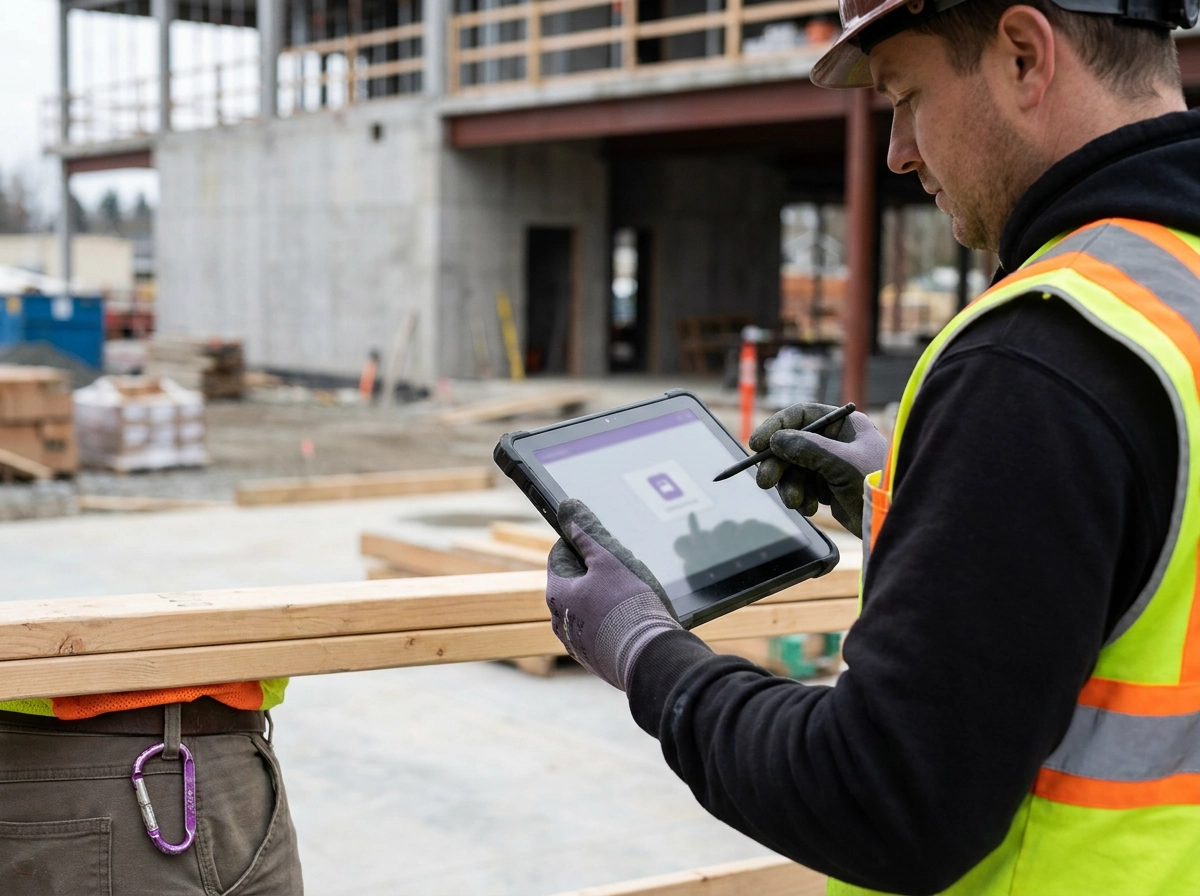
Each of those paper-process failures has a direct digital equivalent.
Near-miss capture in real time. When a worker logs a near-miss on a mobile device, the site manager and H&S lead see it immediately. A timestamped corrective action workflow opens automatically. The hazard does not wait until Friday’s site visit; it is visible, assigned, and tracked within minutes of being identified.
Risk assessments that stay current. Digital risk assessments are version-controlled and accessible on any device. When site conditions change, the document is updated centrally and every operative is working from the same current version. Completion records are generated automatically, removing the manual filing step entirely.
Toolbox talk records that prove who was briefed. Digital toolbox talk records capture attendance with timestamps and individual acknowledgements. If an operative joins site on Wednesday, their briefing record is logged the same day. There is no gap, and no uncertainty when an inspector asks for evidence.
Contractor compliance that can actually be verified. This is where a platform like Contractor Genie genuinely changes the sub-contractor compliance picture. H&S and operations teams can verify inductions, check certification expiry dates, and confirm that each sub-contractor has received and acknowledged site-specific safety documentation before they step on site. For sites where the majority of operatives are sub-contractors, that capability is not a convenience; it is a fundamental compliance requirement that paper cannot reliably satisfy.
Data that reveals patterns before they become incidents. Near-miss and incident records captured digitally become a searchable, analysable dataset. Site managers can identify whether a particular task type, location, or time of day is generating a disproportionate share of near-misses, and intervene before the pattern produces a RIDDOR-reportable injury.
One platform, not a system overhaul. The be-safetech Health and Safety App and Contractor Genie are designed to bring these workflows together in a single place. Risk assessments, toolbox talks, near-miss logs, and contractor compliance records are held centrally, accessible on site, and auditable on demand. The shift from paper to digital does not require a large implementation project; it requires choosing a platform built specifically for construction workflows and using it consistently.

The Numbers Behind Formalised Workplace Safety Management in Construction
The clearest evidence for what formalised safety management actually delivers comes from Build UK’s 2024/25 Accident Survey Report. Across 21 Tier One member contractors covering 173,189 operatives, the group recorded zero fatalities and a combined injury rate well below the industry average. The difference persists at every severity level: Tier One specified injury rates stood at 62.36 per 100,000 versus an industry average of 101 per 100,000; over-7-day injury rates were 79.68 per 100,000 against 124 per 100,000. These are not marginal variations; they represent a structural performance difference, and the broader context of non-fatal workplace injuries across UK industries makes the scale of that gap still more striking.
It would be inaccurate to attribute these outcomes solely to digital tools. Leadership culture, investment in training, and workforce competency all contribute. But what Tier One contractors share, regardless of individual approach, is systematised safety management: consistent documentation, auditable records, and centralised oversight. That combination is precisely what digital health and safety platforms make achievable for teams who currently rely on paper.
For SME contractors and smaller subcontracting firms, the data sets a tangible target. The gap between the industry average combined injury rate and Tier One performance represents real-world potential. Closing even a third of that gap means fewer RIDDOR reports, reduced liability exposure, and, most importantly, fewer people hurt.
That reframes the investment question. Digital adoption is not a compliance overhead bolted onto existing costs. For construction businesses operating in a sector where the injury rate remains structurally elevated, formalised safety systems have a demonstrable return, measured in reduced incident frequency, lower severity outcomes, and a workforce that goes home.
Health and Safety Compliance Software and the Tightening Regulatory Picture
The benchmark data matters only if you can prove compliance when it counts. The regulatory environment is tightening in ways that make that proof increasingly non-negotiable.
The HSE’s active consultation on RIDDOR reform, the first in over a decade, signals a regulatory direction of travel that raises the documentation bar for every business operating on site.
RIDDOR already requires accurate, timely reporting of specified injuries, over-7-day injuries, and dangerous occurrences. The HSE’s ongoing consultation proposes expanding reportable occupational diseases from 6 conditions to 19, broadening that obligation further. Digital H&S systems make RIDDOR compliance a by-product of daily workflows rather than a reactive scramble after an incident; every logged near-miss, completed risk assessment, and toolbox talk acknowledgement builds the continuous audit trail that reporting obligations require. The key takeaways from digital safety reporting in construction consistently reinforce this point: the administrative burden shrinks when records are created in real time rather than reconstructed after the fact.
When an HSE inspection or enforcement notice arrives, the question is not whether safety procedures exist but whether they were followed consistently. Paper records are routinely misdated, incomplete, or simply missing by the time they are needed. Digital records are timestamped at the point of creation, tamper-evident, and retrievable on demand, removing the ambiguity that enforcement teams probe.
For businesses managing sub-contractors, the compliance exposure is wider still. Demonstrating that every contractor on site was inducted, certified, and briefed on relevant risks is a legal obligation. Paper systems routinely fail to satisfy it at scale, particularly when site rosters change daily.
Health and safety compliance software that integrates risk assessments, toolbox talks, near-miss logs, and contractor records in a single platform closes the gap between what a business believes it is doing and what it can actually demonstrate to a regulator.
Making the Shift: What Construction Teams Should Do Next
What remains is a practical question: where do you start?
Measure your hazard-to-correction lag first. Pick a recent near-miss and trace it: when was it identified, when did a manager see it, and when was a corrective action confirmed? That elapsed time is your baseline and your clearest argument for change internally. If you cannot answer the question with confidence, that itself is the answer.
Then test your sub-contractor compliance. Ask whether you can prove, right now, that every sub-contractor currently on site has received and acknowledged the relevant site-specific risk information. If the answer involves checking folders, chasing emails, or relying on memory, the gap is real and the liability exposure is active.
Prioritise the highest-frequency workflows. Falls from height, the leading cause of non-fatal injuries, and manual handling-related musculoskeletal disorders drive 52% of MSD cases in the sector. Digitising risk assessments and toolbox talk records for these two areas alone delivers faster risk reduction than attempting a full-system overhaul from the start. Understanding what safety care in the workplace genuinely requires helps teams sequence those priorities intelligently rather than spreading effort too thinly.
The tools exist and the implementation does not have to be complex. The be-safetech Health and Safety App and Contractor Genie are built to digitise exactly these workflows: near-miss capture, digital risk assessments, toolbox talk acknowledgements, and centralised contractor compliance tracking. Neither requires a large implementation project to get running. If you want to see how they map to your current processes, the team is happy to walk you through it.
Conclusion
Construction remains one of the UK’s most hazardous industries, but the evidence is clear: digital health and safety software meaningfully reduces incident rates when implemented with purpose. The accountability gaps this creates are documented, and closeable. Formalised safety management protects workers, strengthens regulatory compliance, and builds a defensible audit trail that paper simply cannot provide.
Implementation is straightforward when you sequence by highest-frequency risk.
If your current processes cannot answer basic compliance questions with confidence, the gap is already costing you. The tools to fix it exist today. Take the first step: audit where your records live, identify the weakest workflow, and book a walkthrough with the be-safetech team to see the solution in action.