


Digitalising Safety: A 2026 Guide for UK Businesses

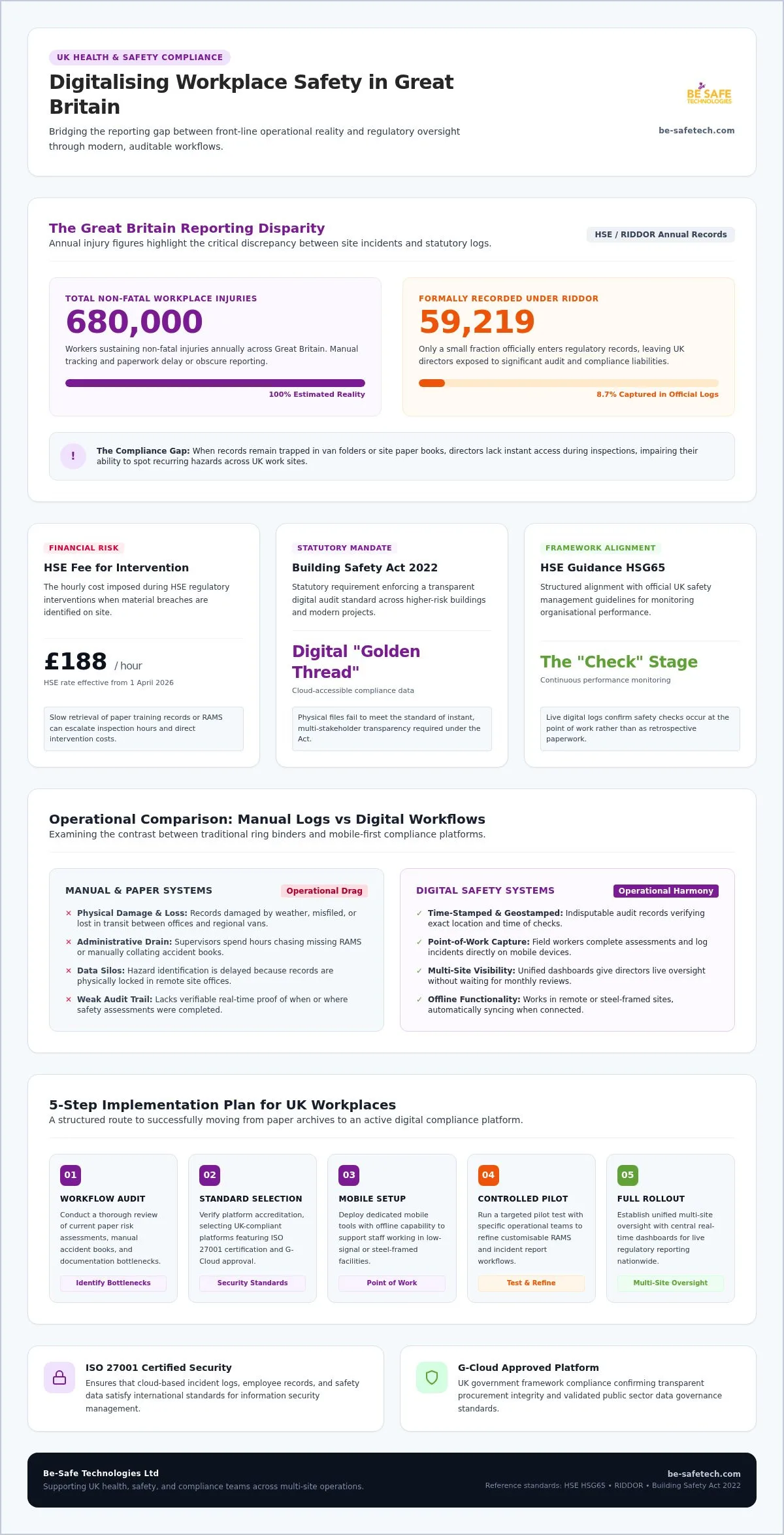
With 680,000 workers sustaining non-fatal injuries annually in Great Britain but only 59,219 recorded under RIDDOR, the gap between site reality and official records remains a significant concern for UK directors. You likely understand the daily pressure of managing this disparity whilst drowning in stacks of paper risk assessments and manual logs. It’s easy to feel overwhelmed by the fear of non-compliance during an unannounced inspection, especially with the HSE Fee for Intervention rate now standing at £188 per hour. This guide demonstrates how to digitalize safety processes to move from a heavy administrative burden to a streamlined digital system that improves oversight and protects your workforce. We will explore how to transition to a paperless office, gain instant access to compliance data across multiple sites, and build a stronger safety culture amongst your team. By modernising your approach, you can replace bureaucratic stress with the quiet confidence of total operational clarity and reliable data management.
Key Takeaways
- Identify the hidden risks of paper-based systems, such as delayed reporting and lost records, to justify the shift towards modern efficiency.
- Discover how to digitalize safety processes using mobile-first technology that allows your team to complete assessments and log incidents directly from the point of work.
- Recognise the importance of ISO 27001 certification and G-Cloud approval when selecting a platform to ensure your data remains secure and compliant with UK standards.
- Follow a structured five-step implementation plan, starting with a thorough audit of current workflows and a controlled pilot test to ensure long-term success.
- Gain total oversight across multi-site operations by adopting a unified system that bridges the gap between site activity and office-based compliance management.
Moving Beyond Paper: Why UK Businesses Must Digitalise Safety Processes
To digitalize safety processes in the modern UK workplace is to move beyond the static nature of filing cabinets and ring binders. It represents a fundamental shift towards capturing live data at the point of work; ensuring that every risk assessment, inspection, and incident report is instantly visible to those who need it. When you digitalize safety processes, you replace the slow crawl of manual paperwork with a system that updates in real time. This transition allows businesses to move away from reactive firefighting and towards a proactive model of protection.
The Health and Safety Executive (HSE) has clearly signalled a preference for better auditability. With the Building Safety Act 2022 now enforcing a digital “golden thread” of information for higher-risk buildings, the expectation for transparent, cloud-accessible data is becoming a standard across all sectors. Relying on paper doesn’t just create a mess; it creates a liability. If an inspector arrives and you can’t produce a specific training record or site induction within minutes, the investigation costs can mount quickly. Since 1 April 2026, the HSE Fee for Intervention (FFI) has stood at £188 per hour, making slow, paper-based retrieval a direct financial risk.
The Environmental and Operational Cost of Paper
Physical paperwork is notoriously difficult to manage across multiple UK sites. Records get damaged by weather, lost in transit, or simply misfiled. Managers often spend hours every week manually checking accident books or chasing site supervisors for missing RAMS. This administrative drain pulls safety professionals away from the field where they are needed most. Adopting digital documentation platforms like GoBuid enables teams to replace paper site diaries and streamline daily reporting directly from the ground. When records are siloed in physical folders, identifying trends becomes nearly impossible. You can’t easily spot a recurring hazard if the data is trapped on a page in a van hundreds of miles away.
Meeting Modern Compliance Expectations
Digital systems transform safety management systems from passive archives into active tools for oversight. Every entry is time-stamped and geostamped, providing an indisputable audit trail that demonstrates exactly when and where a check took place. This level of detail is vital for defending against claims or satisfying regulatory enquiries.
By moving to a digital system, your business ensures a consistent safety standard nationwide. Whether a worker is at a remote facility or a central hub, they follow the same digital workflow, ensuring no steps are skipped. Real-time dashboards allow directors to see compliance levels at a glance, providing peace of mind that the workforce is protected without needing to wait for a monthly report.
Essential Features for an Effective Digital Safety System
Selecting the right tools is the cornerstone of any successful transition. When you choose to digitalize safety processes, the focus must remain on the end-user. A system that is too complex or slow will simply be ignored by the workforce. Therefore, an effective platform prioritises functionality that bridges the gap between the head office and the front line. It should offer a seamless experience that feels like a help rather than a hindrance to daily tasks.
The Importance of Mobile-First Accessibility
A dedicated mobile app is superior to a mobile-responsive website because it offers better stability and speed on-site. Workers in remote locations or steel-framed buildings often face poor connectivity; consequently, offline functionality is vital. It allows staff to complete risk assessments or log incidents without an active internet connection, syncing the data automatically once they return to a signal area. Simple, intuitive interfaces encourage better reporting behaviour amongst staff, as they no longer view safety checks as a time-consuming chore.
Cloud-based storage ensures that every update is available instantly to remote managers. This accessibility aligns with the “Check” stage of the HSE guidance on managing for health and safety, where monitoring performance is key to improvement. Customisable templates for RAMS and incident reports allow businesses to adapt the software to their specific operational needs rather than being forced into a rigid, one-size-fits-all structure. This flexibility is essential for maintaining accuracy across diverse work environments.
Real-Time Reporting and Analytics
Dashboards provide a bird’s-eye view of organisational compliance, replacing the need to manually collate data from various sources. As you digitalize safety processes, this visibility allows safety leads to spot trends in near-misses before accidents occur, facilitating proactive interventions. You can identify specific sites or departments that may require additional training or resources based on live data rather than historical guesswork.
Automated notifications for overdue actions or expiring training certifications ensure that nothing slips through the gaps. This level of automation saves hours of manual data entry every week; it allows your team to focus on high-value safety improvements instead of chasing paperwork. If you are looking for a system that simplifies these workflows, exploring dedicated safety software can provide the clarity and control your business needs to stay protected.
Selecting the Right Platform for UK Regulatory Compliance
Choosing a safety platform is about finding a long-term ally. When you digitalize safety processes, you are entrusting your regulatory standing to a digital infrastructure. In the UK, this means looking beyond basic features to verify that the provider aligns with domestic legal requirements and data standards. A system that works well in other jurisdictions may not necessarily meet the specific reporting timelines required by RIDDOR or the stringent audit expectations of the HSE. You need a partner who understands that safety is not just about logging data; it is about protecting people and reputations.
Data Security and Information Standards
Workplace safety records often contain sensitive personal information; including health data, training records, and detailed accident histories. ISO 27001 certification is a non-negotiable standard for any digital safety provider. It demonstrates that the vendor maintains rigorous, internationally recognised controls for information security management. Under UK GDPR, your organisation remains the data controller; therefore, you must be certain that your software partner acts as a secure data processor with high-tier encryption. Selecting a British-based provider often simplifies these compliance hurdles. It ensures that data remains within the correct legal jurisdiction and that support teams understand the local regulatory climate. The digitalisation of workplace safety is only effective if the data remains protected against breaches, loss, or unauthorised access.
Integration and Scalability
Efficiency is lost when managers have to jump between different systems to manage different groups of people. A scalable platform should grow with your business; adapting as you add new sites or increase your workforce without requiring a total system overhaul. Integrating your workflows allows you to digitalize safety processes across your entire supply chain, ensuring no one is left out of the loop. For businesses that rely heavily on third-party support, Contractor Genie offers a specialised solution for site visit oversight and credential verification. This integration ensures that your safety standards are upheld by every individual on your site, regardless of their employer.
For those operating within the public sector or government supply chains, G-Cloud approval is a vital mark of quality. It confirms that the software has been vetted for use by government bodies and simplifies the procurement process for local authorities and NHS trusts. Finally, consider the human element of the transition. The shift from paper-heavy workflows requires clear communication and practical training. Evaluate whether the provider offers structured onboarding and responsive support to ensure your team feels confident using the new tools from day one. A platform is only as good as the people who use it.
Five Steps to Successfully Digitalise Your Safety Workflows
Digitalising your safety culture is a journey that requires careful planning. To digitalize safety processes effectively, you must focus on the practical realities of your workforce rather than just the technical requirements of the software. A structured rollout guarantees that the system is embraced by those on the front line; reducing resistance and improving the quality of data collected. Start small to build confidence.
Auditing Your Current Processes
Before implementing new technology, you must understand the existing information flow. Identify which paper forms are used most frequently and which ones cause the most friction for site supervisors. Mapping the path of a risk assessment from the site to the head office reveals where delays occur and where records are most likely to go missing. Identifying key stakeholders at this stage confirms that the digital system addresses the needs of everyone; from the site worker to the board director. This clarity prevents the duplication of effort during the transition.
Once the audit is complete, select a pilot group to test the platform on a single site. This allows you to iron out any operational hitches in a controlled environment. During this phase, organise training sessions that highlight the benefits for the end-user. Workers are more likely to adopt a system when they see it as a tool that simplifies their day; such as removing the need for manual filing or providing instant access to site inductions. Migrate your existing risk assessment templates into the new digital format to maintain continuity whilst you digitalize safety processes across the business.
Ensuring Successful User Adoption
The success of the transition depends on how the workforce perceives the new technology. It must feel like a support tool rather than a surveillance mechanism. Providing clear, simple instructions for using the mobile app on-site reduces frustration and builds confidence amongst the team. Review progress regularly and use worker feedback to refine the system; making sure it remains fit for purpose as your operations evolve. This collaborative approach improves reporting behaviour across all levels.
Celebrate early wins to maintain momentum across the organisation. For example, share data showing a reduction in reporting times or the successful completion of a high-risk project with perfect digital documentation. Highlighting these successes encourages wider adoption and demonstrates the tangible value of the new system. If you are ready to begin this transition, book a demonstration of Compliance Genie to see these steps in action.
Optimising Operational Harmony with Compliance Genie
Compliance Genie functions as the central hub for your health and safety ecosystem. It allows you to digitalize safety processes whilst maintaining a clear, unbroken connection between site activities and corporate governance. This alignment ensures that safety is not a separate administrative task but a core part of everyday operations. By unifying these workflows, the platform creates a sense of total control and clarity for directors and safety leads alike. It transforms the act of compliance from a bureaucratic burden into a streamlined part of business operations, fostering a culture where safety is proactive and data is used to prevent incidents before they occur.
The mobile-first design is specifically created to support workers in the field. When compliance tools are accessible on a smartphone or tablet, engagement increases significantly because the technology adapts to the user. This simplicity reduces the stress for safety managers who no longer need to chase missing documents or decipher illegible handwriting. Instead, they can focus on high-level strategic improvements, knowing that the data flowing into their dashboards is accurate and current. The platform ensures that safety standards are consistently met, regardless of the scale or complexity of the project.
A Secure and Reliable Partnership
Be-Safe Technologies Ltd provides a foundation of trust through ISO 9001 and ISO 27001 certifications. These credentials guarantee that your safety data is managed within a secure, high-quality framework that prioritises information integrity. Working with a UK-based specialist offers the reassurance that your system understands the specific nuances of domestic regulation. This quiet confidence allows you to focus on protecting your workforce rather than worrying about the security of your digital infrastructure. The platform fosters a partnership based on reliability, ensuring your safety culture thrives in a modern, paperless environment whilst maintaining full auditability for external bodies.
Taking the Next Step
Modernising your safety workflows is a strategic move that builds long-term resilience across your entire organisation. For those looking to deepen their understanding of how these systems function, The Ultimate Guide to Health and Safety Compliance Software provides additional context on industry best practices. The transition to a digital system is a long-term investment in the welfare of your team and the efficiency of your business. Contact Be-Safe Technologies Ltd today to explore how Compliance Genie can be tailored to your specific operational requirements and to arrange a consultation with our expert team.
Securing the Future of Your Workplace Safety
Transitioning from manual, paper-heavy administration to a modern digital system is a strategic shift that strengthens every level of a business. When you choose to digitalize safety processes, you replace fragmented records with a unified, real-time view of your entire operation. This move not only protects your workforce but also ensures you remain resilient in the face of evolving UK health and safety regulations. It represents a commitment to moving beyond simple record-keeping towards a culture of active protection and operational excellence.
As an Award-Winning UK Software developer and G-Cloud Approved Provider, Be-Safe Technologies Ltd offers the technical proficiency and industry insight needed to guide this transformation. Our ISO 27001 Certified infrastructure ensures that your sensitive compliance data is handled with the highest level of security and professional assurance. By partnering with a specialist who understands the intricacies of the UK landscape, you gain the reliability needed for long-term peace of mind.
Book a Compliance Genie demonstration to see how Be-Safe Technologies Ltd can help you digitalize your safety processes and take the final step towards a streamlined, paperless office. Empower your team with tools that make safety a manageable, high-performing part of your everyday success.
Frequently Asked Questions
What does it mean to digitalise safety processes?
It means replacing manual, paper-based workflows with integrated digital systems that capture data in real time. Instead of filling out physical forms, workers use mobile devices to log risk assessments, audits, and incident reports. This shift ensures that safety information is instantly accessible, time-stamped, and geostamped for better accountability. When you digitalize safety processes, you create a single source of truth that simplifies compliance and improves transparency across the entire organisation.
Is digital safety software better than using spreadsheets?
Yes, dedicated software offers superior auditability and automation compared to static spreadsheets. Spreadsheets are often prone to human error, version control issues, and lack real-time visibility. Digital platforms provide automated notifications for expiring certifications and instantly aggregate data into dashboards. Unlike spreadsheets, these systems are designed to bridge the gap between site reality and office compliance; allowing for proactive risk management rather than just recording historical data in a grid.
How much does it cost to digitalise safety processes in the UK?
Market rates for entry-level digital inspection apps typically range from £20 to £25 per user per month. Mid-tier specialist systems usually cost between £35 and £70 per user per month, depending on the specific feature set required. For larger operations, annual subscriptions can vary from £4,000 to over £25,000 depending on storage and user tiers when you digitalize safety processes across multiple sites. It’s best to request a tailored quote for your specific needs.
Can we use digital signatures for risk assessments?
Yes, digital signatures are widely accepted and often more reliable than physical ones. Modern platforms allow workers to sign off on RAMS or inductions directly on a tablet or smartphone screen. These signatures are usually accompanied by time and location stamps, providing an indisputable record of when a worker acknowledged a specific safety document. This level of detail is useful during HSE inspections or when defending against insurance claims and seeking peace of mind.
Will our site workers be able to use a digital safety app?
Most workers find mobile-first apps intuitive because they mirror the interface of common consumer software. Much like how round-the-clock monitoring solutions such as The Wellbeing App make personal safety accessible through familiar smartphone designs, workplace platforms succeed when they keep daily interaction simple. Successful adoption depends on providing clear instructions and showing how the app removes the burden of manual filing. Features like QR code sign-ins and simple dropdown menus make the process faster than traditional paperwork. When a system is designed for the point of work, it feels like a supportive tool rather than an administrative hurdle for the team.
How secure is our safety data when stored in the cloud?
Cloud storage is highly secure if the provider adheres to recognised standards like ISO 27001. This certification confirms that the vendor has rigorous controls in place to protect sensitive employee health and safety data. Using a UK-based provider also ensures that your data management aligns with UK GDPR requirements. Just as managing web-based privacy and regulatory compliance through platforms like Conzent protects online visitor data, choosing vetted software ensures sensitive internal records remain safe. Secure encryption and regular backups mean your records are better protected from loss, damage, or unauthorised access than physical files stored on-site.
Do we need to keep paper copies of our safety records?
No, digital records satisfy the requirements of the Management of Health and Safety at Work Regulations 1999. Regulation 3 mandates that businesses with five or more employees must record significant findings in a verifiable format; digital systems provide this in a highly searchable and auditable way. Provided your digital system is reliable and accessible for inspection, you can move towards a paperless office without compromising your legal duties or failing to meet regulatory expectations.
How long does it take to implement a digital safety system?
A structured rollout typically takes between four and twelve weeks depending on the size of your organisation. This timeline includes auditing your current forms, migrating templates, and conducting pilot tests with specific site groups. Starting with a smaller pilot allows you to refine the system based on worker feedback before a full nationwide launch. A methodical approach ensures that your team feels confident and that your new digital safety workflows are fully optimised.